Recyclable Beverage Packaging Market Size and Growth
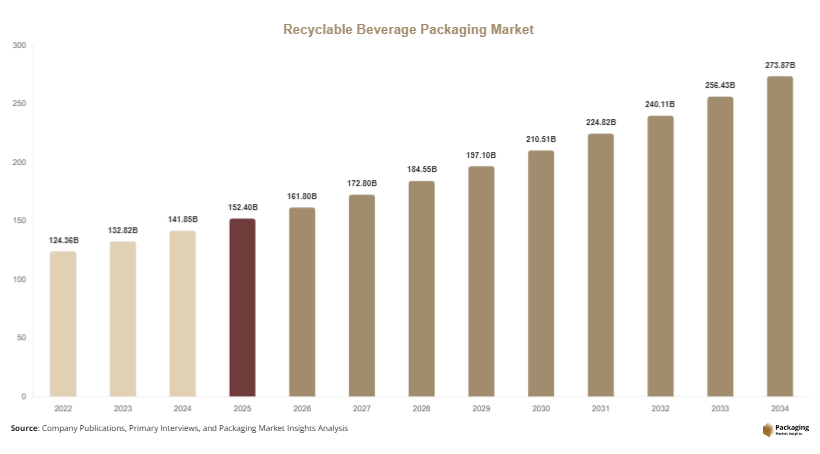
The global recyclable beverage packaging market size was valued at approximately USD 152.4 billion in 2025 and is estimated to reach USD 161.8 billion in 2026. The market is projected to expand to USD 275.6 billion by 2034, registering a compound annual growth rate (CAGR) of 6.8% from 2025 to 2034. Market growth is supported by rising beverage consumption, stricter recycling mandates, and corporate sustainability commitments across global beverage brands.
The recyclable beverage packaging market is gaining strong attention as beverage producers, regulators, and consumers shift toward sustainable packaging solutions. Recyclable materials such as aluminum, glass, recycled PET, and paper-based cartons are increasingly replacing traditional single-use plastics. Growing environmental awareness and tightening waste management regulations are pushing beverage brands to redesign packaging with recyclability and circular economy goals in mind.
Key Highlights
- The Recyclable Beverage Packaging Market was valued at USD 152.4 billion in 2025 and is projected to reach USD 275.6 billion by 2034, growing at a CAGR of 6.8% during 2025–2034.
- Rising sustainability regulations and circular economy initiatives are accelerating the transition toward recyclable beverage packaging across global beverage manufacturers.
- Increasing demand for recyclable materials such as aluminum, glass, and recycled PET (rPET) is driving market expansion as companies focus on reducing packaging waste and improving recycling rates
Explore more data points, trends and opportunities Download Free Sample Report
Market Trends
Rising Adoption of Aluminum and Glass Packaging
One of the most noticeable recyclable beverage packaging market trends is the increasing adoption of aluminum cans and glass bottles across beverage categories. These materials offer high recycling rates and can be reused multiple times without significant loss of quality. Aluminum, in particular, is gaining popularity because it can be recycled indefinitely while requiring significantly less energy compared to producing new metal.
Beverage manufacturers are shifting toward aluminum packaging for soft drinks, sparkling water, and ready-to-drink beverages. Glass bottles are also regaining popularity in premium beverages, including craft beer, wine, and specialty drinks. These materials support circular economy initiatives and help companies meet sustainability targets while maintaining product quality and shelf life.
Growth of Recycled PET and Mono-Material Plastic Packaging
Another important trend is the development of recycled PET (rPET) and mono-material packaging solutions designed to improve recyclability. Traditional plastic packaging often includes multiple materials that are difficult to recycle. Manufacturers are now redesigning packaging structures to use a single recyclable polymer, which improves recovery rates during recycling processes.
Major beverage companies are also increasing the use of high-percentage recycled plastic content in bottles. Many brands aim to incorporate 50–100% recycled PET in packaging within the next decade. Advances in chemical recycling and plastic recovery systems are enabling higher-quality recycled materials, supporting the transition toward circular plastic packaging in the beverage industry.
Market Drivers
Government Regulations Promoting Sustainable Packaging
Government regulations aimed at reducing plastic waste are a major driver of the recyclable beverage packaging market growth. Many countries have introduced policies such as plastic taxes, recycling mandates, and packaging recovery targets. These regulations encourage manufacturers to switch to recyclable packaging materials and improve waste management practices.
For example, several regions have implemented deposit return schemes that encourage consumers to return beverage containers for recycling. Such policies increase collection rates for recyclable materials like aluminum and PET bottles. As regulatory pressure continues to increase, beverage producers are accelerating the transition toward recyclable packaging to remain compliant with environmental standards.
Corporate Sustainability Commitments from Beverage Companies
Global beverage companies are making long-term sustainability commitments that are driving the adoption of recyclable packaging. Many brands have announced goals to make all packaging recyclable, reusable, or compostable within the next decade. These commitments are part of broader environmental strategies designed to reduce carbon emissions and packaging waste.
As a result, beverage producers are investing in research and development to redesign packaging materials and improve recyclability. Companies are collaborating with recycling organizations and packaging suppliers to develop innovative solutions that reduce environmental impact while maintaining product performance and brand identity.
Market Restraints
Limited Recycling Infrastructure in Developing Economies
Despite strong growth prospects, the recyclable beverage packaging market faces a significant restraint related to limited recycling infrastructure in developing regions. Many emerging economies lack efficient waste collection systems and recycling facilities capable of processing large volumes of beverage packaging materials.
Without proper recycling infrastructure, recyclable packaging materials may still end up in landfills or informal waste streams. This reduces the environmental benefits of recyclable packaging and slows adoption in certain markets. For example, some countries in Asia, Africa, and Latin America struggle with low recycling rates due to fragmented waste management systems.
The absence of standardized sorting technologies and collection networks also creates challenges for beverage producers attempting to implement recyclable packaging strategies. Companies may face higher operational costs when investing in recycling programs or partnering with local governments to improve waste management systems.
Additionally, inconsistent recycling regulations across regions create complexity for multinational beverage companies. Packaging designs that meet recycling standards in one region may not be easily recyclable in another due to differences in recycling technology and infrastructure. Addressing these challenges requires coordinated efforts among governments, packaging manufacturers, and beverage companies to strengthen recycling systems globally.
Market Opportunities
Expansion of Circular Economy Initiatives
The growing focus on circular economy models presents a major opportunity for the recyclable beverage packaging market . Circular systems aim to keep materials in continuous use through recycling, reuse, and material recovery. Beverage companies are increasingly participating in such initiatives to reduce environmental impact and improve resource efficiency.
Many governments and industry organizations are launching recycling partnerships and closed-loop packaging programs. These initiatives encourage manufacturers to design packaging that can be easily collected and reused. As circular economy practices become more widely adopted, demand for recyclable beverage packaging materials is expected to increase significantly.
Technological Innovation in Recycling and Packaging Design
Technological innovation is creating new growth opportunities in the recyclable beverage packaging industry. Advances in material science are enabling the development of lightweight, durable, and fully recyclable packaging solutions that maintain product safety and shelf life.
Emerging technologies such as chemical recycling, smart sorting systems, and digital watermarking are improving recycling efficiency and material recovery rates. These technologies allow recycling facilities to process complex packaging materials more effectively. As recycling technologies continue to improve, beverage companies will have greater flexibility in adopting recyclable packaging designs, creating significant opportunities for market expansion.
Report Scope
| Report Metric | Details |
|---|---|
| Market Size in 2025 | USD 152.4 Billion |
| Market Size in 2026 | USD 161.8 Billion |
| Market Size in 2034 | USD 275.6 Billion |
| CAGR | 6.8% (2026-2034) |
| Base Year for Estimation | 2025 |
| Historical Data | 2022-2024 |
| Forecast Period | 2026-2034 |
| Report Coverage | Revenue Forecast, Competitive Landscape, Supply Chain Disruption, Growth Factors, Environment & Regulatory Landscape and Trends |
| Geographies Covered | North America, Europe, APAC, Middle East and Africa, LATAM |
| Countries Covered | U.S., Canada, U.K., Germany, France, Spain, Italy, Russia, Nordic, Benelux, Rest of Europe, China, South Korea, Japan, India, Australia, Singapore, Taiwan, South East Asia, Rest of Asia-Pacific, UAE, Turky, Saudi Arabia, South Africa, Egypt, Nigeria, Rest of MEA, Brazil, Mexico, Argentina, Chile, Colombia, Rest of LATAM |
Explore more data points, trends and opportunities Download Free Sample Report
Segmental Analysis
By Material Type
The aluminum segment dominated the recyclable beverage packaging market in 2024, accounting for approximately 36% of the total market share. Aluminum packaging is widely used for carbonated drinks, energy beverages, and ready-to-drink products due to its durability, lightweight structure, and high recyclability. Aluminum cans can be recycled multiple times without losing quality, making them an attractive option for beverage manufacturers focused on sustainability.
Another advantage of aluminum packaging is its strong barrier properties, which help maintain beverage freshness and extend shelf life. In addition, the global recycling infrastructure for aluminum is relatively well developed compared with other packaging materials. Beverage companies are also investing in lightweight aluminum packaging designs to reduce material usage and transportation costs while maintaining product integrity.
The recycled PET (rPET) segment is expected to be the fastest-growing material category, projected to expand at a CAGR of around 7.5% through 2034. The growth of rPET is driven by increasing regulatory requirements for recycled content in plastic packaging. Many governments now require beverage producers to incorporate a certain percentage of recycled plastic into bottles.
Beverage manufacturers are investing in recycling partnerships to secure reliable supplies of recycled PET material. Technological improvements in plastic recycling processes are also enabling higher-quality rPET suitable for food-grade packaging applications. These developments are encouraging beverage brands to increase the use of recycled plastic bottles in order to meet sustainability goals and reduce reliance on virgin plastic.
By Packaging Type
The bottles segment accounted for the largest share of the recyclable beverage packaging market in 2024, representing nearly 41% of total revenue. Bottles are widely used across multiple beverage categories including water, juices, soft drinks, and alcoholic beverages. Glass and PET bottles dominate this segment because they provide excellent protection against contamination and preserve beverage flavor.
Glass bottles are particularly popular for premium beverages such as wine and craft beer due to their aesthetic appeal and high recyclability. Meanwhile, PET bottles are commonly used for bottled water and carbonated drinks because they are lightweight and cost efficient. Beverage companies continue to invest in bottle design improvements to reduce material usage while maintaining durability.
The cans segment is projected to grow at the fastest CAGR of approximately 7.2% through 2034. Aluminum cans are gaining popularity across beverage categories because they offer high recyclability and strong consumer acceptance. They are also more compact and easier to transport compared with glass bottles.
Another factor contributing to the growth of cans is the increasing popularity of ready-to-drink beverages such as iced coffee, flavored water, and energy drinks. Beverage brands are adopting sleek can designs and lightweight materials to improve product portability and sustainability, which is supporting the rapid expansion of this segment.
By Beverage Type
The carbonated soft drinks segment dominated the market in 2024, accounting for approximately 34% of the global share. Carbonated beverages require packaging materials that can withstand internal pressure and maintain product freshness. Aluminum cans and PET bottles are commonly used for these beverages because they provide strong structural integrity and effective sealing.
Major beverage companies have invested heavily in recyclable packaging solutions for carbonated drinks due to their high production volumes. These companies are transitioning toward aluminum cans and recycled plastic bottles to reduce environmental impact. As global consumption of soft drinks continues to grow, demand for recyclable packaging solutions in this segment remains strong.
The bottled water segment is expected to be the fastest-growing beverage category, with a projected CAGR of 7.8% through 2034. Rising health awareness and increasing demand for convenient hydration products are driving bottled water consumption worldwide. This growth is encouraging manufacturers to adopt recyclable packaging materials such as rPET bottles and aluminum containers.
Another growth factor for this segment is the increasing adoption of eco-friendly water packaging by premium water brands. Many companies are introducing bottles made entirely from recycled plastic or aluminum to appeal to environmentally conscious consumers. These initiatives are expected to significantly boost demand for recyclable beverage packaging in the bottled water segment.
Recyclable Beverage Packaging Market Segmentations
Material Type
- Aluminum
- Glass
- Recycled PET (rPET)
- Paper-based Cartons
Packaging Type
- Bottles
- Cans
- Cartons
- Pouches
Beverage Type
- Carbonated Soft Drinks
- Bottled Water
- Alcoholic Beverages
- Juices & Functional Drinks
- Ready-to-Drink Beverages
Regional Analysis
North America
North America accounted for approximately 29% of the global recyclable beverage packaging market share in 2025. The region is expected to grow at a CAGR of 6.2% through 2034 due to strong sustainability regulations and increasing consumer demand for eco-friendly packaging. Beverage companies operating in the United States and Canada are rapidly shifting toward recyclable materials to comply with environmental policies and reduce plastic waste.
The United States dominates the North American market due to its large beverage manufacturing industry and well-developed recycling infrastructure. A key growth factor in the country is the expansion of deposit return systems, which improve container recovery rates for aluminum cans and PET bottles. These programs encourage consumers to return used containers, increasing the supply of recyclable materials.
Europe
Europe held around 27% of the global market share in 2025 and is projected to grow at a CAGR of 6.5% during the forecast period. The region has some of the most advanced recycling policies and packaging sustainability regulations in the world. Strong environmental legislation and ambitious recycling targets are accelerating the adoption of recyclable beverage packaging across the region.
Germany leads the European market due to its efficient recycling systems and high consumer participation in waste sorting programs. One unique growth factor in the country is the presence of highly organized packaging return schemes, which significantly improve recycling rates. These systems create a steady supply of recycled materials for beverage packaging manufacturers.
Asia Pacific
Asia Pacific accounted for approximately 25% of the global market share in 2025 and is expected to record the fastest CAGR of 7.6% through 2034. Rapid urbanization, rising beverage consumption, and growing awareness of environmental sustainability are contributing to market expansion across the region.
China dominates the Asia Pacific market due to its large beverage production industry and increasing investments in recycling infrastructure. One unique growth factor driving the Chinese market is the expansion of government-led waste reduction policies, which encourage manufacturers to transition toward recyclable packaging materials and improve recycling capacity nationwide.
Middle East & Africa
The Middle East & Africa region held roughly 9% of the global market share in 2025 and is forecast to grow at a CAGR of 6.1% during the forecast period. Market growth is supported by increasing investments in waste management infrastructure and growing awareness of sustainable packaging practices among beverage producers.
United Arab Emirates leads the regional market due to its strong focus on environmental sustainability and circular economy initiatives. A unique growth factor in the country is the government's push for zero-waste initiatives and recycling infrastructure development, which is encouraging beverage manufacturers to adopt recyclable packaging materials.
Latin America
Latin America accounted for nearly 10% of the global recyclable beverage packaging market share in 2025 and is projected to grow at a CAGR of 6.4% through 2034. Rising beverage consumption and growing environmental awareness are driving the adoption of recyclable packaging across the region.
Brazil dominates the Latin American market due to its large beverage industry and established aluminum recycling sector. One key growth factor in Brazil is the country's high aluminum recycling rate, which supports the widespread use of aluminum cans for beverages and encourages beverage companies to expand recyclable packaging solutions.
Competitive Landscape
The recyclable beverage packaging market is moderately competitive, with several global packaging manufacturers competing through product innovation, sustainability initiatives, and strategic partnerships. Companies are focusing on developing recyclable materials, lightweight packaging designs, and improved recycling technologies to strengthen their market position.
Leading companies are also collaborating with beverage producers and recycling organizations to support circular packaging systems. Strategic investments in recycling infrastructure and material recovery facilities are becoming increasingly important as companies seek to secure reliable supplies of recyclable materials.
One of the leading companies in the market is Ball Corporation, which has a strong presence in aluminum beverage packaging. The company has expanded its production capacity and introduced lightweight aluminum cans designed to improve sustainability and reduce material usage. Other major companies are also investing in research and development to enhance recyclable packaging solutions and meet growing environmental regulations.
Key Players List
- Ball Corporation
- Crown Holdings Inc.
- Amcor plc
- Ardagh Group
- Tetra Pak International
- O-I Glass Inc.
- Smurfit Kappa Group
- WestRock Company
- Berry Global Inc.
- Mondi Group
- Sonoco Products Company
- DS Smith Plc
- Stora Enso Oyj
- ALPLA Group
- Silgan Holdings Inc.