Reagent Bottle Market Size
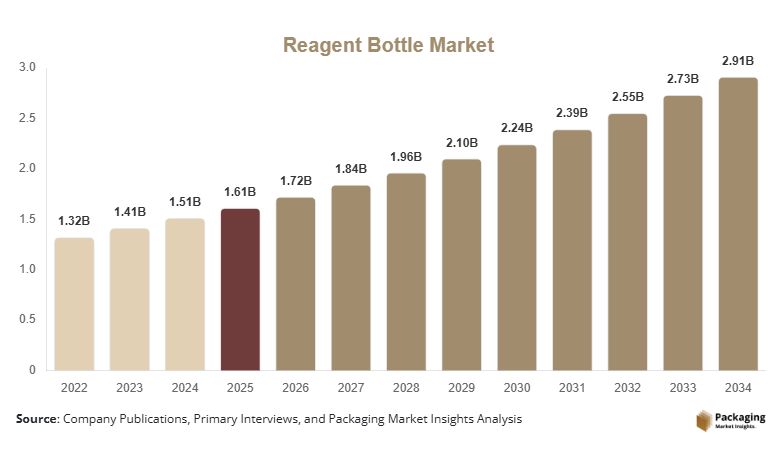
Reagent bottle market size is projected at USD 1.72 billion in 2026 and is expected to hit USD 2.91 billion by 2034 with a CAGR of 6.8%. The report provides comprehensive analysis of production capacity, supply-demand trends, pricing dynamics, market segmentation, and competitive benchmarking across major regional markets. Detailed assessment of technological advancements, regulatory standards, and manufacturing capabilities supports strategic business planning.
The reagent bottle market comprises laboratory-grade storage containers designed for safe handling, storage, and transportation of chemicals, solvents, reagents, and pharmaceutical compounds. Global production exceeded 1.18 billion bottles in 2025, while laboratory adoption surpassed 86% across pharmaceutical and research facilities. HDPE bottles contributed approximately 44% of total production, glass bottles represented 34%, and polypropylene bottles accounted for nearly 22%. Growing laboratory automation and expanding research activities continue supporting the reagent bottle market.
Explore more data points, trends and opportunities Download Free Sample Report
Reagent Bottle Trends
Increasing Adoption of High-Purity Laboratory Storage Solutions
Growing demand for contamination-free laboratory operations is driving adoption of chemically resistant reagent bottles across pharmaceutical and biotechnology laboratories. More than 1.2 billion bottles were manufactured globally during 2025, while laboratory-grade polymer utilization increased by 11.6%. Approximately 64% of newly established laboratories selected high-purity storage systems, reinforcing the reagent bottle market.
Automation in laboratory workflows and digital inventory management are accelerating product innovation. Smart labeling technologies have been adopted by nearly 27% of premium laboratory storage products, while automated filling systems improved production efficiency by 13%. Demand from pharmaceutical quality control laboratories increased by 9.2%, strengthening the reagent bottle market.
Reagent Bottle Drivers
Expansion of Pharmaceutical Research and Laboratory Infrastructure
Growing investments in pharmaceutical manufacturing, biotechnology research, and diagnostic laboratories continue driving product demand. Pharmaceutical R&D expenditure increased by 8.5%, while laboratory infrastructure investments expanded by 10.1% during 2025. Global laboratory chemical consumption exceeded 22 million metric tons, creating sustained demand for safe storage solutions across the reagent bottle market.
Reagent Bottle Restraints
Volatility in Raw Material and Specialty Glass Costs
Fluctuating prices of engineering plastics and laboratory-grade borosilicate glass remain major challenges for manufacturers. Raw material procurement costs increased by 7.3%, while specialty glass production expenses rose by 6.1%. Transportation costs also increased by 5.8%, affecting profitability across the reagent bottle market.
Reagent Bottle Opportunities
Growing Demand for Sustainable and Certified Laboratory Packaging
Increasing emphasis on recyclable laboratory plastics and certified storage solutions is creating significant opportunities. Demand for recyclable laboratory bottles increased by 15%, while pharmaceutical quality certifications expanded across 31% of production facilities. Investments exceeding USD 420 million in laboratory packaging modernization continue creating opportunities for the reagent bottle market.
Challenges in Reagent Bottle
Maintaining Chemical Compatibility Across Diverse Applications
Manufacturers must ensure compatibility with aggressive acids, solvents, and biological reagents while meeting international laboratory standards. Approximately 24% of manufacturers increased testing investments, while compliance costs grew by 6.4%. Maintaining dimensional consistency, chemical resistance, and leak-proof sealing remains a key operational challenge for the reagent bottle market.
Report Scope
| Report Metric | Details |
|---|---|
| Market Size in 2025 | USD 1.61 Billion |
| Market Size in 2026 | USD 1.72 Billion |
| Market Size in 2034 | USD 2.91 Billion |
| CAGR | 6.8% (2026-2034) |
| Base Year for Estimation | 2025 |
| Historical Data | 2022-2024 |
| Forecast Period | 2026-2034 |
| Report Coverage | Revenue Forecast, Competitive Landscape, Supply Chain Disruption, Growth Factors, Environment & Regulatory Landscape and Trends |
| Geographies Covered | North America, Europe, APAC, Middle East and Africa, LATAM |
| Countries Covered | U.S., Canada, U.K., Germany, France, Spain, Italy, Russia, Nordic, Benelux, Rest of Europe, China, South Korea, Japan, India, Australia, Singapore, Taiwan, South East Asia, Rest of Asia-Pacific, UAE, Turky, Saudi Arabia, South Africa, Egypt, Nigeria, Rest of MEA, Brazil, Mexico, Argentina, Chile, Colombia, Rest of LATAM |
Explore more data points, trends and opportunities Download Free Sample Report
Reagent Bottle Market Segmentation
The market is segmented by material and end user, with HDPE accounting for approximately 44% of global production while pharmaceutical laboratories contribute nearly 47% of total demand. Growing laboratory automation and pharmaceutical research continue supporting segment expansion.
By Material
HDPE accounts for approximately 44% of global demand due to superior chemical resistance and impact strength. Annual production exceeded 520 million bottles, supporting storage capacities ranging from 30 ml to 5 liters for laboratory applications.
PP represents nearly 22% of production because of excellent heat resistance and lightweight construction. More than 260 million bottles were manufactured during 2025, with wide usage in analytical and microbiology laboratories.
Glass contributes approximately 34% of total demand owing to exceptional chemical inertness and transparency. Production surpassed 400 million bottles, with borosilicate variants widely preferred for high-purity laboratory applications.
By End User
Pharmaceutical laboratories dominate with approximately 47% market share. Annual consumption exceeded 550 million bottles, supporting quality control, formulation development, and chemical storage with laboratory compliance exceeding 92%.
Academic and research institutes account for approximately 31% of demand, utilizing over 365 million bottles annually for educational laboratories, chemical research, and biotechnology projects.
Chemical industries contribute nearly 22% of total consumption, using more than 260 million bottles for raw material storage, analytical testing, and industrial laboratory operations.
Reagent Bottle Market Segmentations
Material
- High-Density Polyethylene (HDPE)
- Polypropylene (PP)
- Glass
End User
- Pharmaceutical Laboratories
- Academic & Research Institutes
- Chemical Industries
Reagent Bottle Regional Outlook
North America: North America accounts for approximately 35% of global demand, producing more than 410 million bottles annually. The United States contributes nearly 81% of regional production, supported by strong pharmaceutical and biotechnology sectors.
Europe: Europe represents approximately 29% of the market, led by Germany, France, the United Kingdom, and Switzerland. Regional laboratory investments increased by 8.8%, while pharmaceutical manufacturing remained the dominant end-use sector.
Asia-Pacific: Asia-Pacific contributes nearly 30% of global consumption, driven by China, Japan, India, and South Korea. Production exceeded 355 million bottles, while laboratory infrastructure investments increased by 11% during 2025.
Latin America: Latin America accounts for approximately 4% of worldwide demand, supported by expanding pharmaceutical manufacturing and academic research facilities across Brazil and Mexico.
Middle East & Africa: The region contributes nearly 2% of global demand, supported by growing healthcare infrastructure, diagnostic laboratories, and research investments.
Top players in a reagent bottle
- Thermo Fisher Scientific Inc.
- DWK Life Sciences GmbH
- Corning Incorporated
- VITLAB GmbH
- Kartell S.p.A.
- Nalgene (Thermo Fisher Scientific)
- Foxx Life Sciences
- Bürkle GmbH
- Globe Scientific Inc.
- Sarstedt AG & Co. KG
- BRAND GmbH + Co KG
- SPL Life Sciences Co., Ltd.
- Citotest Scientific Co., Ltd.
- Greiner Bio-One International GmbH
- Merck KGaA
Thermo Fisher Scientific Inc.
- Estimated market share: 14–16%
- Global leader in laboratory equipment and consumables with an extensive reagent bottle portfolio.
- Strong manufacturing capabilities across North America, Europe, and Asia.
- Focuses on high-purity polymer bottles, laboratory compliance, and advanced quality assurance systems.
- Maintains leadership through continuous investment in pharmaceutical laboratory solutions, broad global distribution, and innovative laboratory storage technologies serving pharmaceutical, biotechnology, academic, and industrial customers.
DWK Life Sciences GmbH
- Estimated market share: 10–12%
- Leading manufacturer of premium laboratory glassware and reagent storage bottles.
- Strong expertise in borosilicate glass technology and certified laboratory packaging.
- Serves pharmaceutical laboratories, research institutes, and chemical industries with high-quality storage solutions.
- Continues strengthening its competitive position through product innovation, regulatory compliance, and global manufacturing capabilities.