Ready To Use Pharmaceutical Packaging Market
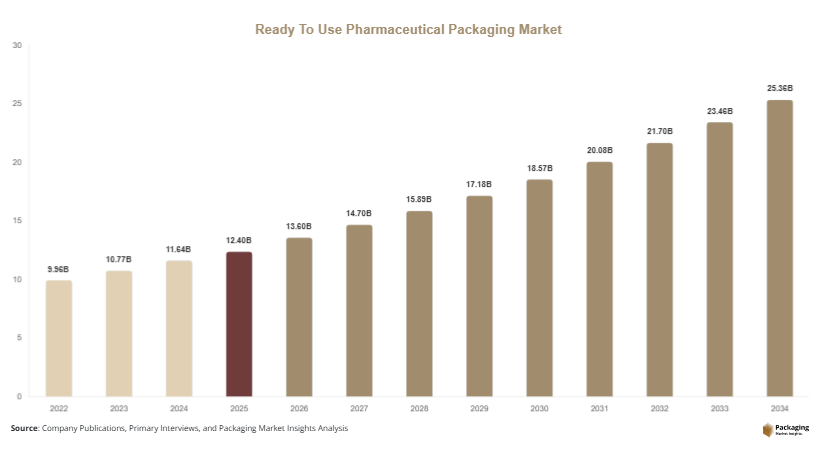
The global ready to use pharmaceutical packaging market size was valued at approximately USD 12.4 billion in 2025 and is projected to reach USD 13.6 billion in 2026. Over the forecast period from 2025 to 2034, the market is expected to grow at a compound annual growth rate (CAGR) of 8.1%, reaching nearly USD 24.9 billion by 2034. Market growth is supported by rising pharmaceutical production volumes, expanding biologics pipelines, and increasing adoption of sterile manufacturing processes.
The ready to use pharmaceutical packaging market is experiencing steady growth as pharmaceutical manufacturers prioritize efficiency, sterility assurance, and faster production cycles. Ready-to-use (RTU) packaging components such as pre-sterilized vials, syringes, cartridges, and containers eliminate several cleaning and sterilization steps in pharmaceutical manufacturing. These solutions help reduce contamination risks while supporting high-speed automated filling lines. As biologics and injectable therapies continue to expand, the demand for sterile packaging formats has grown across both developed and emerging healthcare markets.
Key Highlights
- Market size estimated at USD 12.4 billion in 2025
- Expected to reach USD 24.9 billion by 2034
- CAGR of 8.1% (2025–2034)
- Growing demand for biologics and injectable therapies
- Increasing adoption of sterile manufacturing processes
- Expansion of contract pharmaceutical manufacturing capacity
Explore more data points, trends and opportunities Download Free Sample Report
Market Trends
Growing Adoption of Pre-Sterilized Packaging Components
A key trend shaping the ready to use pharmaceutical packaging market is the increasing adoption of pre-sterilized packaging components across pharmaceutical production facilities. Ready-to-use vials, cartridges, and syringes are supplied in sterile conditions, enabling manufacturers to bypass washing, depyrogenation, and sterilization stages. This shift allows pharmaceutical companies to simplify production workflows and reduce operational risks associated with contamination. The demand for these packaging solutions is particularly strong in the manufacturing of biologics, vaccines, and high-value injectable therapies. In addition, regulatory agencies continue to encourage advanced aseptic manufacturing practices, further reinforcing the adoption of sterile packaging formats that improve production consistency and compliance.
Integration of Automation in Sterile Filling Operations
Another notable trend in the ready to use pharmaceutical packaging market is the integration of automation and robotics within sterile filling operations. Pharmaceutical manufacturers increasingly deploy automated filling lines designed specifically for ready-to-use packaging components. These automated systems improve production efficiency, reduce human intervention, and support higher output volumes. Automation also enhances quality control by minimizing handling errors and improving process monitoring. As pharmaceutical companies scale production for complex therapies such as monoclonal antibodies and gene-based treatments, automated filling systems compatible with ready-to-use packaging formats are becoming a central part of modern sterile manufacturing facilities.
Market Drivers
Rising Demand for Injectable Biologic Drugs
The rapid expansion of biologic drug development is a major driver for the ready to use pharmaceutical packaging market. Biologic therapies such as monoclonal antibodies, vaccines, and recombinant proteins often require sterile injectable delivery formats. These drugs are sensitive to contamination and require strict aseptic packaging conditions throughout production and distribution. Ready-to-use packaging solutions help pharmaceutical companies meet these requirements by providing sterile containers that are immediately compatible with aseptic filling lines. As pharmaceutical pipelines increasingly focus on biologics, the demand for RTU vials, syringes, and cartridges continues to grow. This shift toward complex biologic therapies is expected to support steady market growth during the forecast period.
Increasing Outsourcing to Contract Manufacturing Organizations
Another important growth driver for the ready to use pharmaceutical packaging market is the rising use of contract manufacturing organizations (CMOs) and CDMOs. Many pharmaceutical companies outsource sterile drug manufacturing to specialized facilities that operate high-efficiency production lines. Ready-to-use packaging components help these facilities accelerate production startup while reducing equipment investment related to washing and sterilization systems. In addition, RTU packaging allows contract manufacturers to handle multiple products across smaller batch sizes without extensive changeover processes. As outsourcing becomes more common in the pharmaceutical industry, demand for flexible and sterile packaging formats continues to increase.
Market Restraint
Higher Cost Compared to Conventional Packaging Formats
Despite strong adoption trends, the ready to use pharmaceutical packaging market faces challenges related to the relatively higher cost of RTU packaging solutions compared to conventional packaging components. Traditional pharmaceutical packaging formats often require manufacturers to perform washing and sterilization processes internally, which can reduce upfront packaging costs. In contrast, ready-to-use packaging components are supplied in pre-sterilized formats that require specialized manufacturing, handling, and transportation procedures. These additional processes increase the price of RTU components.
For small pharmaceutical companies and emerging biotech firms operating with limited production budgets, higher packaging costs can slow the adoption of ready-to-use solutions. Additionally, pharmaceutical facilities that already operate established sterilization infrastructure may prefer conventional packaging formats to maximize existing equipment utilization.
However, the cost difference must be evaluated alongside operational benefits. Ready-to-use packaging often reduces production complexity, minimizes contamination risks, and improves manufacturing efficiency. While the initial cost remains a barrier for some manufacturers, the long-term benefits related to product safety and production speed may offset the price difference. Nonetheless, cost sensitivity remains a key factor influencing purchasing decisions in certain segments of the pharmaceutical packaging industry.
Market Opportunities
Expansion of Biotech Manufacturing Facilities
The rapid expansion of biotechnology manufacturing facilities presents a major opportunity for the ready to use pharmaceutical packaging market. Biotechnology companies developing advanced therapies often rely on sterile injectable delivery formats that require high levels of contamination control. New biotech production plants frequently adopt ready-to-use packaging solutions because these components simplify facility design and reduce equipment requirements. Instead of installing extensive washing and sterilization systems, manufacturers can integrate RTU packaging directly into automated filling lines. As global investment in biotechnology manufacturing continues to increase, the demand for ready-to-use pharmaceutical packaging components is expected to expand significantly.
Growth of Emerging Pharmaceutical Markets
Emerging pharmaceutical markets represent another growth opportunity for the ready to use pharmaceutical packaging market. Countries in Asia, Latin America, and the Middle East are investing heavily in domestic pharmaceutical production capacity. Many new production facilities in these regions are designed with modern aseptic processing technologies, which align well with ready-to-use packaging solutions. Additionally, regulatory authorities in emerging markets are strengthening quality standards for sterile drug manufacturing. These evolving regulatory frameworks encourage pharmaceutical manufacturers to adopt packaging formats that improve sterility assurance. As pharmaceutical manufacturing capacity expands across emerging economies, the demand for ready-to-use packaging components is expected to increase.
Report Scope
| Report Metric | Details |
|---|---|
| Market Size in 2025 | USD 12.4 Billion |
| Market Size in 2026 | USD 13.6 Billion |
| Market Size in 2034 | USD 24.9 Billion |
| CAGR | 8.1% (2026-2034) |
| Base Year for Estimation | 2025 |
| Historical Data | 2022-2024 |
| Forecast Period | 2026-2034 |
| Report Coverage | Revenue Forecast, Competitive Landscape, Supply Chain Disruption, Growth Factors, Environment & Regulatory Landscape and Trends |
| Geographies Covered | North America, Europe, APAC, Middle East and Africa, LATAM |
| Countries Covered | U.S., Canada, U.K., Germany, France, Spain, Italy, Russia, Nordic, Benelux, Rest of Europe, China, South Korea, Japan, India, Australia, Singapore, Taiwan, South East Asia, Rest of Asia-Pacific, UAE, Turky, Saudi Arabia, South Africa, Egypt, Nigeria, Rest of MEA, Brazil, Mexico, Argentina, Chile, Colombia, Rest of LATAM |
Explore more data points, trends and opportunities Download Free Sample Report
Segmental Analysis
Segment by Type
The vials segment held the largest share of the ready to use pharmaceutical packaging market in 2024, accounting for approximately 42% of total market revenue. Vials are widely used for packaging injectable drugs, vaccines, and biologic therapies due to their versatility and compatibility with sterile filling lines. Pharmaceutical manufacturers often prefer ready-to-use vials because they simplify production processes by eliminating washing and sterilization steps. These vials are supplied in sterile trays that can be directly integrated into automated filling systems. The widespread use of injectable medications across hospitals, clinics, and vaccination programs continues to support strong demand for ready-to-use vial packaging formats.
The prefilled syringes segment is projected to be the fastest-growing category in the ready to use pharmaceutical packaging market, with an expected CAGR of approximately 9.4% during the forecast period. Prefilled syringes offer several advantages, including improved dosing accuracy, reduced drug waste, and enhanced patient convenience. These features make them particularly suitable for self-administered therapies and chronic disease treatments. The growth of biologic drugs and specialty injectable therapies is accelerating the adoption of prefilled syringes across the pharmaceutical industry. As healthcare providers increasingly focus on patient-friendly drug delivery systems, demand for ready-to-use prefilled syringes is expected to grow steadily.
Segment by Material
The glass packaging segment dominated the ready to use pharmaceutical packaging market in 2024, accounting for nearly 58% of the total market share. Glass remains a preferred material for pharmaceutical packaging due to its chemical stability, excellent barrier properties, and compatibility with a wide range of injectable drugs. Ready-to-use glass vials and cartridges are commonly used in biologic drug packaging because they help maintain product integrity and prevent interactions between the drug and packaging material. Pharmaceutical companies rely on high-quality borosilicate glass containers to ensure sterility and protect sensitive drug formulations throughout the product lifecycle.
The polymer-based packaging segment is expected to grow at the fastest rate in the ready to use pharmaceutical packaging market, with a projected CAGR of around 8.9% through 2034. Polymer packaging materials offer advantages such as reduced breakage risk, lightweight construction, and compatibility with advanced drug delivery devices. These features make polymer containers attractive for applications such as prefilled syringes and specialty cartridges. In addition, advancements in pharmaceutical-grade polymer technology have improved barrier performance and chemical resistance. As pharmaceutical companies explore alternative packaging materials that improve safety and logistics efficiency, polymer-based ready-to-use packaging solutions are gaining traction.
Segment by End-Use
The pharmaceutical manufacturers segment held the largest share of the ready to use pharmaceutical packaging market in 2024, representing approximately 61% of total demand. Pharmaceutical companies rely heavily on sterile packaging solutions to ensure product safety and regulatory compliance. Ready-to-use packaging components simplify manufacturing workflows by reducing the need for in-house sterilization processes. These solutions are particularly valuable for manufacturers producing injectable biologics, vaccines, and specialty drugs that require strict aseptic conditions. As pharmaceutical companies expand production capacity for advanced therapies, demand for RTU packaging components is expected to remain strong.
The contract manufacturing organizations (CMOs) segment is expected to register the fastest growth in the ready to use pharmaceutical packaging market, with an estimated CAGR of about 9.2% over the forecast period. CMOs often handle multiple pharmaceutical products across varying production volumes, which requires flexible manufacturing processes. Ready-to-use packaging solutions help these organizations streamline production setups and reduce changeover times between batches. Additionally, CMOs frequently operate highly automated sterile filling lines designed to work with RTU packaging components. As pharmaceutical outsourcing continues to increase globally, contract manufacturing organizations are expected to become a major driver of demand for ready-to-use pharmaceutical packaging solutions.
Ready To Use Pharmaceutical Packaging Market Segmentations
Type
- Vials
- Prefilled Syringes
- Cartridges
- Ampoules
Material
- Glass
- Polymer
End-Use
- Pharmaceutical Manufacturers
- Contract Manufacturing Organizations
Regional Analysis
North America
North America accounted for approximately 34% share of the ready to use pharmaceutical packaging market in 2025, making it the largest regional market. The region benefits from a strong pharmaceutical manufacturing base, advanced healthcare infrastructure, and widespread adoption of biologic therapies. The ready to use pharmaceutical packaging market in North America is expected to grow at a CAGR of around 7.6% through 2034, supported by continued innovation in injectable drug development and expansion of sterile drug manufacturing facilities.
The United States remains the dominant country in the regional market due to its large pharmaceutical industry and significant biologics pipeline. A key growth factor in the country is the rapid expansion of contract development and manufacturing organizations that specialize in sterile injectable drugs. These facilities frequently adopt ready-to-use packaging solutions to improve operational efficiency and reduce contamination risks during production.
Europe
Europe represented roughly 27% of the ready to use pharmaceutical packaging market share in 2025. The region is expected to register a CAGR of approximately 7.9% between 2025 and 2034. Growth in Europe is driven by a strong biotechnology sector, strict pharmaceutical manufacturing regulations, and increasing investments in advanced drug delivery systems. European pharmaceutical manufacturers often adopt ready-to-use packaging solutions to meet stringent regulatory standards related to sterility and product safety.
Germany is one of the leading markets in Europe due to its strong pharmaceutical manufacturing infrastructure and advanced packaging technology capabilities. A unique growth factor in the country is the presence of specialized glass packaging manufacturers that supply high-quality sterile containers for injectable drugs. This integrated ecosystem supports innovation and adoption of ready-to-use packaging solutions across the regional pharmaceutical industry.
Asia Pacific
Asia Pacific held nearly 23% share of the ready to use pharmaceutical packaging market in 2025 and is expected to grow at the fastest CAGR of about 9.1% during the forecast period. Rapid pharmaceutical manufacturing expansion, increasing healthcare investment, and rising demand for biologics are key factors supporting regional market growth. Countries across the region are expanding sterile injectable production capacity to meet both domestic and global pharmaceutical demand.
China is the dominant country in the Asia Pacific market. A major growth factor driving the ready to use pharmaceutical packaging market in China is the rapid development of domestic biologic drug manufacturers. Government initiatives supporting biotechnology innovation and pharmaceutical exports are encouraging companies to adopt modern sterile manufacturing technologies, including ready-to-use packaging solutions.
Middle East & Africa
The Middle East & Africa accounted for approximately 8% of the ready to use pharmaceutical packaging market share in 2025. The region is expected to grow at a CAGR of about 7.4% through 2034. Pharmaceutical manufacturing investments and healthcare infrastructure development are supporting market growth across several countries. Governments in the region are working to improve domestic drug production capacity to reduce dependence on pharmaceutical imports.
Saudi Arabia is emerging as a key country within the regional market. One major growth factor is the government’s strategic investment in domestic pharmaceutical manufacturing under healthcare modernization initiatives. These investments include the development of sterile drug production facilities that require advanced packaging solutions. As pharmaceutical infrastructure expands, demand for ready-to-use packaging components is expected to increase steadily.
Latin America
Latin America captured roughly 8% of the ready to use pharmaceutical packaging market share in 2025 and is projected to grow at a CAGR of approximately 7.2% during the forecast period. The regional pharmaceutical industry is expanding due to rising healthcare spending, increasing demand for generic drugs, and improvements in regulatory frameworks governing drug manufacturing and packaging standards.
Brazil represents the largest market within Latin America. A key growth factor in the country is the increasing presence of multinational pharmaceutical companies establishing local manufacturing facilities. These companies often introduce global manufacturing standards that include sterile packaging practices and automated filling technologies. As a result, ready-to-use pharmaceutical packaging solutions are gradually gaining adoption across the Brazilian pharmaceutical manufacturing sector.
Competitive Landscape
The ready to use pharmaceutical packaging market is moderately consolidated, with several global packaging companies competing through product innovation, manufacturing expansion, and strategic partnerships with pharmaceutical manufacturers. Leading companies are investing in sterile packaging technologies, automation compatibility, and advanced materials to strengthen their market position.
One of the key leaders in the market is Gerresheimer AG, which offers a wide portfolio of ready-to-use vials, cartridges, and syringes designed for sterile pharmaceutical applications. The company continues to expand its global production capacity to meet increasing demand from biologic drug manufacturers.
Other major companies shaping the ready to use pharmaceutical packaging market include SCHOTT Pharma, West Pharmaceutical Services, Stevanato Group, and Becton, Dickinson and Company. These companies focus on technological innovation, strategic collaborations, and manufacturing investments to strengthen their presence in the pharmaceutical packaging industry.
Key Players List
- Gerresheimer AG
- SCHOTT Pharma
- West Pharmaceutical Services
- Stevanato Group
- Becton, Dickinson and Company
- Nipro Corporation
- SGD Pharma
- Ompi (Stevanato Group)
- Corning Incorporated
- AptarGroup Inc.
- Catalent Inc.
- DWK Life Sciences
- Shandong Pharmaceutical Glass Co.
- Berry Global Inc.
- Amcor plc