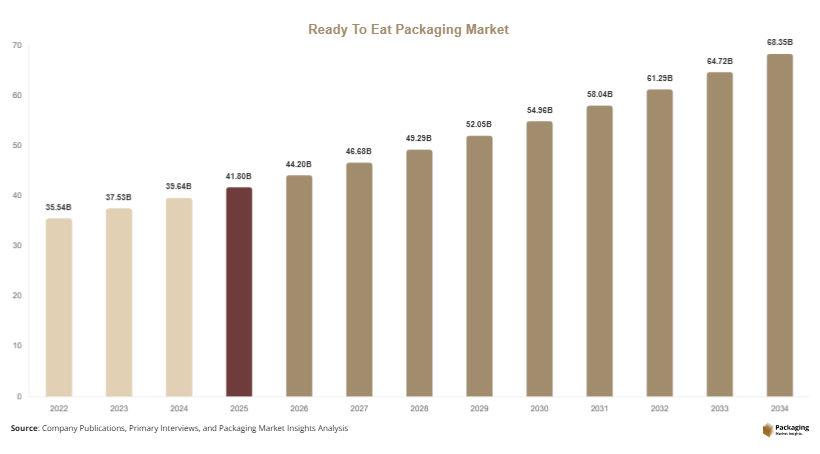
Ready To Eat Packaging Market Size and Growth
In 2025, the global ready to eat packaging market size is estimated at approximately USD 41.8 billion. The market is expected to reach around USD 44.2 billion in 2026, reflecting continued adoption across retail, online grocery, and food service channels. Over the long term, the market is projected to expand to USD 72.6 billion by 2034, registering a compound annual growth rate (CAGR) of 5.6% between 2025 and 2034. Growth is supported by the expansion of convenience food categories such as frozen meals, shelf-stable ready meals, and microwaveable food products.
The ready to eat packaging market has experienced steady expansion in recent years due to changing consumer lifestyles, urbanization, and the growing demand for convenient food solutions. Ready-to-eat meals require packaging formats that preserve freshness, maintain safety, and extend shelf life while offering portability and ease of use. As modern consumers increasingly prioritize convenience and time efficiency, manufacturers are investing in innovative packaging technologies that support rapid heating, portion control, and sustainability.
Key Highlights
- Global market size estimated at USD 41.8 billion in 2025
- Market projected to reach USD 72.6 billion by 2034
- Expected CAGR of 5.6% from 2025 to 2034
- Increasing demand for convenience food drives packaging innovation
- Sustainability and recyclable materials are shaping product development
Explore more data points, trends and opportunities Download Free Sample Report
Market Trends
Rising Adoption of Sustainable Packaging Materials
Sustainability has become a defining trend in the ready to eat packaging market, with manufacturers increasingly transitioning toward environmentally responsible materials. Consumers are paying closer attention to packaging waste and environmental impact, which is encouraging food companies to adopt recyclable, compostable, and biodegradable packaging solutions. Paper-based trays, molded fiber containers, and mono-material plastic films are gaining traction as alternatives to traditional multi-layer plastics.
Packaging companies are also developing lightweight materials that reduce overall plastic consumption without compromising barrier performance. These materials maintain protection against moisture, oxygen, and contamination while minimizing environmental impact. Retailers and food brands are implementing sustainability commitments that require packaging suppliers to reduce carbon footprints and increase recycled content. As sustainability initiatives become integrated into corporate strategies, the adoption of eco-friendly packaging formats is expected to increase steadily.
Growth of Smart and Microwave-Friendly Packaging
Another important trend in the ready to eat packaging market is the expansion of smart packaging technologies designed to enhance consumer convenience and food safety. Microwave-safe trays, self-venting lids, and heat-resistant containers are widely used in ready meal packaging. These solutions allow consumers to heat food directly in the package, reducing preparation time and improving user experience.
In addition, packaging manufacturers are integrating intelligent features such as freshness indicators and temperature-sensitive labels. These technologies help ensure food safety by providing visual indicators of storage conditions and product freshness. Smart packaging also supports logistics efficiency by enabling real-time monitoring of product quality during transportation. As ready-to-eat food categories expand in retail and online channels, demand for advanced functional packaging solutions continues to increase.
Market Drivers
Increasing Demand for Convenience Foods
One of the main drivers of the ready to eat packaging market growth is the rising demand for convenience food products. Modern consumers are seeking meal options that require minimal preparation time while maintaining taste and nutritional value. Urbanization and busy lifestyles have significantly influenced purchasing patterns, with ready-to-eat meals becoming a common choice among working professionals and students.
Packaging plays a crucial role in enabling the convenience associated with these products. Manufacturers are designing containers that allow easy heating, portion control, and extended shelf life. Single-serve trays, resealable pouches, and compartmentalized containers are widely used to meet consumer preferences. Retail expansion and supermarket distribution networks have also increased the availability of ready meals, further driving demand for specialized packaging formats that preserve quality and enhance product presentation.
Expansion of Retail and Online Food Distribution
The growth of modern retail channels and e-commerce platforms has accelerated the demand for ready-to-eat food packaging. Supermarkets, hypermarkets, and convenience stores are dedicating larger shelf spaces to ready meals, frozen dinners, and instant food products. These retail environments require packaging that offers durability, visibility, and efficient storage.
Online grocery services and meal delivery platforms have also transformed distribution dynamics. Ready-to-eat meals must be packaged in a way that protects them during transportation and maintains freshness until delivery. Insulated containers, leak-proof packaging, and tamper-evident seals are becoming standard features. As digital grocery platforms continue expanding globally, the need for reliable packaging solutions will remain a major growth driver for the market.
Market Restraint
Environmental Concerns and Regulatory Pressure on Plastic Packaging
Despite its growth potential, the ready to eat packaging market faces challenges related to environmental regulations and plastic waste concerns. Many ready meal containers are traditionally made from plastic materials such as polypropylene and polyethylene terephthalate. While these materials offer durability and heat resistance, they contribute to plastic waste accumulation if not properly recycled.
Governments across several regions are implementing stricter regulations on single-use plastics and encouraging companies to transition toward sustainable alternatives. Compliance with these regulations can increase production costs for packaging manufacturers, as sustainable materials often require new processing technologies and supply chains.
For example, food brands transitioning from conventional plastic trays to biodegradable alternatives may experience higher material costs and manufacturing adjustments. These factors can affect pricing strategies and profit margins. Additionally, recycling infrastructure varies across regions, making it difficult for some markets to effectively process packaging waste. Addressing these challenges requires collaboration between packaging manufacturers, food producers, and policymakers to develop cost-effective sustainable solutions.
Market Opportunities
Growth of Sustainable and Recyclable Packaging Solutions
The increasing demand for environmentally responsible products presents a significant opportunity for the ready to eat packaging market. Packaging companies are investing in research and development to create recyclable and biodegradable materials that maintain barrier performance while reducing environmental impact. Paper-based trays with bio-coatings, compostable containers, and recyclable mono-material films are gaining popularity among food manufacturers.
These innovations enable companies to meet regulatory requirements and align with consumer sustainability expectations. Food brands that adopt eco-friendly packaging can also enhance brand reputation and differentiate their products in competitive retail markets. As governments introduce stricter environmental policies, sustainable packaging technologies are expected to generate substantial growth opportunities.
Expansion of Ready Meal Consumption in Emerging Markets
Emerging economies present a large growth opportunity for the ready to eat packaging market due to rising disposable incomes and changing dietary habits. Countries in Asia Pacific, Latin America, and parts of the Middle East are experiencing rapid urbanization, which increases demand for convenient meal solutions.
Retail infrastructure is expanding in these regions, with supermarkets and online grocery platforms making ready meals more accessible. Packaging manufacturers are adapting products to local market needs by offering cost-effective and lightweight solutions. Flexible pouches and compact trays are widely used in emerging markets because they reduce transportation costs while maintaining product quality. As consumer awareness and purchasing power increase, the adoption of ready-to-eat food packaging is expected to accelerate.
Report Scope
| Report Metric | Details |
|---|---|
| Market Size in 2025 | USD 41.8 Billion |
| Market Size in 2026 | USD 44.2 Billion |
| Market Size in 2034 | USD 72.6 Billion |
| CAGR | 5.6% (2026-2034) |
| Base Year for Estimation | 2025 |
| Historical Data | 2022-2024 |
| Forecast Period | 2026-2034 |
| Report Coverage | Revenue Forecast, Competitive Landscape, Supply Chain Disruption, Growth Factors, Environment & Regulatory Landscape and Trends |
| Geographies Covered | North America, Europe, APAC, Middle East and Africa, LATAM |
| Countries Covered | U.S., Canada, U.K., Germany, France, Spain, Italy, Russia, Nordic, Benelux, Rest of Europe, China, South Korea, Japan, India, Australia, Singapore, Taiwan, South East Asia, Rest of Asia-Pacific, UAE, Turky, Saudi Arabia, South Africa, Egypt, Nigeria, Rest of MEA, Brazil, Mexico, Argentina, Chile, Colombia, Rest of LATAM |
Explore more data points, trends and opportunities Download Free Sample Report
Segmental Analysis
By Material Type
Plastic materials dominated the ready to eat packaging market, accounting for approximately 58% of the total market share in 2024. Plastics such as polypropylene and polyethylene terephthalate are widely used due to their durability, heat resistance, and cost efficiency. These materials provide effective barrier properties that protect ready meals from moisture and contamination. Plastic containers also support microwave heating, making them suitable for frozen and chilled ready meals. Manufacturers prefer plastic packaging because it allows for lightweight designs that reduce transportation costs. In addition, plastic materials can be molded into various shapes and sizes, enabling packaging companies to design convenient single-serve trays, bowls, and containers.
Paper and fiber-based packaging materials are gradually gaining attention as sustainability becomes an important priority. However, plastic remains the dominant material because it offers strong structural integrity and excellent sealing performance. Packaging manufacturers continue to innovate by developing recyclable plastic formats and reducing material thickness to improve environmental performance.
Paper-based packaging is projected to be the fastest-growing subsegment, with a forecast CAGR of 6.4% through 2034. The growth of this segment is driven by increasing environmental awareness and regulatory pressure to reduce plastic usage. Paper trays and molded fiber containers are becoming popular alternatives in ready meal packaging. These materials can be combined with bio-based coatings that enhance moisture resistance while maintaining recyclability.
Food manufacturers are adopting paper packaging to meet sustainability targets and consumer expectations. Retailers are also promoting eco-friendly packaging solutions as part of their environmental commitments. The increasing availability of high-performance fiber materials is expected to accelerate the adoption of paper-based packaging in ready-to-eat food products.
By Packaging Type
Trays accounted for the largest share of the ready to eat packaging market in 2024, representing approximately 42% of the total market. Trays are widely used in frozen meals, microwaveable dinners, and ready meal kits. They provide structural stability and allow food products to be arranged in compartments, which helps maintain portion control and product presentation. Trays are also compatible with various sealing technologies, including vacuum sealing and modified atmosphere packaging. These features help extend shelf life and maintain product freshness. Retailers prefer tray packaging because it provides clear product visibility and efficient stacking on store shelves.
Tray packaging also supports microwave heating and oven cooking, making it suitable for modern convenience food products. Manufacturers continue to develop trays with improved barrier properties and heat resistance. Innovations such as dual-ovenable trays and recyclable plastic formats are enhancing the functionality of tray packaging.
Flexible pouches are expected to be the fastest-growing packaging type, registering a CAGR of 6.7% during the forecast period. Flexible pouches are lightweight and require less material compared to rigid containers. This reduces manufacturing costs and transportation expenses. Pouches are commonly used for ready-to-eat soups, sauces, and rice-based meals.
The growth of flexible packaging is also supported by its ability to incorporate advanced barrier films that protect food quality. Stand-up pouches with resealable closures are becoming increasingly popular among consumers because they offer convenience and portability. As food manufacturers seek cost-efficient packaging solutions, flexible pouches are expected to gain significant market traction.
By End-Use
The frozen ready meals segment dominated the ready to eat packaging market in 2024, accounting for approximately 46% of the total market share. Frozen meals require packaging that can withstand low temperatures while maintaining structural integrity. Packaging materials used in this segment must also support microwave heating or oven cooking. Trays and plastic containers are widely used because they provide strong protection and allow convenient heating.
The popularity of frozen ready meals has increased due to their extended shelf life and consistent quality. Supermarkets and convenience stores are expanding their frozen food sections, which further drives demand for specialized packaging solutions. Packaging companies are developing heat-resistant materials and improved sealing technologies to meet the requirements of frozen food products.
Chilled ready meals represent the fastest-growing end-use segment, with a projected CAGR of 6.1% through 2034. Consumers increasingly prefer chilled meals because they are perceived as fresher and healthier compared to frozen alternatives. These products require packaging solutions that preserve freshness and prevent contamination.
Modified atmosphere packaging and high-barrier films are widely used to maintain product quality in chilled meals. The expansion of refrigerated retail sections and meal subscription services is also contributing to segment growth. As consumer demand for fresh convenience foods increases, packaging solutions for chilled ready meals will continue evolving.
Ready To Eat Packaging Market Segmentations
Material Type
- Plastic
- Paper & Paperboard
- Metal
- Others
Packaging Type
- Trays
- Flexible Pouches
- Boxes & Cartons
- Cups & Bowls
End-Use
- Frozen Ready Meals
- Chilled Ready Meals
- Shelf-Stable Ready Meals
Regional Analysis
North America
North America accounted for approximately 32% of the global ready to eat packaging market share in 2025. The region is projected to expand at a CAGR of 5.1% through 2034, supported by strong demand for convenience food products and advanced packaging technologies. Consumers in the region increasingly prefer packaged meals that can be heated quickly, which encourages manufacturers to adopt microwave-safe containers and high-barrier packaging materials.
The United States represents the dominant country within the North American market. A major growth factor is the high penetration of frozen ready meals and meal subscription services. Food companies in the country are also investing in recyclable and lightweight packaging formats to meet sustainability targets and regulatory requirements.
Europe
Europe held approximately 27% of the ready to eat packaging market share in 2025, with a forecast CAGR of 4.8% during the study period. Growth in the region is supported by increasing demand for chilled ready meals and packaged convenience foods. European consumers place strong emphasis on packaging sustainability and product safety, encouraging manufacturers to develop recyclable and compostable packaging materials.
Germany leads the regional market due to its well-developed food processing industry and strong retail infrastructure. One unique growth factor in the country is the widespread adoption of environmentally responsible packaging solutions. Government policies promoting circular economy practices are encouraging companies to adopt recyclable materials and reduce plastic waste.
Asia Pacific
Asia Pacific is projected to record the fastest growth rate, with a CAGR of 6.8% through 2034, while accounting for roughly 25% of the global market share in 2025. Rapid urbanization, population growth, and increasing disposable incomes are driving the consumption of ready-to-eat food products across the region.
China dominates the regional market due to its large consumer base and expanding food processing sector. A key growth factor is the rapid expansion of online food delivery services and modern retail chains. These distribution channels require durable and efficient packaging solutions that protect ready meals during transportation.
Middle East & Africa
The Middle East & Africa region represented around 9% of the ready to eat packaging market share in 2025 and is expected to grow at a CAGR of 5.4% during the forecast period. Increasing urban populations and the expansion of supermarket chains are supporting the growth of packaged ready meals.
The United Arab Emirates leads the regional market. A unique growth factor in the country is the strong tourism and hospitality sector, which creates demand for packaged meal solutions in convenience stores, airports, and hotels. Packaging companies are developing lightweight and heat-resistant containers suitable for quick service environments.
Latin America
Latin America accounted for approximately 7% of the global ready to eat packaging market in 2025 and is projected to expand at a CAGR of 5.3% through 2034. The region’s growth is supported by increasing consumer demand for convenient food products and expanding retail infrastructure.
Brazil dominates the regional market due to its large population and growing food processing industry. A key growth factor is the rising popularity of frozen ready meals and instant food products among urban consumers. Packaging manufacturers are introducing cost-effective flexible pouches and trays to meet local market demand.
Competitive Landscape
The ready to eat packaging market is moderately competitive, with several global and regional packaging manufacturers focusing on product innovation, sustainability, and strategic partnerships. Companies are investing in advanced barrier technologies, recyclable materials, and lightweight packaging solutions to meet evolving industry requirements.
Amcor Plc is considered a leading player in the market due to its extensive portfolio of flexible and rigid packaging solutions for food applications. The company continues to invest in recyclable materials and sustainable packaging technologies. A recent development includes the introduction of high-performance recyclable packaging films designed for ready meal applications.
Other major companies such as Sealed Air Corporation, Berry Global Inc., Sonoco Products Company, and Mondi Group are expanding their product offerings through research and development initiatives. These companies are also collaborating with food manufacturers to develop customized packaging formats that improve shelf life and product convenience.
Strategic acquisitions, technological innovations, and sustainability initiatives remain key competitive strategies in the market.
Key Players List
- Amcor Plc
- Sealed Air Corporation
- Berry Global Inc.
- Mondi Group
- Sonoco Products Company
- Huhtamaki Oyj
- Coveris Holdings S.A.
- Constantia Flexibles
- DS Smith Plc
- Smurfit Kappa Group
- ProAmpac LLC
- Graphic Packaging International
- Winpak Ltd.
- Silgan Holdings Inc.
- Pactiv Evergreen Inc.