Punnet Packaging Market Size and Growth
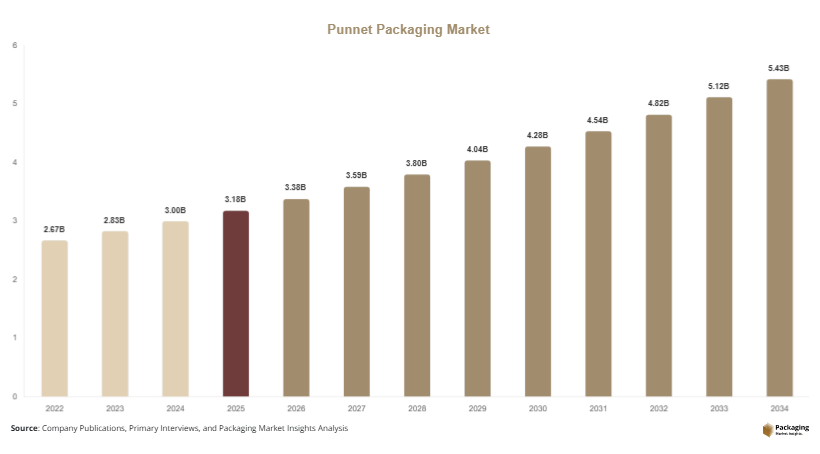
The global punnet packaging market size is estimated at USD 3.18 billion in 2025, rising to USD 3.38 billion in 2026, and projected to reach USD 5.42 billion by 2034, registering a CAGR of 6.1% (2025–2034). The punnet packaging market is expected to experience steady expansion between 2025 and 2034, driven by increasing demand for fresh produce packaging, retail-ready food solutions, and sustainable packaging materials across global supply chains. Growth is primarily supported by shifting consumer preferences toward hygienic, portion-controlled, and visually appealing packaged fruits and vegetables.
One of the major growth factors is the rapid expansion of organized retail and supermarket chains. These distribution formats require standardized packaging formats such as punnets for berries, grapes, cherry tomatoes, and salad mixes. Another key driver is the rising demand for sustainable packaging solutions, particularly recyclable PET and biodegradable fiber-based punnets. Regulatory pressure against single-use plastics is further pushing manufacturers toward eco-friendly alternatives. Additionally, the growth of online grocery platforms has increased demand for protective and ventilated packaging formats that maintain freshness during last-mile delivery.
Key Highlights
- Asia Pacific dominated the market with a 37.4% share in 2025.
- Latin America is projected to grow at the fastest CAGR of 6.2%.
- Antioxidants led the type segment with a 29.6% share.
- Plastic packaging dominated with a 52.3% share.
- Food & beverage applications led the segment with 43.1% share.
- The US market reached USD 11.2 billion in 2025 and USD 11.9 billion in
Explore more data points, trends and opportunities Download Free Sample Report
Market Trends
TShift Toward Sustainable and Recyclable Punnet Packaging
The global punnet packaging industry is witnessing a strong shift toward sustainable materials such as recycled PET (rPET), molded fiber, and biodegradable bioplastics. This transition is largely influenced by environmental regulations in Europe and North America, where governments are imposing strict restrictions on single-use plastics. Retailers such as Tesco and Walmart are actively replacing conventional plastic punnets with recyclable alternatives. Manufacturers are also investing in lightweight designs to reduce material usage while maintaining structural strength. In the future, demand for compostable punnet trays is expected to increase significantly, particularly in premium fruit categories like berries and organic produce.
Integration of Smart Packaging and Modified Atmosphere Technology
Another key trend shaping the market is the adoption of smart packaging solutions and modified atmosphere packaging (MAP) technology. Punnet packaging is increasingly being designed with micro-perforations and breathable films to regulate oxygen and moisture levels, extending shelf life. For example, berry exporters in Spain and Peru use MAP-enabled punnets to reduce spoilage during long-distance shipping to North America and Asia. Smart labeling and QR-based traceability systems are also gaining traction, allowing consumers to track product origin and freshness. This trend is expected to reshape cold chain logistics and reduce food waste globally.
Market Drivers
Rising Consumption of Fresh Fruits and Ready-to-Eat Produce
Growing consumer preference for healthy diets is significantly boosting demand for fresh fruits, vegetables, and ready-to-eat salads. This directly increases the need for punnet packaging, which provides portion control, hygiene, and visual appeal. Urban populations in countries like the United States, Germany, and Japan are shifting toward convenience-based food consumption. Supermarkets are expanding packaged produce sections, further increasing punnet adoption. For instance, berry consumption in North America has grown consistently, requiring high volumes of ventilated punnet trays. This consumption shift is expected to remain a long-term growth driver.
Expansion of Organized Retail and E-commerce Grocery Channels
The rapid expansion of supermarkets, hypermarkets, and online grocery platforms is another major driver. Retailers require standardized packaging formats for better shelf management and logistics efficiency. Companies like Amazon Fresh and Instacart have increased demand for durable punnet trays that can withstand transportation stress. In Europe, discounters such as Aldi and Lidl are expanding packaged produce offerings, increasing punnet penetration. Additionally, cold-chain logistics improvements are enabling long-distance transport of fresh produce, further increasing reliance on protective packaging formats like punnets.
Market Restraint
One of the major restraints in the punnet packaging market is the volatility in raw material prices, particularly petroleum-based plastics such as PET and PP. Fluctuations in crude oil prices directly impact production costs, making pricing unstable for manufacturers. This creates challenges for small and mid-sized packaging companies operating with thin margins. Additionally, the transition toward sustainable materials increases production complexity and cost. For example, biodegradable fiber punnets require specialized manufacturing processes, which are more expensive than conventional plastic trays. This cost burden often limits adoption in price-sensitive markets such as parts of Asia and Africa, slowing overall market penetration.
Market Opportunities
Growth of Biodegradable and Compostable Punnet Packaging
There is a significant opportunity in the development of fully biodegradable punnet packaging made from sugarcane bagasse, corn starch, and molded fiber. Increasing environmental awareness among consumers and stricter regulations are pushing retailers to adopt eco-friendly alternatives. Countries like France and Canada are actively promoting compostable packaging solutions in food retail. Manufacturers investing in bio-based punnets can gain competitive advantage in premium fruit segments. This segment is expected to witness strong adoption in organic food stores and export-oriented fruit packaging industries.
Expansion in Emerging Markets and Cold Chain Infrastructure
Emerging economies in Asia Pacific, Latin America, and Africa offer strong growth potential due to rising supermarket penetration and cold chain infrastructure development. Countries like India, Brazil, and Vietnam are witnessing rapid growth in organized retail, increasing demand for standardized packaging formats. Investments in refrigerated logistics are enabling longer shelf life for fruits and vegetables, further supporting punnet adoption. Local manufacturers have opportunities to expand production capacity and supply cost-effective packaging solutions tailored to regional needs.
Report Scope
| Report Metric | Details |
|---|---|
| Market Size in 2025 | USD 3.18 Billion |
| Market Size in 2026 | USD 3.38 Billion |
| Market Size in 2034 | USD 5.42 Billion |
| CAGR | 6.1% (2026-2034) |
| Base Year for Estimation | 2025 |
| Historical Data | 2022-2024 |
| Forecast Period | 2026-2034 |
| Report Coverage | Revenue Forecast, Competitive Landscape, Supply Chain Disruption, Growth Factors, Environment & Regulatory Landscape and Trends |
| Geographies Covered | North America, Europe, APAC, Middle East and Africa, LATAM |
| Countries Covered | U.S., Canada, U.K., Germany, France, Spain, Italy, Russia, Nordic, Benelux, Rest of Europe, China, South Korea, Japan, India, Australia, Singapore, Taiwan, South East Asia, Rest of Asia-Pacific, UAE, Turky, Saudi Arabia, South Africa, Egypt, Nigeria, Rest of MEA, Brazil, Mexico, Argentina, Chile, Colombia, Rest of LATAM |
Explore more data points, trends and opportunities Download Free Sample Report
Segmental Analysis
By Type
Rigid punnet trays dominated the market with a 44.1% share in 2024, due to their strong structural integrity, durability, and suitability for transporting delicate fruits such as berries and cherry tomatoes. These trays are widely used across supermarkets and retail chains because they provide excellent product visibility and stacking efficiency. Retailers prefer rigid punnets as they reduce spoilage during handling and improve shelf presentation. In developed markets such as Europe and North America, rigid trays are standard for premium fresh produce categories, especially in berries and organic fruit segments.
Flexible and ventilated punnet packaging is the fastest-growing subsegment, expected to register a CAGR of 6.9% (2025–2034). Growth is driven by increasing demand for lightweight, cost-effective, and eco-friendly packaging solutions. Manufacturers are introducing micro-perforated and breathable film-based punnets that enhance air circulation and extend shelf life. These innovations are gaining traction in online grocery delivery systems, where reduced weight and improved product protection are essential. The shift toward sustainable and material-efficient packaging is expected to further accelerate adoption of flexible punnet formats.
By Material
Plastic-based punnet packaging dominated the material segment with a 52.3% share in 2024, primarily driven by PET and polypropylene (PP). Plastic remains widely used due to its low cost, transparency, and ability to preserve product freshness. It is heavily used in supermarkets for berries, grapes, and cherry tomatoes. Plastic punnets also support high-speed production and thermoforming processes, making them suitable for large-scale packaging operations. Despite environmental concerns, plastic continues to dominate due to its functional advantages and supply chain efficiency.
Biodegradable and paper-based materials represent the fastest-growing subsegment, with a projected CAGR of 7.2% (2025–2034). Growth is driven by increasing regulatory pressure on plastic usage and rising consumer preference for sustainable packaging. Molded fiber punnets made from recycled paper and agricultural waste are gaining strong traction in Europe and North America. These materials are widely adopted by premium organic brands and eco-conscious retailers. Over the forecast period, advancements in compostable coatings and fiber strength enhancement are expected to improve performance and broaden application scope.
By End-Use
The food & beverage segment dominated the market with a 43.1% share in 2024, driven primarily by fruits, vegetables, and fresh produce packaging. Supermarkets and hypermarkets extensively rely on punnet packaging for berries, grapes, and salad mixes due to its ability to maintain freshness and improve visual appeal. This segment benefits from strong consumer demand for ready-to-eat and pre-packaged fresh food products. Retail expansion in urban areas has further strengthened demand for standardized punnet packaging formats.
Online grocery retail is the fastest-growing end-use segment, projected to grow at a CAGR of 7.5% (2025–2034). The rapid rise of e-commerce grocery platforms such as Amazon Fresh, Instacart, and regional delivery services is increasing demand for durable and protective punnet packaging. These platforms require packaging that can withstand handling during transportation while preserving product freshness. As digital grocery penetration increases in emerging economies, punnet packaging demand from online retail channels is expected to expand significantly.
Punnet Packaging Market Segmentations
By Type
- Rigid Punnet Trays
- Flexible Punnet Packaging
- Vented Punnet Containers
By Material
- Plastic (PET, PP, RPET)
- Paper & Molded Fiber
- Biodegradable Materials
By End-User
- Fruits & Vegetables
- Berries & Specialty Produce
- Bakery & Ready-to-Eat Foods
Regional Analysis
North America
North America accounted for around 28.9% market share in 2025, with the region projected to expand at a CAGR of 5.8% (2025–2034). The market is supported by strong demand for packaged fresh produce, particularly berries, grapes, and pre-cut fruits. The United States and Canada show high adoption of standardized punnet packaging due to well-established supermarket networks and advanced cold-chain logistics. Retailers increasingly prefer ventilated punnet formats to maintain freshness and reduce food waste during storage and transport.
The United States dominates the regional market due to its large-scale consumption of packaged fresh fruits and vegetables. A key growth driver is the expansion of premium grocery chains such as Whole Foods Market and Trader Joe’s, which actively use recyclable PET and rPET punnet trays. Additionally, the rise of online grocery delivery platforms like Instacart and Amazon Fresh is increasing demand for durable and leak-resistant punnet packaging formats designed for last-mile delivery efficiency.
Europe
Europe held approximately 31.2% market share in 2025, with a projected CAGR of 5.6% through 2034. The region’s growth is strongly influenced by strict environmental regulations aimed at reducing plastic waste. Countries across the European Union are transitioning toward recyclable and compostable packaging materials, significantly boosting demand for fiber-based and biodegradable punnet solutions. The market is also supported by high consumption of berries, salad mixes, and organic produce across Western Europe.
Germany leads the European market due to its advanced recycling infrastructure and strong policy enforcement on plastic reduction. A major growth factor is the adoption of molded fiber punnet trays in supermarkets such as Aldi and Lidl, which are replacing conventional plastic trays with eco-friendly alternatives. The UK and France are also witnessing rapid growth in sustainable punnet packaging due to retailer commitments toward carbon-neutral packaging strategies.
Asia Pacific
Asia Pacific dominated the global market with a 37.4% share in 2025, and is projected to grow at the fastest CAGR of 6.8% (2025–2034). Growth is driven by rising population, increasing disposable income, and rapid expansion of modern retail infrastructure. Countries such as China, India, Japan, and Australia are witnessing strong demand for packaged fruits and vegetables due to urban lifestyle changes and growing health awareness.
China remains the dominant country in the region due to its massive fruit production and export industry. A key growth factor is the expansion of export-oriented packaging facilities in provinces like Guangdong and Shandong, where punnet packaging is widely used for berries and grapes shipped to North America and Europe. India is also emerging as a fast-growing market due to rapid supermarket expansion and increasing adoption of packaged fresh produce in metro cities.
Middle East & Africa
The Middle East & Africa region accounted for approximately 5.3% market share in 2025, with a projected CAGR of 6.0% (2025–2034). Market growth is driven by increasing dependence on imported fruits and vegetables, especially in Gulf Cooperation Council (GCC) countries. Rising supermarket penetration and growing demand for packaged fresh produce are supporting punnet packaging adoption.
The United Arab Emirates dominates the regional market due to its strong reliance on imported fresh produce and advanced retail infrastructure. A key growth driver is the expansion of hypermarkets such as Carrefour and Lulu Group, which increasingly use punnet packaging for berries, grapes, and premium fruit segments. Additionally, Saudi Arabia is investing heavily in food security and cold-chain logistics, further increasing demand for protective packaging solutions.
Latin America
Latin America held around 6.6% market share in 2025, and is expected to grow at a CAGR of 6.2% (2025–2034). The region benefits from strong agricultural exports, particularly in fruits such as berries, avocados, and citrus. Countries like Brazil, Chile, and Peru play a major role in global fresh produce exports, driving demand for export-grade punnet packaging solutions.
Brazil leads the regional market due to its large-scale fruit production and export activities. A key growth factor is the increasing adoption of ventilated punnet trays for international shipments, especially to Europe and North America. Chile and Peru are also emerging as strong exporters of berries, where punnet packaging is essential to maintain freshness during long-distance cold-chain transportation.
Competitive Landscape
The punnet packaging market is moderately consolidated with key players focusing on sustainability and lightweight packaging innovation. Major companies include Amcor plc, Berry Global Inc., Huhtamaki Oyj, DS Smith Plc, and Sealed Air Corporation. Amcor plc is the leading player due to its strong global presence and extensive sustainable packaging portfolio.
Recent developments include investments in recyclable punnet production lines, expansion of molded fiber packaging facilities, and partnerships with supermarket chains to replace plastic packaging with eco-friendly alternatives. Companies are increasingly focusing on R&D for compostable materials and smart packaging integration.
Key Players List
- Amcor plc
- Berry Global Inc.
- Huhtamaki Oyj
- DS Smith Plc
- Sealed Air Corporation
- Sonoco Products Company
- Sabert Corporation
- Coveris Holdings S.A.
- Winpak Ltd.
- Graphic Packaging International
- Clondalkin Group
- Constantia Flexibles
- CKF Inc.
- Great Northern Corporation
- Anchor Packaging Inc.