Protective Packaging Market Size and Growth
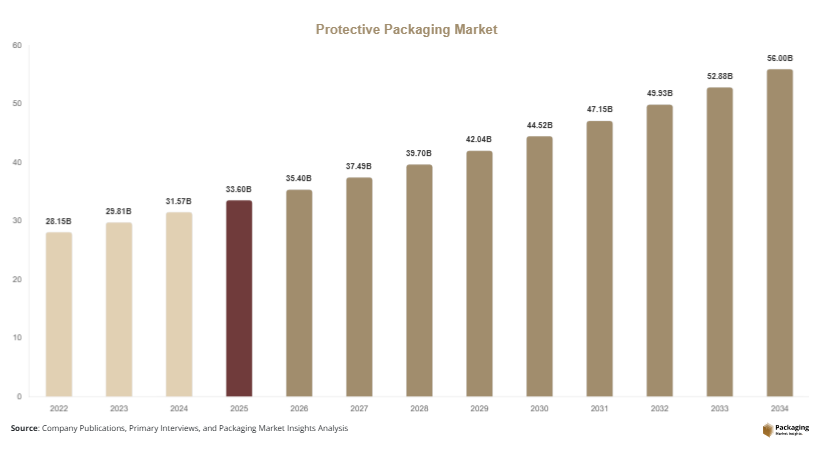
The global protective packaging market size was estimated at USD 33.6 billion in 2025 and is projected to reach USD 35.4 billion in 2026. Over the forecast period, the market is expected to expand at a compound annual growth rate (CAGR) of 5.9% from 2025 to 2034, reaching approximately USD 59.8 billion by 2034. Growth is supported by increasing demand from industries such as electronics, healthcare, automotive, and consumer goods.
The protective packaging market is experiencing steady expansion as industries prioritize product safety, supply chain efficiency, and sustainable packaging solutions. Protective packaging refers to materials designed to safeguard products from damage during transportation, storage, and handling. These materials include foam packaging, bubble wraps, air pillows, molded pulp packaging, and corrugated inserts. The growing scale of global e-commerce and cross-border trade has increased the need for packaging that protects fragile goods across long distribution networks.
Key Highlights
- The protective packaging market size is projected to reach USD 59.8 billion by 2034.
- The market is expected to grow at a CAGR of 5.9% from 2025 to 2034.
- E-commerce expansion remains a key driver of protective packaging demand.
- Sustainable and recyclable packaging materials are becoming a major industry trend.
- Electronics and healthcare sectors represent significant end-use markets.
Explore more data points, trends and opportunities Download Free Sample Report
Market Trends
Rising Adoption of Sustainable Protective Packaging Materials
Sustainability is becoming a central theme in the protective packaging market. Governments, retailers, and consumers are placing greater emphasis on environmentally responsible packaging materials. As a result, packaging manufacturers are transitioning from traditional petroleum-based foam materials toward recyclable and biodegradable solutions such as molded pulp, paper-based cushioning, and starch-based foams. These alternatives provide comparable protection while reducing environmental impact.
Retail companies and global brands are implementing packaging sustainability targets that encourage the use of recyclable protective materials. Logistics companies are also reducing plastic packaging in shipping operations to meet carbon reduction goals. In addition, technological advances in material engineering are improving the durability and cushioning performance of paper-based protective packaging. This shift toward sustainable packaging solutions is expected to remain a defining trend across the protective packaging industry.
Integration of Smart Packaging and Supply Chain Tracking
Another emerging trend in the protective packaging market is the integration of smart packaging technologies that enhance supply chain visibility. Sensors, RFID tags, and temperature monitoring devices are being embedded within protective packaging to track product conditions during transportation. These technologies help companies monitor shock exposure, humidity, and temperature changes, which is particularly important for pharmaceuticals and sensitive electronics.
Smart protective packaging provides real-time logistics data that enables businesses to detect potential damage risks and optimize transportation routes. As global supply chains become more complex, manufacturers and logistics providers are increasingly adopting connected packaging solutions. The use of digital tracking within protective packaging systems improves transparency, reduces losses, and enhances operational efficiency.
Market Drivers
Rapid Expansion of Global E-commerce Logistics
The continued expansion of online retail platforms has significantly increased demand for protective packaging solutions. E-commerce shipments require packaging that can withstand long transit distances, multiple handling points, and unpredictable transportation conditions. Protective materials such as bubble wrap, air pillows, and foam inserts help prevent product damage while maintaining lightweight packaging structures that reduce shipping costs.
Retailers are also focusing on minimizing product return rates caused by shipping damage. Protective packaging plays a critical role in ensuring customer satisfaction and maintaining brand reputation. As cross-border e-commerce continues to grow, packaging suppliers are developing customized protective solutions designed for diverse product categories. This expansion of online retail logistics remains a key driver for market growth.
Increasing Demand from Electronics and Healthcare Industries
The electronics and healthcare industries represent major end-use sectors for the protective packaging market. Consumer electronics products such as smartphones, laptops, and home appliances require specialized packaging that protects delicate components from vibration and shock during transportation. Similarly, medical devices and pharmaceutical products require packaging that ensures product integrity and safety.
Healthcare logistics often involve temperature-sensitive products, which require advanced protective materials combined with insulation properties. As the global demand for medical devices and pharmaceuticals grows, manufacturers are investing in protective packaging solutions that maintain product stability. This increasing demand from technology and healthcare sectors continues to support long-term market expansion.
Market Restraint
Environmental Concerns and Regulations on Plastic Packaging
Despite steady market growth, the protective packaging market faces challenges related to environmental regulations and plastic waste concerns. Many traditional protective packaging materials, including expanded polystyrene foam and plastic bubble wrap, are derived from petroleum-based polymers. These materials are often difficult to recycle and contribute to long-term environmental pollution.
Governments across several regions have introduced regulatory frameworks aimed at reducing single-use plastics and promoting sustainable packaging alternatives. These policies require manufacturers to invest in research and development to develop recyclable or biodegradable packaging solutions. While such innovations create opportunities, they also increase production costs and operational complexity.
For example, certain regions have implemented restrictions on expanded polystyrene packaging used for shipping electronics and food products. Companies that rely heavily on foam packaging must transition toward alternative materials such as molded pulp or paper-based cushioning. This shift requires capital investment in manufacturing infrastructure and material sourcing. Consequently, regulatory pressure on plastic packaging remains a restraint for the industry.
Market Opportunities
Growth of Sustainable Paper-Based Packaging Solutions
The increasing preference for eco-friendly materials is creating new opportunities within the protective packaging market. Paper-based cushioning systems, molded pulp packaging, and corrugated inserts are gaining popularity as alternatives to plastic foam materials. These solutions offer biodegradability, recyclability, and reduced environmental impact while still providing adequate product protection.
Manufacturers are developing advanced paper-based structures that enhance shock absorption and structural durability. Many packaging suppliers are investing in fiber-based packaging technologies that meet sustainability goals without compromising packaging performance. As companies across industries implement circular economy strategies, demand for sustainable protective packaging solutions is expected to grow steadily.
Expansion of Cold Chain Packaging for Pharmaceuticals
The pharmaceutical industry is creating additional opportunities for protective packaging manufacturers. Cold chain logistics require specialized packaging systems that maintain controlled temperatures during transportation. Insulated protective packaging solutions help protect temperature-sensitive vaccines, biologics, and medical supplies.
As pharmaceutical supply chains expand globally, the need for reliable cold chain packaging is increasing. Protective packaging materials that combine insulation with cushioning capabilities are gaining adoption in healthcare logistics. This trend is particularly relevant in emerging markets where pharmaceutical distribution networks are expanding rapidly. As a result, companies offering advanced insulated packaging solutions can capitalize on this growing market opportunity.
Report Scope
| Report Metric | Details |
|---|---|
| Market Size in 2025 | USD 33.6 Billion |
| Market Size in 2026 | USD 35.4 Billion |
| Market Size in 2034 | USD 59.8 Billion |
| CAGR | 5.9% (2026-2034) |
| Base Year for Estimation | 2025 |
| Historical Data | 2022-2024 |
| Forecast Period | 2026-2034 |
| Report Coverage | Revenue Forecast, Competitive Landscape, Supply Chain Disruption, Growth Factors, Environment & Regulatory Landscape and Trends |
| Geographies Covered | North America, Europe, APAC, Middle East and Africa, LATAM |
| Countries Covered | U.S., Canada, U.K., Germany, France, Spain, Italy, Russia, Nordic, Benelux, Rest of Europe, China, South Korea, Japan, India, Australia, Singapore, Taiwan, South East Asia, Rest of Asia-Pacific, UAE, Turky, Saudi Arabia, South Africa, Egypt, Nigeria, Rest of MEA, Brazil, Mexico, Argentina, Chile, Colombia, Rest of LATAM |
Explore more data points, trends and opportunities Download Free Sample Report
Segmental Analysis
By Material Type
Plastic-based protective packaging dominated the protective packaging market, accounting for approximately 48% of the market share in 2024. Materials such as polyethylene foam, air pillows, and bubble wrap are widely used due to their lightweight properties and high cushioning efficiency. Plastic materials also offer flexibility and durability, which makes them suitable for protecting fragile goods during transportation.
Plastic protective packaging solutions are commonly used in electronics, consumer appliances, and industrial equipment shipments. Their ability to absorb shock and vibration makes them ideal for safeguarding delicate components. In addition, plastic packaging can be easily customized to accommodate different product shapes and sizes. Despite environmental concerns, plastic materials remain widely used because of their cost efficiency and protective performance.
Paper-based protective packaging is expected to be the fastest-growing material segment, expanding at a CAGR of approximately 7.2% during the forecast period. The shift toward sustainable packaging practices is encouraging companies to adopt paper cushioning, molded pulp packaging, and corrugated inserts.
Paper-based solutions offer several advantages including recyclability and biodegradability. Retailers and logistics companies are increasingly replacing plastic cushioning materials with paper alternatives to meet sustainability goals. In addition, technological innovations in fiber-based packaging are improving shock absorption capabilities. As environmental regulations continue to strengthen, demand for paper-based protective packaging materials is expected to grow significantly.
By Product Type
Flexible protective packaging accounted for the largest share of the protective packaging market in 2024, representing nearly 55% of total revenue. Flexible packaging solutions include bubble wraps, air cushions, foam rolls, and padded mailers. These products are widely used due to their adaptability and ability to protect items of different sizes.
Flexible protective packaging is particularly popular in e-commerce shipments where lightweight materials reduce shipping costs. Online retailers frequently use bubble wraps and padded envelopes to protect consumer electronics, cosmetics, and fragile household items. The flexibility of these materials allows packaging suppliers to provide customized solutions that fit various product categories while maintaining efficient packaging processes.
Rigid protective packaging is projected to be the fastest-growing product segment, registering a CAGR of around 6.5% through 2034. This category includes molded pulp trays, foam inserts, and protective corrugated structures designed to hold products securely within shipping containers.
Rigid packaging solutions are increasingly used for high-value products such as electronics and medical devices. These solutions provide structural support and prevent movement during transportation. As product shipments become more complex and valuable goods require enhanced protection, demand for rigid protective packaging systems is expected to increase steadily.
By End-Use Industry
The electronics industry accounted for the largest share of the protective packaging market in 2024, contributing approximately 34% of global demand. Consumer electronics products such as smartphones, laptops, gaming consoles, and home appliances require packaging solutions that prevent damage from shock and vibration during shipping.
Electronics manufacturers rely on foam inserts, molded pulp trays, and corrugated packaging to protect delicate internal components. The growth of global electronics manufacturing and increasing consumer demand for digital devices are major factors driving protective packaging demand in this segment. Additionally, the expansion of online electronics retail has further increased the need for reliable protective packaging solutions.
The healthcare industry is expected to be the fastest-growing end-use segment, with a projected CAGR of around 6.9% during the forecast period. Healthcare products often require specialized packaging to maintain sterility, temperature control, and product safety.
Pharmaceutical companies and medical device manufacturers are increasingly investing in advanced protective packaging systems designed for cold chain logistics. These packaging solutions combine insulation and cushioning to ensure that sensitive medical products remain intact during transportation. As healthcare supply chains expand globally, the demand for protective packaging in this sector is expected to rise significantly.
Protective Packaging Market Segmentations
Material Type
- Plastic
- Paper & Paperboard
- Foam
- Biodegradable Materials
Product Type
- Flexible Protective Packaging
- Rigid Protective Packaging
End-Use Industry
- Electronics
- Healthcare
- Automotive
- Consumer Goods
- Industrial Equipment
Regional Analysis
North America
North America held approximately 32% of the protective packaging market share in 2025. The region benefits from strong demand across e-commerce, electronics, and pharmaceutical sectors. Market growth in North America is projected at a CAGR of 5.4% through 2034, supported by advanced logistics infrastructure and high adoption of innovative packaging technologies.
The United States represents the dominant country in this region. A key growth factor is the widespread adoption of automation and smart packaging technologies in logistics operations. Companies are integrating protective packaging systems with digital tracking tools to improve shipment monitoring and reduce damage rates during transportation.
Europe
Europe accounted for nearly 27% of the global protective packaging market share in 2025. The market is expected to expand at a CAGR of around 5.1% during the forecast period. Growth in this region is supported by strong environmental regulations that encourage the development of recyclable and sustainable packaging solutions.
Germany is the leading market in Europe due to its strong manufacturing and automotive industries. A unique growth factor in the region is the increasing adoption of biodegradable protective packaging materials driven by strict environmental policies and corporate sustainability initiatives.
Asia Pacific
Asia Pacific represented approximately 29% of the global protective packaging market in 2025. The region is projected to record the fastest CAGR of 6.8% through 2034, driven by rapid industrialization and expanding consumer markets.
China dominates the Asia Pacific market due to its strong manufacturing base and growing e-commerce sector. A key growth factor is the expansion of cross-border online retail platforms that require reliable protective packaging solutions for international shipping operations.
Middle East & Africa
The Middle East & Africa accounted for around 6% of the protective packaging market share in 2025. The market is forecast to grow at a CAGR of 5.6% during the forecast period as logistics infrastructure and manufacturing industries expand across the region.
United Arab Emirates is emerging as a key market due to its strategic role in global trade routes. The growth of regional logistics hubs and international shipping centers is creating additional demand for protective packaging materials in supply chain operations.
Latin America
Latin America represented nearly 6% of the global protective packaging market in 2025. The market is expected to grow at a CAGR of 5.3% through 2034, supported by expanding retail and manufacturing sectors.
Brazil is the dominant country in the region. A unique growth factor is the increasing penetration of e-commerce platforms that require durable packaging materials for nationwide delivery networks.
Competitive Landscape
The protective packaging market is moderately competitive, with several global packaging manufacturers competing through product innovation, sustainability initiatives, and strategic partnerships. Companies are focusing on developing lightweight and recyclable protective packaging solutions that align with environmental regulations and customer sustainability goals.
Leading companies are investing in research and development to introduce eco-friendly materials and advanced packaging designs. Automation and digital supply chain integration are also becoming important competitive strategies. Manufacturers are collaborating with e-commerce platforms and logistics providers to develop customized packaging solutions that reduce shipping damage and improve operational efficiency.
One of the prominent leaders in the industry is Sealed Air Corporation, known for its innovative protective packaging technologies. The company recently introduced new recyclable cushioning materials designed to reduce plastic waste in shipping operations. Other major companies such as Sonoco Products Company, Pregis LLC, Smurfit Kappa Group, and DS Smith Plc continue to expand their product portfolios and manufacturing capabilities to strengthen their market positions.
Key Players List
- Sealed Air Corporation
- Sonoco Products Company
- Pregis LLC
- Smurfit Kappa Group
- DS Smith Plc
- Storopack Hans Reichenecker GmbH
- Ranpak Holdings Corp
- Intertape Polymer Group
- Huhtamaki Oyj
- WestRock Company
- International Paper Company
- Pregis Innovations
- ProAmpac
- UFP Technologies
- Cascades Inc.