Protective Films Market Size and Growth
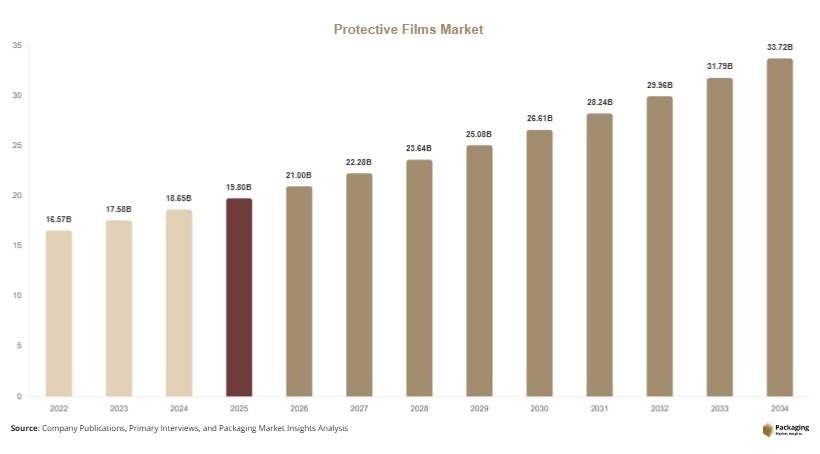
The protective films market is witnessing steady expansion due to increasing demand across industries such as electronics, automotive, construction, and packaging. Protective films are thin layers applied to surfaces to safeguard them from scratches, dust, abrasion, and environmental damage during manufacturing, transportation, and end-use applications. The market size was valued at approximately USD 19.8 billion in 2025 and is expected to reach USD 21.0 billion in 2026. With rising industrial activities and demand for surface protection solutions, the market is projected to reach USD 35.6 billion by 2034, growing at a CAGR of 6.1% during 2025–2034.
One of the major growth factors is the rapid expansion of the electronics industry, where protective films are used to protect screens and components during assembly and shipment. Another key factor is the increasing demand from the automotive sector, where films are applied to protect painted surfaces and interiors from scratches and damage. Additionally, the growth of the construction sector is driving demand for protective films used in windows, panels, and flooring materials.
Key Highlights:
- Market projected to reach USD 35.6 billion by 2034, expanding at a CAGR of 6.1% during 2025–2034, reflecting steady growth across key industries.
- Strong demand from electronics and automotive sectors is driving adoption, with increasing focus on surface protection and maintaining product quality standards.
- Growth is further supported by rapid e-commerce expansion and rising construction activities, boosting the need for protective packaging solutions.
Explore more data points, trends and opportunities Download Free Sample Report
Market Trends
Growing Adoption of Eco-Friendly and Recyclable Protective Films
The protective films market is experiencing a shift toward eco-friendly and recyclable materials. Manufacturers are developing films made from biodegradable or recyclable polymers to reduce environmental impact. This trend is driven by increasing regulatory pressure and consumer demand for sustainable products. Companies are focusing on reducing plastic waste by introducing films that can be easily recycled without compromising performance. Innovations in material science are enabling the production of films that offer high durability while being environmentally friendly. This trend is expected to gain momentum as sustainability becomes a key priority across industries.
Increasing Use of Advanced Multi-Layer and High-Performance Films
Another key trend in the market is the growing adoption of multi-layer and high-performance protective films. These films provide enhanced protection against scratches, UV radiation, and chemical exposure. They are widely used in high-value applications such as electronics and automotive components. Advances in coating technologies and material engineering are enabling the development of films with superior adhesion and durability. This trend is driven by the need for high-quality surface protection in demanding environments, supporting market growth.
Market Drivers
Rising Demand from Electronics and Automotive Industries
The increasing demand from electronics and automotive industries is a major driver of the protective films market. In the electronics sector, protective films are used to safeguard screens, panels, and components during manufacturing and transportation. The growing production of smartphones, tablets, and other electronic devices is driving demand for these films. In the automotive sector, protective films are applied to vehicle surfaces to prevent scratches and damage during assembly and shipping. The expansion of these industries is significantly contributing to market growth.
Growth of Construction and Infrastructure Development
The expansion of construction and infrastructure projects is another key driver of the market. Protective films are widely used in construction materials such as glass, metal panels, and flooring to prevent damage during installation and use. The increasing demand for residential and commercial buildings is boosting the adoption of protective films. Additionally, the focus on maintaining product quality and reducing maintenance costs is driving the use of these films in construction applications.
Market Restraint
Environmental Concerns and Disposal Challenges
Environmental concerns related to plastic waste and disposal challenges pose a significant restraint to the protective films market. Many protective films are made from non-biodegradable materials, contributing to environmental pollution. The disposal of used films can be challenging, especially in regions with limited recycling infrastructure.
For example, protective films used in construction and packaging are often discarded after use, leading to increased waste generation. This has led to stricter regulations on plastic usage, which can impact market growth. Manufacturers are required to invest in sustainable alternatives, which may increase production costs. Addressing these challenges requires innovation in materials and recycling technologies, making it a key concern for industry participants.
Market Opportunities
Development of Sustainable and Biodegradable Film Materials
The development of sustainable and biodegradable protective films presents significant growth opportunities. Companies are investing in research to create materials that decompose naturally without harming the environment. These films can reduce waste and meet regulatory requirements. The adoption of biodegradable films is expected to increase in industries such as packaging and construction, where environmental impact is a major concern. This opportunity is driving innovation and creating new market avenues.
Expansion in Emerging Markets and Industrial Growth
Emerging markets in Asia Pacific, Latin America, and the Middle East offer substantial opportunities for the protective films market. Rapid industrialization and urbanization are increasing demand for protective films in various applications. The growth of manufacturing, construction, and automotive industries in these regions is driving market expansion. Companies that invest in these markets can benefit from increasing demand and favorable economic conditions.
Report Scope
| Report Metric | Details |
|---|---|
| Market Size in 2025 | USD 19.8 Billion |
| Market Size in 2026 | USD 21.0 Billion |
| Market Size in 2034 | USD 35.6 Billion |
| CAGR | 6.1% (2026-2034) |
| Base Year for Estimation | 2025 |
| Historical Data | 2022-2024 |
| Forecast Period | 2026-2034 |
| Report Coverage | Revenue Forecast, Competitive Landscape, Supply Chain Disruption, Growth Factors, Environment & Regulatory Landscape and Trends |
| Geographies Covered | North America, Europe, APAC, Middle East and Africa, LATAM |
| Countries Covered | U.S., Canada, U.K., Germany, France, Spain, Italy, Russia, Nordic, Benelux, Rest of Europe, China, South Korea, Japan, India, Australia, Singapore, Taiwan, South East Asia, Rest of Asia-Pacific, UAE, Turky, Saudi Arabia, South Africa, Egypt, Nigeria, Rest of MEA, Brazil, Mexico, Argentina, Chile, Colombia, Rest of LATAM |
Explore more data points, trends and opportunities Download Free Sample Report
Segmental Analysis
By Type
The polyethylene (PE) films segment dominated the protective films market in 2024, accounting for approximately 45% of the market share. PE films are widely used due to their flexibility, cost-effectiveness, and ease of application. They provide effective protection against scratches and environmental damage, making them suitable for various applications. The increasing demand for lightweight and durable materials is supporting the growth of this segment.
The polypropylene (PP) films segment is expected to be the fastest-growing, with a CAGR of 6.7% during the forecast period. PP films offer higher strength and heat resistance compared to PE films. They are increasingly used in applications requiring enhanced durability. The growing demand for high-performance materials is driving this segment.
By Application
The electronics segment held the largest market share in 2024, accounting for approximately 40%. Protective films are widely used in electronic devices to protect screens and components. The increasing production of consumer electronics is driving demand for these films.
The automotive segment is projected to grow at the fastest CAGR of 6.5% during the forecast period. The use of protective films in automotive applications is increasing, supported by the need to prevent surface damage during manufacturing and transportation. This trend is driving segment growth.
By End-Use
The manufacturing segment dominated the market in 2024, with a share of approximately 50%. Protective films are widely used in manufacturing processes to protect products from damage. The increasing focus on quality control is driving demand in this segment.
The construction segment is expected to grow at the fastest CAGR of 6.4% during the forecast period. The use of protective films in construction materials is increasing, supported by the growth of infrastructure projects. This trend is driving segment growth.
Protective Films Market Segmentations
Material Type
- Polyethylene (PE)
- Polypropylene (PP)
- Polyvinyl Chloride (PVC)
- Polyethylene Terephthalate (PET)
Application
- Electronics & Displays
- Automotive
- Construction
- Industrial Equipment
End-Use Industry
- Electrical & Electronics
- Automotive
- Building & Construction
- Packaging
- Healthcare
Regional Analysis
North America
North America accounted for approximately 32% of the protective films market share in 2025 and is expected to grow at a CAGR of 5.8% during the forecast period. The region benefits from advanced manufacturing capabilities and strong demand from electronics and automotive industries. The presence of major market players is also contributing to growth.
The United States dominates the regional market due to its large industrial base and high adoption of advanced technologies. A key growth factor is the increasing demand for protective films in electronics manufacturing, driven by the production of consumer devices.
Europe
Europe held a market share of around 25% in 2025 and is projected to grow at a CAGR of 6.0% through 2034. The region is characterized by strong regulatory frameworks and a focus on sustainability. The adoption of eco-friendly materials is driving market growth.
Germany leads the European market due to its strong automotive and manufacturing industries. A unique growth factor is the increasing demand for protective films in automotive applications, particularly for surface protection during production.
Asia Pacific
Asia Pacific accounted for approximately 28% of the market share in 2025 and is expected to register the fastest CAGR of 6.8% during the forecast period. Rapid industrialization and urbanization are driving demand for protective films in various applications.
China dominates the Asia Pacific market due to its large manufacturing sector. A key growth factor is the expansion of electronics production, which is increasing demand for protective films.
Middle East & Africa
The Middle East & Africa region held a market share of around 8% in 2025 and is projected to grow at a CAGR of 5.6% during the forecast period. The market is expanding due to increasing construction activities and infrastructure development.
Saudi Arabia is a leading country in the region, supported by its growing construction sector. A unique growth factor is the development of large-scale infrastructure projects, which is driving demand for protective films.
Latin America
Latin America accounted for approximately 7% of the market share in 2025 and is expected to grow at a CAGR of 5.9% through 2034. The region is experiencing growth due to increasing industrial activities and demand for packaging solutions.
Brazil dominates the regional market due to its expanding manufacturing sector. A key growth factor is the growth of e-commerce, which is increasing demand for protective packaging materials.
Competitive Landscape
The protective films market is competitive, with companies focusing on product innovation and expansion strategies. Key players are investing in advanced materials and technologies to improve product performance. Strategic partnerships and acquisitions are common approaches to strengthen market position.
3M Company is a leading player in the market, known for its innovative protective film solutions. The company recently introduced advanced films with improved durability and environmental performance. Other companies are also expanding their product portfolios to meet growing demand.
Key Players List
- 3M Company
- Nitto Denko Corporation
- Avery Dennison Corporation
- Saint-Gobain
- Eastman Chemical Company
- Berry Global Inc.
- DuPont de Nemours Inc.
- Toray Industries Inc.
- Covestro AG
- LINTEC Corporation
- Scapa Group Plc
- Chargeurs SA
- Arkema Group
- Polifilm GmbH
- Surface Armor LLC