Printed Signage Market Size and Growth
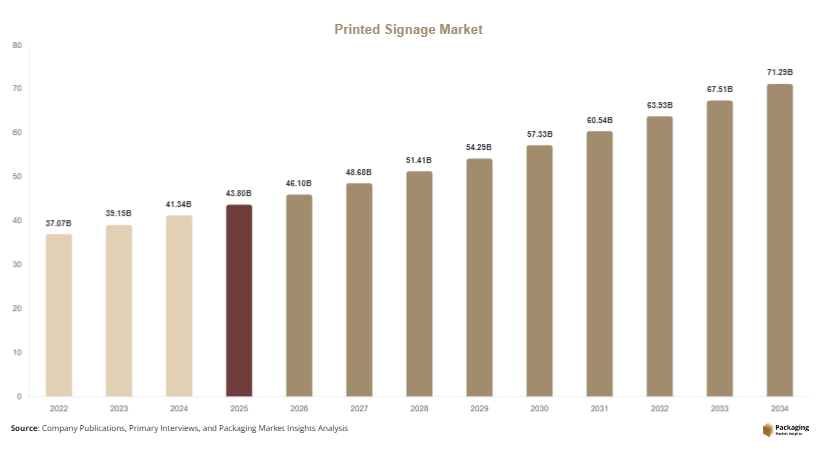
The global printed signage market size is estimated at USD 43.8 billion in 2025 and is projected to reach USD 46.1 billion in 2026. By 2034, the market is forecast to reach USD 71.4 billion, expanding at a CAGR of 5.6% during 2025–2034. Market growth is being shaped by increasing retail branding expenditure, expansion of organized commercial infrastructure, and rising demand for customized short-run print solutions across industries. The printed signage market continues to hold a critical position in brand communication, retail visibility, outdoor advertising, event promotion, and commercial wayfinding despite rapid digital transformation across the advertising industry.
One major growth factor is the continued expansion of modern retail spaces, including shopping malls, convenience chains, supermarkets, branded outlets, and mixed-use commercial complexes. These environments depend heavily on printed signage for promotions, directional messaging, and visual merchandising. A second factor is the growing adoption of high-quality large-format printing technologies that allow sharper graphics, faster production cycles, and lower customization costs for banners, window graphics, point-of-sale signage, and exhibition displays. The third growth driver is increasing demand from transportation, hospitality, healthcare, and public infrastructure sectors where printed signage remains essential for navigation, compliance, and public communication.
Key Highlights:
- Asia Pacific dominated the market with a 38.6% share in 2025.
- Latin America is projected to grow at the fastest CAGR of 6.3%.
- Banners and posters led the type segment with a 30.8% share.
- Vinyl-based signage dominated with a 41.7% share.
- Retail applications led the end-use segment with a 33.9% share.
- The US remained the dominant country with a market size of USD 8.4 billion in 2025 and USD 8.8 billion in 2026.
Explore more data points, trends and opportunities Download Free Sample Report
Market Trends
Sustainable Printing Materials Reshaping Commercial Signage Demand
Environmental considerations are increasingly influencing purchasing decisions across the printed signage market, particularly among retail chains, corporate offices, event operators, and public institutions. Buyers are shifting toward recyclable boards, PVC-free substrates, soy-based inks, and water-based coating technologies that reduce lifecycle environmental impact without sacrificing print quality. For example, large retail chains are replacing foam board promotional displays with recyclable corrugated signage systems for seasonal campaigns. This transition lowers disposal costs and improves sustainability reporting metrics. Over the forecast period, sustainable signage materials are expected to gain wider commercial acceptance as procurement standards become more environmentally focused and governments strengthen waste reduction regulations in commercial advertising materials.
Personalized Short-Run Printing Expanding Market Applications
Short-run customized printing is becoming a defining trend in the printed signage market as brands prioritize local targeting, limited-duration campaigns, and personalized customer engagement. Modern digital printing systems allow quick production of location-specific signage in smaller volumes while maintaining visual consistency. Restaurant chains, franchise retailers, and regional service businesses increasingly use hyperlocal promotional signage customized by language, pricing, or community messaging. For instance, supermarket chains now deploy city-specific promotional signage based on local consumer buying behavior and seasonal demand. Looking ahead, this trend is likely to increase repeat signage orders, improve campaign flexibility, and expand growth opportunities for commercial printers focused on agile production capabilities.
Market Drivers
Retail Expansion and Visual Merchandising Investment
The growth of organized retail is a major factor supporting the printed signage market. New shopping centers, convenience chains, supermarkets, specialty stores, and branded outlets require large volumes of indoor and outdoor signage for branding, pricing, promotion, and directional communication. Printed signage remains one of the most cost-effective tools for customer engagement inside physical retail environments. For example, apparel retailers frequently refresh promotional displays, window graphics, and hanging banners to align with seasonal campaigns and product launches. This creates recurring demand for high-quality printed communication materials. As retail competition intensifies globally, spending on store presentation and in-store customer navigation is expected to continue supporting market growth.
Infrastructure Development Supporting Public Communication Signage
Rapid development of airports, railway terminals, hospitals, universities, highways, and commercial complexes is increasing demand for printed signage used in navigation, information dissemination, and compliance communication. Public infrastructure projects require durable printed boards, reflective graphics, hazard notices, and multilingual communication systems that can be deployed quickly and maintained cost-effectively. For example, transit expansion projects across emerging economies rely heavily on printed directional signage during construction and operation phases. The cause-and-effect relationship is clear: as infrastructure expands, communication complexity rises, directly increasing signage deployment. This structural demand is expected to provide long-term support to the market across developed and developing economies.
Market Restraint
Rising Competition from Digital Display Alternatives
A major restraint affecting the printed signage market is increasing competition from digital displays such as LED billboards, digital kiosks, interactive retail screens, and electronic menu boards. These solutions offer dynamic content rotation, remote content management, and real-time advertising updates, reducing reliance on frequently replaced printed materials in certain high-traffic commercial settings. For example, quick-service restaurant chains increasingly use digital menu boards instead of printed displays because pricing and promotional content can be updated instantly. This transition affects recurring print demand in selected commercial segments. Additionally, digital displays appeal to brands seeking measurable customer engagement analytics. While printed signage remains cost-effective and widely used, digital substitution creates competitive pressure in premium advertising environments.
Market Opportunities
Expansion of Transit Advertising and Outdoor Commercial Branding
Urbanization is creating strong opportunity for the printed signage market through expanding transit advertising and commercial outdoor branding. Metro stations, buses, taxis, airport corridors, roadside retail developments, and public transit shelters increasingly use printed wraps, posters, and large-format graphics for cost-efficient visual communication. Transit networks in rapidly growing cities offer high visibility and repeated consumer exposure, making printed signage commercially attractive. Future scope is substantial in emerging economies investing in smart mobility corridors and transit infrastructure. Applications include station branding, temporary construction signage, vehicle graphics, and promotional outdoor communication. This area is expected to generate recurring demand for durable weather-resistant printed signage solutions.
Growth of Experiential Marketing and Event Branding
Experiential marketing is opening new opportunities for specialized printed signage applications across exhibitions, corporate events, sporting venues, and brand activations. Event organizers increasingly use immersive printed environments including backdrops, floor graphics, directional panels, booth structures, and branded installations to enhance visitor engagement. For instance, trade exhibitions now use layered printed wayfinding systems combined with QR-linked product information for hybrid visitor experiences. Future demand is likely to rise as live events expand globally and brands increase spending on experiential customer interaction. Applications include pop-up retail environments, conferences, product launches, festivals, and branded venue décor, supporting premium print segments with higher design and material value.
Report Scope
| Report Metric | Details |
|---|---|
| Market Size in 2025 | USD 43.8 Billion |
| Market Size in 2026 | USD 46.1 Billion |
| Market Size in 2034 | USD 71.4 Billion |
| CAGR | 5.6% (2026-2034) |
| Base Year for Estimation | 2025 |
| Historical Data | 2022-2024 |
| Forecast Period | 2026-2034 |
| Report Coverage | Revenue Forecast, Competitive Landscape, Supply Chain Disruption, Growth Factors, Environment & Regulatory Landscape and Trends |
| Geographies Covered | North America, Europe, APAC, Middle East and Africa, LATAM |
| Countries Covered | U.S., Canada, U.K., Germany, France, Spain, Italy, Russia, Nordic, Benelux, Rest of Europe, China, South Korea, Japan, India, Australia, Singapore, Taiwan, South East Asia, Rest of Asia-Pacific, UAE, Turky, Saudi Arabia, South Africa, Egypt, Nigeria, Rest of MEA, Brazil, Mexico, Argentina, Chile, Colombia, Rest of LATAM |
Explore more data points, trends and opportunities Download Free Sample Report
Segmental Analysis
By Type
Banners and posters dominated the market in 2024, accounting for 30.8% share. Their leading position is supported by affordability, fast production cycles, broad application range, and ease of deployment across retail, events, public communication, and outdoor promotions. Businesses of all sizes use banners and posters for sales campaigns, directional signage, event announcements, political communication, and branding installations. Their versatility across indoor and outdoor formats further strengthens demand. Commercial printers also benefit from scale efficiencies in banner production, allowing competitive pricing for repeat orders. Material advances in weather-resistant coatings and high-resolution printing continue to enhance application value across diverse industries.
Vehicle wraps are projected to be the fastest-growing type segment, expanding at a CAGR of 6.8% through 2034. Growth is driven by mobile advertising demand, fleet branding, and cost-effective outdoor promotional visibility. Delivery companies, logistics fleets, food trucks, public transport systems, and service businesses increasingly use printed wraps as moving advertising platforms. Improvements in adhesive films, printable vinyl quality, and UV durability are improving lifecycle performance. Future outlook remains strong as urban mobility increases and commercial fleet operators seek scalable brand visibility solutions that combine advertising reach with durable surface protection benefits.
By Material
Vinyl-based signage held the leading 41.7% market share in 2024, supported by durability, flexibility, weather resistance, and compatibility with high-resolution printing technologies. Vinyl materials are widely used for outdoor banners, window graphics, vehicle wraps, wall branding, and large-format advertising due to strong print adhesion and extended lifespan. Retail storefront graphics, construction site banners, and transit advertising frequently rely on vinyl because it performs well in rain, sunlight, and variable temperatures. Laminated vinyl solutions also improve abrasion resistance and color retention. These performance advantages maintain strong commercial demand across both premium and mid-priced signage categories.
Recyclable paperboard signage is forecast to grow at a CAGR of 6.5%, making it the fastest-growing material segment. Growth is being supported by sustainability initiatives, short-term campaign economics, and rising adoption in indoor retail communication. Retail promotional displays, exhibition boards, and event signage increasingly use reinforced recyclable paperboard alternatives instead of plastic-heavy substrates. Advances in coating technologies are improving moisture resistance and structural durability, expanding application scope. Looking ahead, environmentally conscious brand strategies and waste reduction policies are expected to accelerate adoption of recyclable signage materials across commercial marketing channels.
By End-Use
Retail remained the dominant end-use segment in 2024 with 33.9% market share, driven by continuous promotional activity, seasonal merchandising, and storefront branding requirements. Retailers use printed signage extensively for price communication, campaign visibility, customer navigation, loyalty messaging, and experiential store design. Fashion outlets, supermarkets, electronics stores, and specialty chains frequently refresh promotional signage to align with changing inventory cycles and marketing calendars. Window graphics, hanging banners, aisle markers, and point-of-purchase displays all contribute to recurring volume demand. Retail’s high signage replacement frequency makes it the core revenue segment within the printed signage market.
Infrastructure and public communication is expected to register the fastest growth at a CAGR of 6.4% during the forecast period. Airports, rail stations, hospitals, educational campuses, municipal projects, and smart city developments increasingly require printed directional signage, safety messaging, and temporary construction communication materials. Growth is supported by public investment and urban planning projects globally. Future opportunities include multilingual wayfinding systems, reflective safety signage, and QR-enabled printed public communication displays that integrate traditional signage with digital information access, broadening functionality across infrastructure environments.
Printed Signage Market Segmentations
By Type
- Banners and Posters
- Vehicle Wraps
- Window Graphics
- Point-of-Sale Displays
- Directional and Safety Signage
By Material
- Vinyl-Based
- Paperboard-Based
- Fabric-Based
- Plastic Composite
- Metal Sheet Graphics
By End-User
- Retail
- Transportation
- Hospitality
- Events and Exhibitions
- Infrastructure and Public Communication
Regional Analysis
North America
North America accounted for 26.2% of the printed signage market share in 2025 and is projected to grow at a CAGR of 4.8% through 2034. Regional demand remains strong due to established retail infrastructure, recurring commercial promotions, and steady demand for wayfinding signage across healthcare, education, transportation, and hospitality sectors. The market also benefits from advanced printing technology adoption, including UV-curable inks and automated wide-format systems. Increasing franchise expansion across foodservice, retail, and convenience formats continues to generate repeat demand for promotional printed signage, window graphics, and storefront branding materials throughout urban and suburban markets.
The United States dominates the regional market due to its large retail economy and broad commercial advertising ecosystem. A unique growth driver is high seasonal promotional turnover across retail categories, where signage refresh cycles are frequent and volume-intensive. Large retail chains regularly replace in-store promotional graphics, sale banners, and point-of-purchase displays during shopping events, holiday campaigns, and product launches. This recurring refresh model creates consistent demand for short-cycle printed signage production across commercial printing networks.
Europe
Europe held 22.1% market share in 2025 and is forecast to grow at a CAGR of 4.9% during the forecast period. Market expansion is supported by retail branding demand, public communication systems, and strong adoption of environmentally conscious printing materials. Commercial signage demand remains healthy across urban retail districts, transportation systems, hospitality venues, and cultural institutions. The region also shows strong preference for premium print quality and sustainable substrate adoption, supporting higher-value signage production. Tourism recovery and city-center retail redevelopment projects are also increasing signage demand across storefront branding and visitor navigation systems.
Germany remains the dominant country in Europe due to its strong commercial printing industry and broad industrial retail base. A unique growth factor is exhibition and trade fair branding demand. Germany hosts major industrial expos, consumer exhibitions, and business events that require extensive temporary printed signage installations, including booth graphics, directional boards, branded backdrops, and venue-wide communication materials. This event-driven print demand supports recurring high-volume signage production and premium specialty printing applications.
Asia Pacific
Asia Pacific dominated the market with 38.6% share in 2025 and is projected to expand at a CAGR of 6.0% through 2034. Growth is supported by urban retail expansion, commercial real estate development, infrastructure investments, and increasing advertising activity among regional brands. Rapid expansion of malls, transit corridors, office parks, educational campuses, and hospitality infrastructure continues to create strong signage demand. Growing small business formation and local retail competition also contribute significantly to banner, poster, and storefront signage volume across urban and semi-urban commercial zones.
China leads the Asia Pacific market due to its vast commercial construction pipeline and manufacturing scale in signage materials and print equipment. One unique growth driver is rapid branded franchise expansion across foodservice, convenience retail, and specialty stores. These business models rely heavily on standardized printed branding materials for storefront identity, indoor promotional communication, and regional campaign execution. This franchise-driven signage deployment is generating consistent high-volume demand across commercial printing and signage fabrication ecosystems.
Middle East & Africa
The Middle East & Africa represented 5.7% of global market share in 2025 and is expected to grow at a CAGR of 5.7% over the forecast period. Growth is supported by commercial infrastructure development, tourism investment, retail modernization, and urban expansion. New malls, entertainment venues, airports, hospitality projects, and mixed-use developments require large-scale indoor and outdoor signage deployment. Demand is particularly strong for weather-resistant materials suitable for high heat and dust exposure. Expansion in branded retail formats across Gulf markets is also strengthening signage replacement cycles and premium format adoption.
The United Arab Emirates dominates the region due to its advanced retail, tourism, and commercial real estate sectors. A unique growth driver is event-led urban branding. Large exhibitions, tourism festivals, sports events, and commercial expos generate recurring demand for premium printed installations including large-format banners, branded venue graphics, navigation systems, and promotional wraps. This event economy supports frequent signage refresh cycles and strong specialty print demand throughout the year.
Latin America
Latin America accounted for 7.4% share in 2025 and is projected to record the fastest CAGR of 6.3% through 2034. Market growth is supported by expanding retail chains, rising SME advertising activity, and commercial urbanization in major cities. Printed signage remains a highly cost-efficient communication medium for regional businesses, especially where digital display investment remains limited. Demand is increasing across retail corridors, real estate marketing, transit advertising, and event branding. Improving access to modern digital print equipment is also enhancing local production quality and expanding customized signage capabilities.
Brazil dominates the regional market due to its large consumer economy and strong commercial advertising sector. A unique growth factor is neighborhood retail branding modernization. Independent stores, pharmacies, grocery chains, and local service businesses are increasingly investing in upgraded storefront signage, promotional displays, and branded window graphics to improve customer visibility in competitive urban markets. This modernization trend is creating sustained demand for commercial printed signage products across major metropolitan areas.
Competitive Landscape
The printed signage market is moderately fragmented, with major companies competing through print technology upgrades, sustainable substrate innovation, regional service expansion, and customized commercial solutions. Avery Dennison Corporation remains a leading market participant due to its strong materials portfolio, global distribution reach, and continued investment in signage films, graphic substrates, and specialty adhesive technologies. The company recently expanded sustainable signage film offerings designed for recyclable commercial display applications.
Other important players include 3M Company, Orafol Europe GmbH, Arlon Graphics, and Hexis S.A. These companies focus on advanced printable films, weather-resistant coatings, specialty adhesives, and premium graphics solutions for retail branding, vehicle wraps, and architectural signage. Market participants are also investing in eco-materials, digital workflow integration, and fast-turnaround customization capabilities to address growing short-run signage demand.
Key Players List
- Avery Dennison Corporation
- 3M Company
- Orafol Europe GmbH
- Arlon Graphics LLC
- Hexis S.A.
- Mactac
- Fedrigoni Self-Adhesives
- Drytac Corporation
- Contra Vision Ltd.
- General Formulations
- Roland DG Corporation
- HP Inc.
- Canon Inc.
- Mimaki Engineering Co., Ltd.
- Fujifilm Holdings Corporation