Print Receptive PE Films Market Size and Growth
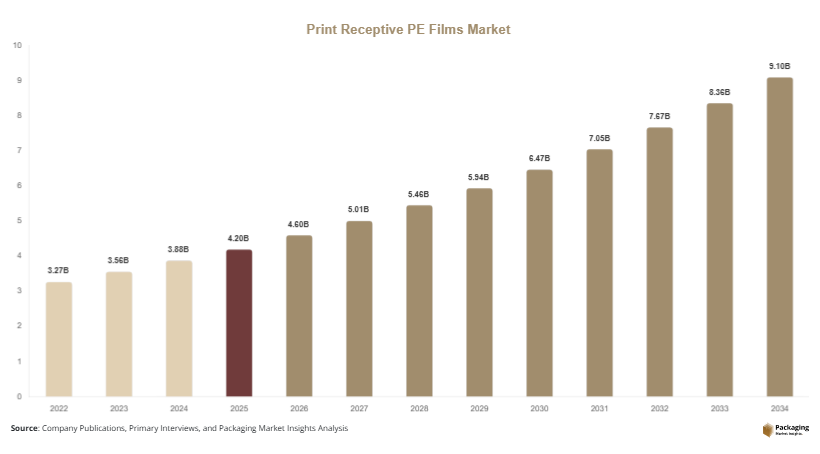
In 2025, the global print receptive PE films market size is estimated at USD 4.2 billion, and it is projected to reach USD 4.6 billion in 2026. By 2034, the market is expected to attain approximately USD 9.1 billion, registering a CAGR of 8.9% (2025–2034). Growth is primarily driven by the increasing shift toward lightweight packaging materials, improved print adhesion technologies, and expanding use of polyethylene-based films in high-resolution branding applications. The print receptive PE films market is witnessing steady expansion due to rising demand from flexible packaging, labeling, and high-performance printing applications across consumer goods, pharmaceuticals, and industrial sectors.
One of the major growth factors is the rapid expansion of the e-commerce and retail packaging industry, where print receptive PE films are used extensively for branded packaging and product differentiation. Additionally, advancements in surface treatment technologies such as corona and plasma treatment are improving ink adhesion and print durability. Another key factor is the increasing adoption of sustainable flexible packaging solutions, where polyethylene films are preferred due to recyclability and cost efficiency compared to multilayer alternatives. These combined factors are contributing to consistent demand growth across multiple end-use industries.
Key Highlights
- Market size (2025): The Print Receptive PE Films Market is valued at USD 4.2 Billion in 2025, supported by rising demand from flexible packaging applications across multiple industries. Growth is strongly linked to increasing use in food, beverage, and retail packaging segments.
- Market size (2026): The market is estimated to reach USD 4.6 Billion in 2026, reflecting steady expansion in packaging consumption and improving adoption of advanced printable polyethylene film technologies in global supply chains.
- Forecast value (2034): By 2034, the market is projected to reach USD 9.1 Billion, driven by continuous innovation in film surface treatment and increasing shift toward sustainable mono-material packaging solutions worldwide.
- CAGR (2025–2034): The market is expected to grow at a CAGR of 8.9% during 2025–2034, supported by strong demand from packaging and labeling industries and rising adoption of high-performance printing films.
- Strong demand from packaging and labeling industries: Demand is increasing significantly due to expanding usage of print receptive PE films in branding, product identification, and regulatory labeling across food, pharmaceutical, and consumer goods packaging sectors globally.
- Rising adoption of advanced surface modification technologies: Manufacturers are increasingly using corona, plasma, and nano-coating technologies to enhance ink adhesion, print durability, and surface energy, improving overall printing efficiency and output quality.
Explore more data points, trends and opportunities Download Free Sample Report
Market Trends
Shift Toward High-Performance Surface Treatment Technologies
The print receptive PE films market is increasingly influenced by advancements in surface treatment technologies that enhance ink adhesion and print quality. Techniques such as corona discharge, flame treatment, and plasma activation are becoming more widely adopted in manufacturing processes. These methods modify the surface energy of polyethylene films, enabling better bonding with water-based and UV-curable inks. As brand owners demand sharper graphics and longer-lasting prints for packaging applications, manufacturers are investing in multi-stage treatment systems. This trend is particularly strong in food and personal care packaging, where visual appeal and durability are critical for consumer engagement and regulatory labeling requirements.
Growing Integration of Sustainable Flexible Packaging Solutions
Sustainability-focused packaging is becoming a central trend shaping the print receptive PE films market. Companies are increasingly adopting mono-material polyethylene films that support recyclability while maintaining print performance. This shift is driven by regulatory pressure in Europe and North America, as well as corporate sustainability commitments from FMCG and retail brands. Manufacturers are developing bio-based polyethylene variants and optimizing film thickness to reduce material usage without compromising strength. Additionally, innovations in recyclable barrier coatings are enabling PE films to replace multilayer laminates in several applications, supporting circular economy goals across the packaging industry.
Market Drivers
Expansion of Flexible Packaging and Branding Applications
The increasing demand for flexible packaging across food, beverage, pharmaceutical, and consumer goods sectors is a primary driver for the print receptive PE films market. Companies are focusing on packaging formats that are lightweight, cost-effective, and visually appealing. Print receptive PE films allow high-resolution branding, product information display, and regulatory compliance labeling. As retail competition intensifies, brands are investing more in packaging aesthetics, which increases the need for films with superior print compatibility. Additionally, growth in packaged food consumption and ready-to-eat product segments is accelerating adoption across both developed and emerging markets.
Technological Advancements in Film Manufacturing Processes
Continuous innovation in polyethylene film extrusion and coating technologies is significantly driving market expansion. Multi-layer co-extrusion processes, nano-coating techniques, and advanced surface modification systems are improving print adhesion and mechanical strength. These technologies allow manufacturers to produce films that are compatible with multiple printing techniques such as flexographic, gravure, and digital printing. Moreover, improvements in production efficiency are reducing manufacturing costs, making print receptive PE films more accessible to mid-sized packaging converters. The integration of automation in film production is also improving quality consistency and scalability across large-volume applications.
Market Restraint
High Dependency on Raw Material Price Volatility
A major restraint in the print receptive PE films market is the fluctuation in raw material prices, particularly polyethylene derived from crude oil. Since polyethylene is a petroleum-based product, its cost is highly sensitive to global oil price movements and supply chain disruptions. This volatility directly impacts production costs and profit margins for film manufacturers. In periods of high crude oil prices, packaging converters often face difficulty in maintaining stable pricing for end-users, which can reduce demand in price-sensitive markets. Additionally, geopolitical tensions and transportation disruptions can further affect raw material availability, creating uncertainty in supply chains. As a result, manufacturers are increasingly seeking long-term supplier contracts and exploring bio-based alternatives, although these solutions are still developing and not yet cost-competitive at scale.
Market Opportunities
Growth in Digital and On-Demand Printing Applications
The rise of digital printing technologies presents a significant opportunity for the print receptive PE films market. Digital printing enables short-run production, customization, and faster turnaround times, which are increasingly demanded by e-commerce brands and promotional packaging segments. Print receptive PE films are being optimized for compatibility with inkjet and electrophotographic printing systems, allowing high-resolution graphics and variable data printing. This trend is particularly relevant for seasonal packaging, limited-edition product launches, and personalized consumer goods. As digital printing infrastructure expands globally, film manufacturers have the opportunity to develop specialized surface coatings that enhance print fidelity and durability.
Expansion in Emerging Economies and Packaging Modernization
Emerging economies in Asia Pacific, Latin America, and parts of Africa present strong growth opportunities due to rapid industrialization and modernization of packaging systems. Increasing urbanization and rising disposable incomes are driving demand for packaged food, personal care products, and pharmaceuticals. This creates a strong need for advanced flexible packaging materials, including print receptive PE films. Local manufacturers are also upgrading their packaging lines to meet international quality standards, which increases adoption of high-performance films. Additionally, foreign investment in packaging infrastructure is accelerating technology transfer, creating opportunities for global suppliers to expand their presence in these high-growth regions.
Report Scope
| Report Metric | Details |
|---|---|
| Market Size in 2025 | USD 4.2 Billion |
| Market Size in 2026 | USD 4.6 Billion |
| Market Size in 2034 | USD 9.1 Billion |
| CAGR | 8.9% (2026-2034) |
| Base Year for Estimation | 2025 |
| Historical Data | 2022-2024 |
| Forecast Period | 2026-2034 |
| Report Coverage | Revenue Forecast, Competitive Landscape, Supply Chain Disruption, Growth Factors, Environment & Regulatory Landscape and Trends |
| Geographies Covered | North America, Europe, APAC, Middle East and Africa, LATAM |
| Countries Covered | U.S., Canada, U.K., Germany, France, Spain, Italy, Russia, Nordic, Benelux, Rest of Europe, China, South Korea, Japan, India, Australia, Singapore, Taiwan, South East Asia, Rest of Asia-Pacific, UAE, Turky, Saudi Arabia, South Africa, Egypt, Nigeria, Rest of MEA, Brazil, Mexico, Argentina, Chile, Colombia, Rest of LATAM |
Explore more data points, trends and opportunities Download Free Sample Report
Segmental Analysis
By Type
The co-extruded print receptive PE films segment held the dominant share of approximately 42% in 2024, driven by its superior structural strength, uniform thickness, and excellent print compatibility. These films are widely used in food packaging, industrial wraps, and retail packaging applications due to their durability and ability to maintain print quality under high-speed production environments. Their multilayer structure enhances barrier properties while ensuring smooth surface energy for consistent ink adhesion. This makes them highly suitable for flexographic and gravure printing processes used in large-scale packaging production.
The nano-coated print receptive PE films segment is expected to grow at a CAGR of 10.1% during 2025–2034, making it the fastest-growing type segment. Growth is driven by increasing demand for high-definition graphics, premium packaging aesthetics, and improved scratch resistance. Nano-coating technology enhances surface smoothness and significantly improves ink bonding strength, making these films suitable for pharmaceutical labeling and luxury consumer packaging. Rising adoption in branded retail packaging and specialty products is further accelerating demand for this segment.
By Application
The packaging segment dominated the print receptive PE films market with approximately 48% share in 2024, supported by widespread usage in flexible pouches, wraps, and laminated packaging formats. The demand is primarily driven by food and beverage manufacturers, who require high-quality printed films for branding, nutritional labeling, and regulatory compliance. Packaging applications also benefit from cost efficiency, lightweight properties, and recyclability of polyethylene films. Increasing consumer preference for visually appealing packaged goods continues to support strong growth in this segment.
The labeling segment is projected to grow at a CAGR of 9.6% during the forecast period, driven by rising demand for high-resolution product identification and regulatory compliance labeling. Print receptive PE films provide excellent ink adhesion, making them suitable for barcode printing, product tracking, and serialization applications. Growth is further supported by expanding pharmaceutical and logistics industries, where durable and legible labeling is essential for safety and supply chain efficiency. Increasing automation in labeling systems is also enhancing demand for advanced printable film materials.
By End-Use Industry
The food and beverage industry held the largest share of approximately 45% in 2024, driven by strong demand for packaged food products, snacks, frozen foods, and beverages. Print receptive PE films are widely used due to their ability to support high-quality branding, product differentiation, and compliance labeling. The rise in ready-to-eat meals and convenience food consumption is further strengthening demand across global markets. Additionally, food safety regulations are pushing manufacturers to adopt reliable and high-performance packaging materials.
The pharmaceutical segment is expected to grow at a CAGR of 9.4%, driven by increasing demand for secure packaging and strict regulatory labeling requirements. Print receptive PE films are widely used in blister packs, pouches, and medical packaging where clarity, durability, and tamper-evidence are essential. The growing pharmaceutical manufacturing base in emerging economies is also contributing to rising adoption. Increasing focus on traceability, anti-counterfeiting measures, and serialization standards further strengthens demand in this segment.
Print Receptive PE Films Market Segmentations
By Type
- Co-extruded PE Films
- Nano-coated PE Films
- Blown PE Films
By Application
- Packaging
- Labeling
- Lamination
- Industrial Printing
By End-Use Industry
- Food & Beverage
- Pharmaceuticals
- Personal Care
- Industrial Goods
- Retail & E-commerce
Market Trends
Shift Toward High-Performance Surface Treatment Technologies
The print receptive PE films market is increasingly influenced by advancements in surface treatment technologies that enhance ink adhesion and print quality. Techniques such as corona discharge, flame treatment, and plasma activation are becoming more widely adopted in manufacturing processes. These methods modify the surface energy of polyethylene films, enabling better bonding with water-based and UV-curable inks. As brand owners demand sharper graphics and longer-lasting prints for packaging applications, manufacturers are investing in multi-stage treatment systems. This trend is particularly strong in food and personal care packaging, where visual appeal and durability are critical for consumer engagement and regulatory labeling requirements.
Growing Integration of Sustainable Flexible Packaging Solutions
Sustainability-focused packaging is becoming a central trend shaping the print receptive PE films market. Companies are increasingly adopting mono-material polyethylene films that support recyclability while maintaining print performance. This shift is driven by regulatory pressure in Europe and North America, as well as corporate sustainability commitments from FMCG and retail brands. Manufacturers are developing bio-based polyethylene variants and optimizing film thickness to reduce material usage without compromising strength. Additionally, innovations in recyclable barrier coatings are enabling PE films to replace multilayer laminates in several applications, supporting circular economy goals across the packaging industry.
Market Drivers
Expansion of Flexible Packaging and Branding Applications
The increasing demand for flexible packaging across food, beverage, pharmaceutical, and consumer goods sectors is a primary driver for the print receptive PE films market. Companies are focusing on packaging formats that are lightweight, cost-effective, and visually appealing. Print receptive PE films allow high-resolution branding, product information display, and regulatory compliance labeling. As retail competition intensifies, brands are investing more in packaging aesthetics, which increases the need for films with superior print compatibility. Additionally, growth in packaged food consumption and ready-to-eat product segments is accelerating adoption across both developed and emerging markets.
Technological Advancements in Film Manufacturing Processes
Continuous innovation in polyethylene film extrusion and coating technologies is significantly driving market expansion. Multi-layer co-extrusion processes, nano-coating techniques, and advanced surface modification systems are improving print adhesion and mechanical strength. These technologies allow manufacturers to produce films that are compatible with multiple printing techniques such as flexographic, gravure, and digital printing. Moreover, improvements in production efficiency are reducing manufacturing costs, making print receptive PE films more accessible to mid-sized packaging converters. The integration of automation in film production is also improving quality consistency and scalability across large-volume applications.
Market Restraint
High Dependency on Raw Material Price Volatility
A major restraint in the print receptive PE films market is the fluctuation in raw material prices, particularly polyethylene derived from crude oil. Since polyethylene is a petroleum-based product, its cost is highly sensitive to global oil price movements and supply chain disruptions. This volatility directly impacts production costs and profit margins for film manufacturers. In periods of high crude oil prices, packaging converters often face difficulty in maintaining stable pricing for end-users, which can reduce demand in price-sensitive markets. Additionally, geopolitical tensions and transportation disruptions can further affect raw material availability, creating uncertainty in supply chains. As a result, manufacturers are increasingly seeking long-term supplier contracts and exploring bio-based alternatives, although these solutions are still developing and not yet cost-competitive at scale.
Market Opportunities
Growth in Digital and On-Demand Printing Applications
The rise of digital printing technologies presents a significant opportunity for the print receptive PE films market. Digital printing enables short-run production, customization, and faster turnaround times, which are increasingly demanded by e-commerce brands and promotional packaging segments. Print receptive PE films are being optimized for compatibility with inkjet and electrophotographic printing systems, allowing high-resolution graphics and variable data printing. This trend is particularly relevant for seasonal packaging, limited-edition product launches, and personalized consumer goods. As digital printing infrastructure expands globally, film manufacturers have the opportunity to develop specialized surface coatings that enhance print fidelity and durability.
Expansion in Emerging Economies and Packaging Modernization
Emerging economies in Asia Pacific, Latin America, and parts of Africa present strong growth opportunities due to rapid industrialization and modernization of packaging systems. Increasing urbanization and rising disposable incomes are driving demand for packaged food, personal care products, and pharmaceuticals. This creates a strong need for advanced flexible packaging materials, including print receptive PE films. Local manufacturers are also upgrading their packaging lines to meet international quality standards, which increases adoption of high-performance films. Additionally, foreign investment in packaging infrastructure is accelerating technology transfer, creating opportunities for global suppliers to expand their presence in these high-growth regions.
Competitive Landscape
The print receptive PE films market is moderately consolidated, with key players focusing on innovation, capacity expansion, and sustainability initiatives. Major companies include Amcor plc, Berry Global Inc., Sealed Air Corporation, Uflex Ltd., and Taghleef Industries. Among these, Amcor plc is a leading player due to its extensive global manufacturing network and continuous investment in recyclable film technologies.
Recent developments include increased R&D investments in mono-material film structures and strategic partnerships with packaging converters to improve printing performance and sustainability outcomes. Companies are also expanding production facilities in Asia Pacific to capture growing regional demand.
Key Players List
- Amcor plc
- Berry Global Inc.
- Sealed Air Corporation
- Uflex Ltd.
- Taghleef Industries
- Jindal Poly Films Ltd.
- Toray Industries Inc.
- Cosmo Films Ltd.
- Coveris Holdings
- Plastchim-T
- Inteplast Group
- Mondi Group
- Winpak Ltd.
- Klöckner Pentaplast
- Polyplex Corporation Ltd.