Presswood Pallets Market Size
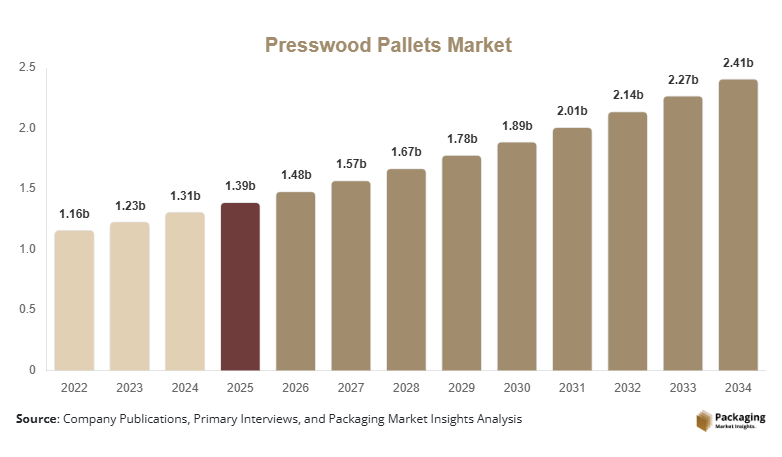
Presswood Pallets market size is projected at USD 1.48 billion in 2026 and is expected to hit USD 2.42 billion by 2034 with a CAGR of 6.3%.The report evaluates production capacity, supply chain developments, product innovations, segmentation, and the competitive landscape across major regions. It provides historical analysis from 2022–2024, the 2025 base year assessment, and forecasts through 2034 for manufacturers, distributors, and end-use industries.
Presswood pallets are engineered pallets manufactured from compressed wood fibers, sawdust, and wood waste using heat and high-pressure molding processes. Global production exceeded 165 million units in 2025, with export-grade pallets accounting for nearly 52% of shipments. Food & beverage represented approximately 34% of overall consumption, while logistics & transportation contributed around 38%. Adoption of ISPM-15 exempt molded wood pallets increased by 14% between 2022 and 2025 as exporters sought cost-effective and sustainable shipping solutions. Growing emphasis on recyclable logistics materials continues to strengthen the Presswood Pallets Market.
Explore more data points, trends and opportunities Download Free Sample Report
Presswood Pallets Market Trends
Rising Adoption of Sustainable Export Packaging
The demand for environmentally friendly shipping platforms continues to accelerate as industries replace conventional wooden pallets with molded presswood alternatives. More than 90 million export presswood pallets were manufactured globally in 2025, while recycled wood utilization exceeded 3.8 million metric tons annually. Nearly 45% of multinational exporters adopted molded pallets for international shipments due to nestable designs and reduced freight costs. These developments continue to influence the Presswood Pallets Market Trend.
Expansion of Automated Warehousing and Circular Economy
Warehouse automation is encouraging demand for dimensionally consistent presswood pallets compatible with robotic handling systems. Approximately 28% of automated distribution centers integrated molded pallets during 2025, improving warehouse efficiency by 18%. Smart logistics investments exceeded USD 12 billion, while pallet reuse programs expanded by 16% globally. Increasing automation and sustainable logistics continue supporting Presswood Pallets Market expansion.
Presswood Pallets Market Drivers
Growing International Trade and Sustainable Packaging Regulations
International merchandise trade exceeding USD 33 trillion annually continues to drive demand for export-ready molded pallets. Presswood pallets eliminate heat-treatment requirements under ISPM-15 regulations, reducing export preparation costs by nearly 20%. More than 40% of exporters now prefer molded wood pallets for one-way shipping due to lighter weight, stackability, and reduced storage requirements, supporting Presswood Pallets Market Growth.
Presswood Pallets Market Restraints
Limited Heavy Load Capacity Compared with Traditional Hardwood Pallets
Although presswood pallets offer environmental benefits, heavy industrial users remain dependent on hardwood and metal alternatives. Heavy-duty applications account for nearly 22% of industrial pallet demand, while molded pallets typically support loads between 800–1,250 kg compared with over 2,000 kg for conventional hardwood pallets. Raw material and resin price fluctuations of 8–12% annually also affect manufacturing costs within the Presswood Pallets Market.
Presswood Pallets Market Opportunities
Increasing Demand for Recyclable Logistics Platforms
Circular economy initiatives present substantial opportunities for manufacturers. More than 65% of European logistics providers now prioritize recyclable packaging materials, while investments in sustainable warehousing exceeded USD 15 billion in 2025. Demand for nestable pallets is projected to increase by over 7% annually, reducing transportation costs by 25–30% through improved container utilization, creating significant opportunities for the Presswood Pallets Market.
Challenges in Presswood Pallets Market
Competition from Plastic and Conventional Wooden Pallets
Presswood pallet manufacturers face competition from reusable plastic pallets and conventional wooden pallets. Plastic pallets represented approximately 17% of global pallet demand in 2025, while wooden pallets retained over 75% market share. Limited awareness in developing regions and fluctuations in wood fiber availability continue creating challenges for the Presswood Pallets Market.
Report Scope
| Report Metric | Details |
|---|---|
| Market Size in 2025 | USD 1.39 billion |
| Market Size in 2026 | USD 1.48 billion |
| Market Size in 2034 | USD 2.42 billion |
| CAGR | 6.3% (2026-2034) |
| Base Year for Estimation | 2025 |
| Historical Data | 2022-2024 |
| Forecast Period | 2026-2034 |
| Report Coverage | Revenue Forecast, Competitive Landscape, Supply Chain Disruption, Growth Factors, Environment & Regulatory Landscape and Trends |
| Geographies Covered | North America, Europe, APAC, Middle East and Africa, LATAM |
| Countries Covered | U.S., Canada, U.K., Germany, France, Spain, Italy, Russia, Nordic, Benelux, Rest of Europe, China, South Korea, Japan, India, Australia, Singapore, Taiwan, South East Asia, Rest of Asia-Pacific, UAE, Turky, Saudi Arabia, South Africa, Egypt, Nigeria, Rest of MEA, Brazil, Mexico, Argentina, Chile, Colombia, Rest of LATAM |
Explore more data points, trends and opportunities Download Free Sample Report
Presswood Pallets Market Segmentation
The market is segmented by product type and end user. Export presswood pallets accounted for approximately 52% of market revenue during 2025 due to rising international trade. Logistics & transportation remained the largest application with nearly 38% share, followed by food & beverage at 34%.
By Type
Nestable Presswood Pallets
Nestable presswood pallets represented approximately 28% of total demand in 2025. Production exceeded 46 million units, reducing warehouse storage space by up to 60% compared with conventional wooden pallets. Their lightweight design averaging 9–12 kg supports efficient logistics.
Export Presswood Pallets
Export presswood pallets dominated with approximately 52% market share and production exceeding 86 million units annually. Their ISPM-15 exemption, moisture resistance, and stackable design make them suitable for international trade, pharmaceuticals, and electronics exports.
Heavy-Duty Presswood Pallets
Heavy-duty variants contributed around 20% of demand with annual production exceeding 33 million units. These pallets support static loads approaching 1,250 kg and are increasingly used in industrial manufacturing and warehouse operations.
By Application
Logistics & Transportation
Logistics & transportation represented nearly 38% of market demand. More than 62 million molded pallets were deployed across distribution centers during 2025, improving transport efficiency and lowering freight costs through nestable designs.
Food & Beverage
Food & beverage accounted for approximately 34% share. Over 56 million units were used across food processing and beverage distribution facilities due to hygienic molded surfaces, reduced contamination risks, and compliance with export regulations.
Manufacturing
Manufacturing contributed nearly 21% of market demand. Approximately 35 million units supported automotive, machinery, and industrial component movement worldwide. Standardized dimensions enhance compatibility with automated production lines.
Presswood Pallets Market Segmentations
Product Type
- Nestable Presswood Pallets
- Export Presswood Pallets
- Heavy-Duty Presswood Pallets
Application
- Logistics & Transportation
- Food & Beverage
- Manufacturing
- Retail & E-commerce
- Pharmaceuticals
End User
- Industrial Manufacturing
- Warehousing & Distribution
- Chemicals
- Consumer Goods
- Agriculture
Presswood Pallets Regional Outlook
North America
North America accounted for approximately 31% of the global market during 2025. The United States represented nearly 82% of regional demand, with production exceeding 50 million pallets annually. Food processing, retail logistics, and pharmaceutical exports remained major consumers.
Europe
Europe captured around 35% market share led by Germany, France, and the Netherlands. Sustainable logistics regulations accelerated adoption, while recycled wood utilization exceeded 1.6 million metric tons annually. Export packaging represented over 55% of regional demand.
Asia-Pacific
Asia-Pacific held approximately 27% market share with China, India, and Japan contributing over 73% of regional consumption. Manufacturing expansion and export growth supported production exceeding 45 million units annually.
Rest of World
Latin America and Middle East & Africa collectively represented nearly 7% of market revenue. Growing export industries, food processing investments, and logistics modernization are expected to increase annual demand by more than 6% through 2034.
Top players in Presswood Pallets Market
- Litco International Inc.
- Presswood International B.V.
- Binderholz GmbH
- NKA Paletten GmbH
- Brambles Limited
- Millwood Inc.
- Cabka Group GmbH
- Loscam
- Schoeller Allibert
- Craemer Holding GmbH
Litco International Inc.
-
Maintains a leading position in molded wood pallet manufacturing with an estimated 15–18% market presence.
-
Operates advanced compression molding facilities serving North America and international export markets.
-
Focuses on ISPM-15 compliant export pallets and sustainable packaging solutions.
-
Invests in recycled wood technologies and lightweight pallet designs to improve logistics efficiency.
-
Expands global distribution through partnerships with industrial packaging and logistics providers.
Presswood International B.V.
-
Holds approximately 10–12% market share in molded presswood pallet manufacturing.
-
Supplies export pallets across Europe, Asia, and North America.
-
Specializes in recyclable molded wood products manufactured from recovered wood fibers.
-
Continues investing in production automation and sustainable manufacturing technologies.
-
Maintains a strong competitive position through innovative pallet designs and international licensing partnerships.