Pressure-Sensitive Tapes And Labels Market Size
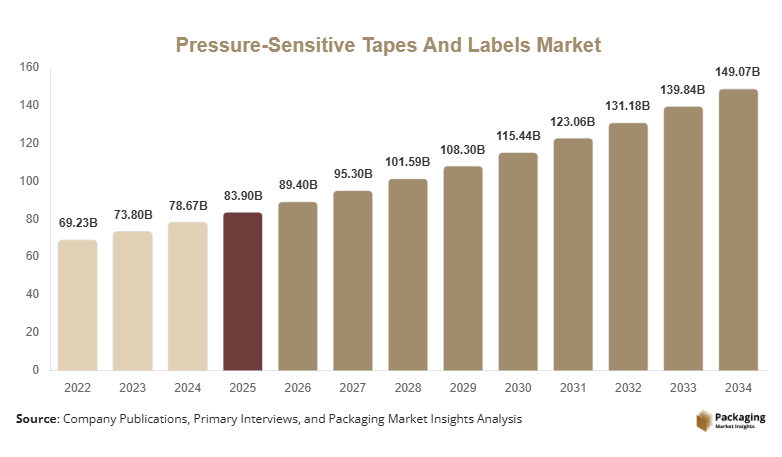
The pressure-sensitive tapes and labels market size is projected at USD 89.4 billion in 2026 and is expected to hit USD 148.9 billion by 2034 with a CAGR of 6.6%.
The report provides comprehensive analysis of market dynamics, production trends, segmentation, technological developments, and competitive positioning across major regions. It evaluates demand patterns, manufacturing capabilities, supply chain developments, and strategic initiatives shaping the industry.
Pressure-sensitive tapes and labels are self-adhesive materials that bond to surfaces with light pressure without requiring heat, water, or solvents. Global production exceeded 152.4 billion square meters in 2025, while shipments surpassed 148.6 billion square meters with manufacturing utilization above 89%. Packaging applications contributed approximately 52.8% of overall consumption, healthcare represented 16.4%, and automotive accounted for 12.7%. More than 81% of consumer packaged goods manufacturers utilize pressure-sensitive labeling technologies, reinforcing the pressure-sensitive tapes and labels market.
Explore more data points, trends and opportunities Download Free Sample Report
Pressure-Sensitive Tapes And Labels Market Trends
Sustainable Adhesives and Smart Label Technologies
Manufacturers are increasingly investing in recyclable facestock materials, bio-based adhesives, and linerless labeling technologies. Production of sustainable pressure-sensitive materials exceeded 39.2 billion square meters during 2025, representing nearly 26% of total output. Adoption of water-based adhesive systems increased by 14.3%, while RFID-enabled label integration expanded by 18.6%, strengthening the Pressure Sensitive Tapes and Labels market.
Digital printing and automated converting technologies continue transforming production efficiency. More than 37% of newly installed label production lines now incorporate digital printing systems capable of reducing waste by approximately 21%. Smart labels with QR codes and NFC functionality experienced annual shipment growth exceeding 17%, while pharmaceutical serialization adoption crossed 84%, supporting the pressure-sensitive tapes and labels market.
Pressure-Sensitive Tapes And Labels Market Drivers
Expanding Demand from Packaging and Logistics Industries
Rapid growth in packaged consumer goods and e-commerce logistics continues driving industry expansion. Packaging applications consumed over 80.4 billion square meters during 2025, while parcel shipments exceeded 210 billion globally. Warehouse labeling requirements increased by 15.2%, and automated packaging facilities expanded by 11.8%, accelerating the pressure-sensitive tapes and labels market.
Pressure-Sensitive Tapes And Labels Market Restraints
Volatility in Raw Material Prices
Fluctuations in resin, acrylic adhesive, silicone coating, and paper prices continue impacting manufacturing costs. Acrylic resin prices increased by approximately 8.4% during 2025, while specialty release liner costs rose 6.9%. Transportation expenses increased by nearly 7.1%, limiting profit margins across the pressure-sensitive tapes and labels market.
Pressure-Sensitive Tapes And Labels Market Opportunities
Increasing Adoption of Smart Identification Solutions
Growing implementation of RFID, QR-coded labels, and intelligent tracking systems creates substantial opportunities. Smart label production exceeded 9.6 billion units during 2025, while industrial asset tracking adoption increased by 19.7%. Retail inventory automation expanded by 16.2%, creating favorable conditions for the pressure-sensitive tapes and labels market.
Challenges in the Pressure-Sensitive Tapes And Labels Market
Environmental Compliance and Recycling Requirements
Manufacturers continue facing challenges associated with adhesive recyclability and waste management regulations. Nearly 42% of converters invested in recyclable liner technologies during 2025, while compliance expenditures increased by 9.3%. Product redesign initiatives affected approximately 31% of manufacturing facilities worldwide, creating operational complexity within the pressure-sensitive tapes and labels market.
Report Scope
| Report Metric | Details |
|---|---|
| Market Size in 2025 | USD 83.9 Billion |
| Market Size in 2026 | USD 89.4 Billion |
| Market Size in 2034 | USD 148.9 Billion |
| CAGR | 6.6% (2026-2034) |
| Base Year for Estimation | 2025 |
| Historical Data | 2022-2024 |
| Forecast Period | 2026-2034 |
| Report Coverage | Revenue Forecast, Competitive Landscape, Supply Chain Disruption, Growth Factors, Environment & Regulatory Landscape and Trends |
| Geographies Covered | North America, Europe, APAC, Middle East and Africa, LATAM |
| Countries Covered | U.S., Canada, U.K., Germany, France, Spain, Italy, Russia, Nordic, Benelux, Rest of Europe, China, South Korea, Japan, India, Australia, Singapore, Taiwan, South East Asia, Rest of Asia-Pacific, UAE, Turkey, Saudi Arabia, South Africa, Egypt, Nigeria, Rest of MEA, Brazil, Mexico, Argentina, Chile, Colombia, Rest of LATAM |
Explore more data points, trends and opportunities Download Free Sample Report
Pressure-Sensitive Tapes And Labels Market Segmentation
The market is segmented by type and application, with pressure-sensitive tapes accounting for approximately 48.9% of total revenue, while packaging remained the dominant application, contributing nearly 52.8% of global consumption.
By Type
Pressure-sensitive tapes represented approximately 48.9% of industry demand. Annual production exceeded 74.5 billion square meters, supporting packaging, construction, electrical insulation, and industrial assembly. Products offer strong peel adhesion, tensile strength, and temperature resistance.
Pressure-sensitive labels accounted for nearly 39.8% of total production, with output surpassing 60.7 billion square meters. High-resolution printing compatibility, barcode integration, and variable data printing make these products widely used in food, pharmaceutical, and logistics sectors.
Specialty pressure-sensitive products contributed approximately 11.3% share. Production exceeded 17.2 billion square meters and includes tamper-evident labels, medical tapes, security labels, and high-performance industrial adhesive products designed for specialized operating conditions.
By Application
Packaging remained the largest application with approximately 52.8% market share. Consumption exceeded 80.4 billion square meters during 2025. Strong adoption across food, beverages, personal care, and e-commerce packaging supports continuous volume expansion.
Healthcare accounted for nearly 16.4% of global demand with production exceeding 25.0 billion square meters. Sterile labeling, pharmaceutical serialization, diagnostic identification, and medical adhesive products continue driving segment growth.
Automotive represented approximately 12.7% share with production exceeding 19.4 billion square meters. Pressure-sensitive products support wiring harnesses, interior assembly, identification labels, insulation, and lightweight component bonding for vehicle manufacturing.
Pressure-Sensitive Tapes And Labels Market Segmentations
Type
- Pressure-Sensitive Tapes
- Pressure-Sensitive Labels
- Specialty Pressure-Sensitive Products
Application
- Packaging
- Healthcare
- Automotive
Pressure-Sensitive Tapes And Labels Market Regional Outlook
North America
North America accounted for approximately 32.6% of global demand during 2025. Production exceeded 49.7 billion square meters, led by the United States and Canada. Packaging and healthcare applications together represented more than 64% of regional consumption.
Europe
Europe contributed nearly 28.4% of industry revenue with production surpassing 43.3 billion square meters. Germany, France, Italy, and the United Kingdom remained major manufacturing hubs supported by sustainable labeling regulations and advanced converting technologies.
Asia-Pacific
The Asia-Pacific held approximately 31.5% share, producing over 48.0 billion square meters annually. China, Japan, India, and South Korea dominate regional manufacturing, supported by electronics, logistics, and consumer goods industries.
Latin America
Latin America represented approximately 4.2% of global demand. Brazil and Mexico remained key contributors with expanding packaged food production and industrial labeling requirements.
Middle East & Africa
Middle East & Africa accounted for nearly 3.3% of the market. Growing retail infrastructure, pharmaceutical manufacturing, and logistics investments supported steady adoption across the region.
Top Players In The Pressure-Sensitive Tapes And Labels Market
- 3M Company
- Avery Dennison Corporation
- CCL Industries Inc.
- UPM Raflatac
- LINTEC Corporation
- tesa SE
- Nitto Denko Corporation
- Henkel AG & Co. KGaA
- Intertape Polymer Group Inc.
- Coveris Holdings S.A.
- Flexcon Company Inc.
- Berry Global Inc.
- SATO Holdings Corporation
- Multi-Color Corporation
- Fuji Seal International Inc.
3M Company
- Estimated market presence of approximately 14%.
- Strong global positioning across industrial tapes, healthcare adhesives, automotive bonding, and specialty labeling solutions.
- Extensive manufacturing footprint, continuous product innovation, and investments in sustainable adhesive technologies support leadership. The company benefits from diversified end-use industries, advanced research capabilities, digital manufacturing, and long-term partnerships with packaging, electronics, automotive, and healthcare manufacturers, strengthening its competitive advantage globally.
Avery Dennison Corporation
- Estimated market presence of approximately 12%.
- Recognized as a leading supplier of pressure-sensitive labels, RFID technologies, and intelligent packaging solutions.
- The company maintains strong competitive positioning through digital identification technologies, sustainable labeling materials, global converting capabilities, and extensive customer relationships. Continuous investment in recyclable materials, smart labels, and supply chain digitization enables expansion across retail, logistics, pharmaceutical, and consumer goods industries.