Pressure Sensitive Labelling Solutions For Pharmaceutical Market Size and Growth
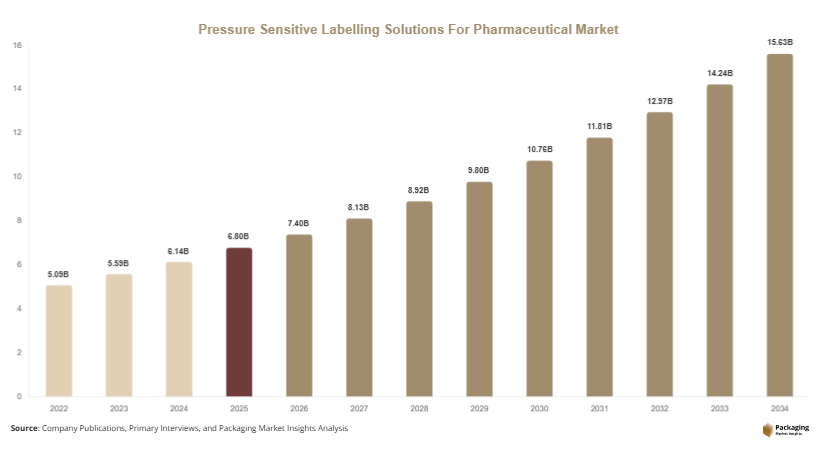
In 2025, the global pressure sensitive labelling solutions for pharmaceutical market size is estimated at USD 6.8 billion, which is expected to reach USD 7.4 billion in 2026. By 2034, the market is projected to attain approximately USD 15.6 billion, growing at a CAGR of 9.8% (2025–2034). The pressure sensitive labelling solutions for pharmaceutical market is expanding steadily due to increasing global demand for drug safety, regulatory compliance, serialization, and anti-counterfeiting solutions. Pressure-sensitive labels (PSL) are widely used in pharmaceutical packaging because they offer strong adhesion, durability, and compatibility with high-speed automated labeling systems.
Growth in the market is driven by rising pharmaceutical production, increasing demand for biologics and specialty drugs, and stricter global labeling regulations. Governments and regulatory bodies are enforcing serialization mandates and track-and-trace requirements to reduce counterfeit drugs and ensure patient safety. This is significantly increasing the adoption of advanced pressure-sensitive labeling technologies across pharmaceutical manufacturing and packaging lines.
Key Highlights
- Market size (2025): The Pressure Sensitive Labelling Solutions For Pharmaceutical Market is valued at USD 6.8 Billion in 2025, driven by strong demand from pharmaceutical manufacturing and packaging sectors. Growth is supported by increasing drug production volumes, expanding biologics demand, and stricter global labeling regulations across major markets.
- Market size (2026): The market is projected to reach USD 7.4 Billion in 2026, reflecting steady expansion in pharmaceutical packaging operations and rising adoption of high-performance labeling systems. Increased use of automated packaging lines is further supporting market growth.
- Forecast value (2034): By 2034, the market is expected to reach USD 15.6 Billion, driven by continued pharmaceutical industry expansion, growth in contract manufacturing, and rising demand for compliant and durable labeling solutions across global supply chains.
- CAGR (2025–2034): The market is projected to grow at a CAGR of 9.8% during 2025–2034, supported by strong demand from pharmaceutical manufacturing and packaging sectors, along with increasing adoption of serialization and anti-counterfeiting labeling systems.
- Strong demand from pharmaceutical manufacturing and packaging sectors: Demand is rising due to increasing global drug production, expansion of injectable and biologics segments, and the need for accurate, high-speed labeling solutions in automated pharmaceutical packaging lines.
- Rising adoption of serialization and anti-counterfeiting labeling systems: Pharmaceutical companies are increasingly adopting advanced labeling technologies such as barcodes, QR codes, and RFID-enabled labels to ensure product traceability, regulatory compliance, and protection against counterfeit drugs across global supply chains.
Explore more data points, trends and opportunities Download Free Sample Report
Market Trends
Rising Adoption of Serialization and Track-and-Trace Labeling
The pharmaceutical industry is increasingly adopting serialization-driven labeling systems to comply with global regulations aimed at preventing counterfeit drugs. Pressure-sensitive labeling solutions are widely used because they can easily incorporate barcodes, QR codes, and RFID tags required for product tracking across the supply chain. Governments in North America, Europe, and Asia Pacific have introduced strict track-and-trace regulations, compelling pharmaceutical manufacturers to upgrade labeling systems. This trend is driving demand for high-performance PSL materials that ensure readability, durability, and resistance to environmental conditions. Additionally, integration of digital printing technologies enables real-time customization of batch information, expiry dates, and regulatory codes, improving operational efficiency.
Growth of Smart and Tamper-Evident Pharmaceutical Labels
Smart labeling solutions are gaining traction in the pharmaceutical sector due to increasing concerns around drug authenticity and patient safety. Pressure-sensitive labels are now being designed with tamper-evident features, holographic security elements, and layered structures to prevent unauthorized access or duplication. Pharmaceutical companies are also integrating smart labels with digital authentication systems that allow patients and healthcare providers to verify drug authenticity using mobile applications. This trend is particularly strong in high-value drug segments such as biologics, oncology medicines, and vaccines, where product integrity is critical throughout the supply chain.
Market Driver
Rising Pharmaceutical Production and Global Healthcare Demand
The increasing global demand for pharmaceutical products is a major driver of the pressure sensitive labelling solutions for pharmaceutical market. Aging populations, rising chronic diseases, and expanding healthcare access in emerging economies are boosting drug production volumes. As pharmaceutical manufacturing scales up, the need for efficient, high-speed labeling solutions also increases. Pressure-sensitive labels are preferred due to their ease of application, compatibility with automated systems, and ability to adhere to a wide range of packaging formats such as vials, ampoules, blister packs, and bottles. Additionally, pharmaceutical companies are investing in advanced packaging lines that require reliable labeling systems to maintain production efficiency.
Strict Regulatory Compliance and Drug Safety Requirements
Stringent regulatory frameworks governing pharmaceutical packaging and labeling are significantly driving market growth. Regulatory bodies such as the FDA and EMA require accurate labeling of drug composition, dosage instructions, safety warnings, and batch tracking information. Pressure-sensitive labeling solutions enable compliance by providing high-resolution printing capabilities and durable adhesion under various storage conditions. The increasing focus on reducing counterfeit medicines and ensuring supply chain transparency is further accelerating adoption. Pharmaceutical companies are increasingly implementing multi-layer security labels and serialized tracking systems to meet global compliance standards.
Market Restraint
High Cost of Advanced Security Labeling Systems
A key restraint in the pressure sensitive labelling solutions for pharmaceutical market is the high cost associated with advanced labeling technologies and security-enhanced materials. Tamper-evident labels, RFID-enabled systems, and multi-layer security labels require specialized materials and sophisticated printing infrastructure, which increases production costs. Small and mid-sized pharmaceutical manufacturers often face challenges in adopting these advanced solutions due to limited budgets and high implementation costs.
For example, upgrading existing packaging lines to support serialized pressure-sensitive labeling requires investment in new printing equipment, software integration, and workforce training. Additionally, frequent regulatory updates in different countries increase compliance complexity, further raising operational costs. These financial barriers can slow down adoption rates, especially in price-sensitive emerging markets, limiting overall market penetration of advanced labeling technologies.
Market Opportunities
Expansion of Biologics and Specialty Drug Packaging
The growing production of biologics, biosimilars, and specialty pharmaceuticals presents a major opportunity for pressure-sensitive labeling solutions. These drug categories require highly sensitive packaging due to strict storage conditions and high value. Pressure-sensitive labels with advanced adhesive properties and temperature resistance are increasingly being used in cold-chain logistics. As biologics become a larger share of global pharmaceutical revenue, demand for reliable labeling systems that ensure product integrity throughout transportation and storage is expected to rise significantly.
Integration of Digital and Smart Labeling Technologies
The integration of digital technologies into pharmaceutical labeling is creating new growth opportunities. Pressure-sensitive labels are increasingly being combined with QR codes, RFID tags, and cloud-based tracking systems to enable real-time monitoring of drug distribution. This digital transformation improves supply chain visibility and enhances patient safety by enabling drug authentication. Pharmaceutical companies are also leveraging smart labels for patient engagement, providing dosage instructions, safety alerts, and product information through mobile scanning. This trend is expected to significantly expand market potential over the forecast period.
Report Scope
| Report Metric | Details |
|---|---|
| Market Size in 2025 | USD 6.8 Billion |
| Market Size in 2026 | USD 7.4 Billion |
| Market Size in 2034 | USD 15.6 Billion |
| CAGR | 9.8% (2026-2034) |
| Base Year for Estimation | 2025 |
| Historical Data | 2022-2024 |
| Forecast Period | 2026-2034 |
| Report Coverage | Revenue Forecast, Competitive Landscape, Supply Chain Disruption, Growth Factors, Environment & Regulatory Landscape and Trends |
| Geographies Covered | North America, Europe, APAC, Middle East and Africa, LATAM |
| Countries Covered | U.S., Canada, U.K., Germany, France, Spain, Italy, Russia, Nordic, Benelux, Rest of Europe, China, South Korea, Japan, India, Australia, Singapore, Taiwan, South East Asia, Rest of Asia-Pacific, UAE, Turky, Saudi Arabia, South Africa, Egypt, Nigeria, Rest of MEA, Brazil, Mexico, Argentina, Chile, Colombia, Rest of LATAM |
Explore more data points, trends and opportunities Download Free Sample Report
Segmental Analysis
By Label Material Type
Paper-based pressure-sensitive labels held the dominant share of approximately 42% in 2024, driven by their cost efficiency, ease of printing, and widespread use in pharmaceutical packaging. These labels are commonly used for secondary packaging such as cartons and bottles where regulatory information, dosage instructions, and branding details must be clearly displayed. Their compatibility with multiple printing technologies also supports large-scale adoption in pharmaceutical manufacturing environments.
Film-based pressure-sensitive labels are expected to grow at a CAGR of 10.6% (2025–2034), driven by increasing demand for durable, moisture-resistant, and chemically stable labeling solutions. These labels are widely used in cold-chain logistics, biologics, and injectable drug packaging where resistance to temperature fluctuations and humidity is essential for maintaining label integrity throughout the supply chain.
By Application
Vial and bottle labeling dominated the market with approximately 45% share in 2024, due to high production volumes of liquid medicines, injectables, and oral drug formulations. Pressure-sensitive labels are preferred in this segment because they ensure strong adhesion, high readability, and compatibility with high-speed filling and packaging lines used in pharmaceutical manufacturing.
Cold-chain and biologics labeling is expected to grow at a CAGR of 10.8% (2025–2034), driven by increasing demand for vaccines, biosimilars, and temperature-sensitive drugs. This segment requires advanced labeling solutions capable of maintaining performance under freezing and refrigerated conditions, supporting traceability and regulatory compliance across global distribution networks.
By End-Use Industry
Pharmaceutical manufacturers held the dominant share of approximately 48% in 2024, as they are the primary users of pressure-sensitive labeling systems across primary and secondary packaging operations. These companies rely heavily on high-performance labels to meet regulatory requirements, ensure product identification, and support global distribution.
Contract Manufacturing Organizations (CMOs) are expected to grow at a CAGR of 11.0% (2025–2034), driven by the increasing outsourcing of drug production by pharmaceutical companies. CMOs require flexible, scalable, and compliant labeling solutions that can handle multiple product formats and regulatory requirements across different regions, accelerating adoption of advanced pressure-sensitive labeling technologies.
Pressure Sensitive Labelling Solutions For Pharmaceutical Market Segmentations
By Label Type
- Paper-Based Pressure Sensitive Labels
- Film-Based Pressure Sensitive Labels
- Foil Labels
By Application
- Vials & Bottles
- Ampoules
- Blister Packs
- Syringes
By End-Use
- Pharmaceutical Manufacturers
- CMOs
- Healthcare Packaging Providers
Regional Analysis
North America
North America accounted for approximately 30% share of the pressure sensitive labelling solutions for pharmaceutical market in 2025, with a projected CAGR of 9.5% (2025–2034). The region leads due to strong pharmaceutical manufacturing capacity, early adoption of serialization technologies, and strict regulatory frameworks governing drug labeling and traceability. High demand for biologics, specialty drugs, and branded generics is further strengthening the need for advanced pressure-sensitive labeling solutions across packaging lines.
The United States dominates the regional market due to the presence of major pharmaceutical companies and advanced packaging infrastructure. A key growth factor is the strict FDA serialization mandate, which requires end-to-end traceability of prescription drugs, driving widespread adoption of high-performance pressure-sensitive labels.
Europe
Europe held around 25% share in 2025, with a projected CAGR of 9.6% (2025–2034). The region benefits from strong pharmaceutical exports, advanced healthcare systems, and strict regulatory compliance under EU packaging and drug safety directives. Demand is particularly high for tamper-evident and traceable labeling solutions across pharmaceutical manufacturing and distribution networks.
Germany leads the regional market due to its strong pharmaceutical production base and advanced industrial automation capabilities. A key growth factor is compliance with the EU Falsified Medicines Directive (FMD), which mandates serialization and secure labeling for prescription medicines.
Asia Pacific
Asia Pacific accounted for approximately 28% share in 2025, and is expected to grow at the fastest CAGR of 10.4% (2025–2034). Growth is driven by expanding pharmaceutical manufacturing, rising healthcare access, and increasing outsourcing of drug production to low-cost countries. The region is also witnessing strong demand for cost-effective yet regulatory-compliant labeling solutions.
China dominates the regional market due to its large-scale pharmaceutical manufacturing ecosystem and export-oriented production base. A key growth factor is the rapid expansion of contract manufacturing organizations (CMOs), which are increasing demand for flexible and high-volume pressure-sensitive labeling systems.
Middle East & Africa
The Middle East & Africa region held approximately 7% share in 2025, with a projected CAGR of 8.9% (2025–2034). Market growth is supported by rising healthcare investments, increasing pharmaceutical imports, and gradual modernization of packaging and distribution infrastructure. Demand for compliant labeling solutions is increasing as regulatory frameworks improve across the region.
Saudi Arabia leads the regional market due to strong government investments in healthcare infrastructure under national transformation programs. A key growth factor is the expansion of local pharmaceutical manufacturing capabilities aimed at reducing import dependency.
Latin America
Latin America accounted for approximately 10% share in 2025, with a projected CAGR of 9.0% (2025–2034). Growth is driven by increasing pharmaceutical consumption, expanding healthcare coverage, and rising demand for branded and generic medicines. Improvements in regulatory frameworks are also encouraging adoption of standardized labeling solutions.
Brazil dominates the regional market due to its large pharmaceutical distribution network and strong domestic drug production. A key growth factor is the modernization of packaging systems in response to increasing regulatory alignment with global pharmaceutical labeling standards.
Competitive Landscape
The market is highly competitive with major players focusing on innovation, compliance solutions, and smart labeling integration. Key companies include Avery Dennison Corporation, CCL Industries Inc., 3M Company, UPM Raflatac, and Schreiner Group.
Avery Dennison leads the market due to strong pharmaceutical-grade labeling solutions and global distribution networks. Recent development includes expansion of RFID-enabled pharmaceutical labeling systems to support serialization requirements.
9. Key Players List
- Avery Dennison Corporation
- CCL Industries Inc.
- 3M Company
- UPM Raflatac
- Schreiner Group
- SATO Holdings Corporation
- Label-Aire Inc.
- Fuji Seal International
- Multi-Color Corporation
- Herma GmbH
- Coveris Holdings
- Constantia Flexibles
- Resource Label Group
- CCL Healthcare
- MCC Label