Premium Packing Material Market Size and Growth
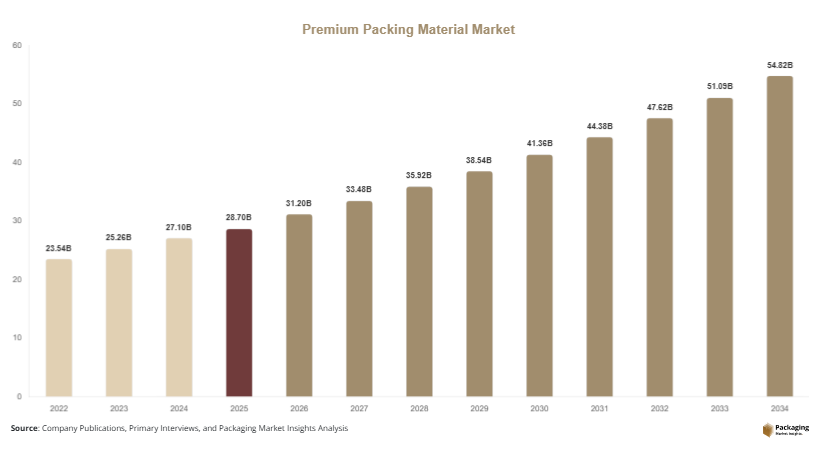
The global premium packing material market size was valued at approximately USD 28.7 billion in 2025 and is projected to reach USD 31.2 billion in 2026. Over the forecast period from 2025 to 2034, the market is expected to grow at a compound annual growth rate (CAGR) of 7.3%, reaching nearly USD 58.9 billion by 2034. This growth reflects the rising demand for aesthetically appealing, durable, and high-quality packaging materials across industries such as luxury goods, cosmetics, electronics, and premium food products. The premium packing material market is experiencing steady expansion as brands increasingly focus on enhancing product presentation, protection, and perceived value.
One of the key growth factors is the increasing demand for luxury and branded products, particularly in emerging economies where disposable income levels are rising. Consumers are placing greater emphasis on packaging as a reflection of product quality and brand identity. Secondly, the expansion of e-commerce and direct-to-consumer channels is driving the need for premium packaging materials that ensure product safety while delivering a positive unboxing experience. Thirdly, sustainability considerations are influencing material selection, with companies opting for recyclable and biodegradable premium packaging options to align with environmental goals.
Key Market Insights
- Asia Pacific dominated the market with a 38.6% share in 2025, while Latin America is projected to grow at the fastest CAGR of 7.9%.
- Rigid packaging materials led the type segment with a 47.3% share, while eco-friendly premium materials are expected to grow at a CAGR of 8.2%.
- Paper-based premium packaging dominated with a 42.5% share, while glass-based packaging is forecasted to grow at a CAGR of 7.1%.
- Cosmetics and personal care applications led the segment with 36.8% share, while electronics packaging is expected to grow at a CAGR of 7.6%.
- China remained the dominant country with a market size of USD 6.4 billion in 2025 and USD 6.9 billion in 2026.
Explore more data points, trends and opportunities Download Free Sample Report
Market Trends
Growing emphasis on sustainable premium packaging solutions
The premium packing material market is increasingly influenced by sustainability considerations, as both consumers and regulatory bodies push for environmentally responsible practices. Brands are adopting premium packaging materials that are recyclable, biodegradable, or derived from renewable resources. This includes the use of high-quality paperboard, molded fiber, and reusable containers that maintain a premium look while reducing environmental impact. Companies are also focusing on reducing excess packaging and optimizing material usage without compromising aesthetics. The shift toward sustainable premium packaging is reshaping product design and supply chain strategies, encouraging innovation in materials and manufacturing processes.
Rising importance of customization and personalized packaging
Customization is becoming a key trend in the premium packing material market, driven by the need for brand differentiation and enhanced customer engagement. Companies are leveraging advanced printing technologies to create personalized packaging designs that reflect brand identity and cater to specific consumer preferences. Limited edition packaging, seasonal designs, and customized labeling are gaining popularity across industries such as cosmetics, luxury goods, and electronics. This trend is particularly prominent in e-commerce, where the unboxing experience plays a significant role in customer satisfaction. As a result, manufacturers are investing in flexible production systems to accommodate customization requirements.
Market Drivers
Increasing demand for luxury and branded products
The rising demand for luxury and branded products is a significant factor driving the premium packing material market. Consumers are increasingly willing to pay for products that offer superior quality and aesthetic appeal, and packaging plays a crucial role in shaping these perceptions. Premium packaging materials such as rigid boxes, embossed papers, and metallic finishes enhance product presentation and create a sense of exclusivity. This trend is particularly evident in industries such as cosmetics, fashion, and electronics, where packaging is an integral part of the overall brand experience. As global consumer spending on premium products continues to grow, the demand for high-quality packaging materials is expected to increase.
Expansion of e-commerce and direct-to-consumer channels
The rapid growth of e-commerce is another key driver of the premium packing material market. Online retail requires packaging solutions that not only protect products during transit but also enhance the customer experience. Premium packaging materials are being used to create visually appealing and durable packaging that reflects brand identity. The unboxing experience has become an important aspect of customer engagement, influencing repeat purchases and brand loyalty. As e-commerce continues to expand globally, the demand for innovative and high-quality packaging solutions is expected to rise.
Market Restraint
High cost of premium packaging materials and production processes
The high cost associated with premium packaging materials and manufacturing processes remains a key challenge for the premium packing material market. Materials such as high-quality paperboard, glass, and metal components often involve higher production costs compared to standard packaging options. Additionally, customization and advanced printing techniques can increase overall expenses. These cost factors can limit adoption, particularly among small and medium-sized enterprises with budget constraints. For example, a startup in the cosmetics industry may find it challenging to invest in premium packaging despite its potential benefits. While larger companies can absorb these costs, smaller players may opt for more economical alternatives, impacting overall market growth.
Market Opportunities
Increasing adoption in emerging economies
Emerging markets present significant growth opportunities for the premium packing material market. Rising disposable incomes and changing consumer preferences are driving demand for premium products and packaging solutions. Countries in Asia Pacific and Latin America are witnessing rapid urbanization and expansion of retail sectors, creating favorable conditions for market growth. As consumers in these regions become more brand-conscious, the demand for high-quality packaging materials is expected to increase. Companies are also expanding their presence in these markets to capitalize on growth opportunities.
Integration of smart and functional packaging technologies
The integration of smart and functional technologies into premium packaging is creating new opportunities for market expansion. Features such as QR codes, NFC tags, and temperature indicators are being incorporated into packaging to enhance product functionality and consumer engagement. These technologies enable brands to provide additional information, track products, and improve supply chain transparency. As innovation continues, smart packaging solutions are expected to gain traction across various industries, contributing to the growth of the premium packing material market.
Report Scope
| Report Metric | Details |
|---|---|
| Market Size in 2025 | USD 28.7 Billion |
| Market Size in 2026 | USD 31.2 Billion |
| Market Size in 2034 | USD 58.9 Billion |
| CAGR | 7.3% (2026-2034) |
| Base Year for Estimation | 2025 |
| Historical Data | 2022-2024 |
| Forecast Period | 2026-2034 |
| Report Coverage | Revenue Forecast, Competitive Landscape, Supply Chain Disruption, Growth Factors, Environment & Regulatory Landscape and Trends |
| Geographies Covered | North America, Europe, APAC, Middle East and Africa, LATAM |
| Countries Covered | U.S., Canada, U.K., Germany, France, Spain, Italy, Russia, Nordic, Benelux, Rest of Europe, China, South Korea, Japan, India, Australia, Singapore, Taiwan, South East Asia, Rest of Asia-Pacific, UAE, Turky, Saudi Arabia, South Africa, Egypt, Nigeria, Rest of MEA, Brazil, Mexico, Argentina, Chile, Colombia, Rest of LATAM |
Explore more data points, trends and opportunities Download Free Sample Report
Segmental Analysis
By Material Type
Rigid packaging materials accounted for the largest share of approximately 47.3% in 2024. These materials include rigid boxes, glass containers, and metal packaging components, which are widely used in luxury goods, electronics, and cosmetics industries. Their durability and premium appearance make them suitable for high-value products that require enhanced protection and visual appeal. The ability to incorporate design elements such as embossing, foil stamping, and textured finishes further contributes to their dominance in the market.
Eco-friendly premium materials are expected to grow at a CAGR of 8.2% during the forecast period. These materials include biodegradable paperboard, recycled plastics, and sustainable composites. Increasing consumer awareness regarding environmental issues is driving the adoption of eco-friendly packaging solutions. Companies are investing in research and development to create materials that offer both sustainability and premium aesthetics. As regulatory pressure increases, the demand for these materials is expected to rise significantly.
By Application
The cosmetics and personal care segment dominated the market in 2024, holding a share of 36.8%. Premium packaging plays a critical role in this industry, as it influences consumer perception and brand value. Products such as perfumes, skincare items, and makeup often use high-quality packaging materials to enhance their appeal. The increasing demand for luxury cosmetics is further supporting the growth of this segment.
Electronics packaging is expected to grow at a CAGR of 7.6%. The need for protective and visually appealing packaging solutions is driving demand in this segment. Premium packaging materials are used to safeguard electronic devices during transportation while enhancing product presentation. The growth of consumer electronics and increasing demand for high-end devices are contributing to the expansion of this segment.
By Packaging Type
Paper-based premium packaging held the largest share of 42.5% in 2024 due to its versatility and sustainability. Materials such as specialty paper and paperboard are widely used for packaging luxury goods, cosmetics, and food products. Their ability to be customized with various finishes and designs makes them a preferred choice for premium packaging applications.
Glass-based packaging is expected to grow at a CAGR of 7.1%. Glass is widely used for packaging high-end products such as perfumes and beverages due to its premium appearance and ability to preserve product quality. The increasing demand for sustainable and recyclable packaging solutions is further supporting the growth of this segment.
Premium Packing Material Market Segmentations
By Material Type
- Rigid Packaging Materials
- Flexible Packaging Materials
- Eco-Friendly Premium Materials
By Application
- Cosmetics & Personal Care
- Electronics
- Food & Beverage
- Luxury Goods
By Packaging Type
- Paper-Based Packaging
- Glass-Based Packaging
- Metal-Based Packaging
- Others
Regional Analysis
North America
North America accounted for approximately 24.2% of the premium packing material market share in 2025 and is projected to grow at a CAGR of 6.5% during the forecast period. The region benefits from a well-established retail and e-commerce sector, along with high consumer demand for premium and luxury products. Companies in the region are focusing on sustainable and innovative packaging solutions to meet evolving consumer preferences.
The United States dominates the regional market due to its strong presence of luxury brands and advanced manufacturing capabilities. A key growth factor is the increasing demand for premium packaging in the cosmetics and personal care industry, where product presentation plays a crucial role in consumer purchasing decisions.
Europe
Europe held a market share of 26.7% in 2025 and is expected to grow at a CAGR of 6.8%. The region is characterized by a strong emphasis on sustainability and high demand for premium packaging solutions. Strict environmental regulations are encouraging companies to adopt eco-friendly materials and production processes.
Germany leads the European market, supported by its robust industrial base and focus on innovation. A unique growth factor is the widespread adoption of sustainable luxury packaging, particularly in the fashion and cosmetics industries, which drives demand for premium materials.
Asia Pacific
Asia Pacific dominated the market with a 38.6% share in 2025 and is projected to grow at a CAGR of 7.5%. Rapid urbanization, increasing disposable incomes, and expanding retail sectors are key factors driving market growth in this region. The rising demand for premium products further supports the adoption of high-quality packaging materials.
China is the dominant country in the region, driven by its large consumer base and strong manufacturing capabilities. A unique growth factor is the rapid growth of e-commerce platforms, which is increasing demand for premium packaging solutions that enhance the customer experience.
Middle East & Africa
The Middle East & Africa region accounted for 5.8% of the market share in 2025 and is expected to grow at a CAGR of 6.1%. The market is gradually expanding due to increasing demand for luxury products and improvements in retail infrastructure.
The United Arab Emirates is a key market in the region, supported by its growing luxury retail sector. A unique growth factor is the increasing demand for high-end packaging in the perfume and cosmetics industry, which drives the use of premium materials.
Latin America
Latin America accounted for 4.7% of the premium packing material market share in 2025 and is projected to grow at the fastest CAGR of 7.9%. The region is experiencing rising demand for premium consumer goods due to economic development and changing lifestyles.
Brazil dominates the regional market, supported by its large population and expanding retail sector. A unique growth factor is the growing demand for premium packaging in the food and beverage industry, particularly for specialty and gourmet products.
Competitive Landscape
The premium packing material market is moderately competitive, with several global and regional players focusing on innovation, sustainability, and customization. Companies are investing in advanced manufacturing technologies and expanding their product portfolios to meet evolving consumer demands. Strategic partnerships and acquisitions are common strategies used to strengthen market presence.
Amcor plc is recognized as a leading player in the market, known for its focus on sustainable packaging solutions. The company recently introduced a range of premium recyclable packaging materials designed to reduce environmental impact. Other key players, including Mondi Group, Smurfit Kappa Group, DS Smith Plc, and WestRock Company, are also investing in research and development to enhance product offerings and maintain competitiveness.
Key Players List
- Amcor plc
- Mondi Group
- Smurfit Kappa Group
- DS Smith Plc
- WestRock Company
- Stora Enso Oyj
- UPM-Kymmene Corporation
- International Paper Company
- Huhtamaki Oyj
- Sonoco Products Company
- Sealed Air Corporation
- Berry Global Inc.
- Crown Holdings Inc.
- Ball Corporation
- Graphic Packaging Holding Company