Pre Qualified Thermal Packaging Market Size and Growth
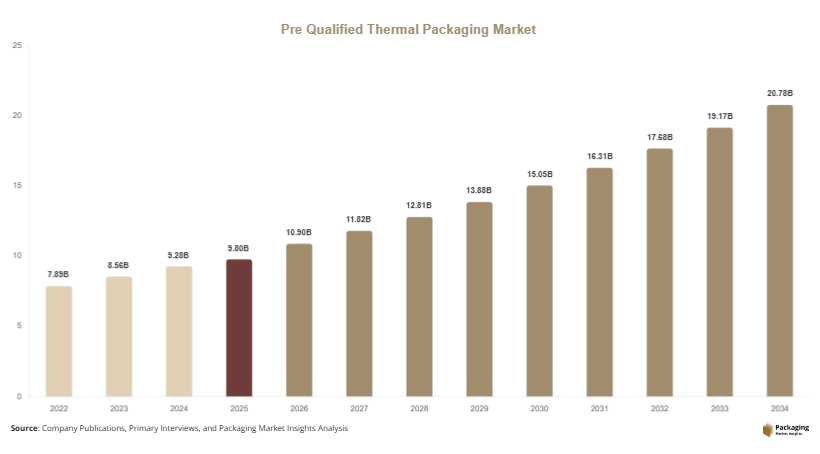
The global pre qualified thermal packaging market size was valued at USD 9.8 billion in 2025 and is projected to reach USD 10.9 billion in 2026, further expanding to approximately USD 22.6 billion by 2034, registering a CAGR of 8.4% during 2025–2034. Pre-qualified thermal packaging solutions are designed and validated to maintain temperature-sensitive products within specific ranges, reducing the need for repeated testing and ensuring regulatory compliance. The pre qualified thermal packaging market is experiencing steady growth due to the rising need for temperature-controlled logistics across pharmaceutical, biotechnology, and food industries.
One of the primary growth factors is the increasing demand for biologics and specialty pharmaceuticals. These products require strict temperature control during transportation to maintain efficacy and safety. Pre-qualified packaging solutions provide reliable performance, reducing the risk of temperature excursions and product loss. The growing global distribution of vaccines and biologics is significantly driving market demand.
Key Highlights:
- North America dominated the market with a 36.8% share in 2025, while Asia Pacific is projected to grow at the fastest CAGR of 9.2%.
- Passive thermal packaging led the type segment with a 58.6% share, while active packaging is expected to grow at a CAGR of 8.9%.
- Expanded polystyrene (EPS) materials dominated with a 44.7% share, while vacuum insulated panels are forecasted to grow at a CAGR of 9.5%.
- Pharmaceutical applications led the segment with 49.3% share, while food delivery applications are expected to grow at a CAGR of 8.7%.
- The United States remained the dominant country with a market size of USD 3.2 billion in 2025 and USD 3.5 billion in 2026.
Explore more data points, trends and opportunities Download Free Sample Report
Market Trends
Increasing Adoption of Sustainable Thermal Packaging Solutions
Sustainability is becoming a central focus in the pre qualified thermal packaging market as companies aim to reduce environmental impact. Manufacturers are developing reusable thermal packaging systems and replacing traditional materials such as EPS with eco-friendly alternatives like molded fiber and recyclable insulation. This trend is driven by regulatory pressure and corporate sustainability goals. Companies are also optimizing packaging designs to reduce material usage while maintaining thermal performance. The adoption of returnable packaging systems is gaining traction, particularly in pharmaceutical logistics, where cost savings and environmental benefits can be achieved over multiple shipment cycles.
Integration of Advanced Monitoring and Tracking Technologies
The integration of smart technologies into thermal packaging is transforming the market. Sensors, data loggers, and IoT-enabled devices are being incorporated into packaging solutions to monitor temperature, humidity, and location in real time. This trend enhances supply chain visibility and ensures compliance with regulatory requirements. Real-time data allows companies to respond quickly to temperature deviations, reducing product loss. Additionally, digital platforms are being used to analyze shipment data and optimize packaging performance, further driving innovation in the market.
Market Drivers
Growth in Biopharmaceutical and Vaccine Distribution
The increasing production and distribution of biopharmaceuticals and vaccines are major drivers of the pre qualified thermal packaging market. These products require strict temperature control to maintain their stability and effectiveness. Pre-qualified packaging solutions provide validated performance, reducing the need for extensive testing and ensuring compliance with regulatory standards. The expansion of global healthcare infrastructure and the need for efficient vaccine distribution are further driving demand for reliable thermal packaging solutions.
Expansion of Cold Chain Logistics Infrastructure
The development of cold chain logistics infrastructure is supporting market growth. Investments in refrigerated storage, transportation, and monitoring systems are increasing the demand for advanced thermal packaging solutions. Pre-qualified packaging simplifies logistics operations by providing standardized performance, reducing the complexity of temperature-controlled shipping. The growth of international trade and the increasing demand for perishable goods are also contributing to the expansion of cold chain networks.
Market Restraint
High Initial Costs and Limited Reusability in Certain Applications
The high initial cost of pre-qualified thermal packaging solutions can act as a restraint for market growth. Advanced materials such as vacuum insulated panels and phase change materials increase production costs, making these solutions more expensive than traditional packaging. Additionally, while reusable packaging systems offer long-term cost benefits, they require reverse logistics and proper handling, which can be challenging in certain regions. For example, small-scale pharmaceutical distributors may find it difficult to implement returnable packaging systems due to limited infrastructure. These factors can limit adoption, particularly in cost-sensitive markets.
Market Opportunities
Expansion in Emerging Markets with Growing Healthcare Infrastructure
Emerging markets present significant opportunities for the pre qualified thermal packaging market. Countries in Asia, Latin America, and Africa are investing in healthcare infrastructure, increasing the demand for temperature-controlled logistics. The growing availability of vaccines and biologics in these regions is driving the need for reliable packaging solutions. Companies that expand their presence in these markets can benefit from increasing demand and relatively low competition.
Development of Lightweight and High-Performance Insulation Materials
Advancements in insulation materials are creating opportunities for market growth. Lightweight materials that provide high thermal performance can reduce shipping costs and improve efficiency. Innovations in phase change materials and vacuum insulation are enabling longer temperature control durations, making these solutions suitable for long-distance shipments. Companies investing in research and development can create differentiated products that meet evolving industry requirements.
Report Scope
| Report Metric | Details |
|---|---|
| Market Size in 2025 | USD 9.8 Billion |
| Market Size in 2026 | USD 10.9 Billion |
| Market Size in 2034 | USD 22.6 Billion |
| CAGR | 8.4% (2026-2034) |
| Base Year for Estimation | 2025 |
| Historical Data | 2022-2024 |
| Forecast Period | 2026-2034 |
| Report Coverage | Revenue Forecast, Competitive Landscape, Supply Chain Disruption, Growth Factors, Environment & Regulatory Landscape and Trends |
| Geographies Covered | North America, Europe, APAC, Middle East and Africa, LATAM |
| Countries Covered | U.S., Canada, U.K., Germany, France, Spain, Italy, Russia, Nordic, Benelux, Rest of Europe, China, South Korea, Japan, India, Australia, Singapore, Taiwan, South East Asia, Rest of Asia-Pacific, UAE, Turky, Saudi Arabia, South Africa, Egypt, Nigeria, Rest of MEA, Brazil, Mexico, Argentina, Chile, Colombia, Rest of LATAM |
Explore more data points, trends and opportunities Download Free Sample Report
Segmental Analysis
By Type
Passive thermal packaging dominated the market, accounting for 58.6% share in 2024. These solutions rely on insulation materials and phase change materials to maintain temperature without external power sources. They are widely used due to their cost efficiency and ease of use.
Active thermal packaging is expected to be the fastest-growing segment, with a CAGR of 8.9%. These systems use powered cooling or heating mechanisms to maintain precise temperature control. The growth of this segment is driven by increasing demand for high-value pharmaceutical shipments.
By Material
Expanded polystyrene (EPS) dominated the market with a 44.7% share in 2024, due to its excellent insulation properties and low cost. EPS-based packaging solutions are widely used for transporting temperature-sensitive products.
Vacuum insulated panels are the fastest-growing segment, with a CAGR of 9.5%. These materials offer superior thermal performance and longer temperature control durations. The increasing demand for high-performance packaging solutions is driving the growth of this segment.
By Application
Pharmaceutical applications dominated the market, accounting for 49.3% share in 2024. The need to maintain strict temperature conditions during drug transportation is driving demand for pre-qualified thermal packaging solutions.
Food delivery applications are expected to be the fastest-growing segment, with a CAGR of 8.7%. The rise of online food delivery services and demand for fresh and perishable products are driving the growth of this segment.
Pre Qualified Thermal Packaging Market Segmentations
By Type
- Passive Thermal Packaging
- Active Thermal Packaging
By Material
- Expanded Polystyrene (EPS)
- Polyurethane (PU)
- Vacuum Insulated Panels
- Phase Change Materials
By Application
- Pharmaceuticals
- Food & Beverage
- Chemicals
- Biotechnology
Regional Analysis
North America
North America accounted for approximately 36.8% of the market share in 2025 and is expected to grow at a CAGR of 7.9%. The region benefits from a well-established pharmaceutical industry and advanced cold chain infrastructure. The demand for pre-qualified thermal packaging is high due to strict regulatory requirements and the need for reliable temperature control.
The United States dominates the regional market, supported by its large healthcare sector and strong presence of pharmaceutical companies. A key growth factor is the increasing demand for biologics and specialty drugs, which require advanced thermal packaging solutions.
Europe
Europe held a market share of 25.4% in 2025 and is projected to grow at a CAGR of 8.1%. The region is characterized by strict regulatory standards and a focus on sustainability. The adoption of pre-qualified thermal packaging solutions is driven by the need to comply with Good Distribution Practices (GDP).
Germany is the leading country in the European market, supported by its strong pharmaceutical manufacturing base. A unique growth factor is the increasing adoption of reusable thermal packaging systems, which help reduce costs and environmental impact.
Asia Pacific
Asia Pacific accounted for 22.6% of the market share in 2025 and is expected to grow at the fastest CAGR of 9.2%. Rapid economic growth, expanding healthcare infrastructure, and increasing demand for temperature-sensitive products are driving market growth.
China is the dominant country in the region, driven by its large population and growing pharmaceutical industry. A key growth factor is the expansion of vaccine distribution programs, which require reliable thermal packaging solutions.
Middle East & Africa
The Middle East & Africa region accounted for a 7.1% share in 2025 and is expected to grow at a CAGR of 8.5%. The market is expanding due to increasing investments in healthcare infrastructure and cold chain logistics.
The United Arab Emirates leads the regional market, supported by its strategic location and growing logistics sector. A unique growth factor is the development of advanced healthcare facilities, which is increasing demand for temperature-controlled packaging solutions.
Latin America
Latin America held a market share of 8.1% in 2025 and is projected to grow at a CAGR of 8.8%. The region is witnessing increasing demand for pharmaceutical products and temperature-sensitive food items.
Brazil is the dominant country in the region, supported by its large population and expanding healthcare sector. A key growth factor is the increasing government focus on improving vaccine distribution and healthcare access.
Competitive Landscape
The pre qualified thermal packaging market is competitive, with key players focusing on innovation, sustainability, and global expansion. Companies are investing in advanced materials and smart technologies to enhance product performance and meet regulatory requirements.
Sonoco ThermoSafe is a leading player in the market, known for its comprehensive range of thermal packaging solutions. The company recently introduced reusable thermal packaging systems to support sustainability initiatives. Other major players such as Pelican BioThermal, Cold Chain Technologies, Envirotainer, and Softbox Systems are also focusing on expanding their product portfolios and strengthening their market presence.
Key Players List
- Sonoco ThermoSafe
- Pelican BioThermal
- Cold Chain Technologies
- Envirotainer AB
- Softbox Systems Ltd.
- Tempack Packaging Solutions
- Intelsius Ltd.
- Cryopak Industries Inc.
- Sofrigam SA
- va-Q-tec AG
- Snyder Industries Inc.
- Inmark Packaging
- American Aerogel Corporation
- Insulated Products Corporation
- Nordic Cold Chain Solutions