Pre Press For Packaging Market Size and Growth
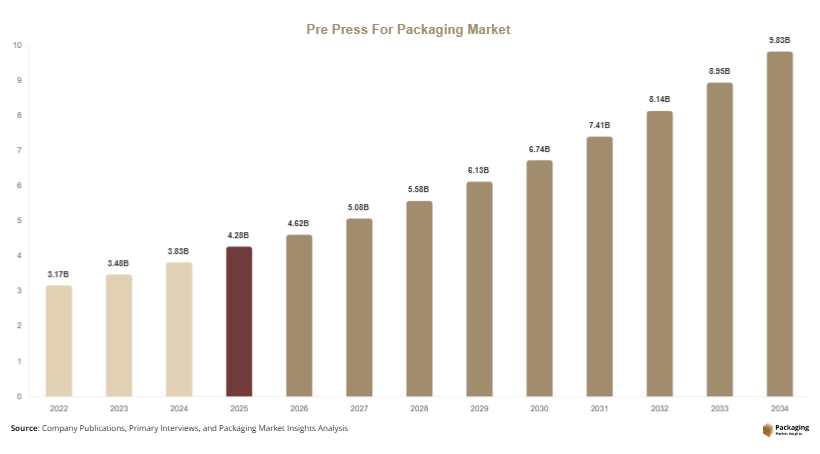
The pre press for packaging market size is estimated at USD 4.28 billion in 2025, and it is projected to reach USD 4.62 billion in 2026. By 2034, the market is expected to reach approximately USD 9.85 billion, growing at a CAGR of 9.9% (2025–2034). The expansion is strongly influenced by rising demand for high-quality packaging output, faster production cycles, and increasing brand competition across FMCG, pharmaceuticals, and e-commerce sectors. The pre press for packaging market is experiencing steady growth as packaging industries increasingly shift toward digital-first workflows and automation-driven production systems.
One of the key growth drivers is the increasing adoption of digital pre-press technologies, which improve accuracy in design processing and reduce production errors. Another major factor is the growing need for packaging consistency across multiple formats and regions, especially for global brands operating at scale. Additionally, sustainability regulations are encouraging packaging manufacturers to optimize design workflows to reduce waste and improve resource efficiency.
Key Highlights
- Europe dominated the market with a 36.8% share in 2025.
- Asia Pacific is projected to grow at the fastest CAGR of 8.6% during 2025–2034.
- Plastic-based chemical packaging materials led the market with a 46.5% share in 2025.
- Drums and barrels accounted for a 39.8% share in 2025.
- The chemicals end-use industry dominated the market with a 51.2% share in 2025.
- The US market reached USD 1.35 billion in 2025 and USD 1.46 billion in 2026.
Explore more data points, trends and opportunities Download Free Sample Report
Market Trends
Transition Toward Fully Digital Pre-Press Ecosystems
The packaging industry is undergoing a significant transformation with the shift from traditional pre-press methods to fully digital ecosystems. Companies are increasingly adopting cloud-based design platforms that allow real-time collaboration between designers, printers, and packaging engineers. This transition is reducing manual intervention, minimizing errors, and significantly improving production speed. Digital pre-press systems also enable better version control, which is essential for managing multiple packaging SKUs across global markets. The trend is particularly strong in developed economies where packaging volumes are high and turnaround times are critical. Additionally, integration with ERP and supply chain systems is improving workflow efficiency, making digital pre-press a core component of modern packaging production.
AI-Driven Automation and Color Management Integration
Another major trend shaping the market is the adoption of AI-driven automation and advanced color management technologies. Artificial intelligence is being used to optimize layout designs, detect errors in packaging files, and simulate final print outputs before production begins. This reduces rework costs and improves material efficiency. Color management systems ensure brand consistency across different substrates such as plastic, paperboard, and flexible packaging films. As global brands expand across multiple regions, maintaining uniform packaging appearance has become critical. AI-based tools are also helping companies reduce production waste by identifying inefficiencies in pre-press planning, making packaging workflows more sustainable and cost-effective.
Market Drivers
Expansion of Global E-commerce Packaging Demand
The rapid expansion of e-commerce platforms has significantly increased demand for efficient and scalable packaging solutions. Online retail requires visually appealing, protective, and standardized packaging formats that ensure safe delivery and strong brand recognition. Pre-press systems play a critical role in ensuring design consistency across millions of SKUs produced globally. With rising consumer expectations for unboxing experiences, brands are investing heavily in packaging design optimization. This has led to increased adoption of advanced pre-press tools that reduce production errors and improve speed-to-market. Additionally, the growth of direct-to-consumer (D2C) brands is further boosting demand for flexible and scalable pre-press workflows.
Rising Demand for Sustainable and Efficient Packaging Design
Sustainability is becoming a core priority across the packaging industry, driving demand for optimized pre-press solutions. Companies are under increasing pressure to reduce material waste, lower carbon emissions, and adopt recyclable packaging formats. Pre-press technologies enable simulation-based design optimization, allowing manufacturers to reduce ink usage and minimize substrate wastage. Regulatory frameworks in Europe and North America are also encouraging eco-friendly packaging innovation. As a result, companies are adopting digital pre-press systems that support sustainable material usage while maintaining high-quality output standards. This trend is expected to continue as environmental compliance becomes stricter globally.
Market Restraint
High Implementation Cost and Technical Complexity
Despite strong growth potential, the pre press for packaging market faces challenges related to high implementation costs and technical complexity. Advanced pre-press systems require significant investment in software, infrastructure, and skilled personnel. Small and medium-sized packaging companies often struggle to adopt these technologies due to budget constraints. Additionally, integration of AI-based tools and cloud platforms requires technical expertise, which is not always available in traditional packaging firms.
Many companies still rely on legacy systems, which are incompatible with modern digital workflows. Transitioning to advanced systems involves training costs, operational downtime, and process restructuring. This slows down adoption rates in developing regions and among smaller packaging service providers, limiting overall market penetration.
Market Opportunities
Growth of Cloud-Based Pre-Press Platforms
Cloud-based pre-press solutions are emerging as a major growth opportunity in the market. These platforms enable remote collaboration, centralized asset management, and real-time file sharing across global teams. This is particularly beneficial for multinational packaging companies managing multiple production facilities. Cloud systems also improve scalability and reduce dependency on physical infrastructure, making them cost-efficient for large-scale operations. As remote work and distributed production models become more common, cloud-based pre-press systems are expected to witness strong adoption across industries.
Expansion of Smart Packaging and Personalized Printing
The rise of smart packaging and personalized printing is creating new opportunities for pre-press service providers. Packaging formats such as QR-enabled labels, interactive designs, and variable data printing require advanced pre-press planning to ensure accuracy and consistency. Brands are increasingly using personalized packaging to enhance customer engagement and marketing impact. Pre-press technologies play a crucial role in managing multiple design variations efficiently without compromising quality. This trend is particularly strong in food & beverage, cosmetics, and healthcare packaging segments.
Report Scope
| Report Metric | Details |
|---|---|
| Market Size in 2025 | USD 4.28 Billion |
| Market Size in 2026 | USD 4.62 Billion |
| Market Size in 2034 | USD 9.85 Billion |
| CAGR | 9.9% (2026-2034) |
| Base Year for Estimation | 2025 |
| Historical Data | 2022-2024 |
| Forecast Period | 2026-2034 |
| Report Coverage | Revenue Forecast, Competitive Landscape, Supply Chain Disruption, Growth Factors, Environment & Regulatory Landscape and Trends |
| Geographies Covered | North America, Europe, APAC, Middle East and Africa, LATAM |
| Countries Covered | U.S., Canada, U.K., Germany, France, Spain, Italy, Russia, Nordic, Benelux, Rest of Europe, China, South Korea, Japan, India, Australia, Singapore, Taiwan, South East Asia, Rest of Asia-Pacific, UAE, Turky, Saudi Arabia, South Africa, Egypt, Nigeria, Rest of MEA, Brazil, Mexico, Argentina, Chile, Colombia, Rest of LATAM |
Explore more data points, trends and opportunities Download Free Sample Report
Segmental Analysis
By Component Type
Software dominates the pre press for packaging market with a share of around 46.7% in 2024, driven by increasing demand for advanced design tools, color management systems, and workflow automation platforms. Packaging converters and brand owners are increasingly investing in software-based prepress systems to ensure consistency in design output, reduce manual intervention, and improve production efficiency across multiple packaging formats.
The fastest-growing subsegment is Services, expected to register a CAGR of 8.5% during 2025–2034, driven by rising outsourcing of prepress operations to specialized service providers. Factors such as cost optimization, access to expert design capabilities, and demand for faster turnaround times are encouraging packaging companies to rely on managed prepress service providers, especially in emerging markets.
By Application
Flexible Packaging dominates the application segment with approximately 42.3% share in 2024, supported by strong demand from food & beverage, pharmaceuticals, and personal care industries. Flexible packaging requires highly precise prepress operations due to complex material surfaces and multi-layer printing requirements, making advanced prepress systems essential for quality output.
Labels & Tags is the fastest-growing subsegment with a projected CAGR of 8.9% during 2025–2034, driven by increasing demand for product identification, branding, and regulatory labeling across industries. Growth in e-commerce, logistics tracking, and pharmaceutical serialization is further accelerating adoption of advanced label prepress solutions.
By End-Use Industry
Food & Beverage dominates the end-use segment with a share of 48.1% in 2024, due to high consumption of packaged goods and strong demand for visually appealing packaging designs. Prepress systems play a critical role in ensuring food packaging complies with labeling regulations, nutritional information accuracy, and brand consistency across global markets.
Pharmaceuticals is the fastest-growing end-use segment, expected to grow at a CAGR of 9.1% during 2025–2034, driven by strict regulatory labeling requirements, serialization needs, and increasing global drug distribution. The need for error-free packaging artwork and compliance-ready label designs is pushing pharmaceutical companies toward advanced automated prepress solutions.
Pre Press For Packaging Market Segmentations
By Material Type
- Plastic-Based Chemical Packaging Materials
- Metal-Based Chemical Packaging Materials
- Paper & Paperboard Packaging
- Composite & Hybrid Materials
By Packaging Type
- Drums and Barrels
- Intermediate Bulk Containers (IBCs)
- Jerricans & Bottles
- Pouches & Flexible Containers
By End-User Industry
- Chemicals
- Oil & Gas
- Pharmaceuticals
- Agriculture Chemicals
- Industrial Manufacturing
Regional Analysis
North America
North America accounted for nearly 28.4% share of the pre press for packaging market in 2025, supported by strong adoption of advanced packaging prepress workflows and digital color management systems. The region is projected to grow at a CAGR of around 6.9% during 2025–2034, driven by increasing demand for high-quality packaging output in food & beverage, pharmaceuticals, and personal care industries. The presence of large-scale packaging converters and strong investment in automation technologies further strengthens regional growth.
The United States dominates the North American market due to rapid integration of cloud-based prepress solutions, color calibration software, and AI-assisted proofing systems. A key growth factor in the U.S. is the rising demand for sustainable packaging design optimization, where brands are focusing on reducing material waste during prepress production stages while improving print accuracy and regulatory compliance.
Europe
Europe held the largest share of 31.2% in 2025 in the pre press for packaging market, making it the leading regional contributor globally. The region is expected to expand at a CAGR of 6.5% from 2025 to 2034, supported by strict packaging regulations, sustainability mandates, and widespread adoption of standardized printing workflows. Demand for high-end packaging design in luxury goods and premium food packaging also contributes significantly to market expansion.
Germany leads the European market due to its strong printing technology base and high concentration of packaging machinery manufacturers. A key growth driver in Germany is the increasing use of automated prepress workflow integration within Industry 4.0 manufacturing systems, enabling faster turnaround times and improved color accuracy in packaging production.
Asia Pacific
Asia Pacific is projected to be the fastest-growing region with a CAGR of 8.8% during 2025–2034, accounting for approximately 26.5% share in 2025. Rapid industrialization, expanding e-commerce packaging demand, and increasing investment in printing infrastructure are major factors driving regional growth. Countries such as China, India, and Japan are witnessing strong adoption of digital prepress technologies.
China dominates the Asia Pacific market due to its large packaging manufacturing base and high export-driven production. A unique growth factor in China is the rapid expansion of smart packaging production facilities that require advanced prepress systems for high-speed label printing, flexible packaging design, and multi-language packaging customization for global markets.
Middle East & Africa
The Middle East & Africa accounted for around 7.9% share in 2025 in the pre press for packaging market and is expected to grow at a CAGR of 6.2% through 2034. Growth is supported by increasing investment in food processing industries, pharmaceutical packaging expansion, and gradual modernization of printing infrastructure across GCC countries and South Africa.
The United Arab Emirates leads the region due to strong growth in luxury packaging and retail branding industries. A key growth factor is the rising demand for premium packaging design services in cosmetics and hospitality sectors, where high-quality prepress workflows are essential for visual branding and product differentiation.
Latin America
Latin America held approximately 5.2% share in 2025 and is projected to grow at a CAGR of 6.4% from 2025 to 2034. Growth is supported by rising demand for packaged food products, expansion of retail distribution networks, and increasing digitalization of printing facilities in countries such as Brazil, Mexico, and Argentina.
Brazil dominates the Latin American market due to its strong food & beverage packaging industry. A key growth factor is the increasing adoption of cost-efficient digital prepress systems among small and medium packaging converters, helping reduce production waste and improve packaging quality for export-oriented businesses.
Competitive Landscape
The pre press for packaging market is moderately consolidated with the presence of global and regional players focusing on digital transformation, automation, and cloud-based workflow solutions. Key companies are investing heavily in AI integration, workflow optimization, and color management technologies to strengthen their market position. Leading players include Esko, Heidelberg, Kodak, Fujifilm, and Agfa-Gevaert.
Esko remains a market leader due to its strong portfolio of packaging design software and pre-press automation tools. Recently, the company expanded its cloud-based packaging workflow solutions to improve remote collaboration and production efficiency. Competitive strategies include mergers, partnerships, and continuous innovation in pre-press software platforms.
Key Players List
- Esko
- Heidelberg
- Kodak
- Fujifilm
- Agfa-Gevaert
- Adobe Systems
- Konica Minolta
- HP Inc.
- Xerox Corporation
- Durst Group
- Bobst Group
- Hybrid Software
- Screen Holdings
- CERM
- EFI Inc.