PP Rigid Plastic Packaging Market Size and Growth
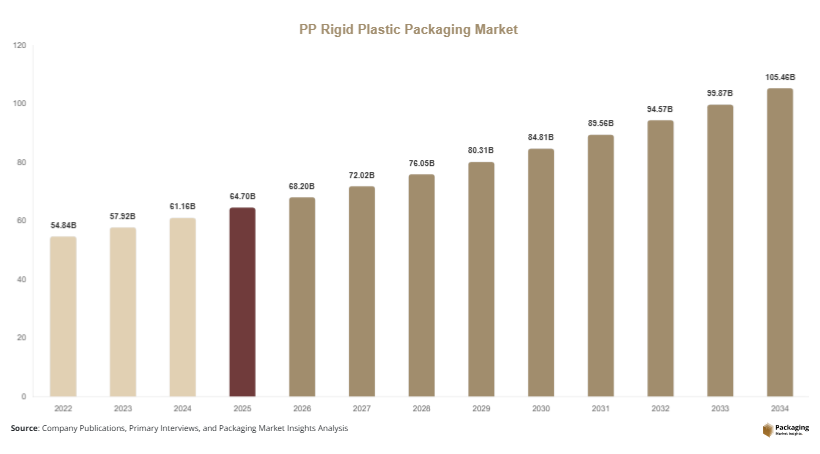
The PP Rigid Plastic Packaging Market is witnessing steady expansion driven by increasing demand for durable, lightweight, and cost-effective packaging solutions across multiple industries. Polypropylene (PP) is widely used in rigid packaging due to its strength, chemical resistance, and recyclability. The global market size was valued at approximately USD 64.7 billion in 2025 and is projected to reach USD 68.2 billion in 2026. Over the forecast period from 2025 to 2034, the market is expected to grow at a compound annual growth rate (CAGR) of 5.6%, reaching an estimated USD 109.5 billion by 2034.
Rigid PP packaging includes containers, bottles, caps, closures, and trays used across food and beverage, pharmaceuticals, personal care, and industrial sectors. The material’s versatility and ability to be molded into various shapes make it suitable for a wide range of applications. The increasing focus on hygiene and product safety is further driving demand for rigid packaging solutions.
Key Highlights:
- Market size: USD 64.7 billion (2025) to USD 109.5 billion (2034)
- CAGR (2025–2034): 5.6%
- Strong demand from food, pharmaceutical, and retail sectors
- Increasing focus on recyclable and sustainable materials
- Growth driven by e-commerce and industrial packaging needs
Explore more data points, trends and opportunities Download Free Sample Report
Market Trends
Increasing Adoption of Recyclable and Circular Packaging
The PP rigid plastic packaging market is experiencing a shift toward recyclable and circular packaging solutions. Governments and regulatory bodies are implementing stricter policies to reduce plastic waste, encouraging manufacturers to adopt sustainable practices. Polypropylene is widely recognized for its recyclability, making it a preferred material in the transition toward circular economy models.
Manufacturers are investing in advanced recycling technologies and designing packaging that can be easily processed in recycling systems. Additionally, companies are focusing on using post-consumer recycled (PCR) materials to reduce environmental impact. This trend is particularly strong in developed regions, where sustainability standards are more established. As environmental concerns continue to grow, the adoption of recyclable PP packaging is expected to increase significantly.
Growth of Lightweight and High-Performance Packaging
Another key trend in the PP rigid plastic packaging market is the increasing demand for lightweight and high-performance packaging solutions. Manufacturers are focusing on reducing material usage while maintaining strength and durability. This approach not only lowers production costs but also reduces environmental impact.
Advancements in material science are enabling the development of thinner yet stronger PP packaging products. These innovations are particularly important in industries such as food and beverage, where packaging efficiency and cost optimization are critical. Additionally, lightweight packaging improves transportation efficiency by reducing shipping costs and carbon emissions. This trend is expected to drive the adoption of advanced PP rigid packaging solutions.
Market Drivers
Growth of the Food and Beverage Industry
The expansion of the food and beverage industry is a major driver for the PP rigid plastic packaging market. Increasing urbanization, changing consumer lifestyles, and rising disposable incomes are contributing to higher demand for packaged food products. PP rigid packaging is widely used in this sector due to its durability, safety, and ability to preserve product quality.
The demand for convenience foods, including ready-to-eat meals and packaged snacks, is further boosting the need for effective packaging solutions. PP packaging provides a protective barrier against contamination and extends shelf life. Additionally, the growth of online food delivery services is increasing demand for secure packaging materials. As the food and beverage industry continues to expand, the demand for PP rigid packaging is expected to grow.
Rising Demand in Pharmaceutical Packaging
The pharmaceutical industry is another key driver of the PP rigid plastic packaging market. The need for safe and reliable packaging solutions for medicines and healthcare products is driving demand for PP packaging. The material’s chemical resistance and durability make it suitable for pharmaceutical applications.
The increasing focus on hygiene and safety is further supporting the adoption of PP packaging in this sector. Regulatory requirements for pharmaceutical packaging are also encouraging the use of high-quality materials. Additionally, the growth of the healthcare sector and increasing demand for medical products are contributing to market expansion. As the pharmaceutical industry continues to grow, the demand for PP rigid packaging is expected to increase.
Market Restraint
Environmental Concerns and Regulatory Pressure
One of the major restraints in the PP rigid plastic packaging market is the growing concern over plastic waste and its environmental impact. Although polypropylene is recyclable, a significant portion of plastic waste still ends up in landfills due to inadequate recycling infrastructure. This has led to increased scrutiny from governments and environmental organizations.
Regulatory measures such as restrictions on single-use plastics and stringent recycling requirements are creating challenges for manufacturers. For example, several countries have introduced policies that limit the use of certain plastic materials, forcing companies to invest in alternative solutions. This can increase production costs and require changes in manufacturing processes.
The impact of this restraint is particularly evident in regions with strict environmental regulations. While efforts are being made to improve recycling systems and develop sustainable alternatives, the transition can be complex and costly. As a result, environmental concerns and regulatory pressure continue to pose challenges to market growth.
Market Opportunities
Development of Advanced Recycling Technologies
The development of advanced recycling technologies presents a significant opportunity for the PP rigid plastic packaging market. Innovations in chemical recycling and mechanical recycling are enabling more efficient processing of plastic waste, improving the sustainability of PP packaging.
Manufacturers are investing in technologies that convert plastic waste into high-quality raw materials, which can be reused in packaging production. This approach supports circular economy initiatives and reduces environmental impact. As recycling infrastructure continues to improve, the adoption of recycled PP materials is expected to increase, creating new growth opportunities.
Expansion in Emerging Markets
Emerging markets offer substantial growth opportunities for the PP rigid plastic packaging market due to rapid urbanization, increasing disposable incomes, and expanding retail sectors. Countries in Asia Pacific, Latin America, and Africa are experiencing rising demand for packaged goods, which is driving the need for packaging solutions.
The growth of e-commerce and organized retail in these regions is further supporting market expansion. Additionally, government initiatives promoting industrial development and sustainability are encouraging the adoption of advanced packaging technologies. As these markets continue to develop, the demand for PP rigid packaging is expected to rise significantly.
Report Scope
| Report Metric | Details |
|---|---|
| Market Size in 2025 | USD 64.7 Billion |
| Market Size in 2026 | USD 68.2 Billion |
| Market Size in 2034 | USD 109.5 Billion |
| CAGR | 5.6% (2026-2034) |
| Base Year for Estimation | 2025 |
| Historical Data | 2022-2024 |
| Forecast Period | 2026-2034 |
| Report Coverage | Revenue Forecast, Competitive Landscape, Supply Chain Disruption, Growth Factors, Environment & Regulatory Landscape and Trends |
| Geographies Covered | North America, Europe, APAC, Middle East and Africa, LATAM |
| Countries Covered | U.S., Canada, U.K., Germany, France, Spain, Italy, Russia, Nordic, Benelux, Rest of Europe, China, South Korea, Japan, India, Australia, Singapore, Taiwan, South East Asia, Rest of Asia-Pacific, UAE, Turky, Saudi Arabia, South Africa, Egypt, Nigeria, Rest of MEA, Brazil, Mexico, Argentina, Chile, Colombia, Rest of LATAM |
Explore more data points, trends and opportunities Download Free Sample Report
Segmental Analysis
By Product Type
Containers dominated the PP rigid plastic packaging market, accounting for approximately 59% of the market share in 2024. PP containers are widely used in food, pharmaceutical, and personal care industries due to their durability and versatility. They provide excellent protection and can be easily customized to meet specific packaging requirements.
The dominance of this segment is supported by increasing demand for packaged food and beverages. Containers offer convenience and ease of use, making them suitable for a wide range of applications. Additionally, advancements in manufacturing processes are enabling the production of high-quality containers with improved performance characteristics.
Caps and closures are expected to be the fastest-growing segment, with a projected CAGR of 6.2%. These products are essential components of packaging systems and play a critical role in maintaining product integrity.
The growth of this segment is driven by increasing demand for secure and tamper-evident packaging solutions. Caps and closures are used across various industries, including food, beverages, and pharmaceuticals. The need for reliable sealing solutions is supporting the growth of this segment.
By Application
The food packaging segment dominated the market, holding approximately 64% share in 2024. PP rigid packaging is widely used in food packaging due to its safety, durability, and ability to preserve product quality.
The dominance of this segment is supported by increasing demand for packaged food products and changing consumer lifestyles. PP packaging provides a protective barrier that helps maintain freshness and prevent contamination. Additionally, the growth of online food delivery services is increasing demand for secure packaging solutions.
The pharmaceutical packaging segment is expected to grow at the fastest rate, with a CAGR of 6.3%. This segment includes the use of PP packaging for medicines and healthcare products.
The growth is driven by increasing demand for safe and reliable packaging solutions. PP packaging provides excellent chemical resistance and durability, making it suitable for pharmaceutical applications. Regulatory requirements are also supporting the adoption of PP packaging.
By End-Use Industry
The food and beverage industry dominated the PP rigid plastic packaging market, accounting for approximately 57% of the market share in 2024. The demand for effective and durable packaging solutions is driving the adoption of PP packaging in this industry.
The dominance of this segment is supported by increasing consumption of packaged food and beverages. PP packaging offers a combination of strength, safety, and cost-effectiveness, making it a preferred choice for manufacturers. Additionally, the need for maintaining product quality is driving demand.
The e-commerce segment is expected to be the fastest-growing, with a CAGR of 6.6%. The growth of online shopping is increasing demand for packaging solutions that provide protection and durability.
PP rigid packaging is increasingly used in e-commerce due to its ability to withstand transportation and handling. The demand for reliable packaging solutions is supporting the growth of this segment.
PP Rigid Plastic Packaging Market Segmentations
Product Type
- Containers
- Bottles
- Caps & Closures
- Trays
- Others
Application
- Food Packaging
- Pharmaceutical Packaging
- Personal Care Packaging
- Industrial Packaging
- Others
End-Use Industry
- Food & Beverage
- Pharmaceuticals
- Personal Care
- E-commerce
- Others
Regional Analysis
North America
North America accounted for approximately 28% of the global PP rigid plastic packaging market share in 2025, supported by strong demand from the food and pharmaceutical sectors. The region is expected to grow at a CAGR of 5.2% during the forecast period, driven by increasing adoption of sustainable packaging solutions and advanced manufacturing technologies.
The United States dominates the North American market due to its well-developed consumer goods and healthcare industries. A unique growth factor in this region is the increasing investment in recycling infrastructure, which is supporting the adoption of recyclable PP packaging and reducing environmental impact.
Europe
Europe held around 25% market share in 2025, with a projected CAGR of 5.0% from 2025 to 2034. The region’s growth is influenced by stringent environmental regulations and a strong focus on sustainability. The adoption of recyclable and eco-friendly packaging materials is increasing across various industries.
Germany leads the European market, supported by its advanced manufacturing sector and commitment to sustainability. A unique growth factor in this region is the implementation of circular economy initiatives, which promote recycling and reduce waste, encouraging the use of PP packaging.
Asia Pacific
Asia Pacific is the fastest-growing region, accounting for approximately 31% of the global market share in 2025 and expected to grow at a CAGR of 6.4%. Rapid urbanization and expanding retail sectors are driving demand for PP rigid packaging in this region.
China dominates the Asia Pacific market due to its large manufacturing base and growing consumer goods industry. A unique growth factor is the increasing demand for packaged food products, which is driving the need for durable and cost-effective packaging solutions.
Middle East & Africa
The Middle East & Africa region accounted for around 7% of the global market share in 2025, with a projected CAGR of 5.3%. The market is driven by growing industrial activities and increasing demand for packaged goods.
The United Arab Emirates is a key market in this region, supported by its strong logistics and trade sectors. A unique growth factor is the expansion of retail and tourism industries, which is increasing demand for packaged products and packaging materials.
Latin America
Latin America held approximately 9% of the global market share in 2025, with an expected CAGR of 5.1% during the forecast period. The region is experiencing steady growth due to increasing urbanization and rising consumer demand.
Brazil leads the Latin American market, supported by its large population and expanding industrial sector. A unique growth factor is the increasing adoption of sustainable packaging practices, which is driving demand for recyclable PP packaging.
Competitive Landscape
The PP rigid plastic packaging market is competitive, with several global and regional players focusing on innovation, sustainability, and cost efficiency. Companies are investing in advanced manufacturing technologies and expanding their production capacities to meet growing demand.
Berry Global Inc. is one of the leading players in the market, known for its extensive product portfolio and global presence. The company has recently introduced recyclable PP packaging solutions aimed at reducing environmental impact. Other major players are also focusing on developing sustainable packaging materials and enhancing their product offerings.
Strategic partnerships, mergers, and acquisitions are common in the market as companies seek to strengthen their market position. The competitive landscape is expected to remain dynamic, with increasing emphasis on sustainability and technological advancements.
Key Players List
- Berry Global Inc.
- Amcor Plc
- Silgan Holdings Inc.
- Plastipak Holdings Inc.
- ALPLA Group
- Graham Packaging Company
- RPC Group Plc
- AptarGroup Inc.
- Gerresheimer AG
- Sonoco Products Company
- Coveris Holdings S.A.
- Winpak Ltd.
- Mondi Group
- Huhtamaki Oyj
- UFlex Ltd.