PP Deli Food Container Market Size and Growth
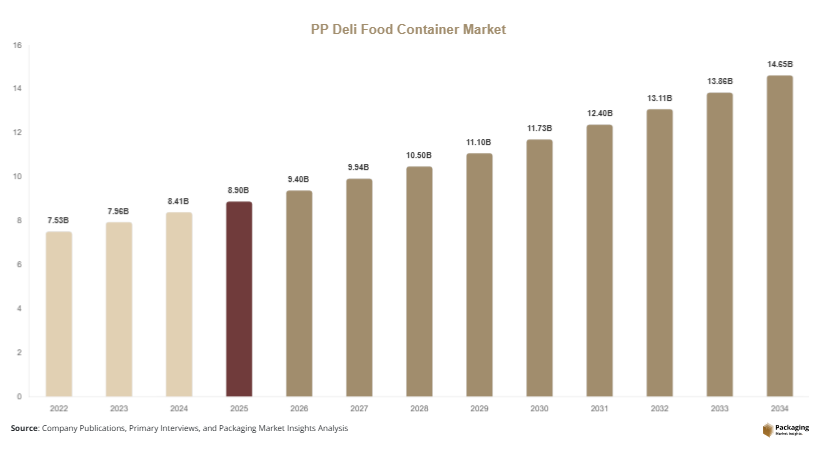
The PP deli food container market size was valued at approximately USD 8.9 billion in 2025 and is projected to reach USD 9.4 billion in 2026. Over the forecast period, the market is expected to expand significantly, reaching USD 14.7 billion by 2034, registering a compound annual growth rate (CAGR) of 5.7% from 2025 to 2034. This upward trajectory is driven by the expansion of the foodservice industry, rising demand for ready-to-eat meals, and the growing popularity of takeaway and delivery services. The global PP deli food container market is experiencing consistent growth due to the increasing demand for convenient, hygienic, and cost-effective food packaging solutions.
Polypropylene (PP) deli food containers are widely used due to their lightweight nature, durability, heat resistance, and cost efficiency. These containers are particularly suitable for storing and transporting hot and cold foods, making them essential in quick-service restaurants, supermarkets, and catering services. The growing urban population and changing consumer lifestyles are contributing to increased consumption of packaged and ready-to-eat food products, further supporting market growth..
Market Insights:
- Asia Pacific dominated the market with a 39.1% share in 2025, while Latin America is projected to grow at the fastest CAGR of 6.3%.
- Injection-molded containers led the type segment with a 44.8% share, while thermoformed containers are expected to grow at a CAGR of 6.0%.
- Plastic packaging dominated with a 52.3% share, while recyclable PP containers are forecasted to grow at a CAGR of 6.2%.
- Food service applications led the segment with 46.7% share, while retail packaging is expected to grow at a CAGR of 5.8%.
- China remained the dominant country with a market size of USD 2.1 billion in 2025 and USD 2.3 billion in 2026.
Explore more data points, trends and opportunities Download Free Sample Report
Market Trends
Rising Demand for Sustainable and Recyclable Food Packaging
Sustainability is becoming an important consideration in the PP deli food container market as environmental concerns continue to influence packaging choices. Manufacturers are increasingly focusing on producing recyclable and reusable polypropylene containers to reduce environmental impact. The shift toward eco-friendly packaging is driven by both regulatory requirements and consumer awareness regarding plastic waste. Foodservice providers are adopting containers that can be recycled or reused, which helps in reducing operational waste and aligning with sustainability goals.
Additionally, innovations in material composition are enabling the production of lighter containers with reduced plastic usage while maintaining strength and durability. These advancements are helping companies balance sustainability with cost efficiency. As consumers become more conscious of environmental issues, the demand for recyclable PP deli containers is expected to grow, shaping the future of the market.
Growth of Online Food Delivery and Takeaway Services
The rapid growth of online food delivery platforms is significantly influencing the PP deli food container market. The increasing reliance on digital ordering systems has led to a surge in demand for durable and leak-proof packaging solutions. PP deli containers are widely preferred for their ability to maintain food quality during transportation, making them essential for delivery services.
Restaurants and food chains are investing in packaging that ensures food safety and enhances customer experience. Features such as tamper-evident lids and secure sealing mechanisms are becoming standard requirements. The expansion of cloud kitchens and takeaway-focused business models is further driving the demand for PP containers. This trend is expected to continue, supported by changing consumer lifestyles and increased convenience-oriented consumption patterns.
Market Drivers
Expansion of the Foodservice Industry
The growth of the foodservice industry is a key driver of the PP deli food container market. Increasing urbanization and rising disposable incomes are leading to higher spending on dining and takeaway services. Restaurants, cafes, and catering businesses require reliable packaging solutions to store and transport food, which is driving demand for PP deli containers.
The versatility of polypropylene containers, which can be used for a wide range of food products, makes them a preferred choice in the industry. Additionally, the increasing number of quick-service restaurants and food chains is contributing to market growth. As the foodservice sector continues to expand globally, the demand for PP deli containers is expected to rise steadily.
Increasing Demand for Convenient and Hygienic Packaging
The growing demand for convenient and hygienic food packaging solutions is another major factor driving the market. Consumers are increasingly seeking packaging that ensures food safety and ease of use. PP deli containers offer excellent barrier properties and resistance to contamination, making them suitable for food storage and transportation.
The COVID-19 pandemic has further emphasized the importance of hygiene, leading to increased adoption of secure and disposable packaging solutions. Manufacturers are focusing on developing containers with improved sealing and tamper-proof features to meet these requirements. This trend is expected to continue, supporting the growth of the market.
Market Restraint
Environmental Concerns and Regulatory Challenges
Environmental concerns related to plastic waste present a significant challenge for the PP deli food container market. Governments and regulatory bodies are implementing strict policies to reduce the use of single-use plastics, which can impact the demand for polypropylene containers. These regulations often require manufacturers to adopt sustainable practices and develop eco-friendly alternatives.
The increasing preference for biodegradable and compostable packaging materials is also influencing market dynamics. For example, some foodservice providers are switching to paper-based or biodegradable containers to meet regulatory requirements and consumer expectations. This shift can limit the growth potential of PP containers, particularly in regions with stringent environmental regulations. However, ongoing innovations in recyclable PP materials are expected to mitigate some of these challenges.
Market Opportunities
Development of Reusable and Microwave-Safe Containers
The development of reusable and microwave-safe PP containers presents a significant growth opportunity in the market. Consumers are increasingly looking for packaging solutions that offer convenience and functionality. PP containers that can be reused and safely used in microwaves provide added value, making them more attractive to consumers.
Manufacturers are investing in product development to enhance the durability and performance of PP containers. These innovations are helping to extend the lifecycle of the products, reducing environmental impact and improving cost efficiency. As demand for multifunctional packaging solutions grows, reusable PP containers are expected to gain traction in the market.
Expansion in Emerging Markets
Emerging markets offer substantial growth opportunities for the PP deli food container market. Rapid urbanization, increasing population, and rising disposable incomes are driving demand for packaged food products in these regions. The expansion of retail and foodservice sectors is further supporting market growth.
In addition, the growing penetration of modern retail formats and online food delivery platforms is increasing the demand for reliable packaging solutions. Manufacturers are focusing on expanding their presence in emerging markets to capitalize on these opportunities. As economic conditions improve, the demand for PP deli containers is expected to increase, driving market growth.
Report Scope
| Report Metric | Details |
|---|---|
| Market Size in 2025 | USD 8.9 Billion |
| Market Size in 2026 | USD 9.4 Billion |
| Market Size in 2034 | USD 14.7 Billion |
| CAGR | 5.7% (2026-2034) |
| Base Year for Estimation | 2025 |
| Historical Data | 2022-2024 |
| Forecast Period | 2026-2034 |
| Report Coverage | Revenue Forecast, Competitive Landscape, Supply Chain Disruption, Growth Factors, Environment & Regulatory Landscape and Trends |
| Geographies Covered | North America, Europe, APAC, Middle East and Africa, LATAM |
| Countries Covered | U.S., Canada, U.K., Germany, France, Spain, Italy, Russia, Nordic, Benelux, Rest of Europe, China, South Korea, Japan, India, Australia, Singapore, Taiwan, South East Asia, Rest of Asia-Pacific, UAE, Turky, Saudi Arabia, South Africa, Egypt, Nigeria, Rest of MEA, Brazil, Mexico, Argentina, Chile, Colombia, Rest of LATAM |
Explore more data points, trends and opportunities Download Free Sample Report
Segmental Analysis
By Type
Injection-molded containers dominated the PP deli food container market in 2024, accounting for approximately 44.8% of total revenue. These containers are widely used due to their durability, strength, and ability to withstand high temperatures. Injection molding allows for precise shaping and consistent quality, making these containers suitable for various food packaging applications.
Thermoformed containers are expected to grow at the fastest CAGR of 6.0% during the forecast period. These containers are lightweight and cost-effective, making them suitable for large-scale food packaging operations. The growing demand for economical packaging solutions is driving the adoption of thermoformed containers.
By Application
The foodservice segment dominated the market in 2024, accounting for 46.7% of total revenue. PP deli containers are widely used in restaurants, cafes, and catering services for packaging takeaway and delivery food. The increasing demand for convenient food options is supporting the growth of this segment.
The retail packaging segment is expected to grow at a CAGR of 5.8%. This growth is driven by increasing demand for packaged food products in supermarkets and grocery stores. The need for hygienic and attractive packaging solutions is further supporting segment growth.
By End-Use
The commercial segment dominated the PP deli food container market in 2024, accounting for a significant share of total revenue. This includes usage in restaurants, catering services, and food processing industries. The demand for bulk packaging solutions is driving growth in this segment.
The household segment is expected to grow at a CAGR of 5.5%. Increasing adoption of convenient food storage solutions at home is driving demand for PP deli containers. The availability of reusable and microwave-safe containers is further supporting growth in this segment.
PP Deli Food Container Market Segmentations
By Product Type
- Injection-Molded Containers
- Thermoformed Containers
By Application
- Foodservice
- Retail Packaging
By Distribution Channel
- Online Retail
- Supermarkets & Hypermarkets
- Specialty Stores
- Wholesale Distribution
- Direct Sales (B2B)
Regional Analysis
North America
North America accounted for approximately 22.8% of the PP deli food container market share in 2025 and is projected to grow at a CAGR of 5.1% during the forecast period. The region’s growth is supported by strong demand from the foodservice and retail sectors, along with increasing consumer preference for convenient food packaging solutions.
The United States dominates the North American market due to its large foodservice industry and high adoption of takeaway and delivery services. A key growth factor is the increasing demand for sustainable packaging solutions, which is encouraging manufacturers to develop recyclable PP containers.
Europe
Europe held a significant share of approximately 26.5% in 2025 and is expected to grow at a CAGR of 5.3%. The region is characterized by strict environmental regulations and high consumer awareness regarding sustainability, which is influencing packaging choices.
Germany is a leading market in Europe, supported by its strong food processing industry. A unique growth factor is the adoption of circular economy practices, which is driving innovation in recyclable and reusable packaging solutions.
Asia Pacific
Asia Pacific dominated the market with a share of 39.1% in 2025 and is projected to grow at a CAGR of 6.0%. Rapid urbanization, population growth, and increasing demand for convenience foods are driving market growth in the region.
China leads the regional market due to its large population and expanding foodservice sector. A key growth factor is the growth of online food delivery platforms, which is increasing demand for PP deli containers.
Middle East & Africa
The Middle East & Africa region accounted for approximately 5.2% of the market in 2025 and is expected to grow at a CAGR of 4.8%. The region’s growth is supported by increasing demand for packaged food products and improving economic conditions.
The United Arab Emirates is a key market in the region, driven by its growing hospitality industry. A unique growth factor is the increasing adoption of premium packaging solutions, which is supporting the demand for PP containers.
Latin America
Latin America held a share of approximately 6.4% in 2025 and is projected to grow at the fastest CAGR of 6.3%. The region’s growth is driven by increasing consumer spending and expanding foodservice industry.
Brazil dominates the market in Latin America, supported by its large population and growing retail sector. A key growth factor is the rising demand for affordable and convenient food packaging solutions.
Competitive Landscape
The PP deli food container market is moderately fragmented, with several key players focusing on product innovation, sustainability, and expansion strategies. Companies are investing in advanced manufacturing technologies to improve product quality and efficiency. Strategic partnerships and acquisitions are also common as companies aim to strengthen their market presence.
Berry Global Inc. is a leading player in the market, known for its extensive product portfolio and global reach. The company has recently introduced recyclable PP containers to address environmental concerns and meet regulatory requirements. Other major players are focusing on expanding their production capacities and entering new markets to enhance their competitive position.
Key Players List
- Berry Global Inc.
- Amcor plc
- Sabert Corporation
- Genpak LLC
- Pactiv Evergreen Inc.
- Dart Container Corporation
- Anchor Packaging Inc.
- Silgan Holdings Inc.
- Novolex Holdings LLC
- Huhtamaki Oyj
- Winpak Ltd.
- Coveris Holdings S.A.
- Greiner Packaging International GmbH
- Plastipak Holdings Inc.
- Inteplast Group