Post Consumer Recycled Plastic Market Size and Growth
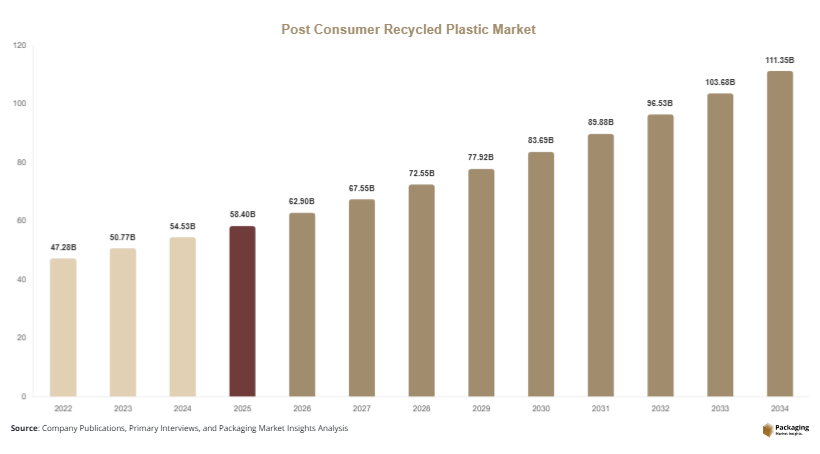
The post consumer recycled plastic market is experiencing steady expansion as industries shift toward circular economy practices and sustainable material sourcing. The market size was estimated at USD 58.4 billion in 2025 and is projected to reach USD 62.9 billion in 2026. With increasing regulatory pressure and growing environmental awareness, the market is forecast to reach approximately USD 118.6 billion by 2034, expanding at a compound annual growth rate (CAGR) of 7.4% during 2025–2034.
Post consumer recycled (PCR) plastics are derived from materials discarded by end users, including packaging, bottles, and containers. These materials are reprocessed into usable raw materials, supporting sustainability goals across industries such as packaging, automotive, construction, and consumer goods. The growing demand for recycled materials is driven by regulatory mandates aimed at reducing landfill waste and carbon emissions, particularly in developed economies.
Key Highlights:
- Market size expected to grow from USD 58.4 billion (2025) to USD 118.6 billion (2034)
- CAGR of 7.4% during the forecast period
- Packaging sector remains the largest application segment
- Technological advancements improving recycled plastic quality
- Strong regulatory support driving market expansion
Explore more data points, trends and opportunities Download Free Sample Report
Market Trends
Increasing Adoption of Closed-Loop Recycling Systems
Closed-loop recycling systems are becoming a prominent trend in the post consumer recycled plastic market. Companies are focusing on collecting, processing, and reusing their own plastic waste to create new products. This approach ensures material traceability and consistency in quality, which is essential for industries such as food packaging and healthcare. Many multinational corporations are investing in infrastructure that allows them to recover post-consumer plastics directly from consumers or retail channels. This trend is also supported by digital tracking technologies that enable better monitoring of material flows, enhancing operational efficiency and reducing waste leakage into the environment.
Integration of Advanced Recycling Technologies
The integration of advanced recycling technologies, particularly chemical recycling, is reshaping the market landscape. Unlike traditional mechanical recycling, chemical processes break plastics down into their molecular components, allowing for the production of high-quality recycled materials. This enables the recycling of complex and contaminated plastics that were previously difficult to process. As a result, industries are expanding the range of applications for PCR plastics, including high-performance products. Increased investment in research and development is further driving innovation, making recycled plastics more competitive with virgin materials in terms of performance and cost.
Market Drivers
Stringent Environmental Regulations and Policies
Government regulations are playing a central role in driving the post consumer recycled plastic market. Many countries have introduced policies that mandate the use of recycled content in packaging and other products. These regulations are aimed at reducing plastic waste and promoting sustainable resource utilization. For instance, extended producer responsibility programs require manufacturers to manage the lifecycle of their products, including waste collection and recycling. Such policies encourage companies to adopt PCR plastics to remain compliant and avoid penalties. This regulatory push is particularly strong in developed regions, where environmental standards are more stringent.
Rising Consumer Demand for Sustainable Products
Consumer preferences are shifting toward environmentally responsible products, which is significantly influencing market growth. Customers are increasingly aware of the environmental impact of plastic waste and are choosing products made from recycled materials. This shift is prompting companies to incorporate PCR plastics into their product offerings to enhance brand image and meet customer expectations. Retailers are also prioritizing sustainable packaging, further boosting demand. The growing influence of social media and environmental campaigns is amplifying consumer awareness, creating a favorable environment for market expansion.
Market Restraint
Quality and Supply Chain Challenges in Recycled Plastics
Despite strong growth prospects, the post consumer recycled plastic market faces challenges related to material quality and supply chain inefficiencies. Recycled plastics often exhibit variability in quality due to contamination and degradation during the recycling process. This limits their application in high-performance products, particularly in industries requiring strict material specifications. Additionally, the collection and sorting infrastructure for post-consumer waste remains underdeveloped in many regions, leading to inconsistent supply.
These challenges impact manufacturers who rely on steady and high-quality raw materials. For example, packaging companies may struggle to maintain product integrity when using lower-grade recycled plastics. The lack of standardized recycling processes further complicates the issue, resulting in higher processing costs. Addressing these challenges requires significant investment in infrastructure, advanced sorting technologies, and quality control measures, which can be a barrier for smaller market players.
Market Opportunities
Expansion in Emerging Economies
Emerging economies present significant growth opportunities for the post consumer recycled plastic market. Rapid urbanization and increasing waste generation in these regions are creating a large pool of recyclable materials. Governments are gradually implementing waste management and recycling policies, opening new avenues for market expansion. Additionally, the growing middle-class population is driving demand for packaged goods, which in turn increases the availability of post-consumer plastics. Investments in recycling infrastructure and public awareness campaigns can further enhance market growth in these regions.
Innovation in Product Applications
The development of new applications for PCR plastics is another key opportunity. Advances in material science are enabling the use of recycled plastics in high-value applications such as automotive components, electronics, and construction materials. These innovations are expanding the market beyond traditional packaging uses. Companies are also exploring the use of PCR plastics in 3D printing and advanced manufacturing processes. This diversification not only increases demand but also enhances the overall value chain, making recycled plastics more attractive to a wider range of industries.
Report Scope
| Report Metric | Details |
|---|---|
| Market Size in 2025 | USD 58.4 Billion |
| Market Size in 2026 | USD 62.9 Billion |
| Market Size in 2034 | USD 118.6 Billion |
| CAGR | 7.4% (2026-2034) |
| Base Year for Estimation | 2025 |
| Historical Data | 2022-2024 |
| Forecast Period | 2026-2034 |
| Report Coverage | Revenue Forecast, Competitive Landscape, Supply Chain Disruption, Growth Factors, Environment & Regulatory Landscape and Trends |
| Geographies Covered | North America, Europe, APAC, Middle East and Africa, LATAM |
| Countries Covered | U.S., Canada, U.K., Germany, France, Spain, Italy, Russia, Nordic, Benelux, Rest of Europe, China, South Korea, Japan, India, Australia, Singapore, Taiwan, South East Asia, Rest of Asia-Pacific, UAE, Turky, Saudi Arabia, South Africa, Egypt, Nigeria, Rest of MEA, Brazil, Mexico, Argentina, Chile, Colombia, Rest of LATAM |
Explore more data points, trends and opportunities Download Free Sample Report
Segmental Analysis
By Type
Polyethylene terephthalate (PET) dominated the market in 2024, accounting for approximately 34.6% of the total share. PET is widely used in beverage bottles and food packaging due to its recyclability and strength. The high collection rates of PET products contribute to its dominance in the PCR market. Additionally, the material’s compatibility with existing recycling processes makes it a preferred choice for manufacturers.
Polypropylene (PP) is expected to be the fastest-growing segment, with a projected CAGR of 8.1%. The growth is driven by increasing demand in automotive and consumer goods applications. PP offers excellent durability and chemical resistance, making it suitable for a wide range of uses. Advancements in recycling technologies are further enhancing its adoption.
By Application
Packaging emerged as the dominant application segment in 2024, holding a 45.2% market share. The demand for sustainable packaging solutions is driving the use of PCR plastics in this segment. Companies are increasingly adopting recycled materials to meet regulatory requirements and consumer expectations. The food and beverage industry is a major contributor to this segment.
The construction segment is expected to grow at the fastest rate, with a CAGR of 7.9%. The use of recycled plastics in building materials is gaining traction due to its cost-effectiveness and environmental benefits. Innovations in material design are enabling the use of PCR plastics in structural applications.
By End-Use Industry
The consumer goods industry dominated the market in 2024, accounting for 38.7% of the total share. The widespread use of plastics in everyday products drives demand for recycled materials. Companies are incorporating PCR plastics into their product lines to enhance sustainability.
The automotive industry is projected to be the fastest-growing segment, with a CAGR of 8.4%. The demand for lightweight and sustainable materials is driving the adoption of PCR plastics in vehicle manufacturing. This trend is supported by regulatory requirements for emission reduction.
Post Consumer Recycled Plastic Market Segmentations
Type
- Polyethylene Terephthalate (PET)
- Polypropylene (PP)
- High-Density Polyethylene (HDPE)
- Low-Density Polyethylene (LDPE)
- Others
Application
- Packaging
- Construction
- Automotive
- Electronics
- Others
End-Use Industry
- Consumer Goods
- Automotive
- Building & Construction
- Electrical & Electronics
- Others
Regional Analysis
North America
North America accounted for approximately 28.5% of the market share in 2025, supported by strong regulatory frameworks and high consumer awareness. The region is expected to grow at a CAGR of 6.8% during the forecast period, driven by increasing adoption of sustainable materials across industries. The presence of established recycling infrastructure and advanced technologies contributes to market stability and growth.
The United States dominates the regional market due to its extensive recycling programs and corporate sustainability initiatives. A key growth factor is the increasing investment in chemical recycling facilities, which enhances the quality and usability of recycled plastics. This technological advancement is enabling broader application of PCR materials across industries.
Europe
Europe held around 26.3% of the global market share in 2025 and is projected to grow at a CAGR of 7.1%. The region’s growth is driven by stringent environmental regulations and circular economy initiatives. The European Union’s policies on plastic waste reduction are encouraging the adoption of recycled materials.
Germany leads the European market, supported by its advanced recycling infrastructure and strong industrial base. A unique growth factor is the implementation of strict packaging regulations that mandate the use of recycled content, driving demand for PCR plastics across multiple sectors.
Asia Pacific
Asia Pacific accounted for 30.2% of the market share in 2025, making it the largest regional market. The region is expected to grow at a CAGR of 8.2%, driven by rapid industrialization and increasing waste generation. The expanding manufacturing sector is also contributing to market growth.
China dominates the region due to its large population and high plastic consumption. A key growth factor is government initiatives aimed at improving waste management systems and promoting recycling. These efforts are enhancing the availability of raw materials for the PCR market.
Middle East & Africa
The Middle East & Africa region held approximately 7.4% of the market share in 2025 and is projected to grow at a CAGR of 6.5%. The market is gradually developing, supported by increasing awareness and government initiatives.
South Africa is a leading country in the region, driven by its established recycling industry. A unique growth factor is the rising focus on reducing landfill waste through public-private partnerships, which is improving recycling rates and supporting market growth.
Latin America
Latin America accounted for 7.6% of the market share in 2025 and is expected to grow at a CAGR of 6.9%. The region is witnessing steady growth due to improving waste management practices and increasing demand for sustainable materials.
Brazil dominates the regional market, supported by its large consumer base and growing industrial sector. A key growth factor is the expansion of recycling initiatives and government programs aimed at reducing plastic waste, which is enhancing the supply of post-consumer plastics.
Competitive Landscape
The post consumer recycled plastic market is moderately fragmented, with several key players focusing on expanding their recycling capabilities and product portfolios. Leading companies are investing in advanced recycling technologies and forming strategic partnerships to strengthen their market position.
Veolia is recognized as a market leader due to its extensive recycling infrastructure and global presence. The company has recently expanded its chemical recycling operations to improve material quality. Other major players are also focusing on innovation and capacity expansion to meet growing demand. Competitive strategies include mergers, acquisitions, and collaborations aimed at enhancing operational efficiency and market reach.
Key Players List
- Veolia
- SUEZ Group
- Waste Management Inc.
- Republic Services Inc.
- Plastipak Holdings Inc.
- KW Plastics
- Biffa plc
- Remondis SE & Co. KG
- Stericycle Inc.
- Clean Harbors Inc.
- MBA Polymers Inc.
- Jayplas Ltd.
- Custom Polymers Inc.
- Green Line Polymers
- Envision Plastics