Polypropylene Packaging Films Market Size and Growth
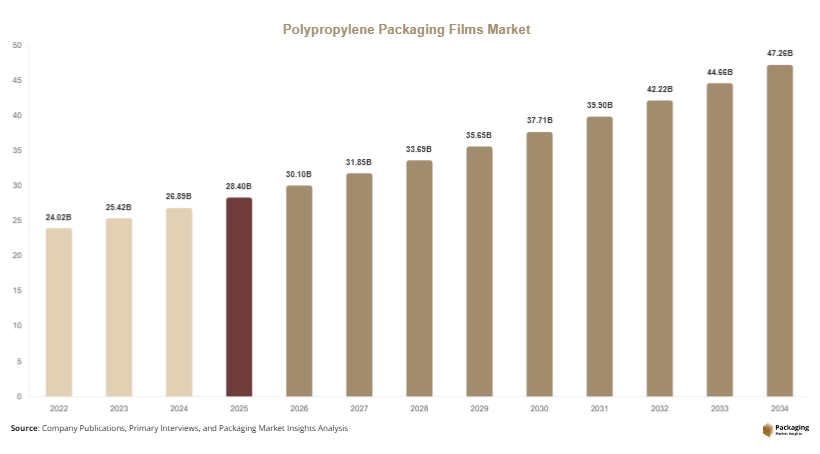
The global polypropylene packaging films market size was valued at approximately USD 28.4 billion in 2025. The market is estimated to reach USD 30.1 billion in 2026 as consumption increases across emerging economies and high-growth packaging segments. Over the forecast period from 2025 to 2034, the market is projected to grow at a compound annual growth rate (CAGR) of 5.8%, reaching nearly USD 50.3 billion by 2034.
The polypropylene packaging films market continues to expand steadily as industries increasingly adopt lightweight, durable, and cost-efficient flexible packaging materials. Polypropylene (PP) films are widely used across food, beverage, pharmaceutical, and consumer goods sectors due to their moisture resistance, clarity, barrier performance, and recyclability potential. Growing demand for packaged food, rising e-commerce activity, and innovations in flexible packaging technologies are shaping the market landscape.
Key Highlights
- The global polypropylene packaging films market was valued at USD 28.4 billion in 2025 and is estimated to reach USD 30.1 billion in 2026, with projections indicating it will grow to USD 50.3 billion by 2034, expanding at a CAGR of 5.8% during 2025–2034.
- Market growth is primarily driven by rising demand from food packaging and consumer goods industries, where polypropylene films are widely used for their durability, clarity, and moisture resistance.
- The industry is also witnessing a growing shift toward recyclable mono-material polypropylene packaging solutions, supporting sustainability initiatives and regulatory compliance in global packaging markets
Explore more data points, trends and opportunities Download Free Sample Report
Market Trends
Increasing Adoption of Biaxially Oriented Polypropylene (BOPP) Films
One of the most significant trends in the polypropylene packaging films market is the increasing adoption of biaxially oriented polypropylene (BOPP) films. These films offer enhanced strength, improved clarity, and superior barrier properties compared with conventional polypropylene films. BOPP films are widely used in snack packaging, confectionery wrappers, and labels due to their excellent printability and durability. As brand owners focus on attractive shelf presentation and longer product shelf life, BOPP films are gaining strong traction across retail packaging applications. Manufacturers are also investing in advanced orientation technologies to improve tensile strength and optical properties. As a result, BOPP films are expected to remain a dominant and expanding segment within the polypropylene packaging films industry.
Development of Recyclable and Sustainable Film Structures
Another important trend shaping the polypropylene packaging films market is the development of recyclable and environmentally responsible packaging films. Governments and regulatory bodies are encouraging the packaging industry to reduce plastic waste and improve recyclability. In response, film manufacturers are designing mono-material polypropylene structures that replace multilayer laminates containing incompatible polymers. These recyclable solutions help simplify the recycling process while maintaining barrier and mechanical performance. Several packaging producers are also introducing downgauged films that use less material without compromising strength. Sustainability commitments from global consumer brands are accelerating adoption of these advanced polypropylene packaging films, making eco-friendly film technologies a key trend across the market.
Market Drivers
Rapid Expansion of the Global Packaged Food Industry
The expansion of the packaged food sector is a major driver of the polypropylene packaging films market. Changing lifestyles, urbanization, and increasing disposable income have led to higher consumption of convenience foods and ready-to-eat meals. Polypropylene films play a critical role in protecting food products from moisture, contamination, and oxygen exposure. They also offer high sealing efficiency and strong puncture resistance, which are essential for snack foods and bakery packaging. As global retail networks and supermarket chains expand, demand for visually appealing and protective packaging continues to grow. Consequently, food manufacturers rely heavily on polypropylene films to maintain product quality and extend shelf life.
Growing Demand for Flexible and Lightweight Packaging
Another key driver influencing the polypropylene packaging films market is the shift toward flexible and lightweight packaging solutions. Compared with rigid containers, flexible films require less material, occupy less storage space, and reduce transportation costs. These advantages improve supply chain efficiency for manufacturers and retailers. Polypropylene films are particularly valued for their low density, excellent moisture resistance, and versatility in packaging design. As industries seek cost-efficient and high-performance materials, polypropylene packaging films are increasingly used across pharmaceuticals, personal care products, and consumer goods packaging applications.
Market Restraint
Environmental Concerns and Regulatory Pressure on Plastic Packaging
Despite strong demand growth, environmental concerns related to plastic waste represent a significant restraint for the polypropylene packaging films market. Governments around the world are implementing stricter regulations on single-use plastics and non-recyclable packaging materials. These policies are intended to reduce landfill waste and encourage sustainable material use.
Polypropylene films, although recyclable in theory, often face challenges in practical recycling systems due to contamination and multilayer structures. In many regions, recycling infrastructure remains underdeveloped, which limits the recovery of polypropylene packaging waste. This situation creates pressure on packaging producers to redesign products and invest in recycling technologies.
For example, several European regulatory frameworks require packaging companies to increase the proportion of recyclable materials in consumer packaging. Compliance with these requirements can increase production costs and require additional research and development investment. While the industry is actively developing recyclable film solutions, the transition period may slow market growth in regions with strict environmental policies.
Market Opportunities
Growth of E-Commerce Packaging Applications
The rapid growth of global e-commerce represents a significant opportunity for the polypropylene packaging films market. Online retail requires durable and protective packaging materials to ensure safe product delivery during transportation and handling. Polypropylene films offer excellent puncture resistance, flexibility, and sealing performance, making them suitable for protective packaging formats such as mailer bags, wrapping films, and protective liners. As e-commerce platforms continue expanding in emerging economies, packaging demand is increasing across logistics networks. This trend is encouraging manufacturers to develop stronger and more adaptable polypropylene film structures designed specifically for shipping and distribution environments.
Technological Advancements in High-Barrier Film Solutions
Another promising opportunity in the polypropylene packaging films market lies in technological innovation related to high-barrier film solutions. Packaging companies are developing advanced coatings and multilayer structures that enhance oxygen, moisture, and aroma barrier properties. These innovations allow polypropylene films to replace more complex packaging materials traditionally used in pharmaceutical and high-value food applications. Improved barrier performance also helps extend product shelf life, reducing food waste and improving supply chain efficiency. As research and development activities continue, advanced polypropylene packaging films are expected to penetrate new high-performance packaging applications across multiple industries.
Report Scope
| Report Metric | Details |
|---|---|
| Market Size in 2025 | USD 28.4 Billion |
| Market Size in 2026 | USD 30.1 Billion |
| Market Size in 2034 | USD 50.3 Billion |
| CAGR | 5.8% (2026-2034) |
| Base Year for Estimation | 2025 |
| Historical Data | 2022-2024 |
| Forecast Period | 2026-2034 |
| Report Coverage | Revenue Forecast, Competitive Landscape, Supply Chain Disruption, Growth Factors, Environment & Regulatory Landscape and Trends |
| Geographies Covered | North America, Europe, APAC, Middle East and Africa, LATAM |
| Countries Covered | U.S., Canada, U.K., Germany, France, Spain, Italy, Russia, Nordic, Benelux, Rest of Europe, China, South Korea, Japan, India, Australia, Singapore, Taiwan, South East Asia, Rest of Asia-Pacific, UAE, Turky, Saudi Arabia, South Africa, Egypt, Nigeria, Rest of MEA, Brazil, Mexico, Argentina, Chile, Colombia, Rest of LATAM |
Explore more data points, trends and opportunities Download Free Sample Report
Segmental Analysis
By Type
The Biaxially Oriented Polypropylene (BOPP) segment dominated the polypropylene packaging films market in 2024, accounting for approximately 56% of total market share. BOPP films are widely preferred due to their excellent clarity, high tensile strength, and superior moisture barrier properties. These films are extensively used in packaging snack foods, confectionery, bakery products, and tobacco products. Their strong printability and compatibility with advanced packaging machinery make them highly suitable for large-scale commercial packaging operations. As consumer product brands increasingly focus on attractive packaging designs and shelf visibility, BOPP films remain the dominant material choice in the polypropylene packaging films industry.
The Cast Polypropylene (CPP) segment is expected to be the fastest-growing type segment, projected to grow at a CAGR of approximately 6.5% during the forecast period. CPP films offer excellent heat seal strength and flexibility, making them suitable for lamination structures and retort packaging applications. Growth in this segment is driven by rising demand for flexible packaging in ready-to-eat meals and processed foods. In addition, technological advancements in film extrusion processes are enabling manufacturers to produce CPP films with improved mechanical properties and barrier performance.
By Application
The Food Packaging segment held the largest share in the polypropylene packaging films market, accounting for nearly 62% of the market in 2024. Polypropylene films are widely used in food packaging due to their moisture resistance, lightweight properties, and ability to preserve product freshness. These films are commonly used for packaging snacks, bakery items, dried fruits, confectionery, and frozen foods. Their strong sealing properties help prevent contamination and extend product shelf life. As global food consumption continues to increase and retail distribution networks expand, food packaging remains the primary application area for polypropylene packaging films.
The Labeling and Lamination segment is projected to be the fastest-growing application segment, with an estimated CAGR of 6.2% over the forecast period. Polypropylene films are widely used in pressure-sensitive labels and lamination structures due to their clarity and durability. Growth in this segment is supported by increasing demand for high-quality packaging labels that enhance brand visibility and product differentiation. Additionally, advancements in printing technologies and decorative packaging designs are encouraging manufacturers to adopt polypropylene films for labeling applications across multiple industries.
By End-Use Industry
The Food & Beverage industry dominated the polypropylene packaging films market in 2024, accounting for approximately 48% of total market share. Food manufacturers widely use polypropylene films to protect products from moisture, oxygen, and external contamination. These films are suitable for high-volume packaging operations due to their durability and compatibility with automated packaging systems. As demand for packaged food products continues to grow worldwide, the food and beverage sector remains the largest end-use segment for polypropylene packaging films.
The Pharmaceutical industry is expected to be the fastest-growing end-use segment, expanding at a CAGR of around 6.3% during the forecast period. Pharmaceutical companies require high-quality packaging materials that provide strong barrier properties and product protection. Polypropylene films are increasingly used in blister packs, sachets, and medical packaging applications. Growth in this segment is supported by increasing global pharmaceutical production and the need for secure packaging solutions that ensure product integrity during transportation and storage.
Polypropylene Packaging Films Market Segmentations
Type
- Biaxially Oriented Polypropylene (BOPP)
- Cast Polypropylene (CPP)
Application
- Food Packaging
- Labeling & Lamination
- Industrial Packaging
End-Use Industry
- Food & Beverage
- Pharmaceuticals
- Personal Care & Cosmetics
- Consumer Goods
Regional Analysis
North America
North America accounted for approximately 24% of the global polypropylene packaging films market share in 2025. The region is projected to grow at a CAGR of around 4.9% during the forecast period. Demand in the region is largely driven by established food processing industries and widespread adoption of flexible packaging solutions. Polypropylene films are widely used in snack foods, frozen meals, and bakery packaging applications. In addition, ongoing technological innovations in packaging materials and strong presence of packaging manufacturers support market growth in the region.
The United States represents the dominant country in the North American polypropylene packaging films market. A key growth factor is the increasing demand for sustainable packaging solutions from major consumer goods brands. Companies in the country are actively developing recyclable polypropylene film structures to meet sustainability targets and regulatory requirements. This shift toward recyclable packaging materials is expected to stimulate further innovation and investment within the regional market.
Europe
Europe held nearly 21% share of the polypropylene packaging films market in 2025 and is expected to grow at a CAGR of approximately 4.6% through 2034. The region’s packaging industry is characterized by strong regulatory oversight and high consumer awareness regarding environmental sustainability. Polypropylene films are widely used across food packaging, labeling, and pharmaceutical applications. Growth in the region is supported by technological improvements in recyclable film production and increasing adoption of lightweight flexible packaging solutions.
Germany remains the dominant country in the European market due to its well-established packaging manufacturing sector and advanced industrial infrastructure. One unique growth factor is the strong presence of research-driven packaging technology companies that continually develop improved film processing techniques. These innovations allow manufacturers to produce thinner, stronger, and more efficient polypropylene packaging films while complying with stringent environmental regulations.
Asia Pacific
Asia Pacific accounted for the largest share of the polypropylene packaging films market at approximately 38% in 2025 and is projected to expand at a CAGR of around 6.7% during the forecast period. Rapid industrialization, population growth, and expanding consumer markets are driving strong demand for packaged products across the region. Polypropylene packaging films are widely used in food packaging, personal care products, and consumer goods sectors. Additionally, the presence of large manufacturing bases and lower production costs supports market expansion.
China leads the Asia Pacific market due to its extensive packaging manufacturing industry and strong domestic demand for packaged consumer goods. A major growth factor is the rapid expansion of e-commerce platforms in the country. Increased online retail activity requires durable and cost-efficient packaging materials, which has significantly boosted demand for polypropylene films used in protective and shipping packaging solutions.
Middle East & Africa
The Middle East & Africa region accounted for roughly 9% of the polypropylene packaging films market share in 2025 and is forecast to grow at a CAGR of about 5.1% through 2034. Rising urbanization and increasing demand for packaged food products are supporting growth in the regional packaging industry. Polypropylene films are widely used in food wrapping, labeling, and consumer goods packaging due to their durability and cost efficiency.
The United Arab Emirates is emerging as a key market in the region. One unique growth factor is the expansion of regional logistics and distribution hubs supporting international trade. As the UAE strengthens its role as a global logistics center, demand for flexible packaging materials, including polypropylene films, is increasing across food exports and consumer product distribution sectors.
Latin America
Latin America held around 8% share of the polypropylene packaging films market in 2025 and is projected to grow at a CAGR of approximately 5.4% during the forecast period. The region’s growth is supported by increasing demand for packaged food products and rising investments in retail infrastructure. Flexible packaging materials are becoming increasingly popular among food manufacturers due to their cost efficiency and convenience.
Brazil is the dominant country in the Latin American market. A major growth factor is the expansion of the domestic food processing industry, which relies heavily on flexible packaging materials. As local food manufacturers expand their product offerings and distribution networks, demand for polypropylene packaging films used in snack foods, dairy products, and processed foods continues to increase.
Competitive Landscape
The polypropylene packaging films market is moderately consolidated, with several global and regional manufacturers competing through product innovation, capacity expansion, and strategic partnerships. Leading companies focus on developing advanced film technologies that offer improved barrier properties, enhanced printability, and greater recyclability. Investments in research and development are also increasing as companies aim to meet sustainability requirements and evolving packaging regulations.
Among the major players, Amcor is considered a leading company due to its strong global presence and extensive flexible packaging portfolio. The company continues to invest in recyclable polypropylene packaging technologies. Other prominent players include Berry Global, Toray Industries, Jindal Poly Films, and Cosmo Films.
A recent industry development includes investments in new BOPP film production lines aimed at increasing global manufacturing capacity. Companies are also focusing on developing recyclable mono-material packaging structures to align with global sustainability goals.
Key Players List
- Amcor
- Berry Global
- Toray Industries
- Jindal Poly Films
- Cosmo Films
- Taghleef Industries
- Treofan Group
- UFlex Limited
- Inteplast Group
- Innovia Films
- Polibak Plastik
- Vibac Group
- Manucor
- SRF Limited
- Profol GmbH