Polypropylene Foam Trays Market Size and Growth
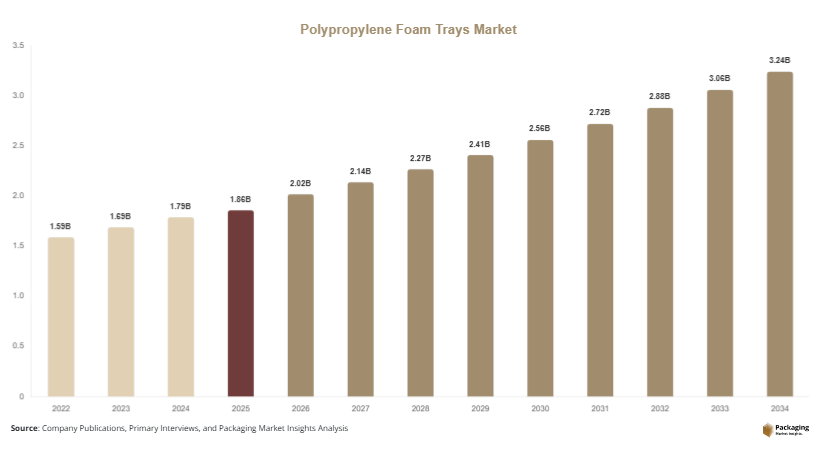
The global polypropylene foam trays market size is estimated to reach USD 1.86 billion in 2025, reflecting steady adoption across the food processing and retail sectors. The market is expected to grow further to USD 2.02 billion in 2026 as demand for hygienic and protective packaging continues to rise. Over the forecast period from 2025 to 2034, the market is projected to reach USD 3.42 billion in 2034, expanding at a compound annual growth rate (CAGR) of 6.1%.
The polypropylene foam trays market has gained steady traction over the past decade due to increasing demand for lightweight, durable, and cost-efficient packaging materials across multiple industries. Polypropylene foam trays are widely used in food packaging, electronics protection, pharmaceutical transport, and industrial packaging applications. Their strong cushioning ability, moisture resistance, and recyclability make them a practical choice for manufacturers seeking both performance and sustainability.
Key Highlights
- The Polypropylene Foam Trays Market is projected to reach USD 3.42 billion by 2034, growing at a CAGR of 6.1% from 2025 to 2034.
- Food packaging remains the leading application segment, supported by rising demand for hygienic and protective packaging for fresh and processed foods.
- Asia Pacific is expected to witness the fastest growth, driven by expanding retail infrastructure and ongoing technological advancements improving tray durability and recyclability.
Explore more data points, trends and opportunities Download Free Sample Report
Market Trends
Increasing Adoption of Sustainable Packaging Solutions
One major trend shaping the polypropylene foam trays market is the growing demand for sustainable packaging alternatives. Governments, retailers, and consumers are placing greater attention on environmentally responsible packaging practices. As a result, manufacturers are developing recyclable polypropylene foam trays and exploring material reduction strategies that lower environmental impact without compromising structural integrity.
Producers are also integrating post-consumer recycled polypropylene into foam tray production processes. This approach reduces reliance on virgin plastic while maintaining product quality. Retail chains are increasingly requesting packaging suppliers to meet sustainability targets related to recyclability and carbon footprint reduction. These initiatives are encouraging innovation in foam extrusion technologies and lightweight tray designs.
Growth of Ready-to-Eat and Fresh Food Packaging
Another significant trend is the rapid growth of ready-to-eat meals and fresh food packaging. Consumers are purchasing more pre-packaged meats, vegetables, and prepared foods due to convenience and time constraints. Polypropylene foam trays provide strong insulation, shock resistance, and moisture control, which makes them suitable for protecting perishable food items during storage and transport.
Food retailers and processors are increasingly adopting foam trays with enhanced sealing compatibility for modified atmosphere packaging systems. These packaging formats extend product shelf life while maintaining product visibility on store shelves. The expansion of meal-kit services and online grocery delivery platforms is further accelerating the demand for protective foam trays.
Market Drivers
Rising Demand from the Food Processing Industry
The expanding global food processing industry is a primary driver of the polypropylene foam trays market. Processed meat, poultry, seafood, fruits, and vegetables require packaging solutions that maintain hygiene, freshness, and structural protection. Polypropylene foam trays provide reliable cushioning and insulation, helping to prevent product damage during transportation and storage.
Supermarkets and food retailers rely on foam trays to present fresh food products in a visually appealing and organized manner. The trays are compatible with sealing films, making them suitable for vacuum and modified atmosphere packaging systems. As global food consumption continues to rise and supply chains become more complex, demand for dependable protective packaging solutions is expected to grow steadily.
Expansion of Organized Retail and E-Commerce
The rapid expansion of organized retail formats and e-commerce platforms is another important driver. Modern supermarkets, hypermarkets, and online grocery platforms require packaging materials that support product safety and efficient logistics operations. Polypropylene foam trays offer lightweight construction and strong structural stability, which reduces transportation costs and protects fragile products.
E-commerce grocery delivery services rely on protective packaging to maintain product quality throughout last-mile delivery. Foam trays help prevent product movement and absorb impact during shipping. As online food retail continues to expand globally, demand for durable and efficient packaging solutions such as polypropylene foam trays is expected to increase significantly.
Market Restraint
Environmental Concerns and Regulatory Pressure on Plastic Packaging
Despite growing adoption, the polypropylene foam trays market faces challenges related to environmental concerns and increasing regulatory scrutiny of plastic packaging materials. Many governments and environmental organizations are promoting policies aimed at reducing single-use plastic consumption. These initiatives have created pressure on packaging manufacturers to develop recyclable, reusable, or biodegradable alternatives.
In several regions, policymakers are introducing regulations that restrict certain types of plastic packaging or encourage the adoption of alternative materials such as molded pulp and paper-based trays. These policies can increase compliance costs for foam tray manufacturers and create uncertainty in long-term investment planning.
Retailers are also responding to consumer expectations by setting packaging sustainability targets. Some food retailers are experimenting with alternative packaging materials, which may reduce the use of foam trays in certain product categories. For example, fresh produce and ready meals are sometimes packaged using molded fiber trays to improve environmental perception.
Although polypropylene foam trays remain recyclable and offer strong protective performance, manufacturers must invest in recycling infrastructure and material innovation to remain competitive. Companies are therefore focusing on developing thinner foam structures, recyclable tray formats, and improved collection systems to address sustainability concerns.
Market Opportunities
Development of Recyclable and Circular Packaging Systems
A major opportunity in the polypropylene foam trays market lies in the development of recyclable and circular packaging systems. Advances in material recovery technologies are enabling polypropylene foam products to be collected, processed, and reintroduced into manufacturing cycles. This shift toward circular packaging models is attracting interest from retailers and food manufacturers seeking to reduce waste.
Packaging companies are investing in improved recycling programs that allow used foam trays to be collected from retail stores and food processing facilities. These trays can then be converted into raw polypropylene pellets for reuse in packaging applications. By strengthening recycling infrastructure and improving product design, manufacturers can address sustainability concerns while expanding market opportunities.
Increasing Demand in Emerging Economies
Emerging economies present another strong opportunity for the market. Rapid urbanization, rising disposable income, and expansion of modern retail chains are driving the consumption of packaged food products across regions such as Asia Pacific, Latin America, and the Middle East.
As consumer lifestyles change, demand for convenient packaged meals and fresh food products is increasing. Food producers and retailers in these regions require cost-efficient packaging materials that protect products while supporting high-volume distribution networks. Polypropylene foam trays offer an attractive solution due to their lightweight structure, durability, and affordability, making them well suited for high-growth consumer markets.
Report Scope
| Report Metric | Details |
|---|---|
| Market Size in 2025 | USD 1.86 Billion |
| Market Size in 2026 | USD 2.02 Billion |
| Market Size in 2034 | USD 3.42 Billion |
| CAGR | 6.1% (2026-2034) |
| Base Year for Estimation | 2025 |
| Historical Data | 2022-2024 |
| Forecast Period | 2026-2034 |
| Report Coverage | Revenue Forecast, Competitive Landscape, Supply Chain Disruption, Growth Factors, Environment & Regulatory Landscape and Trends |
| Geographies Covered | North America, Europe, APAC, Middle East and Africa, LATAM |
| Countries Covered | U.S., Canada, U.K., Germany, France, Spain, Italy, Russia, Nordic, Benelux, Rest of Europe, China, South Korea, Japan, India, Australia, Singapore, Taiwan, South East Asia, Rest of Asia-Pacific, UAE, Turky, Saudi Arabia, South Africa, Egypt, Nigeria, Rest of MEA, Brazil, Mexico, Argentina, Chile, Colombia, Rest of LATAM |
Explore more data points, trends and opportunities Download Free Sample Report
Segmental Analysis
By Type
The expanded polypropylene (EPP) foam trays segment dominated the polypropylene foam trays market in 2024, accounting for approximately 62% of the global market share. EPP foam trays are widely used due to their superior shock absorption, lightweight properties, and resistance to moisture and chemicals. These characteristics make them suitable for protecting delicate food products and industrial components during transportation. Food packaging companies prefer EPP trays because they maintain structural integrity even under varying temperature conditions, making them compatible with refrigerated supply chains.
The extruded polypropylene (XPP) foam trays segment is projected to be the fastest-growing category, expanding at a CAGR of around 7.1% during the forecast period. XPP trays are gaining popularity due to their uniform cell structure and improved surface finish, which enhances product presentation in retail displays. Manufacturers are adopting advanced extrusion technologies that allow thinner and stronger foam structures. These improvements help reduce material consumption while maintaining product durability, making XPP trays an attractive option for food packaging and electronics protection.
By Application
The food packaging segment held the largest share of the polypropylene foam trays market in 2024, accounting for roughly 68% of total demand. Polypropylene foam trays are widely used for packaging fresh meat, seafood, poultry, fruits, and vegetables. Their ability to absorb shocks and prevent product movement helps maintain product quality during transportation. In addition, foam trays provide insulation that helps preserve freshness in refrigerated environments. Food retailers rely on these trays to display products in an organized and hygienic manner.
The electronics packaging segment is projected to register the fastest growth, with an estimated CAGR of 6.8% during the forecast period. Increasing demand for consumer electronics and delicate electronic components requires packaging materials that offer reliable cushioning and static resistance. Polypropylene foam trays are increasingly used to protect circuit boards, sensors, and precision components during shipping and storage. As electronics manufacturing expands globally, particularly in Asia Pacific, demand for protective foam trays is expected to rise steadily.
By End-Use Industry
The food processing industry accounted for the largest share of the polypropylene foam trays market in 2024, representing approximately 55% of overall demand. Food processors require packaging solutions that maintain hygiene, prevent contamination, and ensure efficient product handling. Polypropylene foam trays provide a practical packaging format for large-scale food distribution systems. Their compatibility with sealing films and labeling systems further enhances their suitability for automated packaging lines.
The pharmaceutical and healthcare industry is expected to be the fastest-growing end-use segment, expanding at a CAGR of around 6.6% through 2034. Pharmaceutical companies are increasingly using foam trays to protect medical devices, diagnostic kits, and sensitive healthcare equipment. These trays offer excellent cushioning and vibration resistance, ensuring that fragile medical products remain intact during transportation. As global healthcare logistics networks expand, the demand for reliable protective packaging solutions is expected to increase.
Polypropylene Foam Trays Market Segmentations
Type
- Expanded Polypropylene (EPP) Foam Trays
- Extruded Polypropylene (XPP) Foam Trays
Application
- Food Packaging
- Electronics Packaging
- Industrial Packaging
- Consumer Goods Packaging
End-Use Industry
- Food Processing
- Electronics Manufacturing
- Pharmaceutical & Healthcare
- Consumer Goods
Regional Analysis
North America
North America accounted for approximately 29% of the global polypropylene foam trays market share in 2025, making it one of the largest regional markets. The region is projected to grow at a CAGR of around 5.4% through 2034. Demand is driven primarily by strong consumption of packaged meat, poultry, and ready-to-eat meals. Retail chains and food processors in the United States and Canada rely heavily on foam tray packaging due to its ability to maintain hygiene and product integrity during distribution.
The United States remains the dominant country in this region. A key growth factor is the advanced cold-chain logistics infrastructure supporting fresh food distribution. The presence of large supermarket chains and food service providers has encouraged the widespread adoption of protective packaging formats such as polypropylene foam trays.
Europe
Europe held nearly 24% of the global market share in 2025 and is expected to expand at a CAGR of approximately 5.2% during the forecast period. The region demonstrates strong demand for food packaging materials that meet strict safety and hygiene standards. Polypropylene foam trays are widely used in supermarkets for packaging fresh meat, seafood, and poultry products.
Germany represents a leading country in the European market due to its well-developed food processing industry. A unique growth factor in the region is the strong focus on packaging innovation and sustainability initiatives. Manufacturers are developing recyclable foam tray solutions to comply with evolving environmental regulations.
Asia Pacific
Asia Pacific captured around 31% of the global polypropylene foam trays market share in 2025, making it the largest regional market. The region is projected to grow at the fastest CAGR of about 7.4% through 2034. Rapid population growth and rising demand for packaged food products are driving strong consumption of protective packaging materials.
China dominates the regional market due to its extensive food processing and retail sectors. A key growth factor is the rapid expansion of organized supermarkets and online grocery platforms. These retail channels require reliable packaging solutions that maintain product quality during transportation.
Middle East & Africa
The Middle East & Africa region accounted for approximately 7% of the global market share in 2025 and is expected to expand at a CAGR of 5.7% during the forecast period. The market is gradually growing as food retail infrastructure and cold-chain logistics improve across several countries.
Saudi Arabia leads the regional market due to rising demand for packaged meat and poultry products. A unique growth factor is the increasing investment in modern food processing facilities and supermarket networks, which require reliable protective packaging materials such as polypropylene foam trays.
Latin America
Latin America represented nearly 9% of the global polypropylene foam trays market share in 2025 and is forecast to grow at a CAGR of around 6.0% through 2034. The market is supported by increasing consumption of packaged food products and expansion of regional food retail chains.
Brazil dominates the Latin American market due to its large agricultural and food processing industries. A major growth factor in the country is the increasing adoption of modern packaging technologies by meat exporters and food processors seeking to improve product safety and shelf presentation.
Competitive Landscape
The polypropylene foam trays market is moderately competitive, with several global and regional manufacturers operating across packaging supply chains. Companies are focusing on product innovation, sustainability initiatives, and expansion of production capacity to strengthen their market positions.
Major participants are investing in advanced foam extrusion technologies that enable lightweight structures with improved durability. Many companies are also introducing recyclable polypropylene foam trays and implementing material reduction strategies to align with sustainability goals.
Among leading companies, Sealed Air Corporation is considered a prominent market leader due to its extensive packaging portfolio and strong presence in the food packaging industry. The company recently introduced improved foam tray designs that reduce plastic usage while maintaining structural strength.
Other key companies are expanding their geographic footprint by establishing new manufacturing facilities in emerging markets. Strategic collaborations with food processors and retail chains are also helping companies strengthen long-term supply relationships and improve distribution networks.
Key Players List
- Sealed Air Corporation
- Sonoco Products Company
- DS Smith Plc
- Dart Container Corporation
- Genpak LLC
- Coveris Holdings S.A.
- Pactiv Evergreen Inc.
- Anchor Packaging LLC
- Borealis AG
- Kaneka Corporation
- JSP Corporation
- BASF SE
- Pregis LLC
- Sabic
- NOVA Chemicals Corporation