Polyethylene Mailers Market Size and Growth
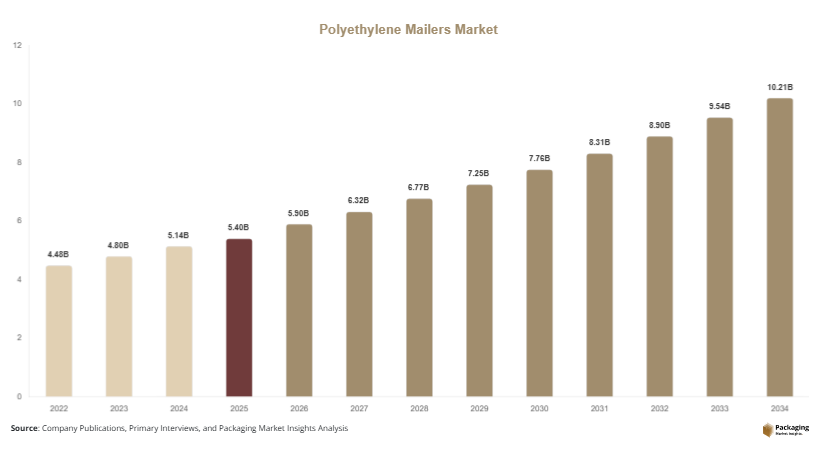
The polyethylene mailers market is undergoing steady expansion as demand for lightweight, durable, and cost-effective packaging solutions increases across global industries. Polyethylene mailers, often made from low-density polyethylene (LDPE) or linear low-density polyethylene (LLDPE), are widely used in e-commerce, retail, logistics, and direct-to-consumer (DTC) deliveries due to their strength, water resistance, and flexibility. In 2025, the market size is estimated at USD 5.4 billion, and it is expected to grow to approximately USD 5.9 billion in 2026. By 2034, the market is projected to reach USD 10.7 billion, registering a compound annual growth rate (CAGR) of 7.1% from 2025 to 2034.
One of the primary growth factors is the rapid expansion of e-commerce. As more consumers shift to online shopping, the need for reliable and efficient packaging – especially mailers that can protect merchandise during transit – has surged. Polyethylene mailers are preferred for their lightweight nature, which helps reduce shipping costs, and their tear-resistant properties that improve durability during handling and transportation.
Key Highlights:
- The market size for this segment is projected to reach USD 10.7 billion by 2034, reflecting strong growth trends and increasing adoption across various industries.
- The market is expected to grow at a CAGR of 7.1% during 2025–2034, indicating steady expansion driven by evolving consumer and business needs.
- Growth is primarily driven by the rapid expansion of e-commerce and direct-to-consumer (DTC) channels, which require efficient and reliable packaging solutions.
- There is increasing demand for lightweight and durable packaging, enabling cost-effective shipping and better protection of products during transit.
- Rising focus on recyclable and enhanced-function mailers is encouraging innovation in materials and design, aligning with sustainability goals and regulatory requirements.
Explore more data points, trends and opportunities Download Free Sample Report
Market Trends
Shift Toward Sustainable and Recyclable Polyethylene Mailers
Environmental sustainability is becoming a central focus in the polyethylene mailers market. Many manufacturers are shifting toward recyclable and recyclable-compatible mailers made from advanced polyethylene blends that can be more easily reintegrated into recycling systems. This shift is driven by both regulatory mandates targeting plastic waste reduction and increasing consumer awareness of environmental issues. Companies are investing in research and development to create mailer products that maintain strength and performance while minimizing environmental impact. Packaging buyers and retailers are placing greater importance on sustainability credentials, making eco-friendly mailers a competitive necessity. This trend is expected to reshape supply chains and influence purchasing behavior across regions.
Customization and Branding Through Printed Polyethylene Mailers
Customization is a key trend driving the polyethylene mailers market as brands seek to enhance consumer experience and strengthen brand visibility. Customized mailers, featuring logos, brand colors, and printed messaging, are increasingly used by e-commerce retailers to differentiate themselves in competitive markets. Printing technologies have advanced, enabling high-quality graphics without compromising the integrity and functionality of the polyethylene material. The trend is particularly evident in fashion, beauty, and lifestyle segments, where mailer packaging is part of the unboxing experience that influences customer perception. As digital commerce evolves, the integration of interactive elements like QR codes and scannable branding is also augmenting the value of custom mailers.
Market Drivers
Expansion of E-commerce and Direct-to-Consumer Retail
The global e-commerce landscape continues to grow rapidly, fundamentally altering packaging requirements and driving demand for polyethylene mailers. Online purchases for apparel, accessories, cosmetics, and small electronics need efficient, cost-effective packaging for secure delivery. Polyethylene mailers are lightweight, reducing shipping costs and improving handling efficiency, which are critical factors for e-commerce retailers seeking to enhance profitability. The direct-to-consumer model allows brands to manage end-to-end customer experiences and leverage packaging as part of their brand identity. As more companies adopt this model, the need for tailored and affordable mailer solutions rises. The increasing volume of parcel deliveries globally is thus a fundamental driver for the mailer market.
Need for Durable, Water-Resistant, and Cost-Effective Packaging
Polyethylene mailers are preferred due to their blend of durability, water resistance, and cost-effectiveness. In comparison to traditional cardboard boxes or paper envelopes, polyethylene mailers offer superior protection against moisture and tear-related damage. For businesses, this means reduced losses due to damaged goods, fewer returns, and higher customer satisfaction. The resilience of polyethylene films also supports multi-product shipments, where flexible packaging can accommodate irregular shapes without compromising strength. Companies across logistics, retail, and distribution sectors view these attributes as contributors to operational efficiency. As packaging continues to influence total delivery costs and product safety, the demand for polyethylene mailers remains strong.
Market Restraint
Environmental Concerns Over Plastic Waste and Regulatory Limitations
One of the primary restraints on the polyethylene mailers market is environmental concern related to plastic waste and subsequent regulatory actions. Despite efforts to make polyethylene mailers recyclable, the association of plastic packaging with environmental pollution persists. Governments and regulatory bodies in several regions are implementing stricter policies to reduce single-use plastics. Such regulations can limit the use of traditional polyethylene mailers, forcing manufacturers and end-users to explore alternatives or add recycling requirements. For example, certain municipalities may ban non-recyclable polymer blends or require mailers to have post-consumer recycled (PCR) content, impacting material sourcing and production costs. Additionally, consumer sentiment against plastic packaging can influence purchasing decisions, potentially reducing demand. These regulatory and perceptual challenges make environmental compliance and sustainable innovation critical for market growth.
Market Opportunities
Development of Recycled and Recyclable Polyethylene Mailer Solutions
The growing focus on sustainability presents an opportunity for companies to innovate and expand offerings in recycled and recyclable polyethylene mailer solutions. Advanced material technology enables the production of mailers with higher percentages of post-consumer recycled content without compromising performance. Businesses that invest in eco-conscious packaging stand to benefit from regulatory incentives, meet retailer sustainability standards, and appeal to environmentally aware consumers. Partnerships with recycling infrastructure providers and deposit-return schemes can further enhance the practical recyclability of mailers. As sustainability continues to gain traction across supply chains, the ability to provide credible, certified eco-friendly mailer products can differentiate manufacturers and unlock new revenue streams.
Adoption of Enhanced Functionality and Smart Packaging Features
There is significant potential in integrating enhanced functionality and smart packaging features into polyethylene mailers. Anti-static coatings, tamper-evident seals, QR code integration, and temperature indicators can add value, particularly for specific sectors like electronics, healthcare, and premium retail. Smart packaging opens avenues for improved tracking, consumer engagement, and security during shipment. These features can also aid in supply chain visibility and product authentication, which are increasingly critical in global logistics environments. Manufacturers who can offer such value-added solutions differentiate themselves and attract clients looking for more than basic protective packaging. The growing adoption of IoT and digital tracking further amplifies the opportunity for smart mailer innovations.
Report Scope
| Report Metric | Details |
|---|---|
| Market Size in 2025 | USD 5.4 Billion |
| Market Size in 2026 | USD 5.9 Billion |
| Market Size in 2034 | USD 10.7 Billion |
| CAGR | 7.1% (2026-2034) |
| Base Year for Estimation | 2025 |
| Historical Data | 2022-2024 |
| Forecast Period | 2026-2034 |
| Report Coverage | Revenue Forecast, Competitive Landscape, Supply Chain Disruption, Growth Factors, Environment & Regulatory Landscape and Trends |
| Geographies Covered | North America, Europe, APAC, Middle East and Africa, LATAM |
| Countries Covered | U.S., Canada, U.K., Germany, France, Spain, Italy, Russia, Nordic, Benelux, Rest of Europe, China, South Korea, Japan, India, Australia, Singapore, Taiwan, South East Asia, Rest of Asia-Pacific, UAE, Turky, Saudi Arabia, South Africa, Egypt, Nigeria, Rest of MEA, Brazil, Mexico, Argentina, Chile, Colombia, Rest of LATAM |
Explore more data points, trends and opportunities Download Free Sample Report
Segmental Analysis
Type
The poly mailers segment made from Low-Density Polyethylene (LDPE) dominated the market in 2024, accounting for approximately 45% share. LDPE mailers are preferred due to their flexibility, tear resistance, and lightweight nature. They provide reliable protection for a wide range of products, from apparel to electronics, making them highly versatile. The high adoption of LDPE mailers in e-commerce operations is driven by the material’s ability to reduce shipping costs while ensuring product integrity. Businesses also benefit from their ease of customization, allowing for printed branding and tamper-evident solutions. Overall, LDPE mailers remain a cornerstone in packaging due to their cost-effectiveness and performance characteristics.
The Linear Low-Density Polyethylene (LLDPE) subsegment is the fastest-growing type, with a CAGR of 8.1% during 2025–2034. The growth of LLDPE mailers is driven by their superior puncture resistance and higher tensile strength compared to LDPE, making them suitable for heavier or bulkier shipments. Additionally, LLDPE allows for thinner films without compromising durability, helping to reduce material consumption and environmental impact. E-commerce companies and logistics providers increasingly prefer LLDPE for premium packaging solutions, as it balances cost, sustainability, and functionality. Adoption is further fueled by innovations in recyclable and bio-compatible LLDPE mailers.
Application
The e-commerce application segment held the largest market share in 2024, contributing around 50%. The proliferation of online retail platforms has fueled the demand for polyethylene mailers as an essential packaging solution. E-commerce businesses prioritize mailers that are lightweight, durable, and cost-efficient to optimize shipping expenses while protecting products. Polyethylene mailers also enhance the unboxing experience, an important factor in customer satisfaction and brand loyalty. Additionally, these mailers reduce storage and handling requirements compared to traditional cardboard packaging, making them ideal for high-volume operations across diverse e-commerce verticals, including apparel, electronics, and cosmetics.
The logistics and courier service application is the fastest-growing subsegment with a CAGR of 7.9%. Logistics providers require packaging that can withstand multiple handling points, variable environmental conditions, and long transit distances. Polyethylene mailers offer the flexibility, tear resistance, and water protection necessary for shipping sensitive and non-fragile goods efficiently. With increasing demand for same-day and express delivery services, logistics companies are adopting specialized mailers with reinforced adhesives, anti-static coatings, and tamper-evident features. This growth is also supported by the expanding cross-border e-commerce trade, which demands reliable mailer solutions to reduce damages and returns.
End-Use
The retail and consumer goods end-use segment dominated in 2024, holding approximately 42% share. Retailers extensively use polyethylene mailers to ship apparel, footwear, beauty products, and lifestyle items directly to consumers. The preference is due to mailers’ combination of low weight, durability, and branding opportunities through printed graphics and custom designs. Polyethylene mailers also simplify warehousing and reduce transportation costs. Brands increasingly view mailers as a vehicle for marketing, enabling enhanced brand visibility while ensuring product protection. These factors make retail and consumer goods the leading end-use segment globally.
The electronics and technology end-use is the fastest-growing subsegment, expected to expand at a CAGR of 8.5% during the forecast period. The adoption of polyethylene mailers in electronics is driven by the need for protective packaging for items like small devices, accessories, and peripherals during shipment. Anti-static polyethylene mailers have become popular in this segment, mitigating the risk of electrostatic discharge that could damage sensitive components. The growth of e-commerce electronics retail and the rising consumer preference for secure, tamper-evident mailers further drive demand. This trend highlights the increasing importance of specialized mailer features for high-value and sensitive products.
Polyethylene Mailers Market Segmentations
Type
- Low-Density Polyethylene (LDPE)
- Linear Low-Density Polyethylene (LLDPE)
- High-Density Polyethylene (HDPE)
Application
- E-commerce
- Logistics & Courier Services
- Retail & Consumer Goods
- Others (Healthcare, Electronics)
End-Use
- Retail & Consumer Goods
- Electronics & Technology
- Food & Beverage
- Industrial & Manufacturing
Regional Analysis
North America
North America accounted for approximately 34% of the polyethylene mailers market share in 2025 and is expected to grow at a CAGR of 6.5% during the forecast period. The region’s well-established e-commerce infrastructure and high consumer spending on online retail are key drivers of market growth. The increasing demand for reliable and cost-efficient packaging solutions is encouraging retailers to adopt polyethylene mailers. Additionally, the presence of advanced logistics systems supports rapid delivery expectations, which aligns well with the functional benefits of polyethylene mailers. Retail and distribution sectors in North America continue to prioritize materials that balance performance with cost-effectiveness, further solidifying the role of polyethylene mailers in the packaging mix.
The United States dominates the regional market due to its large consumer market and extensive e-commerce penetration. A unique growth factor in this region is the presence of strong corporate sustainability initiatives. Many U.S.-based retailers are adopting recyclable and reduced-plastic mailer solutions as part of broader environmental goals. These initiatives are supported by consumer expectations for eco-conscious packaging. As leading brands implement policies to reduce packaging waste, demand for advanced polyethylene mailer products continues to rise. Additionally, the strong logistics network in the U.S. supports efficient distribution, reinforcing the adoption of versatile mailer solutions.
Europe
Europe held around 28% market share in 2025 and is projected to grow at a CAGR of 6.2%. Strict regulatory frameworks around plastic usage and packaging waste in Europe are influencing the adoption of sustainable polyethylene mailers. These policies are prompting manufacturers to innovate and offer recyclable or biodegradable polyethylene solutions. The strong emphasis on environmental compliance creates a market environment where sustainable alternatives gain traction. Consumer awareness of eco-friendly packaging practices is also high, which further accelerates demand for polyethylene mailers that meet strict sustainability criteria. Retailers in Europe are increasingly selecting mailers that comply with extended producer responsibility (EPR) regulations.
Germany is a leading country in the European market, supported by its robust industrial and retail sectors. A key growth factor in Germany is the integration of circular economy initiatives, which encourage packaging materials that can be reintegrated into the production cycle. This focus on sustainability is promoting the adoption of polyethylene mailer solutions that are recyclable and made with recycled content. Furthermore, the demand for polyethylene mailers in Germany is supported by strong logistics infrastructure and high consumer expectations for reliable packaging. As retail and e-commerce sectors expand, the need for efficient mailer solutions continues to grow.
Asia Pacific
Asia Pacific accounted for approximately 26% market share in 2025 and is expected to register the highest CAGR of 7.8%. Rapid urbanization, increasing internet penetration, and rising middle-class incomes are driving the demand for e-commerce services and, consequently, packaging solutions such as polyethylene mailers. The market is also benefiting from expanding logistics networks and investments in distribution infrastructure. As consumer shopping preferences shift toward online channels, the requirement for durable and cost-efficient mailers increases. The growth trajectory in Asia Pacific is also supported by favorable government policies that promote industrial expansion and foreign investment.
China dominates the Asia Pacific market due to its large consumer base and rapidly growing e-commerce industry. A unique growth factor in China is the extensive development of regional logistics hubs and same-day delivery services, which rely heavily on efficient packaging solutions. The sheer volume of packages processed daily in China necessitates reliable and cost-effective mailer products. Additionally, the increasing adoption of online shopping by consumers across urban and rural areas is contributing to strong demand. As logistics and postal services expand, the polyethylene mailers market continues to build upon these foundational growth drivers.
Middle East & Africa
The Middle East & Africa region held approximately 6% market share in 2025 and is projected to grow at a CAGR of 6.3%. Growth in this region is gradually accelerating due to expanding retail infrastructure and increasing internet penetration, which supports the adoption of e-commerce. As markets in the Middle East & Africa become more interconnected, there is a growing need for efficient packaging solutions that can support regional and cross-border trade. Polyethylene mailers provide the durability and lightweight characteristics needed for cost-effective shipping, making them suitable for local businesses expanding into online sales.
The United Arab Emirates is a key market in this region, driven by its strategic position as a logistics hub and its developing retail sector. A unique growth factor in the UAE is the investment in advanced logistics facilities and technology-driven distribution centers. These developments support efficient shipping processes and encourage the use of reliable mailer packaging. Additionally, the UAE’s focus on diversifying its economy drives demand for modern packaging solutions, including polyethylene mailers, which support both domestic and international trade operations.
Latin America
Latin America accounted for nearly 6% of the market share in 2025 and is expected to grow at a CAGR of 6.6%. The region’s expanding retail and e-commerce sectors are contributing to increased demand for polyethylene mailers. With growing internet connectivity and rising consumer spending, demand for packaged goods delivered through online channels is increasing. Retailers in Latin America are adopting polyethylene mailers due to their cost-effectiveness and ease of use. Additionally, improvements in distribution networks and postal services are supporting market growth.
Brazil dominates the Latin American market due to its large population, increasing urbanization, and growing retail industry. A key growth factor is the rising adoption of online retail and direct-to-consumer brands in Brazil. These trends necessitate reliable packaging solutions that can protect products during transit while being economically viable. As companies explore regional expansion and seek to improve customer satisfaction, the use of polyethylene mailers continues to gain momentum.
Competitive Landscape
The polyethylene mailers market is moderately fragmented, with several global and regional players offering a range of standard, recyclable, and customized mailer solutions. Key companies include International Paper Company, Sealed Air Corporation, Pregis LLC, Intertape Polymer Group, and Uline Inc. Among them, Sealed Air Corporation is a market leader, recently launching an advanced line of recyclable polyethylene mailers designed for heavy e-commerce usage. This innovation not only strengthens its sustainability portfolio but also addresses growing regulatory demands for eco-friendly packaging. Competitors are focusing on product innovation, strategic partnerships, and geographic expansion to enhance market presence.
Other companies are also leveraging technological advancements to differentiate products. For example, companies are introducing tamper-evident, anti-static, and high-strength mailers for logistics and electronics segments. The competitive landscape emphasizes innovation, sustainability, and customer-centric solutions as critical factors for market leadership. Regional and local players are expanding production capacity to meet rising demand in emerging markets such as Asia Pacific and Latin America, thereby increasing market penetration.
Key Players List
- Sealed Air Corporation
- International Paper Company
- Pregis LLC
- Intertape Polymer Group
- Uline Inc.
- Novolex
- Berry Global, Inc.
- DS Smith Plc
- Smurfit Kappa Group
- Bemis Company, Inc.
- Huhtamaki Oyj
- Winpak Ltd.
- Jiffy Packaging Products
- MACtac
- Plastipak Holdings, Inc.