Polyethylene Films Market Size and Growth
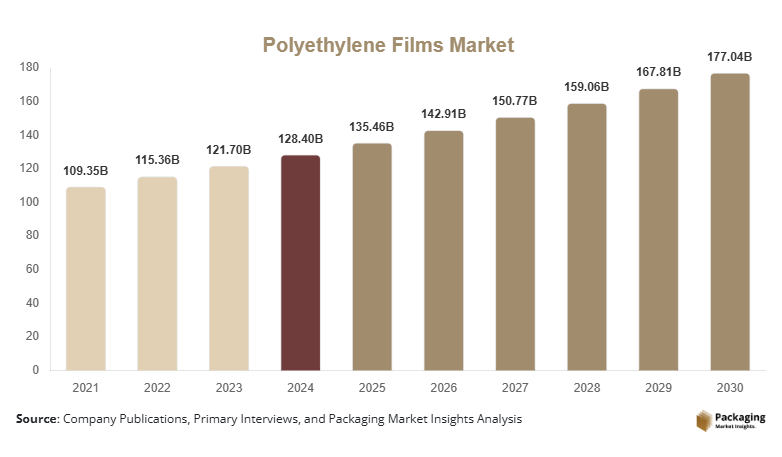
The global polyethylene films market size was valued at approximately USD 128.40 billion in 2024 and is projected to grow from around USD 135.46 billion in 2025 to reach nearly USD 177.04 billion by 2030, expanding at a CAGR of about 5.5% during the forecast period (2025–2030). Polyethylene films are extensively used across packaging, agriculture, construction, and consumer goods due to their cost efficiency, flexibility, moisture resistance, and mechanical strength. Their ability to be engineered for specific barrier, thickness, and durability requirements continues to reinforce demand across both mature and emerging economies.
A key global factor supporting the growth of the polyethylene films market has been the steady expansion of packaged consumer goods and food supply chains, particularly in urbanizing regions. Rising demand for shelf-stable food, hygienic packaging, and protective materials has sustained consistent consumption of polyethylene-based films across flexible packaging formats. In addition, improvements in film extrusion technologies have enhanced product consistency, downgauging potential, and application-specific customization, supporting adoption across industrial and commercial end uses.
Key Highlights
- Asia Pacific dominated the market with a 41.6% share in 2024, while the Middle East & Africa is expected to register the fastest CAGR of 6.3%
- LDPE films led the market by type with 38.2% share, while LLDPE films are projected to grow at a CAGR of 6.1%
- Packaging accounted for 56.4% of total demand, with agricultural films emerging as the fastest-growing application at 6.5% CAGR
- China led globally with a 2024 market value of USD 29.8 billion, rising to USD 31.5 billion in 2025
Explore more data points, trends and opportunities Download Free Sample Report
Latest Market Trends
Rising Adoption of Downgauged and High-Performance Films
Manufacturers in the polyethylene films market are increasingly adopting downgauged film solutions that deliver equivalent strength and performance at reduced thickness. This trend is driven by material efficiency goals, cost optimization, and evolving packaging design requirements. High-performance films with improved tensile strength and puncture resistance are replacing conventional thicker films, particularly in food and industrial packaging applications. This shift supports volume growth while maintaining material consumption efficiency.
Growing Demand for Specialty Films in Controlled Environments
Another notable trend shaping the polyethylene films market is the increasing use of specialty films in controlled-environment agriculture and industrial applications. Films engineered with UV resistance, thermal regulation, and controlled permeability are gaining traction in greenhouse coverings, silage films, and industrial liners. This trend reflects the growing need for productivity enhancement and operational consistency across agricultural and manufacturing sectors, particularly in regions with climatic variability.
Market Drivers
Expanding Flexible Packaging Industry
The sustained expansion of the global flexible packaging industry has been a primary driver for the polyethylene films market. Polyethylene films are widely used in pouches, wraps, liners, and laminates due to their adaptability, sealing performance, and moisture resistance. Growth in packaged food, personal care, and household products has directly increased demand for polyethylene-based film structures, particularly in urban consumer markets.
Cost-Effectiveness Compared to Alternative Materials
Polyethylene films offer a favorable cost-to-performance ratio compared to alternative polymer and paper-based materials. Their lower raw material cost, efficient processing, and recyclability in mono-material formats make them attractive for large-volume applications. This economic advantage has supported continued usage across price-sensitive industries such as agriculture, construction, and industrial packaging.
Market Restraint
Volatility in Raw Material Prices
The polyethylene films market faces a significant restraint from volatility in petrochemical feedstock prices. Polyethylene resin prices are closely linked to crude oil and natural gas markets, resulting in fluctuating production costs for film manufacturers. These variations can impact profit margins and pricing stability, particularly for small and mid-sized producers operating under long-term supply contracts. Unpredictable raw material costs may also delay investment decisions and capacity expansions in certain regions.
Market Opportunities
Growth of Agricultural Modernization
The modernization of agricultural practices presents a notable opportunity for the polyethylene films market. Increasing use of mulching films, greenhouse covers, and silage wraps to improve crop yields and reduce water loss is expected to drive demand. Emerging economies are gradually adopting protected cultivation techniques, creating sustained growth potential for agricultural polyethylene films.
Expansion of Industrial and Logistics Packaging
The expansion of industrial manufacturing and logistics infrastructure offers additional growth opportunities. Polyethylene films used in stretch wrap, shrink films, and protective liners are gaining demand as supply chains become more complex and geographically dispersed. Growth in warehousing and bulk transportation is expected to support long-term consumption of industrial-grade polyethylene films.
Report Scope
| Report Metric | Details |
|---|---|
| Market Size in 2024 | USD 128.40 Billion |
| Market Size in 2025 | USD 135.46 Billion |
| Market Size in 2030 | USD 177.04 Billion |
| CAGR | 5.5% (2025-2030) |
| Base Year for Estimation | 2024 |
| Historical Data | 2021-2023 |
| Forecast Period | 2025-2030 |
| Report Coverage | Revenue Forecast, Competitive Landscape, Supply Chain Disruption, Growth Factors, Environment & Regulatory Landscape and Trends |
| Geographies Covered | North America, Europe, APAC, Middle East and Africa, LATAM |
| Countries Covered | U.S., Canada, U.K., Germany, France, Spain, Italy, Russia, Nordic, Benelux, Rest of Europe, China, South Korea, Japan, India, Australia, Singapore, Taiwan, South East Asia, Rest of Asia-Pacific, UAE, Turky, Saudi Arabia, South Africa, Egypt, Nigeria, Rest of MEA, Brazil, Mexico, Argentina, Chile, Colombia, Rest of LATAM |
Explore more data points, trends and opportunities Download Free Sample Report
Segmental Analysis
By Type
LDPE films accounted for 38.2% of market share in 2024, driven by their flexibility, clarity, and ease of processing. These films were widely used in bags, liners, and agricultural applications where softness and impact resistance were required. LLDPE films are expected to grow at a CAGR of 6.1%, supported by superior tensile strength and puncture resistance. Their increasing adoption in stretch and shrink packaging applications is anticipated to drive future growth.
By Application
Packaging dominated the polyethylene films market with a 56.4% share in 2024, supported by extensive use in food, beverage, and consumer goods packaging. Demand remained high due to functional versatility and cost efficiency. Agricultural applications are projected to expand at a CAGR of 6.5%, driven by increasing adoption of mulching and greenhouse films. Improved crop yield and water conservation benefits are expected to support growth.
By End-Use Industry
Food and beverage end-use held a 44.7% share in 2024, supported by rising consumption of packaged and processed foods. Polyethylene films offered moisture protection and extended shelf life. The industrial end-use segment is forecast to grow at a CAGR of 5.9%, driven by increasing use of stretch wraps and protective films in logistics and manufacturing environments.
Polyethylene Films Market Segmentations
By Type
- LDPE
- LLDPE
- HDPE
By Application
- Packaging
- Agriculture
- Construction
- Industrial
By End-Use Industry
- Food & Beverage
- Consumer Goods
- Industrial
- Agriculture
Regional Analysis
North America
North America accounted for 22.8% of the polyethylene films market share in 2025 and is expected to grow at a CAGR of 4.6% during 2025–2033. The region exhibited stable demand driven by mature packaging, construction, and industrial sectors. Technological adoption and product standardization supported consistent consumption across applications.
The United States dominated the regional market due to its well-established food packaging industry. Growth was supported by strong demand for stretch and shrink films used in retail-ready packaging and industrial palletization. Ongoing investments in packaging automation further reinforced polyethylene film usage.
Europe
Europe held approximately 19.4% market share in 2025 and is forecast to expand at a CAGR of 4.2% through 2033. Demand remained steady across packaging, agriculture, and consumer goods, supported by advanced manufacturing capabilities.
Germany emerged as the dominant country, driven by its industrial base and export-oriented packaging sector. The presence of advanced film extrusion facilities and consistent demand from food processors supported regional growth without significant volume volatility.
Asia Pacific
Asia Pacific represented the largest regional market with 43.1% share in 2025 and is projected to grow at a CAGR of 6.1% over the forecast period. Rapid urbanization, expanding consumer goods markets, and industrial development contributed to high consumption levels.
China led the region due to its large-scale manufacturing ecosystem and domestic packaging demand. Growth was supported by increasing use of polyethylene films in food packaging and agricultural applications, alongside ongoing capacity expansions by local producers.
Middle East & Africa
The Middle East & Africa accounted for 7.6% of global market share in 2025 and is expected to register a CAGR of 6.3% through 2033, the fastest among all regions. Industrialization and agricultural development initiatives supported demand growth.
Saudi Arabia dominated the region due to its petrochemical production capacity and growing domestic packaging industry. Availability of feedstock and export-oriented film manufacturing supported steady market expansion.
Latin America
Latin America captured 7.1% of the polyethylene films market in 2025 and is forecast to grow at a CAGR of 5.2% during 2025–2033. The region demonstrated moderate growth supported by expanding food packaging and agricultural film usage.
Brazil led the regional market due to its large agricultural sector and consumer goods industry. Demand for mulch films and flexible packaging formats supported consistent polyethylene film consumption.
Competitive Landscape
The polyethylene films market is characterized by the presence of global petrochemical companies and specialized film manufacturers. Competition is driven by capacity scale, product consistency, and regional supply capabilities. Market participants focus on portfolio diversification and operational efficiency.
A leading market participant maintained its position through capacity expansion and the development of application-specific film grades. Recent investments in advanced extrusion lines enabled improved output efficiency and product uniformity, strengthening its competitive position.
Key Players List
- Dow Inc.
- ExxonMobil Corporation
- LyondellBasell Industries
- SABIC
- INEOS Group
- Borealis AG
- Braskem S.A.
- TotalEnergies
- Chevron Phillips Chemical
- Mitsui Chemicals
- Formosa Plastics Corporation
- Westlake Corporation
- Berry Global Group
- Amcor plc
- Sealed Air Corporation