Polyester Labels Market Size
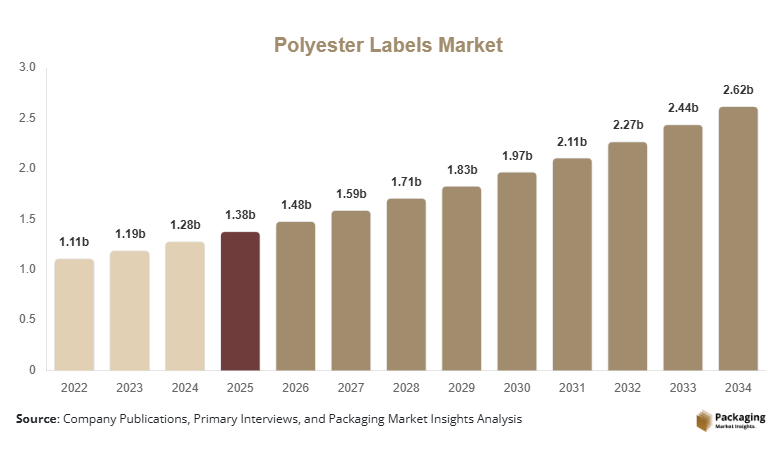
Polyester Labels market size is projected at USD 1.48 billion in 2026 and is expected to hit USD 2.62 billion by 2034 with a CAGR of 7.4%.” The Polyester Labels Market report provides comprehensive analysis covering market segmentation, production capacity, technological developments, competitive landscape, and regional performance. The study evaluates demand patterns, material innovations, and adoption trends across packaging, industrial, and consumer applications to provide detailed market insights.
Polyester Labels are durable labeling solutions manufactured using polyethylene terephthalate (PET) films known for high tensile strength, chemical resistance, moisture protection, and dimensional stability. Global production of polyester labels exceeded 38 billion units in 2025, supported by increasing demand from packaging, healthcare, electronics, and retail sectors. Flexible polyester labels accounted for nearly 52% of total consumption due to their adaptability for curved surfaces and lightweight packaging formats. Pharmaceutical and food packaging applications contributed approximately 45% of overall demand, driven by regulatory labeling requirements and product identification needs. Rising adoption of sustainable labeling materials and advanced printing technologies continues to strengthen Polyester Labels Market Growth.
Explore more data points, trends and opportunities Download Free Sample Report
Polyester Labels Trends
Increasing Adoption of Sustainable and High-Performance Label Materials
The Polyester Labels Market is experiencing a shift toward recyclable PET-based materials and environmentally efficient production processes. More than 35% of label manufacturers introduced recycled polyester solutions between 2023 and 2025, while global polyester label production surpassed 40 billion units in 2025. Advanced coating technologies have improved resistance against moisture, chemicals, and temperature variations by 20–30%, increasing adoption in healthcare and industrial applications. Food and beverage companies account for nearly 38% of polyester label consumption due to the need for durable product identification solutions, supporting the Polyester Labels Market Trend.
Growth of Digital Printing and Smart Labeling Technologies
Digital printing integration is transforming polyester label manufacturing, with approximately 42% of large-scale label producers adopting digital printing systems by 2025. These technologies reduce production waste by nearly 25% and enable customized labeling for small-batch products. Smart labeling applications, including QR codes, RFID compatibility, and variable data printing, are increasing at an annual rate of 10–12%. Electronics, pharmaceutical, and logistics industries are driving demand for advanced polyester labels with improved tracking capabilities, accelerating Polyester Labels Market Trend.
Polyester Labels Market Drivers
Rising Demand for Durable Packaging Identification Solutions
Growing demand for reliable product identification systems is a major driver for the Polyester Labels Market, with global packaging label consumption exceeding 1.2 trillion units annually. Polyester labels provide 90%+ resistance against moisture, abrasion, and chemicals compared with conventional paper labels. Food, beverage, and pharmaceutical industries collectively contribute more than 60% of market demand due to strict labeling regulations. Increasing packaged product consumption and expansion of organized retail channels are expected to increase polyester label adoption by more than 7% annually, supporting Polyester Labels Market Growth.
Polyester Labels Market Restraints
High Production Costs Compared with Paper-Based Labels
Higher raw material and manufacturing costs remain a major restraint for polyester labels, as PET-based materials are approximately 25–40% more expensive than traditional paper labels. Nearly 30% of small-scale manufacturers face cost pressure due to fluctuations in polyester resin prices. Recycling limitations and complex adhesive separation processes also impact sustainability performance. Although polyester labels provide superior durability, cost-sensitive applications continue to limit penetration in emerging markets, affecting Polyester Labels Market expansion.
Polyester Labels Market Opportunities
Expansion of Smart Packaging and Premium Product Labeling
The increasing adoption of smart packaging creates significant opportunities for polyester label manufacturers. Smart and connected labels are expected to grow at more than 12% CAGR through 2034, supported by rising demand for authentication and traceability solutions. Premium consumer goods companies are increasing investment in high-quality labeling, with nearly 45% of luxury packaging brands adopting durable polyester-based labels. Growth in pharmaceutical serialization and logistics tracking systems is expected to generate additional opportunities for Polyester Labels Market development.
Challenges in Polyester Labels Market
Environmental Regulations and Raw Material Supply Uncertainty
Environmental regulations related to plastic-based materials represent a key challenge, as polyester films contribute to approximately 8–10% of flexible labeling waste streams. Around 40% of manufacturers are investing in recycling technologies to meet sustainability targets. Supply chain disruptions affecting PET resin availability have caused raw material price variations of 15–20% during recent years. Balancing durability requirements with environmental compliance remains a major challenge for Polyester Labels Market participants.
Report Scope
| Report Metric | Details |
|---|---|
| Market Size in 2025 | USD 1.38 billion |
| Market Size in 2026 | USD 1.48 billion |
| Market Size in 2034 | USD 2.62 billion |
| CAGR | 7.4% (2026-2034) |
| Base Year for Estimation | 2025 |
| Historical Data | 2022-2024 |
| Forecast Period | 2026-2034 |
| Report Coverage | Revenue Forecast, Competitive Landscape, Supply Chain Disruption, Growth Factors, Environment & Regulatory Landscape and Trends |
| Geographies Covered | North America, Europe, APAC, Middle East and Africa, LATAM |
| Countries Covered | U.S., Canada, U.K., Germany, France, Spain, Italy, Russia, Nordic, Benelux, Rest of Europe, China, South Korea, Japan, India, Australia, Singapore, Taiwan, South East Asia, Rest of Asia-Pacific, UAE, Turky, Saudi Arabia, South Africa, Egypt, Nigeria, Rest of MEA, Brazil, Mexico, Argentina, Chile, Colombia, Rest of LATAM |
Explore more data points, trends and opportunities Download Free Sample Report
Polyester Labels Market Segmentation
Polyester Labels Market segmentation is analyzed based on type and application. Flexible polyester labels dominate with nearly 52% market share due to their wide usage in packaging applications, while clear and metallized polyester labels collectively represent around 48% demand. Application analysis shows food and beverage packaging leading with approximately 38% share, followed by pharmaceutical and personal care industries.
By Type
Flexible Polyester Labels
Flexible polyester labels represent approximately 52% of the Polyester Labels Market share, with global production exceeding 20 billion units in 2025. These labels typically use PET films ranging from 25–100 microns thickness and provide excellent flexibility, printability, and resistance properties. They are widely used for bottles, containers, and flexible packaging formats across food, beverage, and consumer goods industries.
Clear Polyester Labels
Clear polyester labels account for nearly 28% market share and are increasingly preferred for premium packaging applications. Production exceeded 11 billion units in 2025, with transparent PET films enabling no-label appearance effects. These labels offer high optical clarity above 90%, excellent adhesive compatibility, and resistance to temperatures ranging from -40°C to 150°C.
Metallized Polyester Labels
Metallized polyester labels contribute around 20% market share, with production reaching more than 8 billion units globally. These labels incorporate aluminum-coated PET films to provide enhanced visual appeal and barrier properties. They are commonly used in premium packaging, electronics, and specialty industrial applications requiring high durability and aesthetic performance.
By Application
Food & Beverage Packaging
Food and beverage packaging dominates the Polyester Labels Market with approximately 38% share. More than 15 billion polyester labels were consumed in this segment during 2025. These labels provide resistance against moisture, refrigeration conditions, and handling damage. Beverage manufacturers, dairy companies, and processed food producers increasingly use polyester labels, with adoption penetration exceeding 55% among major packaged food brands.
Pharmaceutical Packaging
Pharmaceutical packaging represents nearly 32% market share due to strict regulatory labeling requirements. Global pharmaceutical applications consumed over 12 billion polyester labels in 2025. These labels support barcode printing, serialization, and product authentication while maintaining performance under temperature and chemical exposure conditions.
Personal Care Packaging
Personal care packaging contributes around 30% market share, supported by premium cosmetic and skincare product demand. More than 11 billion polyester labels were used in 2025 across bottles, jars, and containers. High-quality printing capabilities and resistance to oils and moisture make polyester labels suitable for luxury and premium personal care products.
Polyester Labels Market Segmentations
Type
- Flexible Polyester Labels
- Clear Polyester Labels
- Metallized Polyester Labels
Application
- Food & Beverage Packaging
- Pharmaceutical Packaging
- Personal Care Packaging
End-Use Industry
- Food & Beverage
- Healthcare & Pharmaceuticals
- Personal Care & Cosmetics
- Electronics & Industrial Products
- Retail & Consumer Goods
Polyester Labels Regional Outlook
North America
North America accounted for approximately 31% of the Polyester Labels Market share in 2025, driven by advanced packaging infrastructure and strong pharmaceutical demand. The United States contributed nearly 75% of regional consumption, with more than 12 billion units produced annually. Food, healthcare, and consumer goods sectors represent over 65% of regional polyester label demand.
Europe
Europe held around 28% market share, supported by sustainability initiatives and premium packaging adoption. Germany, France, and the United Kingdom collectively contributed nearly 70% of regional demand. More than 10 billion polyester labels were produced in Europe during 2025, with recycled PET adoption increasing by approximately 14% annually.
Asia-Pacific
Asia-Pacific represented nearly 30% market share and is the fastest-growing region with projected CAGR above 8% through 2034. China, India, and Japan account for more than 80% of regional production. Expanding pharmaceutical manufacturing and packaged food industries increased polyester label consumption by nearly 18% between 2022 and 2025.
Latin America
Latin America accounted for around 7% market share, supported by retail expansion and increasing packaged product consumption. Brazil and Mexico contribute nearly 65% of regional demand, with more than 3 billion units consumed annually.
Middle East & Africa
The Middle East & Africa region represented approximately 4% share, driven by healthcare, food processing, and consumer product industries. Increasing manufacturing investments are expected to raise regional polyester label demand by more than 6% annually.
Top players in Polyester Labels Market
- Avery Dennison Corporation
- CCL Industries Inc.
- Brady Corporation
- 3M Company
- Multi-Color Corporation
- UPM Raflatac
- Fedrigoni S.p.A.
- Fuji Seal International Inc.
- R.R. Donnelley & Sons Company
- Constantia Flexibles
Avery Dennison Corporation
-
Holds a leading position with an estimated 15–18% share in global label solutions.
-
Provides advanced polyester label materials for food, healthcare, logistics, and consumer applications.
-
Focuses on sustainable PET materials, smart labeling technologies, and digital printing solutions.
-
Operates across more than 50 countries with extensive manufacturing and distribution networks.
CCL Industries Inc.
-
Maintains approximately 10–12% market share through diversified labeling solutions.
-
Specializes in durable polyester labels for healthcare, electronics, and premium consumer products.
-
Invests in advanced printing technologies and sustainable label manufacturing.
-
Supports global brands with customized labeling solutions and high-performance materials.