Plastic Vials And Ampoules Market Size
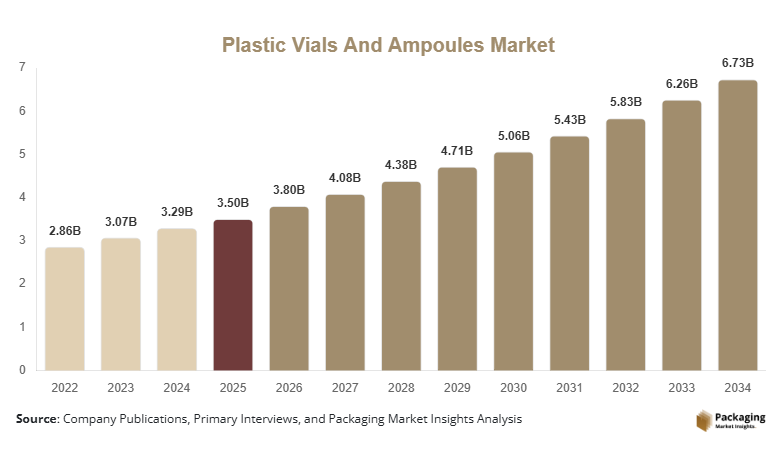
The plastic vials and ampoules market size is projected at USD 3.8 billion in 2026 and is expected to hit USD 6.7 billion by 2034 with a CAGR of 7.4%. Increasing pharmaceutical production, biologics manufacturing, and demand for sterile primary packaging continue supporting industry expansion. The report provides detailed analysis of production capacity, market segmentation, competitive landscape, technology developments, and regional performance throughout the forecast period.
Plastic vials and ampoules are sterile primary packaging containers manufactured primarily from polypropylene (PP), polyethylene (PE), cyclic olefin polymer (COP), and cyclic olefin copolymer (COC) for injectable drugs, vaccines, biologics, and diagnostic solutions. Global production exceeded 39.6 billion units in 2025 and is projected to surpass 63.8 billion units by 2034. Pharmaceutical companies account for nearly 69% of total consumption, and biotechnology companies contribute 18%, while hospitals and clinics represent approximately 13%. Blow-fill-seal technology adoption has surpassed 61% across sterile pharmaceutical packaging facilities, reinforcing the plastic vials and ampoules market.
Explore more data points, trends and opportunities Download Free Sample Report
Plastic Vials And Ampoules Market Trends
Increasing adoption of Blow-Fill-Seal packaging technology
Blow-fill-seal manufacturing capacity expanded by 15% during 2025, while production of sterile plastic ampoules increased by over 3.4 billion units. Automated aseptic filling systems now operate at speeds exceeding 18,000 units per hour, reducing contamination risks and improving manufacturing efficiency. Rising biologics and injectable drug production continues supporting the plastic vials and ampoules market.
Growing adoption of high-barrier polymers, lightweight pharmaceutical packaging, and smart manufacturing technologies is reshaping production. More than 67% of newly commissioned pharmaceutical packaging facilities utilize digital inspection systems, improving defect detection by approximately 21%. Increasing vaccine production and personalized medicine applications continue strengthening the plastic vials and ampoules market.
Plastic Vials And Ampoules Drivers
Growing demand for injectable pharmaceutical products
Global injectable drug production increased by approximately 13% during 2025, while biologics manufacturing expanded by 12%. More than 18 billion sterile plastic containers were utilized for injectable formulations, vaccines, and ophthalmic solutions. Expanding pharmaceutical manufacturing capacity continues driving the plastic vials and ampoules market.
Plastic Vials And Ampoules Restraints
Stringent regulatory compliance and validation costs
Regulatory validation requirements increase manufacturing expenses by approximately 10%–16%, while quality assurance activities account for nearly 23% of production costs. Material qualification, extractable and leachable testing, and sterilization validation extend product development timelines, moderately restraining the plastic vials and ampoules market.
Plastic Vials And Ampoules Opportunities
Expansion of biologics and advanced drug delivery systems
Global biologics production capacity increased by 17% during 2025, while demand for high-purity pharmaceutical packaging expanded by approximately 14%. Growing adoption of COP and COC materials, together with increasing investments in aseptic manufacturing facilities, creates substantial opportunities for the plastic vials and ampoules market.
Challenges in Plastic Vials And Ampoules Market
Maintaining sterility and material compatibility
Manufacturers must maintain sterility assurance levels of 10⁻⁶, particulate contamination below regulatory limits, and dimensional tolerances within ±0.05 mm. Rising validation costs, raw material consistency requirements, and compatibility with sensitive biologic formulations remain significant operational challenges for the plastic vials and ampoules market.
Report Scope
| Report Metric | Details |
|---|---|
| Market Size in 2025 | USD 3.5 Billion |
| Market Size in 2026 | USD 3.8 Billion |
| Market Size in 2034 | USD 6.7 Billion |
| CAGR | 7.4% (2026-2034) |
| Base Year for Estimation | 2025 |
| Historical Data | 2022-2024 |
| Forecast Period | 2026-2034 |
| Report Coverage | Revenue Forecast, Competitive Landscape, Supply Chain Disruption, Growth Factors, Environment & Regulatory Landscape and Trends |
| Geographies Covered | North America, Europe, APAC, Middle East and Africa, LATAM |
| Countries Covered | U.S., Canada, U.K., Germany, France, Spain, Italy, Russia, Nordic, Benelux, Rest of Europe, China, South Korea, Japan, India, Australia, Singapore, Taiwan, South East Asia, Rest of Asia-Pacific, UAE, Turkey, Saudi Arabia, South Africa, Egypt, Nigeria, Rest of MEA, Brazil, Mexico, Argentina, Chile, Colombia, Rest of LATAM |
Explore more data points, trends and opportunities Download Free Sample Report
Plastic Vials And Ampoules Market Segmentation
The market is segmented by product type and end user. Plastic vials account for approximately 45% of total revenue, followed by blow-fill-seal containers at 34%, while pharmaceutical companies remain the dominant end-user segment with nearly 69% market consumption.
By Product Type
Plastic vials account for nearly 45% of the market with annual production exceeding 17.8 billion units. These containers provide high impact resistance, lightweight performance, and compatibility with injectable drugs, vaccines, and diagnostic reagents manufactured using PP, COP, and COC materials.
Plastic ampoules contribute approximately 21% of total demand, with production surpassing 8.3 billion units annually. They offer single-dose packaging, excellent sterility, tamper resistance, and reduced breakage compared to conventional glass ampoules.
Blow-fill-seal containers represent nearly 34% of market revenue, with production exceeding 13.5 billion units. BFS technology integrates container formation, filling, and sealing into a single aseptic process, reducing contamination risks while improving manufacturing efficiency.
By End User
Pharmaceutical companies account for approximately 69% of global demand, utilizing more than 27 billion units annually. Applications include vaccines, injectable drugs, ophthalmic products, respiratory therapies, and sterile liquid formulations.
Biotechnology companies contribute around 18% of the market with annual consumption exceeding 7.1 billion units. Growth is supported by expanding biologics, biosimilars, monoclonal antibodies, and advanced therapeutic manufacturing.
Hospitals and clinics account for nearly 13% of demand, consuming approximately 5.2 billion units annually for emergency medicines, sterile injectable preparations, and diagnostic procedures requiring safe pharmaceutical packaging.
Plastic Vials And Ampoules Market Segmentations
Product Type
- Plastic Vials
- Plastic Ampoules
- Blow-Fill-Seal (BFS) Containers
End User
- Pharmaceutical Companies
- Biotechnology Companies
- Hospitals & Clinics
Plastic Vials And Ampoules Regional Outlook
North America
North America accounts for approximately 35% of global revenue. The United States contributes nearly 83% of regional demand, supported by advanced pharmaceutical manufacturing, biologics production, and sterile packaging capacity exceeding 13 billion units annually.
Europe
Europe represents approximately 29% of the market. Germany, Switzerland, France, Italy, and the United Kingdom lead regional production with annual pharmaceutical packaging output exceeding 11 billion units.
Asia-Pacific
Asia-Pacific accounts for approximately 30% of global demand and records the fastest expansion. China contributes nearly 42% of regional production, followed by India, Japan, and South Korea as pharmaceutical manufacturing continues expanding.
Latin America
Latin America contributes around 4% of market revenue. Brazil and Mexico dominate regional demand through expanding pharmaceutical production and healthcare infrastructure investments.
Middle East & Africa
The Middle East & Africa account for nearly 2% of the global market. Rising healthcare investments, vaccine manufacturing initiatives, and pharmaceutical localization programs continue supporting regional demand.
Top Players In Plastic Vials And Ampoules Market
- Gerresheimer AG
- SCHOTT Pharma AG
- West Pharmaceutical Services, Inc.
- AptarGroup, Inc.
- Amcor plc
- Berry Global Inc.
- Nipro Corporation
- DWK Life Sciences
- Catalent, Inc.
- Stevanato Group S.p.A.
Gerresheimer AG estimated global market presence of approximately 14%. Leading supplier of pharmaceutical primary packaging solutions across North America, Europe, and Asia-Pacific. The company offers high-quality plastic vials, sterile packaging systems, and advanced blow-fill-seal solutions for injectable drugs, biologics, and vaccines. Continuous investments in pharmaceutical manufacturing automation, sustainable polymer technologies, and regulatory-compliant production strengthen its competitive position in global healthcare packaging. SCHOTT Pharma AG: Estimated market presence of approximately 11%. Strong global position in pharmaceutical containment and drug delivery packaging. The company supplies high-performance polymer packaging, sterile containers, and pharmaceutical primary packaging solutions with emphasis on biologics compatibility, dimensional precision, and regulatory compliance. Ongoing investments in aseptic manufacturing technologies and international production expansion continue reinforcing its leadership across pharmaceutical packaging markets.