Plastic Packaging For Food And Beverage Market Size and Growth
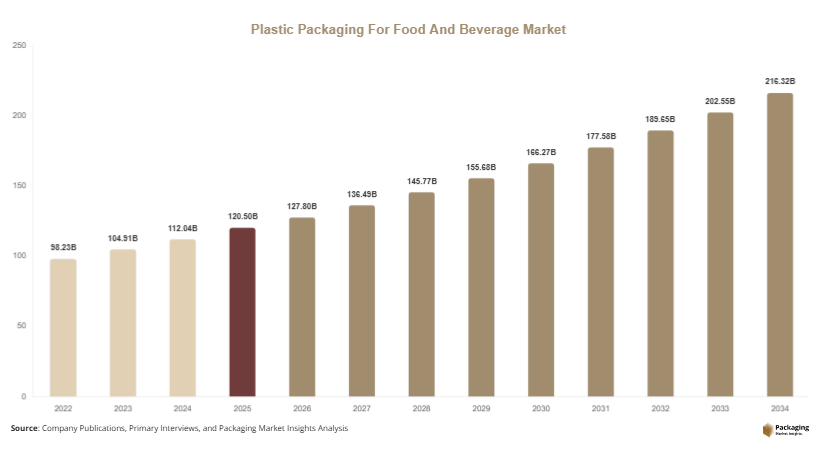
The plastic packaging for food and beverage market is projected to experience significant growth over the forecast period from 2025 to 2034. The market was valued at approximately USD 120.5 billion in 2025, and it is expected to reach USD 127.8 billion in 2026, expanding to a projected USD 215.2 billion by 2034, reflecting a CAGR of 6.8% during 2025–2034. This growth is fueled by increasing consumer demand for packaged and processed foods, rising urbanization, and evolving lifestyles that emphasize convenience, hygiene, and extended shelf life.
Plastic packaging provides lightweight, durable, and cost-effective solutions for food and beverage manufacturers, supporting product integrity and reducing transportation costs. In addition, technological innovations, such as biodegradable plastics, multilayer films, and vacuum-sealed packaging, are enhancing product protection, sustainability, and shelf appeal. The growth of the e-commerce food delivery sector further accelerates demand for reliable and safe packaging solutions, as products require secure handling and tamper-evident packaging.
Key Highlights:
- 2025 market size: USD 120.5 billion; 2026 market size: USD 127.8 billion
- 2034 projected market size: USD 215.2 billion at a CAGR of 6.8%
- Growth driven by urbanization, processed food demand, and e-commerce packaging
- Technological advancements: multilayer films, biodegradable plastics, vacuum sealing
- Rising focus on hygiene, product protection, and sustainability initiatives
Explore more data points, trends and opportunities Download Free Sample Report
Market Trends
Sustainability and Biodegradable Packaging
A prominent trend in the plastic packaging for food and beverage market is the growing focus on sustainability. Companies are increasingly adopting biodegradable, recyclable, and compostable plastics to meet consumer demand and regulatory pressures. This trend is particularly notable in Europe and North America, where governments and consumers emphasize reducing single-use plastics. Manufacturers are investing in multilayer films and bioplastics that provide the same barrier protection and durability as conventional plastics but are environmentally friendly. Sustainable packaging solutions not only reduce carbon footprint but also enhance brand reputation and customer loyalty. Retailers and food service providers are promoting eco-friendly packaging to appeal to environmentally conscious consumers, encouraging wider adoption across the industry.
Smart and Functional Packaging Solutions
Another trend is the integration of smart packaging technologies in plastic food and beverage packaging. Features such as QR codes, RFID tracking, tamper-evident seals, and temperature-sensitive films allow better product monitoring, traceability, and consumer engagement. Smart packaging helps extend shelf life, maintain freshness, and improve supply chain management. In addition, interactive packaging with embedded consumer information enhances transparency and trust in food safety. The rise of e-commerce and delivery platforms has accelerated the demand for functional, tamper-proof, and secure packaging, driving innovation in design and material applications globally.
Market Drivers
Growth of Processed and Convenience Foods
The increasing demand for processed and convenience foods is a key driver for the plastic packaging market. Urbanization, changing lifestyles, and busy work schedules have led consumers to prefer ready-to-eat meals, snacks, and beverages. Plastic packaging provides lightweight, durable, and hygienic solutions that extend shelf life, maintain product quality, and facilitate easy transportation. Manufacturers benefit from cost-effective packaging options that support high-volume production while ensuring safety and compliance with regulatory standards. The surge in refrigerated and frozen food consumption further emphasizes the need for high-performance plastic packaging, as it prevents contamination, preserves texture, and maintains nutritional value during storage and transit.
Expansion of E-commerce and Food Delivery Services
The rapid growth of e-commerce and food delivery services globally is another significant driver. With the increasing preference for online grocery shopping, meal kits, and beverages, secure and tamper-proof plastic packaging is critical to maintaining product integrity. Packaging that protects against leakage, breakage, and spoilage ensures customer satisfaction and reduces waste. Food and beverage brands are investing in innovative plastic solutions, such as resealable pouches, vacuum packs, and custom-shaped containers, to cater to the rising demand for convenient, ready-to-consume products. The expansion of last-mile delivery networks also amplifies the need for robust, durable, and lightweight packaging solutions that can withstand multiple handling stages.
Market Restraint
Environmental Concerns and Regulatory Challenges
Despite its advantages, the plastic packaging for food and beverage market faces challenges from environmental concerns and stringent regulations. Single-use plastics have come under scrutiny due to their contribution to pollution and non-biodegradable waste. Governments in Europe, North America, and Asia are implementing restrictions and bans on certain types of plastic packaging, prompting manufacturers to explore alternative materials. Compliance with evolving regulations requires investment in research, development, and new production processes, which can increase operational costs.
For instance, the implementation of extended producer responsibility (EPR) programs mandates that manufacturers are accountable for the disposal and recycling of plastic packaging. Such regulations can impact profitability and slow adoption in certain regions. Additionally, public awareness of environmental impacts has driven consumer preference toward sustainable packaging, pressuring companies to invest in more expensive biodegradable or recyclable alternatives. Failure to meet sustainability expectations may affect brand perception and market competitiveness. While technological innovations offer potential solutions, regulatory compliance and environmental concerns remain significant restraints for market expansion.
Market Opportunities
Innovation in Biodegradable and Compostable Plastics
The rising emphasis on sustainability presents a lucrative opportunity for manufacturers to develop biodegradable and compostable plastic packaging solutions. Innovations in PLA (polylactic acid), PBS (polybutylene succinate), and other bio-based polymers allow food and beverage companies to reduce environmental impact while maintaining functional packaging properties. Businesses adopting eco-friendly materials gain a competitive advantage in environmentally conscious markets, particularly in Europe and North America. Investment in research and development for multi-layered biofilms can provide superior barrier properties, extending shelf life and supporting premium product positioning.
Expansion in Emerging Markets
Emerging economies in Asia Pacific, Latin America, and the Middle East offer substantial growth opportunities. Rising disposable incomes, rapid urbanization, and increasing consumption of packaged foods and beverages are driving demand for high-quality plastic packaging. Manufacturers expanding production capabilities and establishing local partnerships can capitalize on growing urban populations and retail infrastructure development. Additionally, the penetration of e-commerce and cold chain logistics enhances the need for durable, tamper-proof, and convenient packaging solutions. Regional expansion strategies and localized product customization can strengthen market presence and drive revenue growth over the next decade.
Report Scope
| Report Metric | Details |
|---|---|
| Market Size in 2025 | USD 120.5 Billion |
| Market Size in 2026 | USD 127.8 Billion |
| Market Size in 2034 | USD 215.2 Billion |
| CAGR | 6.8% (2026-2034) |
| Base Year for Estimation | 2025 |
| Historical Data | 2022-2024 |
| Forecast Period | 2026-2034 |
| Report Coverage | Revenue Forecast, Competitive Landscape, Supply Chain Disruption, Growth Factors, Environment & Regulatory Landscape and Trends |
| Geographies Covered | North America, Europe, APAC, Middle East and Africa, LATAM |
| Countries Covered | U.S., Canada, U.K., Germany, France, Spain, Italy, Russia, Nordic, Benelux, Rest of Europe, China, South Korea, Japan, India, Australia, Singapore, Taiwan, South East Asia, Rest of Asia-Pacific, UAE, Turky, Saudi Arabia, South Africa, Egypt, Nigeria, Rest of MEA, Brazil, Mexico, Argentina, Chile, Colombia, Rest of LATAM |
Explore more data points, trends and opportunities Download Free Sample Report
Segmental Analysis
By Type
The rigid plastic packaging segment dominated the market in 2024, accounting for approximately 45% of total share. Rigid packaging solutions such as bottles, containers, and tubs are widely adopted in beverages, sauces, and dairy products. Their strength, durability, and ability to protect perishable foods make them a preferred choice for manufacturers aiming for extended shelf life and transport efficiency.
The flexible plastic packaging subsegment is the fastest-growing, with a CAGR of 7.2% during 2025–2034. Flexible films, pouches, and wraps offer lightweight, space-saving, and cost-effective solutions. The rising adoption of flexible packaging is supported by e-commerce, ready-to-eat meals, and snack food sectors, which demand tamper-proof and customizable solutions that reduce storage and shipping costs.
By Application
The food segment remains the dominant application, capturing approximately 55% of market share in 2024. Packaged snacks, frozen foods, beverages, dairy, and sauces contribute to high demand. Food manufacturers prefer plastic packaging due to its lightweight nature, barrier properties, and compatibility with automation and labeling.
The beverage segment is the fastest-growing, with a CAGR of 7.0%. Increased consumption of bottled water, soft drinks, and juices drives demand for PET bottles, containers, and multi-layer films. Beverage manufacturers are adopting innovative designs to enhance portability, shelf appeal, and leak-proof packaging.
By End-Use
The retail sector dominates, accounting for roughly 60% of market share in 2024, driven by grocery chains, supermarkets, and convenience stores requiring diverse packaging formats for packaged foods and beverages.
The food service and e-commerce end-use segment is the fastest-growing, with a CAGR of 7.3%. The growth is fueled by rising online food delivery, meal kits, and ready-to-eat packaging solutions.
Plastic Packaging For Food And Beverage Market Segmentations
By Type
- Rigid Plastic Packaging
- Flexible Plastic Packaging
- Foil Laminates
By Application
- Food
- Beverage
- Dairy & Frozen
- Snacks & Confectionery
By End-Use
- Retail Sector
- Food Service & E-Commerce
- Industrial & Institutional
Regional Analysis
North America
In 2025, North America accounted for approximately 28% of the global market share, with a projected CAGR of 5.9% during 2025–2034. The region’s mature food and beverage industry, coupled with high awareness of convenience and hygiene, supports strong demand for plastic packaging. Advanced manufacturing capabilities, technological integration, and well-established supply chains further enhance market growth.
The United States is the dominant country in North America, driven by rising consumption of ready-to-eat meals and beverages. A unique growth factor is the increasing adoption of sustainable packaging initiatives by major retailers and food manufacturers, which promotes innovation in biodegradable and recyclable plastics. North America’s robust e-commerce infrastructure and food delivery services also amplify the need for secure and functional packaging.
Europe
Europe held a 25% market share in 2025, with a projected CAGR of 5.6% over the forecast period. Strict environmental regulations and consumer preference for sustainable packaging are key drivers of innovation in the region. Companies are increasingly investing in eco-friendly materials while ensuring compliance with safety and quality standards.
Germany leads the European market due to its strong manufacturing base and focus on sustainable food packaging. A unique growth factor is the widespread implementation of extended producer responsibility (EPR) policies, incentivizing companies to adopt recyclable and biodegradable packaging solutions. Germany’s consumer base also demonstrates strong demand for premium and hygienic packaging formats, boosting market adoption.
Asia Pacific
Asia Pacific accounted for roughly 32% of the market in 2025, with a projected CAGR of 7.1%. Rapid urbanization, increasing disposable income, and rising consumption of processed and convenience foods are primary growth drivers. Countries like China, India, and Japan are witnessing robust investments in food packaging infrastructure.
China is the dominant market country, fueled by rapid e-commerce expansion and the rising popularity of ready-to-eat meals. A unique growth factor is government support for domestic packaging innovation, including incentives for sustainable and high-performance plastics. China’s modern retail and cold chain logistics sectors further contribute to higher adoption of advanced packaging solutions.
Middle East & Africa
The region accounted for about 8% of global market share in 2025, with a CAGR of 6.0%. Investments in food processing facilities and rising urban populations are driving adoption of high-quality plastic packaging. The growing retail and hospitality sectors also contribute to market growth.
United Arab Emirates dominates the region, supported by its focus on export-oriented food industries and modern retail infrastructure. A unique growth factor is the investment in tamper-proof, lightweight, and flexible packaging solutions to meet international quality and safety standards.
Latin America
Latin America accounted for approximately 7% of market share in 2025, with a CAGR of 6.7%. Market expansion is driven by increasing industrialization, urbanization, and retail development. Rising packaged food consumption across Brazil, Mexico, and Argentina is boosting demand.
Brazil is the dominant country, supported by growing e-commerce and urban food consumption trends. A unique growth factor is the increasing adoption of resealable, portion-controlled, and tamper-evident plastic packaging to enhance convenience and ensure hygiene in food delivery and retail sectors.
Competitive Landscape
The plastic packaging for food and beverage market is highly competitive, with key players emphasizing technological innovation, sustainability, and global expansion. Leading companies include Amcor Ltd., Berry Global Inc., Sealed Air Corporation, Mondi Group, and DS Smith Plc.
Amcor Ltd. is the market leader, recently launching a range of recyclable and biodegradable packaging solutions for food and beverage applications. This initiative aligns with sustainability regulations and growing consumer preference for eco-friendly packaging. Berry Global Inc. focuses on high-performance flexible films, while Sealed Air Corporation invests in vacuum-sealed and tamper-evident packaging solutions. Mondi Group offers innovative multilayer films and rigid plastic solutions, whereas DS Smith Plc emphasizes cost-effective and sustainable packaging designs. Strategic acquisitions, collaborations, and investment in R&D are common, allowing these companies to expand their product portfolio and strengthen global market presence.
Key Players List
- Amcor Ltd.
- Berry Global Inc.
- Sealed Air Corporation
- Mondi Group
- DS Smith Plc
- Huhtamaki Oyj
- Alpla Werke Alwin Lehner GmbH & Co KG
- Winpak Ltd.
- Plastipak Holdings, Inc.
- RPC Group Plc
- Oerlikon Packaging
- Coveris Holdings S.A.
- Bemis Company, Inc.
- Linpac Packaging Ltd.
- Constar International, Inc.