Plastic Medical Packaging Market Size and Growth
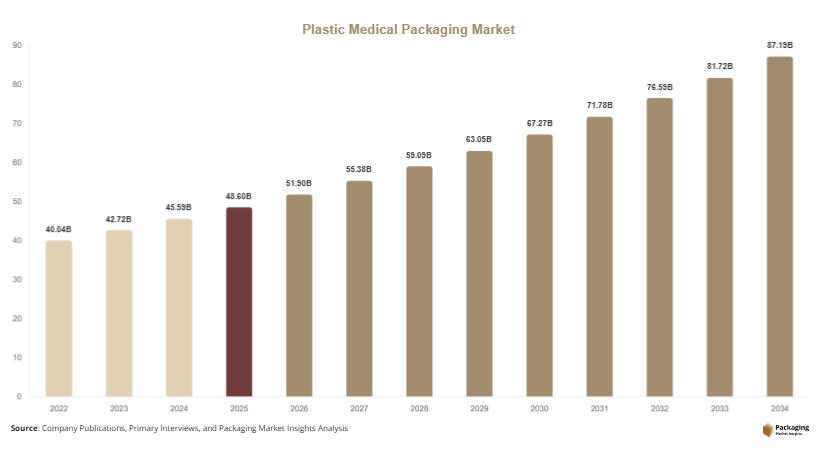
The global plastic medical packaging market size was valued at approximately USD 48.6 billion in 2025 and is projected to reach nearly USD 51.9 billion in 2026. By 2034, the market is expected to grow to around USD 87.5 billion, registering a CAGR of 6.7% during 2025–2034. Plastic medical packaging is widely used for pharmaceutical products, medical devices, diagnostic equipment, and healthcare consumables due to its lightweight structure, durability, barrier protection, and cost efficiency. The global plastic medical packaging market is experiencing steady expansion due to increasing healthcare expenditures, rising pharmaceutical production, and growing demand for sterile medical packaging solutions.
One of the major growth factors driving the market is the increasing demand for sterile and contamination-resistant packaging solutions in hospitals, laboratories, and pharmaceutical manufacturing facilities. Plastic materials provide strong moisture and microbial barriers that help maintain product integrity during storage and transportation. Another significant factor is the rapid growth of the pharmaceutical and biotechnology industries, particularly in emerging economies where healthcare infrastructure investments continue to increase. Rising production of injectable drugs, biologics, and over-the-counter medicines is further contributing to packaging demand.
Key Highlights
- North America dominated the market with a 34.6% share in 2025.
- Asia Pacific is projected to grow at the fastest CAGR of 7.5%.
- Blister packaging led the packaging type segment with a 32.8% share.
- Polyethylene materials dominated with a 29.4% share.
- Pharmaceutical applications led the market with 46.3% share.
- The US remained the dominant country with a market size of USD 12.8 billion in 2025 and USD 13.6 billion in 2026.
Explore more data points, trends and opportunities Download Free Sample Report
Market Trends
Growing Adoption of Sustainable Medical Packaging Materials
Sustainability has become an important trend in the plastic medical packaging market as healthcare companies seek to reduce environmental impact without compromising product safety. Packaging manufacturers are increasingly developing recyclable polyethylene films, bio-based polymers, and lightweight packaging formats to reduce plastic waste and improve material efficiency. Hospitals and pharmaceutical companies are also adopting environmentally responsible procurement practices, encouraging suppliers to offer sustainable packaging alternatives. In addition, advancements in mono-material packaging structures are helping improve recyclability while maintaining barrier protection. Regulatory pressure regarding plastic waste reduction is further accelerating the transition toward eco-friendly medical packaging solutions across global healthcare systems.
Integration of Smart Packaging and Traceability Technologies
Smart packaging technologies are gaining popularity in the plastic medical packaging market due to increasing demand for product traceability, patient safety, and counterfeit prevention. Manufacturers are integrating QR codes, RFID tags, and digital serialization systems into packaging designs to improve inventory management and regulatory compliance. Pharmaceutical companies use smart packaging to monitor product authenticity and ensure safe distribution throughout supply chains. Interactive labeling technologies also help healthcare professionals access dosage instructions, expiration details, and storage conditions quickly. This trend is expected to support operational efficiency and strengthen patient safety standards across pharmaceutical and medical device packaging applications.
Market Drivers
Rising Demand for Sterile and Infection-Resistant Packaging
The increasing need for sterile packaging solutions is a major driver of the plastic medical packaging market. Healthcare facilities and pharmaceutical manufacturers require packaging materials that protect medical products from contamination, moisture, and microbial exposure during storage and transportation. Plastic packaging formats such as blister packs, pouches, and thermoformed trays provide reliable barrier protection while supporting sterilization processes. Rising awareness regarding infection control and patient safety is encouraging hospitals and laboratories to adopt high-performance packaging solutions for surgical instruments, diagnostic kits, and disposable healthcare products. The growing use of single-use medical products is further supporting market demand.
Expansion of Pharmaceutical and Biotechnology Industries
The rapid growth of pharmaceutical manufacturing and biotechnology research is another key factor driving the plastic medical packaging market. Increasing production of vaccines, biologics, injectable drugs, and over-the-counter medicines is creating significant demand for secure and lightweight packaging solutions. Pharmaceutical companies rely on plastic packaging due to its durability, flexibility, and compatibility with automated filling systems. Emerging markets are also witnessing increased investments in pharmaceutical manufacturing facilities and healthcare infrastructure, contributing to higher packaging consumption. The expansion of global drug distribution networks is expected to sustain long-term market growth throughout the forecast period.
Market Restraint
Environmental Concerns and Regulatory Restrictions on Plastic Waste
One of the major restraints affecting the plastic medical packaging market is the growing concern regarding plastic waste generation and environmental sustainability. Governments and regulatory agencies worldwide are implementing stricter rules related to single-use plastics, recycling requirements, and waste management practices. Although plastic packaging plays a critical role in maintaining sterility and patient safety, healthcare organizations are under pressure to reduce non-recyclable plastic usage and improve sustainability performance.
For example, several healthcare systems in Europe and North America have introduced procurement policies encouraging recyclable or reusable medical packaging solutions. Packaging manufacturers may face increased operational costs associated with redesigning products, investing in recyclable materials, and complying with evolving environmental regulations. In addition, certain high-barrier multilayer plastics used in medical applications are difficult to recycle due to complex material compositions. These challenges can create financial pressure for small and medium-sized packaging suppliers while slowing the adoption of conventional plastic packaging formats in environmentally regulated markets.
Market Opportunities
Expansion of Bio-Based and Recyclable Medical Plastics
The increasing focus on sustainability is creating strong opportunities for bio-based and recyclable plastic medical packaging solutions. Packaging manufacturers are investing in renewable polymers, mono-material structures, and recyclable flexible films that maintain medical-grade performance while reducing environmental impact. Pharmaceutical companies and healthcare providers are seeking sustainable alternatives that comply with regulatory standards and corporate environmental goals. Advances in material science are improving the durability, sterilization compatibility, and barrier protection of recyclable plastics. As healthcare systems prioritize sustainability initiatives, demand for eco-friendly medical packaging solutions is expected to grow steadily across global markets.
Rising Demand for Home Healthcare and Diagnostic Packaging
The expansion of home healthcare services and diagnostic testing presents substantial growth opportunities for the plastic medical packaging market. Increasing use of home diagnostic kits, wearable medical devices, and self-administered medications requires safe and user-friendly packaging formats. Packaging companies are developing lightweight pouches, tamper-evident containers, and portable blister packaging designed specifically for home healthcare applications. Aging populations and rising chronic disease prevalence are further supporting demand for at-home medical treatment solutions. This trend is expected to create new opportunities for packaging innovation and product customization across healthcare distribution channels.
Report Scope
| Report Metric | Details |
|---|---|
| Market Size in 2025 | USD 48.6 Billion |
| Market Size in 2026 | USD 51.9 Billion |
| Market Size in 2034 | USD 87.5 Billion |
| CAGR | 6.7% (2026-2034) |
| Base Year for Estimation | 2025 |
| Historical Data | 2022-2024 |
| Forecast Period | 2026-2034 |
| Report Coverage | Revenue Forecast, Competitive Landscape, Supply Chain Disruption, Growth Factors, Environment & Regulatory Landscape and Trends |
| Geographies Covered | North America, Europe, APAC, Middle East and Africa, LATAM |
| Countries Covered | U.S., Canada, U.K., Germany, France, Spain, Italy, Russia, Nordic, Benelux, Rest of Europe, China, South Korea, Japan, India, Australia, Singapore, Taiwan, South East Asia, Rest of Asia-Pacific, UAE, Turky, Saudi Arabia, South Africa, Egypt, Nigeria, Rest of MEA, Brazil, Mexico, Argentina, Chile, Colombia, Rest of LATAM |
Explore more data points, trends and opportunities Download Free Sample Report
Segmental Analysis
By Packaging Type
Blister packaging dominated the plastic medical packaging market in 2024, accounting for approximately 32.8% of the total market share. These packaging formats are widely used for pharmaceutical tablets, capsules, and medical devices due to their strong barrier protection and tamper-evident features. Blister packaging helps extend product shelf life while protecting medications from moisture, oxygen, and contamination. Pharmaceutical manufacturers also prefer blister packs because they support unit-dose dispensing and improve patient compliance. Advancements in thermoforming technologies and lightweight materials are further improving packaging efficiency and reducing transportation costs across healthcare supply chains.
Flexible medical pouches are projected to be the fastest-growing subsegment, registering a CAGR of 7.9% during the forecast period. The growth is driven by rising demand for lightweight sterile packaging solutions used for surgical instruments, diagnostic kits, and disposable healthcare products. Flexible pouches provide excellent sterilization compatibility and barrier protection while reducing material usage and shipping costs. Healthcare providers are increasingly adopting these packaging formats because they improve handling convenience and storage efficiency. Growing investments in outpatient care and home healthcare services are also supporting demand for portable and easy-to-use flexible packaging solutions.
By Material
Polyethylene accounted for the largest share of 29.4% in 2024 due to its flexibility, chemical resistance, and cost-effectiveness. The material is widely used in medical bags, pharmaceutical packaging films, and sterile pouches because it offers reliable moisture protection and compatibility with sterilization processes. Polyethylene packaging also supports lightweight structures and high-volume manufacturing, making it suitable for healthcare applications requiring affordability and efficiency. Packaging companies continue to develop improved polyethylene formulations with enhanced durability and recyclability to meet evolving healthcare industry requirements.
Biodegradable medical plastics are expected to witness the fastest growth, expanding at a CAGR of 8.2% during the forecast period. Increasing environmental concerns and regulatory pressure regarding medical waste reduction are encouraging healthcare companies to explore sustainable packaging alternatives. Biodegradable plastics provide opportunities to reduce landfill waste while maintaining essential packaging performance characteristics. Advancements in bio-based polymer technology are improving material strength, barrier protection, and sterilization compatibility. Pharmaceutical companies and healthcare providers focused on sustainability initiatives are expected to increase adoption of biodegradable medical packaging solutions in coming years.
By Application
Pharmaceutical packaging held the dominant market share of 46.3% in 2024 due to increasing global drug production and rising demand for sterile medicine packaging solutions. Pharmaceutical companies require secure and contamination-resistant packaging for tablets, injectables, biologics, and over-the-counter medicines. Plastic packaging formats such as bottles, blister packs, and flexible pouches help maintain product integrity throughout storage and transportation. Regulatory requirements regarding patient safety and product traceability are also contributing to demand for advanced pharmaceutical packaging technologies. The expansion of global pharmaceutical distribution networks is expected to sustain strong growth in this segment.
Diagnostic packaging is projected to register the fastest CAGR of 7.7% during the forecast period. Increasing use of home diagnostic kits, laboratory testing equipment, and point-of-care testing devices is driving demand for secure and sterile diagnostic packaging solutions. Packaging manufacturers are developing tamper-evident and moisture-resistant packaging formats that support safe transportation and storage of diagnostic products. Rising awareness regarding preventive healthcare and early disease detection is also supporting segment growth. Expanding healthcare access in emerging economies is expected to further increase demand for diagnostic packaging products.
Plastic Medical Packaging Market Segmentations
By Packaging Type
- Blister Packaging
- Flexible Medical Pouches
- Bottles & Containers
- Thermoformed Trays
- Medical Bags
By Material
- Polyethylene
- Polypropylene
- Polyvinyl Chloride
- Biodegradable Medical Plastics
By Application
- Pharmaceutical Packaging
- Medical Device Packaging
- Diagnostic Packaging
- Surgical Packaging
Regional Analysis
North America
North America accounted for approximately 34.6% of the global plastic medical packaging market share in 2025 and is projected to grow at a CAGR of 5.9% during the forecast period. The region benefits from advanced healthcare infrastructure, high pharmaceutical production, and strong demand for sterile medical packaging solutions. Increasing investments in biotechnology research and rising adoption of smart packaging technologies are also supporting market growth across the United States and Canada.
The United States dominates the North American market due to its large pharmaceutical manufacturing sector and extensive healthcare spending. A unique growth factor is the increasing adoption of home healthcare services and self-administered medical products. This trend is encouraging packaging companies to develop portable, tamper-resistant, and user-friendly medical packaging solutions for direct patient use.
Europe
Europe held around 27.1% of the global market share in 2025 and is expected to register a CAGR of 5.8% through 2034. Strict healthcare regulations, increasing focus on patient safety, and strong pharmaceutical exports are driving demand for advanced plastic medical packaging solutions across the region. Sustainability initiatives and recyclable packaging development are also becoming major priorities for healthcare packaging manufacturers operating in European markets.
Germany remains the dominant country in the European plastic medical packaging market due to its established pharmaceutical industry and advanced medical technology sector. A unique growth factor is the region’s growing investment in sustainable healthcare packaging innovations. Manufacturers are increasingly adopting recyclable plastics and lightweight packaging materials to comply with environmental regulations and reduce operational waste.
Asia Pacific
Asia Pacific accounted for approximately 24.8% of the global market share in 2025 and is projected to grow at the fastest CAGR of 7.5% during the forecast period. Rapid healthcare infrastructure development, expanding pharmaceutical manufacturing, and increasing healthcare spending are major drivers supporting market growth in the region. Rising population levels and improving access to medical services are also contributing to higher demand for medical packaging solutions.
China dominates the regional market due to its large pharmaceutical production capacity and growing healthcare investments. A unique growth factor is the rapid expansion of domestic medical device manufacturing and export activities. Packaging companies are increasing production capacities to support rising demand for sterile and cost-effective medical packaging solutions across hospitals and pharmaceutical facilities.
Middle East & Africa
The Middle East & Africa region represented approximately 5.2% of the global plastic medical packaging market share in 2025 and is expected to grow at a CAGR of 6.2% during the forecast period. Expanding healthcare infrastructure, rising pharmaceutical imports, and increasing awareness regarding infection prevention are supporting market demand. Governments in several countries are investing in hospital construction and healthcare modernization projects to improve medical services.
The United Arab Emirates remains the dominant market within the region due to its strong healthcare investment and growing pharmaceutical distribution sector. A unique growth factor is the increasing establishment of regional healthcare logistics hubs that require temperature-resistant and durable medical packaging formats. This is supporting demand for advanced plastic packaging solutions across healthcare supply chains.
Latin America
Latin America accounted for nearly 8.3% of the global plastic medical packaging market share in 2025 and is projected to grow at a CAGR of 6.8% during the forecast period. Rising healthcare awareness, increasing pharmaceutical manufacturing activities, and expanding public healthcare programs are contributing to market growth across the region. Demand for affordable and lightweight packaging solutions is also increasing among regional healthcare providers and pharmaceutical companies.
Brazil dominates the Latin American market due to its expanding pharmaceutical industry and growing healthcare infrastructure investments. A unique growth factor is the increasing demand for low-cost medical packaging solutions for generic pharmaceutical products. Packaging manufacturers are focusing on flexible and high-volume production formats to support the region’s growing demand for affordable healthcare products.
Competitive Landscape
The plastic medical packaging market is moderately consolidated, with several international packaging manufacturers competing through product innovation, sustainable material development, and healthcare compliance expertise. Companies are focusing on recyclable plastics, high-barrier packaging technologies, and smart traceability solutions to strengthen market presence and meet evolving healthcare regulations. Strategic partnerships with pharmaceutical companies and healthcare providers are also supporting market expansion across global regions.
Amcor Plc remains one of the leading companies in the market due to its extensive medical packaging portfolio and advanced flexible packaging technologies. In 2024, the company introduced recyclable high-barrier medical packaging films designed for pharmaceutical and diagnostic applications while improving sustainability performance.
Other major companies operating in the market include Berry Global Inc., Sonoco Products Company, Sealed Air Corporation, and West Pharmaceutical Services. These firms continue to invest in lightweight materials, sterile packaging innovations, and automated production technologies to strengthen operational efficiency and expand product offerings within the healthcare packaging industry.
Key Players List
- Amcor Plc
- Berry Global Inc.
- Sonoco Products Company
- Sealed Air Corporation
- West Pharmaceutical Services
- Gerresheimer AG
- AptarGroup Inc.
- DuPont de Nemours Inc.
- Constantia Flexibles
- Nelipak Corporation
- Oliver Healthcare Packaging
- Tekni-Plex Inc.
- Wipak Group
- Winpak Ltd.
- Mondi Group