Plastic Liner Market Size and Growth
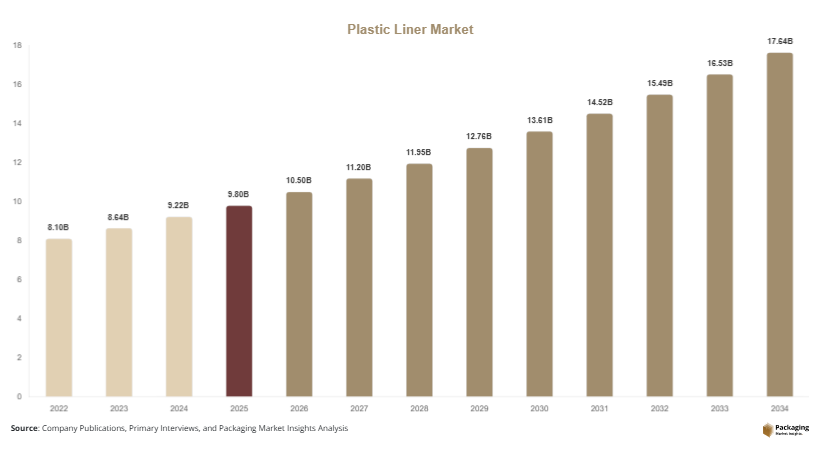
The global plastic liner market size was valued at approximately USD 9.8 billion in 2025 and is projected to reach USD 10.5 billion in 2026. Over the forecast period, the market is expected to grow to nearly USD 17.6 billion by 2034, registering a CAGR of 6.7% from 2025 to 2034. Plastic liners are widely used to provide protection against moisture, contamination, and chemical exposure, making them essential in industries such as food processing, pharmaceuticals, agriculture, and construction. The plastic liner market is witnessing steady expansion due to increasing demand across packaging, industrial, and waste management applications.
One of the primary growth factors driving the plastic liner market is the rising demand for flexible and protective packaging solutions. As global trade and e-commerce activities expand, there is a growing need for packaging materials that ensure product safety during storage and transportation. Plastic liners offer durability, cost efficiency, and versatility, making them suitable for a wide range of applications.
Key Highlights:
- Asia Pacific dominated the market with a 39.1% share in 2025, while Latin America is projected to grow at the fastest CAGR of 7.4%.
- Flat liners led the type segment with a 34.8% share, while gusseted liners are expected to grow at a CAGR of 7.1%.
- Polyethylene dominated with a 58.6% share, while biodegradable plastics are forecasted to grow at a CAGR of 8.2%.
- Food & beverage applications led the segment with 42.7% share, while industrial applications are expected to grow at a CAGR of 6.9%.
- China remained the d
Explore more data points, trends and opportunities Download Free Sample Report
Market Trends
Increasing adoption of biodegradable and recyclable plastic liners
The plastic liner market is experiencing a shift toward biodegradable and recyclable materials. Environmental concerns and regulatory pressures are encouraging manufacturers to develop sustainable alternatives to conventional plastic liners. Biodegradable liners made from plant-based materials are gaining traction in industries such as food packaging and waste management. These liners help reduce environmental impact while maintaining functionality. Additionally, recycling initiatives are promoting the use of recyclable plastic liners. Companies are investing in research to improve the performance of sustainable materials, ensuring they meet industry requirements. This trend is expected to drive innovation and support long-term market growth.
Rising demand for customized and high-performance liners
Another significant trend is the increasing demand for customized and high-performance plastic liners. Industries are seeking liners that meet specific requirements such as chemical resistance, temperature stability, and durability. For example, the chemical industry requires liners that can withstand harsh conditions, while the food industry demands liners that maintain hygiene and product quality. Manufacturers are developing advanced liners with multi-layer structures to enhance performance. Customization is becoming a key differentiator, allowing companies to cater to diverse applications. This trend is expected to drive product innovation and expand market opportunities.
Market Drivers
Growth in packaging and logistics industries
The expansion of packaging and logistics industries is a major driver of the plastic liner market. Increasing global trade and e-commerce activities are driving demand for packaging solutions that ensure product safety during transportation. Plastic liners provide protection against moisture, contamination, and physical damage. Their lightweight nature and cost-effectiveness make them a preferred choice for packaging applications. As supply chains become more complex, the demand for reliable packaging solutions is expected to increase, supporting market growth.
Rising demand from food and beverage sector
The food and beverage industry is a significant contributor to the growth of the plastic liner market. Plastic liners are widely used in bulk packaging, storage, and transportation of food products. They help maintain product quality and prevent contamination. The increasing consumption of packaged food products is driving demand for plastic liners. Additionally, strict hygiene standards in the food industry are encouraging the use of protective packaging solutions. This trend is expected to continue, supporting market expansion.
Market Restraint
Environmental concerns and regulatory challenges
One of the key challenges in the plastic liner market is the growing concern over plastic waste and its environmental impact. Governments across regions are implementing regulations to reduce plastic usage and promote sustainable alternatives. These regulations can limit the adoption of conventional plastic liners. For example, bans on single-use plastics in certain regions are affecting market growth. Additionally, the disposal and recycling of plastic liners can be challenging, leading to environmental issues. Manufacturers are investing in sustainable solutions, but the transition can be costly and time-consuming. These factors may hinder market growth to some extent.
Market Opportunities
Development of eco-friendly and biodegradable liners
The development of eco-friendly and biodegradable plastic liners presents significant opportunities for market growth. As environmental concerns increase, there is a growing demand for sustainable packaging solutions. Biodegradable liners made from renewable materials offer a viable alternative to conventional plastics. These liners are gaining popularity in industries such as food packaging and waste management. Manufacturers are focusing on improving the performance of biodegradable materials to meet industry requirements. This trend is expected to create new growth opportunities in the market.
Expansion in emerging markets and industrial applications
Emerging markets offer substantial growth opportunities for the plastic liner market. Rapid industrialization and urbanization are driving demand for packaging and storage solutions. Industries such as construction, agriculture, and chemicals are increasing their use of plastic liners. Additionally, the growth of waste management and sanitation sectors is contributing to market expansion. Companies are focusing on expanding their presence in these regions to capitalize on growing demand.
Report Scope
| Report Metric | Details |
|---|---|
| Market Size in 2025 | USD 9.8 Billion |
| Market Size in 2026 | USD 10.5 Billion |
| Market Size in 2034 | USD 17.6 Billion |
| CAGR | 6.7% (2026-2034) |
| Base Year for Estimation | 2025 |
| Historical Data | 2022-2024 |
| Forecast Period | 2026-2034 |
| Report Coverage | Revenue Forecast, Competitive Landscape, Supply Chain Disruption, Growth Factors, Environment & Regulatory Landscape and Trends |
| Geographies Covered | North America, Europe, APAC, Middle East and Africa, LATAM |
| Countries Covered | U.S., Canada, U.K., Germany, France, Spain, Italy, Russia, Nordic, Benelux, Rest of Europe, China, South Korea, Japan, India, Australia, Singapore, Taiwan, South East Asia, Rest of Asia-Pacific, UAE, Turky, Saudi Arabia, South Africa, Egypt, Nigeria, Rest of MEA, Brazil, Mexico, Argentina, Chile, Colombia, Rest of LATAM |
Explore more data points, trends and opportunities Download Free Sample Report
Segmental Analysis
By Type
Flat liners dominated the plastic liner market with a share of 34.8% in 2024. These liners are widely used due to their simplicity and versatility in various applications. They are commonly used in packaging, waste management, and industrial storage. Their cost-effectiveness and ease of use make them a preferred choice for many industries. Additionally, flat liners are available in different sizes and thicknesses, allowing customization for specific applications.
Gusseted liners are expected to grow at a CAGR of 7.1% during the forecast period. These liners provide additional capacity and flexibility, making them suitable for bulk storage applications. Their ability to expand and accommodate larger volumes is driving their adoption in industries such as agriculture and chemicals. This trend is expected to support segment growth.
By Material
Polyethylene dominated the segment with a share of 58.6% in 2024. This material is widely used due to its durability, flexibility, and resistance to moisture and chemicals. Polyethylene liners are suitable for a wide range of applications, including food packaging and industrial storage. Additionally, their cost-effectiveness makes them a preferred choice for manufacturers.
Biodegradable plastics are expected to grow at a CAGR of 8.2% during the forecast period. The increasing focus on sustainability is driving the adoption of biodegradable materials. These liners are made from renewable resources and offer environmental benefits. Innovations in material science are improving their performance, supporting segment growth.
By Application
Food and beverage applications dominated the segment with a share of 42.7% in 2024. The increasing demand for packaged food products is driving the use of plastic liners. These liners help maintain product quality and prevent contamination. Additionally, strict hygiene standards in the food industry are supporting the adoption of plastic liners.
Industrial applications are expected to grow at a CAGR of 6.9% during the forecast period. The expansion of industries such as chemicals and construction is driving demand for plastic liners. These liners are used for safe storage and transportation of materials. This trend is supporting segment growth.
Plastic Liner Market Segmentations
By Material Type
- Polyethylene (PE)
- Polypropylene (PP)
- Polyvinyl Chloride (PVC)
- Others (EVA, PET)
By Application
- Food Packaging
- Industrial Packaging
- Agriculture
- Healthcare
By End-Use Industry
- Food & Beverage
- Chemicals
- Pharmaceuticals
- Agriculture
- Others
Regional Analysis
North America
North America accounted for approximately 24.5% of the plastic liner market share in 2025 and is expected to grow at a CAGR of 6.2% during the forecast period. The region benefits from a well-established packaging industry and advanced logistics infrastructure. Increasing demand for packaged food and industrial goods is supporting market growth. Additionally, the presence of major manufacturers and technological advancements is contributing to the adoption of high-performance plastic liners.
The United States dominates the North American market due to its large consumer base and strong industrial sector. A unique growth factor in this region is the increasing focus on sustainable packaging solutions. Companies are adopting recyclable and biodegradable liners to meet regulatory requirements and consumer expectations. This trend is expected to drive market growth in the coming years.
Europe
Europe held a market share of around 23.2% in 2025 and is projected to grow at a CAGR of 6.4%. The region’s strict environmental regulations are driving the adoption of sustainable plastic liners. The food and beverage industry is a major contributor to market growth. Additionally, increasing awareness regarding environmental sustainability is encouraging the use of eco-friendly packaging solutions.
Germany is a leading country in the European market due to its strong industrial base. A key growth factor is the implementation of strict recycling policies. These policies are encouraging manufacturers to develop recyclable and biodegradable plastic liners. This trend is supporting market growth.
Asia Pacific
Asia Pacific dominated the market with a share of 39.1% in 2025 and is expected to grow at a CAGR of 7.4%. Rapid industrialization and urbanization are driving demand for plastic liners in the region. The expansion of manufacturing and construction industries is further supporting market growth. Additionally, increasing consumption of packaged goods is contributing to demand.
China is the dominant country in the region, supported by its large manufacturing capacity. A major growth factor is the increasing demand for packaging solutions in the food and beverage industry. This trend is driving the adoption of plastic liners.
Middle East & Africa
The Middle East & Africa region accounted for a market share of 6.8% in 2025 and is projected to grow at a CAGR of 6.9%. Increasing industrialization and investment in infrastructure are driving demand for plastic liners. The region is also witnessing growth in construction and chemical industries, which require protective packaging solutions.
Saudi Arabia is a dominant country in this region, driven by its industrial development initiatives. A unique growth factor is the expansion of construction projects, which require plastic liners for material storage and protection. This trend is supporting market growth.
Latin America
Latin America held a market share of 6.4% in 2025 and is expected to grow at the fastest CAGR of 7.4%. The region’s growing industrial sector and increasing demand for packaged goods are driving market growth. The expansion of retail and e-commerce channels is also contributing to demand for packaging solutions.
Brazil is the leading country in Latin America, supported by its expanding industrial base. A key growth factor is the increasing adoption of plastic liners in agriculture and food packaging. This trend is driving market growth.
Competitive Landscape
The plastic liner market is moderately competitive, with several global and regional players focusing on product innovation and expansion strategies. Companies are investing in research and development to create high-performance and sustainable liners. Strategic partnerships and acquisitions are common approaches to strengthen market position.
Berry Global Inc. is considered a leading player in the market due to its extensive product portfolio and strong global presence. The company recently introduced recyclable plastic liners to meet sustainability goals. Other key players are also focusing on developing eco-friendly solutions and expanding their market reach.
Key Players List
- Berry Global Inc.
- Amcor plc
- Sealed Air Corporation
- Mondi plc
- Sonoco Products Company
- Coveris Holdings S.A.
- Novolex Holdings LLC
- Inteplast Group
- Sigma Plastics Group
- Poly-America L.P.
- Clondalkin Group
- Greif Inc.
- DS Smith plc
- Winpak Ltd.
- Alpha Packaging