Plastic Films And Sheets Market Size and Growth
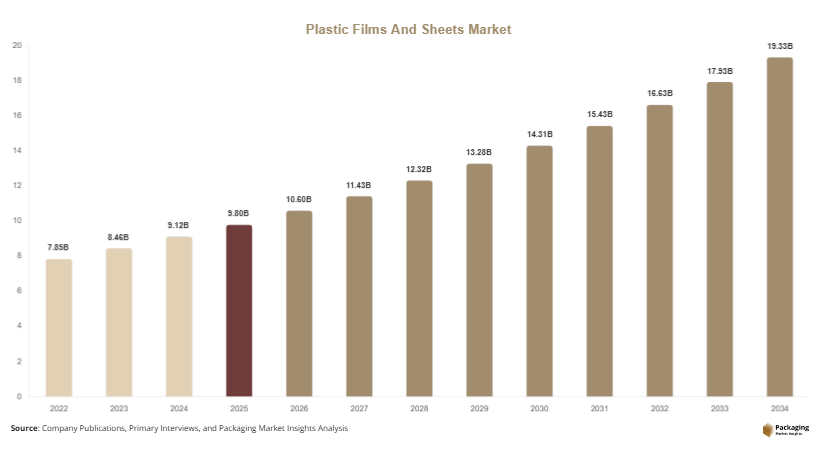
The plastic films and sheets market is witnessing steady expansion as industries increasingly prioritize sustainability and circular economy practices. In 2025, the global market size is estimated at USD 9.8 billion, with growth to USD 10.6 billion in 2026. The market is projected to reach approximately USD 19.4 billion by 2034, registering a compound annual growth rate (CAGR) of 7.8% during the forecast period (2025–2034). This growth trajectory reflects the rising demand for environmentally responsible packaging solutions, particularly in food, retail, and industrial sectors.
One of the primary growth factors is the increasing regulatory pressure across developed and emerging economies to reduce plastic waste and promote recycling. Governments are introducing stricter mandates and extended producer responsibility policies, compelling manufacturers to incorporate recycled materials into their production processes. This has significantly boosted the demand for recycled plastic films and sheets.
Key Highlights:
- Market size valued at USD 9.8 billion in 2025
- Expected to reach USD 19.4 billion by 2034
- CAGR of 7.8% from 2025 to 2034
- Increasing regulatory pressure driving adoption
- Growing demand from packaging and retail industries
Explore more data points, trends and opportunities Download Free Sample Report
Market Trends
Increasing Adoption of Circular Economy Practices
The adoption of circular economy models is becoming a defining trend in the plastic films and sheets market. Companies are focusing on reducing waste and reusing materials to create a closed-loop system. This trend is gaining traction across industries such as packaging, agriculture, and construction. Manufacturers are investing in recycling infrastructure and forming partnerships with waste management companies to ensure a consistent supply of recycled raw materials.
Furthermore, brands are actively promoting recycled content in their products to align with sustainability goals. This has led to increased transparency in supply chains and the adoption of eco-labeling practices. The emphasis on lifecycle assessment and environmental impact reduction is encouraging innovation in recycled plastic films and sheets. As a result, companies are developing products with improved durability, flexibility, and barrier properties while maintaining sustainability standards.
Technological Advancements in Recycling Processes
Technological innovation is playing a crucial role in shaping the market landscape. Advanced recycling techniques, including chemical recycling and improved mechanical recycling processes, are enhancing the quality of recycled plastic films and sheets. These technologies enable the processing of complex plastic waste, including multi-layer films, which were previously difficult to recycle.
Additionally, automation and artificial intelligence are being integrated into sorting and processing systems to improve efficiency and reduce contamination. This leads to higher-quality recycled materials that can compete with virgin plastics in terms of performance. The development of food-grade recycled plastics is also gaining attention, opening new opportunities in the food packaging sector. These technological advancements are expected to drive long-term growth and innovation in the market.
Market Drivers
Stringent Environmental Regulations
Government regulations aimed at reducing plastic waste are a major driver of market growth. Policies such as bans on single-use plastics, recycling mandates, and incentives for sustainable materials are encouraging industries to adopt recycled plastic films and sheets. These regulations are particularly strong in regions such as Europe and North America, where environmental standards are continuously evolving.
Manufacturers are responding by increasing their use of recycled content in packaging and industrial applications. Compliance with these regulations not only helps companies avoid penalties but also enhances their brand image. The regulatory landscape is expected to become more stringent in the coming years, further driving demand for recycled plastic films and sheets across various industries.
Rising Demand from Packaging Industry
The packaging industry is a significant contributor to the growth of the plastic films and sheets market. Flexible packaging solutions made from recycled materials are gaining popularity due to their cost-effectiveness and environmental benefits. Industries such as food and beverage, pharmaceuticals, and consumer goods are increasingly adopting recycled plastic films for packaging applications.
Moreover, the growth of e-commerce has led to increased demand for protective packaging materials, including films and sheets. Companies are focusing on sustainable packaging solutions to meet consumer expectations and reduce environmental impact. This trend is expected to continue, driving the demand for recycled plastic films and sheets over the forecast period.
Market Restraint
Quality and Performance Limitations
One of the primary challenges in the plastic films and sheets market is the quality and performance limitations associated with recycled materials. Recycled plastics often exhibit variability in properties such as strength, clarity, and durability, which can limit their application in certain high-performance uses. This inconsistency is primarily due to contamination and degradation during the recycling process.
For instance, in food packaging applications, maintaining strict hygiene and safety standards is essential. Recycled plastics may not always meet these requirements, restricting their use in sensitive applications. Additionally, the cost of advanced recycling technologies required to improve material quality can be high, posing a barrier for small and medium-sized manufacturers.
These limitations impact the overall adoption rate of recycled plastic films and sheets, particularly in industries that require high-quality materials. Addressing these challenges through technological advancements and improved recycling processes is crucial for market growth.
Market Opportunities
Expansion in Emerging Markets
Emerging economies present significant growth opportunities for the plastic films and sheets market. Rapid urbanization, industrialization, and increasing awareness of environmental issues are driving demand for sustainable materials in regions such as Asia Pacific and Latin America. Governments in these regions are introducing policies to promote recycling and reduce plastic waste.
Additionally, the expansion of manufacturing and packaging industries in these regions is creating a strong demand for cost-effective and sustainable materials. Companies are investing in local recycling facilities to capitalize on these opportunities. The availability of abundant plastic waste and lower production costs further enhance the growth potential in emerging markets.
Development of High-Performance Recycled Materials
The development of high-performance recycled plastic films and sheets is another key opportunity in the market. Advances in material science and recycling technologies are enabling the production of recycled plastics with properties comparable to virgin materials. This opens up new applications in industries such as automotive, construction, and electronics.
Furthermore, the increasing demand for sustainable products is encouraging companies to invest in research and development. Innovations such as multi-layer recycled films and biodegradable composites are gaining attention. These developments are expected to expand the application scope of recycled plastic films and sheets, driving market growth.
Report Scope
| Report Metric | Details |
|---|---|
| Market Size in 2025 | USD 9.8 Billion |
| Market Size in 2026 | USD 10.6 Billion |
| Market Size in 2034 | USD 19.4 Billion |
| CAGR | 7.8% (2026-2034) |
| Base Year for Estimation | 2025 |
| Historical Data | 2022-2024 |
| Forecast Period | 2026-2034 |
| Report Coverage | Revenue Forecast, Competitive Landscape, Supply Chain Disruption, Growth Factors, Environment & Regulatory Landscape and Trends |
| Geographies Covered | North America, Europe, APAC, Middle East and Africa, LATAM |
| Countries Covered | U.S., Canada, U.K., Germany, France, Spain, Italy, Russia, Nordic, Benelux, Rest of Europe, China, South Korea, Japan, India, Australia, Singapore, Taiwan, South East Asia, Rest of Asia-Pacific, UAE, Turky, Saudi Arabia, South Africa, Egypt, Nigeria, Rest of MEA, Brazil, Mexico, Argentina, Chile, Colombia, Rest of LATAM |
Explore more data points, trends and opportunities Download Free Sample Report
Segmental Analysis
By Type
Polyethylene (PE) films dominated the market in 2024, accounting for approximately 45% of the total share. These films are widely used due to their flexibility, durability, and cost-effectiveness. Recycled PE films are commonly used in packaging, agriculture, and construction applications, making them a preferred choice among manufacturers.
Polypropylene (PP) films are expected to be the fastest-growing subsegment, with a CAGR of 8.5%. The growth is driven by their superior strength and resistance to heat, making them suitable for advanced packaging applications. Increasing demand from the food and pharmaceutical industries is supporting this growth.
By Application
Packaging applications dominated the market in 2024, accounting for approximately 50% of the total share. Recycled plastic films and sheets are extensively used in flexible packaging, shrink wraps, and protective films. The growing demand for sustainable packaging solutions is driving this segment.
Agricultural applications are expected to witness the fastest growth, with a CAGR of 8.8%. The use of recycled films in greenhouse covers, mulch films, and silage wraps is increasing due to their cost-effectiveness and environmental benefits. Rising agricultural activities are further supporting this growth.
By End-Use
The food and beverage industry dominated the market in 2024, accounting for approximately 40% of the total share. The demand for sustainable packaging solutions in this industry is driving the use of recycled plastic films and sheets.
The construction industry is expected to be the fastest-growing end-use segment, with a CAGR of 8.2%. Recycled plastic sheets are increasingly used in insulation, vapor barriers, and protective coverings. The growth of infrastructure projects is a key factor driving this segment.
Plastic Films And Sheets Market Segmentations
Type
- Polyethylene (PE)
- Polypropylene (PP)
- Polyethylene Terephthalate (PET)
- Others
Application
- Packaging
- Agriculture
- Industrial
- Construction
End-Use
- Food & Beverage
- Pharmaceuticals
- Construction
- Consumer Goods
Regional Analysis
North America
North America accounted for approximately 28% of the market share in 2025, with a projected CAGR of 6.9% during the forecast period. The region's growth is driven by strong regulatory frameworks and increasing consumer awareness regarding environmental sustainability. The presence of established recycling infrastructure further supports market expansion.
The United States dominates the regional market due to its advanced waste management systems and strong focus on sustainability. A unique growth factor in the region is the increasing adoption of recycled materials in the e-commerce packaging sector, driven by major online retailers seeking eco-friendly solutions.
Europe
Europe held a market share of around 30% in 2025, making it one of the leading regions. The market is expected to grow at a CAGR of 7.2% through 2034. Strict environmental regulations and the European Union’s circular economy initiatives are key drivers of growth in the region.
Germany leads the European market due to its robust recycling infrastructure and strong industrial base. A unique growth factor is the implementation of extended producer responsibility policies, which require manufacturers to take responsibility for the entire lifecycle of their products.
Asia Pacific
Asia Pacific accounted for approximately 25% of the market share in 2025 and is expected to grow at the fastest CAGR of 9.1% during the forecast period. Rapid industrialization and urbanization are driving demand for recycled plastic films and sheets in the region.
China is the dominant country in the region, supported by its large manufacturing sector and government initiatives to reduce plastic waste. A unique growth factor is the increasing investment in recycling infrastructure and technology to manage the growing volume of plastic waste.
Middle East & Africa
The Middle East & Africa region held a market share of about 9% in 2025, with a projected CAGR of 6.5%. The market is gradually expanding due to increasing awareness of environmental issues and the adoption of sustainable practices.
The United Arab Emirates is a key market in the region, driven by government initiatives to promote recycling and reduce waste. A unique growth factor is the development of smart city projects that incorporate sustainable materials, including recycled plastic films and sheets.
Latin America
Latin America accounted for approximately 8% of the market share in 2025, with a CAGR of 7.0% during the forecast period. The region is witnessing growth due to increasing industrialization and government efforts to improve waste management systems.
Brazil leads the regional market, supported by its growing packaging industry and recycling initiatives. A unique growth factor is the increasing adoption of recycled materials in agricultural applications, particularly for greenhouse films and mulch films.
Competitive Landscape
The plastic films and sheets market is moderately fragmented, with several global and regional players competing based on product quality, innovation, and pricing. Key companies are focusing on expanding their recycling capacities and investing in advanced technologies to improve product performance.
One of the leading players in the market is Berry Global Inc., known for its extensive portfolio of sustainable packaging solutions. The company has recently expanded its recycling capabilities to meet growing demand. Other major players are also engaging in strategic partnerships, mergers, and acquisitions to strengthen their market position and expand their global footprint.
Key Players List
- Berry Global Inc.
- Amcor plc
- Mondi Group
- Sealed Air Corporation
- Coveris Holdings S.A.
- Plastipak Holdings Inc.
- Novolex Holdings LLC
- Alpek S.A.B. de C.V.
- Indorama Ventures Public Company Limited
- Uflex Ltd.
- Taghleef Industries
- Jindal Poly Films Ltd.
- Trex Company Inc.
- LyondellBasell Industries
- Veolia Environnement S.A.