Plastic Airless Packaging Market Size and Growth
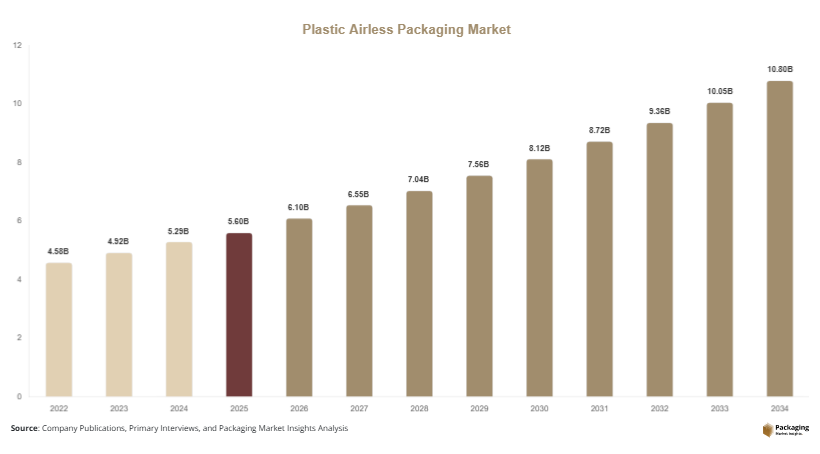
The global plastic airless packaging market was valued at USD 5.6 billion in 2025 and is expected to reach USD 6.1 billion in 2026. With growing demand across cosmetics, personal care, and pharmaceutical sectors, the market is forecasted to reach USD 10.8 billion by 2034, registering a CAGR of 7.4% from 2025 to 2034. Plastic airless packaging systems, which prevent air exposure during product dispensing, are gaining traction for preserving sensitive formulations such as serums, creams, and medicated gels. The plastic airless packaging market is experiencing steady expansion as brands increasingly prioritize product protection, extended shelf life, and enhanced consumer convenience.
One of the primary growth factors is the rising demand for premium cosmetic and skincare products that require contamination-free packaging. Airless packaging ensures minimal oxidation and microbial exposure, making it ideal for formulations with active ingredients. Another significant driver is the increasing awareness of product hygiene and safety among consumers, especially in post-pandemic markets. This has led brands to adopt packaging solutions that offer controlled dispensing and reduced product waste.
Key Market Insights
- Asia Pacific dominated the market with a 38.2% share in 2025, while Latin America is projected to grow at the fastest CAGR of 7.8%.
- Bottles led the type segment with a 34.1% share, while bags & pouches are expected to grow at a CAGR of 7.9%.
- Plastic materials dominated with a 71.6% share, while recyclable mono-material packaging is forecasted to grow at a CAGR of 8.1%.
- Personal care applications led the segment with 46.5% share, while pharmaceutical applications are expected to grow at a CAGR of 7.7%.
- China remained the dominant country with a market size of USD 1.4 billion in 2025 and USD 1.5 billion in 2026.
Explore more data points, trends and opportunities Download Free Sample Report
Market Trends
Growing adoption of sustainable and refillable airless packaging
Sustainability is becoming a central focus in the plastic airless packaging market as brands respond to environmental concerns and regulatory pressure. Manufacturers are developing recyclable plastic solutions and mono-material packaging designs that simplify recycling processes. Refillable airless containers are also gaining popularity among premium cosmetic brands, allowing consumers to reuse packaging while purchasing refill cartridges. This approach helps reduce plastic waste and supports circular economy initiatives. Companies are also investing in biodegradable polymers and lightweight materials to minimize environmental impact. These developments are encouraging wider adoption of eco-friendly airless packaging solutions across global markets.
Rising demand for precision dispensing and premium user experience
Consumers increasingly prefer packaging that offers precise product dispensing and ease of use. Airless systems provide controlled dosage, preventing product overuse and enhancing user convenience. This trend is especially prominent in skincare and pharmaceutical applications where dosage accuracy is important. Brands are focusing on ergonomic designs, improved pump mechanisms, and aesthetic appeal to enhance consumer experience. Premium packaging also plays a role in brand differentiation, particularly in the luxury cosmetics segment. As competition intensifies, companies are investing in innovative packaging designs that combine functionality with visual appeal, further supporting market growth.
Market Drivers
Expansion of cosmetics and personal care industry
The rapid growth of the global cosmetics and personal care sector is a major driver of the plastic airless packaging market. Consumers are increasingly investing in skincare products that contain active ingredients requiring protection from air exposure. Airless packaging helps maintain product efficacy by preventing oxidation and contamination. Brands are also launching new product lines with advanced formulations, which require specialized packaging solutions. This has increased demand for airless bottles, jars, and pumps. The rise of premium and organic skincare products is further boosting the need for high-quality packaging systems that ensure product safety and performance.
Increasing demand for hygienic and contamination-free packaging
Consumer awareness regarding hygiene and safety has grown significantly, influencing packaging preferences. Airless packaging systems minimize contact between the product and external environment, reducing the risk of contamination. This feature is particularly important for pharmaceuticals and dermatological products. Manufacturers are adopting airless technology to meet strict safety standards and improve product shelf life. Additionally, the convenience of touchless dispensing is appealing to consumers, especially in urban markets. As hygiene remains a key concern, demand for airless packaging solutions is expected to rise steadily.
Market Restraint
High production costs and design complexity
The plastic airless packaging market faces challenges related to higher production costs and complex design requirements. Airless systems require precision engineering, multiple components, and advanced manufacturing processes, which increase overall costs compared to traditional packaging. Small and medium-sized brands may find it difficult to adopt these solutions due to budget constraints. Additionally, the need for specialized molds and assembly processes can limit production scalability. For example, a mid-sized skincare brand transitioning to airless packaging may face increased costs in tooling and manufacturing setup. These factors can restrict market penetration, particularly in price-sensitive regions.
Market Opportunities
Increasing demand from pharmaceutical applications
The pharmaceutical sector presents significant growth opportunities for the plastic airless packaging market. Airless systems are being used for topical medications, creams, and gels that require protection from contamination. These packaging solutions help maintain product stability and extend shelf life. Pharmaceutical companies are adopting airless packaging to comply with safety regulations and improve patient convenience. The growing prevalence of chronic skin conditions and demand for dermatological treatments are further driving adoption. As the pharmaceutical industry expands, the need for reliable and hygienic packaging solutions is expected to increase.
Growth of e-commerce and direct-to-consumer brands
The rise of e-commerce and direct-to-consumer brands is creating new opportunities for airless packaging manufacturers. Online sales require packaging that is durable, leak-proof, and visually appealing. Airless containers meet these requirements by providing secure product storage and minimizing spillage during transit. Brands are also focusing on compact and lightweight designs to reduce shipping costs. Additionally, digital-first brands are using innovative packaging to enhance customer experience and build brand identity. As online retail continues to grow, demand for efficient and attractive airless packaging solutions is expected to rise.
Report Scope
| Report Metric | Details |
|---|---|
| Market Size in 2025 | USD 5.6 Billion |
| Market Size in 2026 | USD 6.1 Billion |
| Market Size in 2034 | USD 10.8 Billion |
| CAGR | 7.4% (2026-2034) |
| Base Year for Estimation | 2025 |
| Historical Data | 2022-2024 |
| Forecast Period | 2026-2034 |
| Report Coverage | Revenue Forecast, Competitive Landscape, Supply Chain Disruption, Growth Factors, Environment & Regulatory Landscape and Trends |
| Geographies Covered | North America, Europe, APAC, Middle East and Africa, LATAM |
| Countries Covered | U.S., Canada, U.K., Germany, France, Spain, Italy, Russia, Nordic, Benelux, Rest of Europe, China, South Korea, Japan, India, Australia, Singapore, Taiwan, South East Asia, Rest of Asia-Pacific, UAE, Turky, Saudi Arabia, South Africa, Egypt, Nigeria, Rest of MEA, Brazil, Mexico, Argentina, Chile, Colombia, Rest of LATAM |
Explore more data points, trends and opportunities Download Free Sample Report
Segmental Analysis
By Type
Bottles accounted for 34.1% of the market share in 2024, making them the dominant subsegment in the plastic airless packaging market. These containers are widely used in personal care and cosmetic applications due to their convenience and compatibility with pump systems. Airless bottles provide controlled dispensing, preventing product exposure to air and ensuring longer shelf life. Manufacturers are focusing on lightweight designs and improved aesthetics to enhance consumer appeal. The ability to use bottles for a wide range of viscosities also supports their dominance. Additionally, advancements in pump mechanisms have improved efficiency and reliability, further driving adoption.
Bags and pouches are expected to grow at a CAGR of 7.9% through 2034. These formats are gaining popularity due to their flexibility, reduced material usage, and cost efficiency. Airless pouches are particularly suitable for refill systems, allowing consumers to replace product contents without discarding the outer packaging. This supports sustainability initiatives and reduces waste. Manufacturers are developing high-barrier films to protect sensitive formulations. The increasing demand for eco-friendly packaging solutions is expected to drive growth in this segment over the forecast period.
By Material
Plastic materials dominated the market with a 71.6% share in 2024 due to their versatility, durability, and cost-effectiveness. Common materials include polypropylene and polyethylene, which offer excellent barrier properties and compatibility with airless systems. Plastic packaging is widely used across personal care, pharmaceutical, and food applications. Manufacturers are continuously improving material formulations to enhance performance and recyclability. The availability of lightweight and customizable plastic options supports their widespread adoption in airless packaging.
Recyclable mono-material packaging is projected to grow at a CAGR of 8.1% through 2034. This segment is driven by increasing regulatory pressure and consumer demand for sustainable solutions. Mono-material designs simplify recycling processes and reduce environmental impact. Companies are investing in research and development to create packaging solutions that maintain performance while being environmentally friendly. The shift toward circular economy practices is expected to accelerate growth in this segment.
By End Use
Personal care applications held 46.5% of the market share in 2024, making them the largest end-use segment. Airless packaging is widely used for skincare products such as creams, lotions, and serums. These products often contain active ingredients that require protection from air exposure. Airless systems help maintain product efficacy and improve user experience. The growing demand for premium and organic skincare products is supporting market growth. Brands are also using innovative packaging designs to attract consumers and enhance product appeal.
Pharmaceutical applications are expected to grow at a CAGR of 7.7% through 2034. This growth is driven by increasing demand for hygienic and contamination-free packaging solutions. Airless systems are used for topical medications and dermatological products. These packaging solutions help maintain product stability and improve patient safety. The rising prevalence of chronic diseases and increasing healthcare spending are further supporting growth in this segment.
Plastic Airless Packaging Market Segmentations
By Type
- Bottles
- Jars
- Bags & Pouches
- Tubes
By Material
- Plastic
- Recyclable Mono-Material
- Bioplastics
- Others
By End User
- Personal Care
- Pharmaceutical
- Food & Beverage
- Others
Regional Analysis
North America
North America accounted for 27.6% of the plastic airless packaging market in 2025 and is expected to grow at a CAGR of 6.8% through 2034. The region benefits from strong demand in the cosmetics and pharmaceutical industries. Companies are investing in advanced packaging technologies to improve product quality and meet regulatory standards. Consumer preference for premium skincare products is also driving adoption of airless packaging solutions.
The United States dominates the regional market due to its well-established beauty and healthcare sectors. A unique growth factor is the increasing adoption of sustainable packaging practices among major brands. Companies are focusing on recyclable materials and refillable systems to reduce environmental impact, which is encouraging wider use of airless packaging.
Europe
Europe held 24.9% of the market share in 2025 and is projected to grow at a CAGR of 7.0% during the forecast period. The region is characterized by strong environmental regulations and high demand for eco-friendly packaging. Manufacturers are developing innovative airless systems that meet sustainability standards while maintaining product performance.
Germany leads the European market due to its advanced manufacturing capabilities and strong cosmetic industry. A unique growth factor is the emphasis on circular economy initiatives, which encourages the use of recyclable and reusable packaging solutions. This trend supports the adoption of airless packaging technologies.
Asia Pacific
Asia Pacific dominated the market with 38.2% share in 2025 and is expected to grow at a CAGR of 7.6% through 2034. Rapid urbanization, rising disposable income, and expanding beauty industry are key factors driving market growth. Manufacturers are increasing production capacity to meet growing demand for airless packaging solutions.
China remains the dominant country in the region due to its large consumer base and strong manufacturing sector. A unique growth factor is the rapid expansion of domestic skincare brands, which are adopting premium packaging solutions to compete globally. This is boosting demand for airless packaging systems.
Middle East & Africa
The Middle East & Africa accounted for 4.3% of the market in 2025 and is projected to grow at a CAGR of 6.5% through 2034. The region is witnessing gradual growth in the cosmetics and healthcare sectors. Increasing consumer awareness about product safety is supporting demand for airless packaging solutions.
The United Arab Emirates leads the regional market due to its growing luxury beauty segment. A unique growth factor is the rising demand for premium imported cosmetics, which often use advanced packaging technologies. This is encouraging adoption of airless packaging systems.
Latin America
Latin America held 5.0% of the market share in 2025 and is expected to grow at a CAGR of 7.8% through 2034. The region is experiencing growth in the personal care industry, supported by increasing urbanization and consumer spending. Packaging innovation is becoming important for brand differentiation.
Brazil dominates the regional market due to its large cosmetics industry. A unique growth factor is the increasing presence of local beauty brands focusing on sustainable packaging. This is driving demand for recyclable airless packaging solutions across the region.
Competitive Landscape
The plastic airless packaging market is moderately competitive, with key players focusing on innovation, sustainability, and product differentiation. Companies are investing in advanced manufacturing technologies to improve packaging performance and reduce costs. Strategic partnerships and product launches are common strategies to expand market presence.
AptarGroup, Inc. is recognized as a leading player due to its strong product portfolio and global presence. The company recently introduced a new recyclable airless packaging system designed to reduce environmental impact. Other major players include Silgan Holdings Inc., Albéa Group, Quadpack Industries, and Lumson S.p.A. These companies are focusing on developing eco-friendly packaging solutions and expanding their product offerings to meet evolving market demand.
Key Players List
- AptarGroup, Inc.
- Silgan Holdings Inc.
- Albéa Group
- Quadpack Industries
- Lumson S.p.A.
- HCP Packaging
- Raepak Ltd.
- Fusion Packaging
- Libo Cosmetics Company Ltd.
- APackaging Group
- RPC Group Plc
- Yonwoo Co., Ltd.
- Frapak Packaging
- Berlin Packaging
- Cosmopak Corp.