Plantable Packaging Market Size and Growth
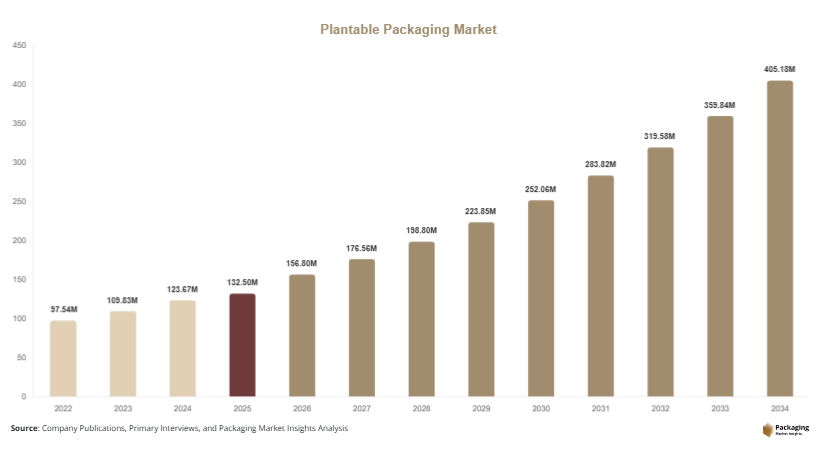
The Plantable Packaging Market is emerging as a niche yet rapidly expanding segment within the broader sustainable packaging industry. This market focuses on biodegradable packaging embedded with seeds that can be planted after use, contributing to environmental restoration and waste reduction. The market size was valued at approximately USD 132.5 million in 2025 and is projected to reach USD 156.8 million in 2026. Over the forecast period from 2025 to 2034, the market is expected to grow at a CAGR of 12.6%, reaching nearly USD 451.2 million by 2034. This growth reflects increasing consumer awareness of environmental sustainability and the demand for eco-friendly packaging alternatives.
One of the key growth factors driving the plantable packaging market is the rising concern over plastic waste and environmental degradation. Governments and regulatory bodies are implementing strict policies to reduce single-use plastics, encouraging the adoption of biodegradable and plantable packaging solutions. Another important growth factor is the growing demand for sustainable branding among companies. Businesses are increasingly using plantable packaging as a marketing tool to enhance their environmental image and engage eco-conscious consumers.
Additionally, the growth of e-commerce and direct-to-consumer brands is supporting the adoption of innovative packaging formats. Plantable packaging offers a unique consumer experience, which aligns with the increasing focus on customer engagement. Technological advancements in biodegradable materials and seed integration techniques are further enhancing product quality and durability. Moreover, the rising popularity of organic products and green initiatives is creating favorable conditions for market expansion. These factors collectively contribute to the growth of the plantable packaging market.
Key Highlights:
- Market size reached USD 132.5 million in 2025
- Expected to grow to USD 451.2 million by 2034
- CAGR of 12.6% from 2025 to 2034
- Increasing demand for sustainable and biodegradable packaging
- Growing adoption by eco-conscious brands
Explore more data points, trends and opportunities Download Free Sample Report
Market Trends
Rising Integration of Circular Economy Principles in Packaging Design
The plantable packaging market is increasingly influenced by circular economy principles, which emphasize waste reduction and resource reuse. Companies are designing packaging solutions that not only decompose naturally but also contribute positively to the environment. Plantable packaging aligns with this concept by transforming waste into plant life, creating a closed-loop system. Brands are using such packaging to strengthen their sustainability commitments and appeal to environmentally conscious consumers. This trend is gaining traction across industries such as cosmetics, food, and retail. As awareness of circular economy practices grows, the adoption of plantable packaging solutions is expected to increase steadily.
Increasing Use in Premium and Niche Product Segments
Plantable packaging is gaining popularity in premium and niche product segments where brand differentiation is critical. Companies in industries such as organic food, skincare, and luxury goods are adopting plantable packaging to enhance product value. This packaging not only serves functional purposes but also creates a unique consumer experience. Customers can plant the packaging, which adds emotional and environmental value to the product. This trend is particularly prominent among small and medium enterprises that focus on sustainability-driven branding. As competition intensifies, the use of innovative packaging solutions like plantable packaging is expected to expand.
Market Drivers
Increasing Consumer Demand for Sustainable Packaging Solutions
The growing consumer demand for sustainable packaging solutions is a major driver of the plantable packaging market. Consumers are becoming more aware of the environmental impact of packaging waste and are seeking eco-friendly alternatives. Plantable packaging addresses this demand by offering a biodegradable solution that contributes to environmental restoration. This shift in consumer preferences is encouraging companies to adopt sustainable packaging practices. As awareness continues to increase, the demand for plantable packaging solutions is expected to rise significantly, supporting market growth.
Government Regulations and Environmental Policies
Government regulations and environmental policies are playing a crucial role in driving the market. Many countries are implementing restrictions on single-use plastics and promoting sustainable alternatives. These regulations encourage companies to adopt biodegradable and plantable packaging solutions. Compliance with environmental standards is becoming a priority for businesses. As regulatory frameworks become more stringent, the adoption of plantable packaging is expected to increase. This driver is particularly significant in regions with strong environmental policies.
Market Restraint
Limited Scalability and Higher Production Costs
Limited scalability and higher production costs present a significant challenge in the plantable packaging market. The production of plantable packaging involves specialized materials and processes, which can increase costs compared to conventional packaging. Additionally, scaling up production to meet large-scale demand can be difficult due to technical limitations. For example, a company producing plantable packaging for a global brand may face challenges in maintaining consistent quality and supply. These factors can limit the adoption of plantable packaging, particularly among cost-sensitive industries. Addressing these challenges is essential for market growth.
Market Opportunities
Expansion in E-commerce and Sustainable Retail
The expansion of e-commerce and sustainable retail presents significant opportunities for the plantable packaging market. Online retailers are increasingly adopting eco-friendly packaging solutions to reduce their environmental impact. Plantable packaging offers a unique value proposition by combining sustainability with consumer engagement. This is particularly important for brands that focus on environmentally conscious consumers. As e-commerce continues to grow, the demand for innovative packaging solutions is expected to increase. This opportunity supports the expansion of the plantable packaging market.
Innovation in Material Technology and Seed Integration
Advancements in material technology and seed integration offer new opportunities in the market. Companies are developing improved biodegradable materials that enhance the durability and functionality of plantable packaging. Innovations in seed integration techniques ensure better germination rates and product performance. These developments address some of the challenges associated with plantable packaging and improve its appeal. As technology continues to evolve, the market is expected to benefit from new and improved packaging solutions.
Report Scope
| Report Metric | Details |
|---|---|
| Market Size in 2025 | USD 132.5 Million |
| Market Size in 2026 | USD 156.8 Million |
| Market Size in 2034 | USD 451.2 Million |
| CAGR | 12.6% (2026-2034) |
| Base Year for Estimation | 2025 |
| Historical Data | 2022-2024 |
| Forecast Period | 2026-2034 |
| Report Coverage | Revenue Forecast, Competitive Landscape, Supply Chain Disruption, Growth Factors, Environment & Regulatory Landscape and Trends |
| Geographies Covered | North America, Europe, APAC, Middle East and Africa, LATAM |
| Countries Covered | U.S., Canada, U.K., Germany, France, Spain, Italy, Russia, Nordic, Benelux, Rest of Europe, China, South Korea, Japan, India, Australia, Singapore, Taiwan, South East Asia, Rest of Asia-Pacific, UAE, Turky, Saudi Arabia, South Africa, Egypt, Nigeria, Rest of MEA, Brazil, Mexico, Argentina, Chile, Colombia, Rest of LATAM |
Explore more data points, trends and opportunities Download Free Sample Report
Segmental Analysis
By Packaging Type
Paper-based plantable packaging dominated the market in 2024, accounting for approximately 58% of the total market share. This type of packaging is widely used due to its biodegradability and ease of seed integration. Paper-based solutions are suitable for various applications, including product labels and packaging inserts. The increasing demand for sustainable packaging supports the dominance of this segment.
Molded fiber packaging is expected to be the fastest-growing segment, with a CAGR of 13.2% during the forecast period. This type offers improved durability and versatility. Increasing demand for eco-friendly packaging drives the growth of this segment.
By Application
Food and beverage packaging dominated the market in 2024, accounting for approximately 46% of the total market share. The demand for sustainable packaging in the food industry supports this segment. Plantable packaging is used for product labels and packaging materials.
Personal care and cosmetics are expected to grow at the fastest CAGR of 13.5% during the forecast period. Increasing demand for sustainable packaging in the cosmetics industry drives growth.
By End-Use
Retail dominated the market in 2024, with a share of approximately 49%. Retail companies are adopting plantable packaging to enhance brand image and meet consumer expectations. The growing demand for sustainable products supports this segment.
E-commerce is expected to grow at the highest CAGR of 14.1% during the forecast period. The expansion of online retail drives demand for innovative packaging solutions.
Plantable Packaging Market Segmentations
Material Type
- Recycled Paper & Pulp
- Biodegradable Polymers
- Natural Fibers (Hemp, Jute, Cotton)
- Seed-Embedded Paper
Application
- Food & Beverage Packaging
- Personal Care & Cosmetics
- E-commerce Packaging
- Retail & Consumer Goods
End-Use Industry
- FMCG
- Agriculture & Horticulture
- Healthcare
- Electronics
- Others
Regional Analysis
North America
North America accounted for approximately 35% of the plantable packaging market share in 2025 and is expected to grow at a CAGR of 11.8% during the forecast period. The region benefits from high consumer awareness of sustainability and strong regulatory frameworks. Companies are actively adopting eco-friendly packaging solutions to meet consumer expectations and comply with regulations.
The United States dominates the regional market due to its large consumer base and strong focus on sustainability. A unique growth factor is the increasing adoption of plantable packaging by direct-to-consumer brands seeking to enhance customer engagement.
Europe
Europe held around 28% of the market share in 2025 and is projected to grow at a CAGR of 12.1% through 2034. The region’s strict environmental regulations and commitment to sustainability support market growth. Companies are investing in innovative packaging solutions to reduce their environmental impact.
Germany leads the European market, supported by its strong manufacturing sector. A key growth factor is the emphasis on reducing plastic waste and promoting biodegradable packaging.
Asia Pacific
Asia Pacific accounted for approximately 22% of the market share in 2025 and is expected to grow at a CAGR of 13.9% during the forecast period. Rapid urbanization and increasing environmental awareness drive demand for sustainable packaging solutions.
China dominates the Asia Pacific market due to its large population and growing e-commerce sector. A unique growth factor is the increasing adoption of eco-friendly packaging in online retail.
Middle East & Africa
The Middle East & Africa region held about 8% of the market share in 2025 and is projected to grow at a CAGR of 11.5% over the forecast period. The market is driven by increasing awareness of sustainability and environmental issues.
UAE leads the regional market, supported by its growing retail sector. A key growth factor is the adoption of sustainable packaging solutions in premium products.
Latin America
Latin America accounted for nearly 7% of the market share in 2025 and is expected to grow at a CAGR of 12.3% through 2034. Economic development and increasing environmental awareness contribute to market growth.
Brazil dominates the Latin American market due to its expanding consumer base. A unique growth factor is the growing demand for eco-friendly packaging solutions.
Competitive Landscape
The plantable packaging market is characterized by the presence of several small and medium-sized companies focusing on innovation and sustainability. Companies are investing in research and development to improve product quality and expand their offerings. Strategic collaborations and partnerships are common strategies used to enhance market presence.
Botanical PaperWorks is a leading player in the market, known for its innovative plantable packaging solutions. The company recently introduced new seed paper products to expand its portfolio. Other key players include Pangea Organics, Earthly Goods, Green Field Paper Company, and Bloomin. These companies are focusing on sustainability and product innovation to maintain their competitive positions.
Key Players List
- Botanical PaperWorks
- Pangea Organics
- Earthly Goods
- Green Field Paper Company
- Bloomin
- Seed Phytonutrients
- Botanical Paperworks Inc.
- PaperFoam B.V.
- EcoEnclose
- Packhelp
- Noissue
- Arjowiggins Group
- UPM Specialty Papers
- Smurfit Kappa Group
- DS Smith Plc