Pillow Shape Aseptic Packaging Material Market Size and Growth
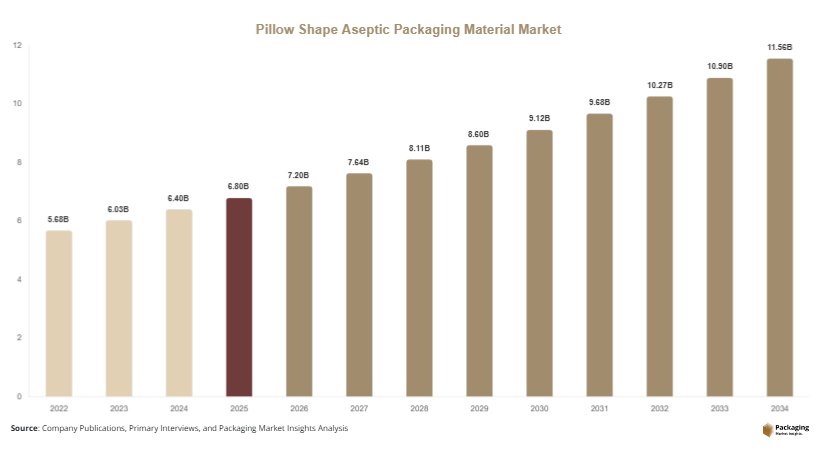
In 2025, the global pillow shape aseptic packaging material market size is estimated at USD 6.8 billion, and it is projected to reach approximately USD 7.2 billion in 2026. The market is expected to expand significantly, reaching USD 11.6 billion by 2034, growing at a CAGR of 6.1% from 2025 to 2034. Pillow-shaped aseptic packaging is widely used for packaging dairy products, juices, liquid foods, and certain pharmaceuticals, offering extended shelf life without the need for refrigeration.
One of the primary growth factors is the increasing demand for affordable and efficient liquid packaging formats in emerging economies. Pillow packs are cost-effective compared to rigid cartons and bottles, making them suitable for mass-market consumption. Another key growth factor is the expansion of the dairy and beverage industries. Products such as milk, flavored drinks, and juices rely heavily on aseptic packaging to maintain freshness and prevent contamination. The rising consumption of these products is directly contributing to market growth.
Key Highlights:
- Market size is projected to reach USD 11.6 billion by 2034, reflecting steady expansion driven by increasing demand across food and beverage sectors. The growth indicates rising adoption of aseptic packaging solutions globally.
- The market is expected to register a CAGR of 6.1% during 2025–2034, supported by continuous innovation and expanding end-use industries. Consistent demand from emerging economies is further contributing to this growth trajectory.
- Rising demand for low-cost liquid packaging solutions is a key factor driving market expansion. Manufacturers are focusing on cost-efficient formats such as pillow packaging to cater to price-sensitive consumers.
- Strong growth in dairy and beverage industries is significantly boosting demand for aseptic packaging materials. Increasing consumption of milk, juices, and ready-to-drink products is supporting market growth.
- Advancements in aseptic and multilayer packaging technologies are improving product safety and shelf life. These innovations are enhancing barrier properties and enabling wider adoption across industries.
Explore more data points, trends and opportunities Download Free Sample Report
Market Trends
Increasing Use of Lightweight and Cost-Effective Packaging Formats
A prominent trend in the pillow shape aseptic packaging material market is the growing preference for lightweight and cost-efficient packaging solutions. Pillow-shaped packaging requires less material compared to rigid alternatives, reducing production and transportation costs. This format is particularly popular in developing regions where affordability plays a key role in purchasing decisions. Manufacturers are optimizing material usage while maintaining strength and barrier properties. The trend is also supported by the need for efficient logistics, as lightweight packaging reduces shipping costs and improves supply chain efficiency.
Shift Toward Sustainable and Recyclable Aseptic Materials
Another key trend is the increasing focus on sustainability and recyclability. Companies are investing in the development of eco-friendly aseptic packaging materials that reduce environmental impact. Efforts include reducing plastic content, incorporating bio-based materials, and improving recyclability of multilayer films. Regulatory pressure and consumer awareness are encouraging the adoption of greener solutions. This trend is driving innovation in material science, leading to the development of advanced laminates that maintain performance while being more environmentally responsible.
Market Drivers
Growth of Dairy and Beverage Industries
The expansion of dairy and beverage industries is a major driver of the pillow shape aseptic packaging material market. Products such as milk, juices, and flavored drinks require packaging that ensures safety and extends shelf life. Aseptic packaging eliminates the need for refrigeration, making it suitable for regions with limited cold chain infrastructure. The increasing consumption of packaged beverages is supporting demand. Additionally, the introduction of new product variants and flavors is driving the need for versatile packaging solutions.
Rising Demand for Affordable Packaging in Emerging Markets
Rising demand for affordable packaging solutions in emerging markets is another key driver. Pillow-shaped aseptic packaging offers a cost-effective alternative to cartons and bottles, making it accessible to a larger consumer base. This is particularly important in regions with price-sensitive consumers. The growth of urban populations and increasing disposable income are further supporting market expansion. Manufacturers are focusing on optimizing production processes to reduce costs and improve efficiency.
Market Restraint
Limited Recycling Infrastructure and Environmental Concerns
A major restraint in the pillow shape aseptic packaging material market is the limited recycling infrastructure for multilayer materials. Aseptic packaging typically consists of layers of plastic and aluminum, which are difficult to separate and recycle. This creates environmental concerns, particularly in regions with strict waste management regulations. For example, improper disposal of used packaging can contribute to pollution and landfill accumulation. These challenges are prompting regulatory authorities to impose restrictions on non-recyclable materials. Manufacturers are required to invest in sustainable alternatives, which may increase production costs. Addressing these issues is essential for long-term market growth.
Market Opportunities
Development of Eco-Friendly Aseptic Packaging Solutions
The development of eco-friendly aseptic packaging solutions presents a significant opportunity for the market. Companies are exploring biodegradable materials and recyclable laminates to reduce environmental impact. Innovations in material science are enabling the creation of sustainable packaging without compromising performance. As consumers become more environmentally conscious, demand for such solutions is expected to increase. This trend offers opportunities for companies to differentiate their products and gain a competitive edge.
Expansion in Emerging Markets and Rural Distribution
Expansion in emerging markets and rural distribution networks is another major opportunity. Many developing regions lack adequate refrigeration infrastructure, making aseptic packaging an ideal solution for preserving liquid products. The increasing penetration of retail networks and government initiatives to improve food distribution are supporting market growth. Companies can capitalize on this opportunity by offering cost-effective and durable packaging solutions tailored to local needs.
Report Scope
| Report Metric | Details |
|---|---|
| Market Size in 2025 | USD 6.8 Billion |
| Market Size in 2026 | USD 7.2 Billion |
| Market Size in 2034 | USD 11.6 Billion |
| CAGR | 6.1% (2026-2034) |
| Base Year for Estimation | 2025 |
| Historical Data | 2022-2024 |
| Forecast Period | 2026-2034 |
| Report Coverage | Revenue Forecast, Competitive Landscape, Supply Chain Disruption, Growth Factors, Environment & Regulatory Landscape and Trends |
| Geographies Covered | North America, Europe, APAC, Middle East and Africa, LATAM |
| Countries Covered | U.S., Canada, U.K., Germany, France, Spain, Italy, Russia, Nordic, Benelux, Rest of Europe, China, South Korea, Japan, India, Australia, Singapore, Taiwan, South East Asia, Rest of Asia-Pacific, UAE, Turky, Saudi Arabia, South Africa, Egypt, Nigeria, Rest of MEA, Brazil, Mexico, Argentina, Chile, Colombia, Rest of LATAM |
Explore more data points, trends and opportunities Download Free Sample Report
Segmental Analysis
By Type
Plastic-based aseptic materials dominated the market in 2024, accounting for approximately 65% of the total share. These materials are widely preferred due to their flexibility, durability, and cost efficiency, which make them highly suitable for pillow-shaped packaging formats. Their lightweight structure allows for easy handling, storage, and transportation, reducing overall logistics costs for manufacturers and distributors. In addition, plastic-based materials provide strong barrier properties against moisture, oxygen, and contaminants, ensuring product safety and extended shelf life. These advantages are particularly important in the packaging of liquid food products such as milk, juices, and other beverages. The growing demand for convenient, portable, and affordable packaging solutions is further driving the adoption of plastic-based aseptic materials across both developed and emerging markets.
Paper-based aseptic materials are expected to be the fastest-growing segment, with a CAGR of 6.3% during the forecast period. This growth is primarily driven by increasing demand for eco-friendly and sustainable packaging alternatives as environmental concerns continue to rise globally. Governments and regulatory bodies are encouraging the reduction of plastic usage, which is pushing manufacturers to invest in recyclable and biodegradable materials. Paper-based aseptic packaging offers a renewable and more environmentally responsible option while still maintaining adequate barrier properties when combined with thin layers of coatings. In addition, consumers are becoming more aware of sustainability issues and are increasingly favoring products packaged in environmentally friendly materials. This shift in consumer preference, along with advancements in paper-based coating technologies, is expected to support the rapid growth of this segment over the coming years.
By Application
Dairy products dominated the market in 2024, accounting for approximately 58% of the market share. Pillow-shaped aseptic packaging is extensively used for milk and other dairy products due to its cost-effectiveness and efficiency in high-volume distribution. The packaging format is particularly popular in emerging markets, where it supports the supply of affordable milk to large populations. Its ability to maintain product freshness without the need for refrigeration makes it an ideal choice in regions with limited cold chain infrastructure. Additionally, the lightweight and flexible nature of pillow packaging helps reduce transportation costs and storage space requirements. The growing consumption of dairy products, especially in urban areas, along with increasing demand for packaged milk, continues to drive the dominance of this segment in the global market.
Beverages are expected to be the fastest-growing segment, with a CAGR of 6.4% during the forecast period. The growth is driven by increasing consumption of packaged drinks, including juices, flavored beverages, and ready-to-drink products. Changing consumer lifestyles, rising urbanization, and a growing preference for convenience are key factors contributing to the expansion of this segment. Pillow-shaped aseptic packaging provides an economical and practical solution for beverage manufacturers looking to cater to mass markets. It enables extended shelf life without preservatives and ensures product safety during distribution. Furthermore, the expansion of retail networks and the growing presence of modern trade channels are making packaged beverages more accessible to consumers, thereby supporting the rapid growth of this application segment.
By End-Use
The food and beverage industry dominated the market in 2024, holding approximately 70% of the total share. The need for efficient, safe, and scalable liquid packaging solutions is a major factor driving this segment. Aseptic pillow packaging is widely used for a variety of food and beverage products due to its ability to preserve freshness and extend shelf life without refrigeration. This is particularly important in regions where cold storage facilities are limited or costly. The industry also benefits from the cost advantages of pillow packaging, which allows manufacturers to offer competitively priced products. In addition, increasing demand for processed and packaged foods, along with the expansion of distribution networks, is further strengthening the position of the food and beverage segment in the market.
The pharmaceutical industry is expected to be the fastest-growing segment, with a CAGR of 6.2% during the forecast period. The growth is driven by the rising demand for sterile and contamination-free packaging solutions for liquid medicines, vaccines, and healthcare products. Aseptic packaging plays a crucial role in maintaining the integrity and safety of pharmaceutical products, ensuring that they remain effective throughout their shelf life. The increasing focus on healthcare infrastructure, particularly in developing regions, is contributing to higher demand for reliable packaging solutions. Additionally, the growth of biopharmaceuticals and liquid drug formulations is creating new opportunities for aseptic packaging materials. As regulatory standards for pharmaceutical packaging become more stringent, the adoption of advanced aseptic solutions is expected to accelerate further.
Pillow Shape Aseptic Packaging Material Market Segmentations
Product Type
- Plastic-Based Aseptic Materials
- Paper-Based Aseptic Materials
Application
- Dairy Products
- Beverages
End-Use
- Food & Beverage Industry
- Pharmaceutical Industry
Regional Analysis
North America
North America accounted for approximately 20% of the global market share in 2025, driven by strong demand for packaged beverages and dairy products across developed economies. The region is projected to grow at a CAGR of 5.4% during the forecast period, supported by continuous advancements in packaging materials and well-established distribution networks. The presence of major food processing companies and increasing consumer preference for convenient, shelf-stable products are further contributing to market expansion. Additionally, the growing adoption of aseptic packaging technologies is enhancing product safety and extending shelf life, making it a preferred choice among manufacturers.
The United States dominates the regional market due to its advanced food processing industry and high consumption of packaged liquid products. A unique growth factor is the increasing demand for shelf-stable dairy products, particularly in remote and rural areas where cold chain infrastructure may be limited. The rising popularity of on-the-go consumption and ready-to-drink beverages is also supporting demand. Furthermore, investments in sustainable packaging innovations and recycling initiatives are shaping the future of the market in this region.
Europe
Europe held around 22% of the market share in 2025 and is expected to grow at a CAGR of 5.7% during the forecast period. The region’s growth is largely driven by stringent food safety regulations and a strong focus on sustainability in packaging materials. Increasing awareness regarding environmental impact and waste reduction is encouraging manufacturers to adopt recyclable and eco-friendly aseptic packaging solutions. Additionally, the demand for high-quality packaged food and beverages is supporting steady market growth across key European countries.
Germany is a key market in Europe, supported by its strong manufacturing base and technological expertise in packaging solutions. A unique growth factor is the region’s focus on reducing food waste through efficient and durable packaging formats. The adoption of advanced aseptic technologies is enabling longer shelf life for liquid products without refrigeration. Moreover, increasing consumer preference for organic and preservative-free beverages is further boosting demand for reliable aseptic packaging materials across the region.
Asia Pacific
Asia Pacific accounted for approximately 35% of the global market share in 2025, making it the largest regional market. The region is projected to grow at a CAGR of 6.8%, driven by rapid urbanization, population growth, and increasing consumption of packaged liquid products. Expanding retail infrastructure and rising disposable income levels are encouraging consumers to shift toward packaged milk, juices, and beverages. Additionally, the growing food processing industry is creating significant demand for cost-effective and efficient packaging solutions.
India dominates the market due to its large dairy industry and widespread consumption of milk and dairy products. A unique growth factor is the extensive use of pillow-shaped aseptic packaging for milk distribution, particularly in urban and semi-urban areas. The affordability and convenience of this packaging format make it highly suitable for mass consumption. Furthermore, government initiatives to improve food safety standards and distribution networks are supporting the adoption of aseptic packaging technologies across the region.
Middle East & Africa
The Middle East & Africa region held about 10% of the market share in 2025 and is expected to grow at a CAGR of 5.9% during the forecast period. The market is gradually expanding due to increasing demand for packaged beverages and dairy products. Rapid urbanization and improving living standards are driving the consumption of processed and packaged foods. Additionally, the development of retail infrastructure and growing investments in the food and beverage sector are contributing to market growth in the region.
Saudi Arabia is a key market, supported by significant investments in food infrastructure and processing facilities. A unique growth factor is the need for non-refrigerated storage solutions in regions with high temperatures and limited cold chain capabilities. Aseptic packaging materials provide an effective solution by preserving product quality without refrigeration. The increasing demand for convenience foods and beverages is also encouraging manufacturers to adopt advanced packaging technologies, further supporting market expansion.
Latin America
Latin America accounted for around 13% of the global market share in 2025 and is projected to grow at a CAGR of 6.0% during the forecast period. The region is experiencing steady growth due to increasing consumption of packaged liquids, particularly in the beverage sector. Expanding urban populations and rising disposable incomes are driving demand for convenient and affordable packaging solutions. Additionally, the growth of modern retail channels is improving product accessibility and boosting market expansion.
Brazil dominates the regional market, driven by its strong beverage industry and high consumption of packaged drinks. A unique growth factor is the growing demand for affordable packaging solutions that cater to price-sensitive consumers. Pillow-shaped aseptic packaging offers a cost-effective alternative to rigid packaging formats, making it widely adopted in the region. Furthermore, increasing investments in food processing and packaging technologies are expected to support long-term market growth across Latin America.
Competitive Landscape
The food and beverage industry dominated the market in 2024, holding approximately 70% of the total share. The need for efficient, safe, and scalable liquid packaging solutions is a major factor driving this segment. Aseptic pillow packaging is widely used for a variety of food and beverage products due to its ability to preserve freshness and extend shelf life without refrigeration. This is particularly important in regions where cold storage facilities are limited or costly. The industry also benefits from the cost advantages of pillow packaging, which allows manufacturers to offer competitively priced products. In addition, increasing demand for processed and packaged foods, along with the expansion of distribution networks, is further strengthening the position of the food and beverage segment in the market.
The pharmaceutical industry is expected to be the fastest-growing segment, with a CAGR of 6.2% during the forecast period. The growth is driven by the rising demand for sterile and contamination-free packaging solutions for liquid medicines, vaccines, and healthcare products. Aseptic packaging plays a crucial role in maintaining the integrity and safety of pharmaceutical products, ensuring that they remain effective throughout their shelf life. The increasing focus on healthcare infrastructure, particularly in developing regions, is contributing to higher demand for reliable packaging solutions. Additionally, the growth of biopharmaceuticals and liquid drug formulations is creating new opportunities for aseptic packaging materials. As regulatory standards for pharmaceutical packaging become more stringent, the adoption of advanced aseptic solutions is expected to accelerate further.
Key Players List
- Tetra Pak International S.A.
- SIG Combibloc Group AG
- Elopak AS
- Uflex Ltd.
- Amcor Plc
- Mondi Group
- Berry Global Inc.
- Sealed Air Corporation
- Sonoco Products Company
- Huhtamaki Oyj
- Coveris Holdings S.A.
- Constantia Flexibles
- ProAmpac LLC
- Winpak Ltd.
- Clondalkin Group