Pharmacy Repackaging Systems Market Size and Growth
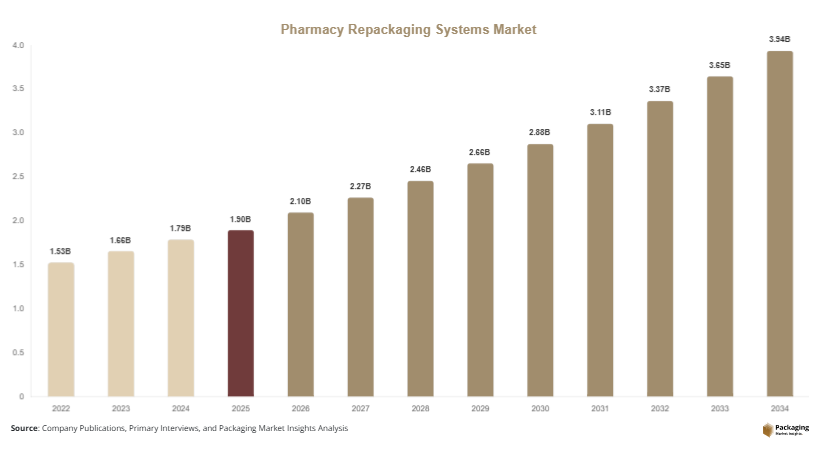
The global pharmacy repackaging systems market was valued at approximately USD 1.9 billion in 2025 and is projected to reach USD 2.1 billion in 2026. By 2034, the market is forecasted to attain nearly USD 4.2 billion, registering a CAGR of 8.2% during 2025–2034. The pharmacy repackaging systems market is witnessing steady expansion due to increasing medication safety requirements, rising automation in hospital pharmacies, and growing demand for unit-dose drug dispensing solutions. Pharmacy repackaging systems are used to repackage medications from bulk containers into patient-specific doses, blister packs, pouches, or barcoded packaging formats. These systems improve dispensing accuracy, reduce medication errors, and support inventory management across hospitals, retail pharmacies, and long-term care facilities.
One of the primary growth factors supporting the pharmacy repackaging systems market is the increasing focus on patient safety and medication traceability. Healthcare providers are adopting automated repackaging systems with barcode labeling and electronic verification capabilities to minimize dispensing errors. Another major factor is the rising burden of chronic diseases, which has increased prescription volumes and the need for efficient medication management systems in healthcare facilities. Additionally, the expansion of long-term care centers and outpatient pharmacy services is contributing to growing demand for customized medication packaging solutions.
Key Highlights
- North America dominated the market with a 39.7% share in 2025.
- Asia Pacific is projected to grow at the fastest CAGR of 9.1%.
- Automated repackaging systems led the product segment with a 56.4% share.
- Unit-dose packaging applications dominated with a 48.9% share.
- Hospital pharmacies led the end-use segment with 44.6% share.
- The US remained the dominant country with a market size of USD 590 million in 2025 and USD 640 million in 2026.
Explore more data points, trends and opportunities Download Free Sample Report
Market Trends
Growing Integration of Automation and Barcode Verification Technologies
Automation and barcode verification technologies are becoming increasingly important in the pharmacy repackaging systems market as healthcare providers focus on medication safety and workflow efficiency. Modern repackaging systems integrate barcode scanning, automated labeling, and digital tracking tools that help reduce dispensing errors and improve compliance with medication management regulations. Hospitals and retail pharmacies are adopting centralized automated systems capable of processing large prescription volumes while maintaining packaging accuracy. Cloud-based software integration is also allowing pharmacies to track inventory, monitor medication expiration dates, and improve patient record management. The increasing use of AI-driven pharmacy automation platforms is expected to further strengthen adoption of advanced repackaging technologies across healthcare facilities globally.
Rising Demand for Patient-Centric Adherence Packaging Solutions
The increasing emphasis on patient medication adherence is creating strong demand for patient-centric repackaging systems. Healthcare providers are adopting multi-dose pouch packaging and calendar-based blister packaging systems to improve medication compliance among elderly and chronic disease patients. Adherence packaging simplifies medication administration by organizing doses according to time and date schedules, reducing the risk of missed or incorrect dosages. Retail pharmacy chains and long-term care facilities are increasingly investing in automated adherence packaging technologies to improve patient outcomes and reduce hospital readmission rates. Growing awareness regarding personalized healthcare and remote patient management is expected to continue supporting demand for advanced adherence packaging solutions.
Market Drivers
Increasing Focus on Medication Safety and Error Reduction
The growing emphasis on medication safety and error prevention is one of the primary drivers supporting the pharmacy repackaging systems market. Medication dispensing errors remain a significant challenge within hospitals, retail pharmacies, and long-term care facilities. Automated repackaging systems improve labeling accuracy, dosage verification, and barcode tracking, helping healthcare providers reduce risks associated with incorrect medication dispensing. Regulatory agencies and healthcare organizations are also encouraging implementation of unit-dose packaging systems to enhance traceability and improve patient safety. As prescription volumes continue increasing globally, pharmacies are investing in automated repackaging technologies to improve operational accuracy, reduce manual handling, and strengthen medication management practices across healthcare environments.
Expansion of Hospital and Long-Term Care Pharmacy Services
The rapid expansion of hospital pharmacy operations and long-term care services is significantly contributing to market growth. Aging populations and rising chronic disease prevalence are increasing demand for continuous medication management solutions within healthcare institutions. Long-term care facilities require efficient repackaging systems capable of organizing medications for multiple patients while ensuring dosage accuracy and regulatory compliance. Hospitals are also adopting centralized pharmacy automation systems to improve workflow efficiency and reduce labor-intensive dispensing processes. Growing investments in healthcare infrastructure, combined with increasing pharmaceutical consumption, are encouraging healthcare providers to implement advanced pharmacy repackaging systems that support large-scale medication distribution and patient-specific packaging requirements.
Market Restraints
High Capital Investment and Complex Regulatory Compliance
One of the major restraints affecting the pharmacy repackaging systems market is the high initial investment associated with automated pharmacy packaging technologies. Advanced repackaging systems require specialized machinery, barcode integration software, robotics, and controlled operating environments, resulting in significant installation and maintenance expenses. Small independent pharmacies and healthcare facilities with limited financial resources may face challenges adopting these systems. In addition, pharmacy repackaging operations must comply with strict healthcare regulations regarding labeling accuracy, traceability, and packaging standards. Regulatory approval processes and compliance documentation can increase operational complexity and implementation timelines. For example, hospital pharmacies introducing automated unit-dose packaging systems often require software validation, staff training, and regulatory inspections before full deployment. These factors can slow adoption rates, particularly within smaller healthcare institutions and developing healthcare markets.
Market Opportunities
Growth in Centralized Pharmacy Automation Systems
The increasing adoption of centralized pharmacy automation systems presents significant growth opportunities for the pharmacy repackaging systems market. Healthcare providers are consolidating pharmacy operations to improve efficiency, reduce labor costs, and standardize medication dispensing processes across multiple facilities. Centralized pharmacy hubs require high-capacity repackaging systems capable of processing large prescription volumes with minimal human intervention. Automated pouch packaging, blister packaging, and barcode verification technologies are becoming essential components of these centralized operations. The growing need for scalable pharmacy automation infrastructure in hospitals, retail pharmacy networks, and healthcare distribution centers is expected to create strong long-term demand for advanced repackaging systems.
Expansion of Home Healthcare and Remote Medication Management
The growing popularity of home healthcare services and remote patient monitoring is creating new opportunities within the pharmacy repackaging systems market. Patients managing chronic diseases increasingly require organized medication packaging solutions that improve adherence and simplify treatment schedules. Automated multi-dose pouch packaging and personalized blister packaging systems are helping pharmacies support remote medication management programs and home healthcare services. Telehealth expansion and digital healthcare platforms are also encouraging pharmacies to provide customized adherence packaging directly to patients. As healthcare systems continue shifting toward outpatient and home-based care models, demand for flexible and patient-focused pharmacy repackaging solutions is expected to increase steadily.
Report Scope
| Report Metric | Details |
|---|---|
| Market Size in 2025 | USD 1.9 Billion |
| Market Size in 2026 | USD 2.1 Billion |
| Market Size in 2034 | USD 4.2 Billion |
| CAGR | 8.2% (2026-2034) |
| Base Year for Estimation | 2025 |
| Historical Data | 2022-2024 |
| Forecast Period | 2026-2034 |
| Report Coverage | Revenue Forecast, Competitive Landscape, Supply Chain Disruption, Growth Factors, Environment & Regulatory Landscape and Trends |
| Geographies Covered | North America, Europe, APAC, Middle East and Africa, LATAM |
| Countries Covered | U.S., Canada, U.K., Germany, France, Spain, Italy, Russia, Nordic, Benelux, Rest of Europe, China, South Korea, Japan, India, Australia, Singapore, Taiwan, South East Asia, Rest of Asia-Pacific, UAE, Turky, Saudi Arabia, South Africa, Egypt, Nigeria, Rest of MEA, Brazil, Mexico, Argentina, Chile, Colombia, Rest of LATAM |
Explore more data points, trends and opportunities Download Free Sample Report
Segmental Analysis
By Product Type
Automated repackaging systems dominated the pharmacy repackaging systems market in 2024, accounting for approximately 56.4% of the total market share. These systems are widely used in hospitals, centralized pharmacy facilities, and retail pharmacy chains due to their ability to improve dispensing accuracy, reduce labor requirements, and increase packaging efficiency. Automated systems integrate barcode verification, digital inventory management, and robotic handling technologies that support high-volume medication packaging operations. Rising prescription volumes and increasing focus on medication traceability are significantly contributing to segment growth. Healthcare facilities are increasingly adopting automated repackaging technologies to minimize medication errors and improve workflow efficiency. Continuous advancements in AI-assisted pharmacy software and robotics integration are further strengthening demand for automated repackaging solutions across global healthcare institutions.
Robotic pouch packaging systems are projected to register the fastest CAGR of 9.4% during the forecast period. Growth in this segment is driven by increasing demand for multi-dose adherence packaging and personalized medication management solutions. Robotic pouch systems organize medications according to patient schedules, improving compliance and simplifying drug administration for chronic disease patients and elderly populations. Retail pharmacy chains and long-term care facilities are investing in robotic pouch packaging technologies to support large-scale medication adherence programs. Additionally, the growing popularity of home healthcare services and remote patient management is encouraging adoption of compact automated pouch packaging systems capable of supporting customized medication dispensing operations.
By Application
Unit-dose packaging dominated the application segment in 2024 with approximately 48.9% of the market share. Unit-dose packaging systems are extensively used in hospitals and institutional healthcare environments because they improve medication traceability, reduce contamination risks, and support accurate dosage management. Automated unit-dose repackaging technologies help healthcare providers standardize medication dispensing while complying with patient safety regulations. Increasing hospital admissions, rising pharmaceutical consumption, and expanding inpatient healthcare services are supporting strong demand for unit-dose packaging systems. Healthcare facilities are also implementing barcode-enabled unit-dose packaging solutions to improve medication tracking and reduce administration errors. Advancements in automated blister packaging and labeling technologies are further enhancing operational efficiency within hospital pharmacy departments and centralized medication distribution centers.
Multi-dose adherence packaging is expected to be the fastest-growing application segment, expanding at a CAGR of 8.8% during the forecast period. Growth is supported by rising demand for patient-centric medication management solutions and increasing prevalence of chronic diseases requiring long-term drug therapy. Multi-dose packaging systems organize medications according to scheduled administration times, improving patient compliance and reducing missed dosages. Long-term care facilities, retail pharmacies, and home healthcare providers are increasingly investing in automated adherence packaging technologies to support aging populations and remote patient management programs. The growing adoption of telehealth services and personalized healthcare models is also encouraging pharmacies to implement flexible adherence packaging solutions designed for customized medication delivery.
By End-Use
Hospital pharmacies dominated the end-use segment in 2024, accounting for approximately 44.6% of the total market share. Hospitals handle large prescription volumes and require highly accurate medication dispensing systems to ensure patient safety and regulatory compliance. Automated repackaging systems improve workflow efficiency by reducing manual handling, minimizing medication errors, and supporting barcode-based medication verification. Increasing patient admissions, rising surgical procedures, and expanding pharmaceutical inventories are driving demand for advanced pharmacy automation technologies within hospital environments. Healthcare institutions are also investing in centralized pharmacy operations to streamline medication distribution and improve operational productivity. Technological advancements in robotic dispensing systems and integrated pharmacy management software are further supporting growth within the hospital pharmacy segment.
Long-term care facilities are anticipated to register the fastest CAGR of 8.7% during the forecast period. Growth in this segment is primarily driven by aging populations, increasing chronic disease prevalence, and rising demand for medication adherence solutions. Long-term care centers require efficient repackaging systems capable of organizing medications for multiple residents while maintaining dosage accuracy and administration schedules. Automated pouch packaging and calendar blister packaging technologies are helping caregivers simplify medication management and improve patient compliance. Additionally, increasing investments in elderly care infrastructure and home healthcare services are contributing to growing demand for flexible pharmacy repackaging solutions tailored for long-term patient care applications.
Pharmacy Repackaging Systems Market Segmentations
By Product Type
- Automated Repackaging Systems
- Semi-Automated Repackaging Systems
- Robotic Pouch Packaging Systems
- Blister Packaging Systems
By Application
- Unit-Dose Packaging
- Multi-Dose Adherence Packaging
- Blister Card Packaging
- Strip Packaging
By End-User
- Hospital Pharmacies
- Retail Pharmacies
- Long-Term Care Facilities
- Centralized Pharmacy Centers
Regional Analysis
North America
North America accounted for approximately 39.7% of the global pharmacy repackaging systems market share in 2025 and is expected to grow at a CAGR of 7.8% during the forecast period. The region benefits from advanced healthcare infrastructure, strong adoption of pharmacy automation technologies, and increasing emphasis on medication safety standards. Hospitals and retail pharmacy chains are investing heavily in automated unit-dose packaging and barcode verification systems to improve workflow efficiency and reduce medication dispensing errors across healthcare facilities.
The United States dominates the North American market due to its large hospital network, high pharmaceutical consumption, and advanced pharmacy automation ecosystem. A unique growth factor is the widespread adoption of centralized pharmacy fulfillment centers by healthcare providers and pharmacy chains. These facilities require high-capacity repackaging systems capable of supporting large prescription volumes while maintaining regulatory compliance and medication traceability standards.
Europe
Europe represented nearly 26.3% of the pharmacy repackaging systems market share in 2025 and is forecasted to grow at a CAGR of 7.6% through 2034. Increasing demand for automated healthcare technologies, rising elderly populations, and growing pharmaceutical distribution activities are supporting regional market expansion. European healthcare providers are emphasizing patient safety initiatives and medication adherence programs, encouraging investments in automated repackaging and labeling technologies.
Germany remains the dominant country within Europe due to its strong healthcare infrastructure and advanced pharmaceutical manufacturing capabilities. A unique growth factor is the increasing implementation of digital healthcare and e-prescription systems integrated with pharmacy automation platforms. This integration supports accurate medication tracking, automated dispensing, and efficient repackaging operations across hospitals and pharmacy networks within the country.
Asia Pacific
Asia Pacific accounted for approximately 22.4% of the global market share in 2025 and is projected to register the fastest CAGR of 9.1% during the forecast period. Rapid healthcare infrastructure development, increasing pharmaceutical consumption, and expanding hospital networks are driving demand for pharmacy repackaging systems across the region. Governments are also investing in healthcare modernization initiatives aimed at improving medication management and patient safety standards.
China dominates the Asia Pacific market due to its large pharmaceutical sector and rapidly growing healthcare infrastructure. A unique growth factor is the expansion of urban hospital networks and centralized pharmaceutical distribution systems. Healthcare providers are increasingly adopting automated pharmacy technologies to manage rising prescription volumes and improve operational efficiency within large medical institutions and pharmacy chains.
Middle East & Africa
The Middle East & Africa region held approximately 5.1% of the global market share in 2025 and is expected to grow at a CAGR of 7.4% during the forecast period. Growth in the region is supported by rising healthcare investments, expanding pharmaceutical distribution activities, and increasing adoption of healthcare automation technologies. Governments are focusing on improving medication safety standards and strengthening healthcare service quality across hospitals and clinics.
Saudi Arabia dominates the regional market due to ongoing healthcare modernization initiatives and rising investments in hospital infrastructure. A unique growth factor is the increasing establishment of digitally integrated hospital pharmacies capable of supporting automated medication dispensing and repackaging operations. These developments are contributing to rising demand for advanced pharmacy automation and packaging technologies within the country.
Latin America
Latin America accounted for nearly 6.5% of the pharmacy repackaging systems market share in 2025 and is anticipated to grow at a CAGR of 8.0% through 2034. Expanding healthcare access, increasing pharmaceutical consumption, and modernization of hospital infrastructure are supporting market growth across the region. Healthcare institutions are gradually adopting automated packaging technologies to improve medication safety and operational efficiency.
Brazil remains the dominant country in Latin America due to its large healthcare system and growing pharmaceutical market. A unique growth factor is the increasing demand for medication adherence packaging solutions within public healthcare programs and long-term care facilities. Healthcare providers are investing in automated pouch packaging and unit-dose systems to improve patient compliance and reduce medication administration errors.
Competitive Landscape
The pharmacy repackaging systems market is moderately competitive, with major companies focusing on automation technologies, barcode verification systems, and AI-enabled pharmacy management platforms to strengthen market presence. Leading manufacturers are investing in robotic packaging systems, centralized pharmacy automation solutions, and patient adherence technologies to address evolving healthcare requirements. Strategic partnerships with hospitals, retail pharmacy chains, and long-term care facilities are also influencing competitive strategies across the industry.
Omnicell Inc. remains one of the leading companies in the market due to its broad pharmacy automation portfolio and strong healthcare technology integration capabilities. In 2024, the company introduced upgraded automated pouch packaging systems featuring cloud-based inventory monitoring and enhanced barcode verification functions. Other prominent players include Swisslog Healthcare, TCGRx, Pearson Medical Technologies, and Parata Systems. These companies are focusing on expanding software integration capabilities, improving packaging efficiency, and developing scalable pharmacy automation systems suitable for both large hospitals and independent pharmacy operations. Increasing investments in digital healthcare infrastructure are expected to accelerate innovation and competition across the market.
Key Players List
- Omnicell Inc.
- Swisslog Healthcare
- TCGRx
- Pearson Medical Technologies
- Parata Systems
- ScriptPro LLC
- JVM Co., Ltd.
- Yuyama Co., Ltd.
- RxSafe LLC
- ARxIUM Inc.
- Kirby Lester LLC
- Euclid Medical Products
- Medical Packaging Inc.
- Capsa Healthcare
- Noritsu Pharmacy Automation