Pharmaceutical Tube Packaging Market Size and Growth
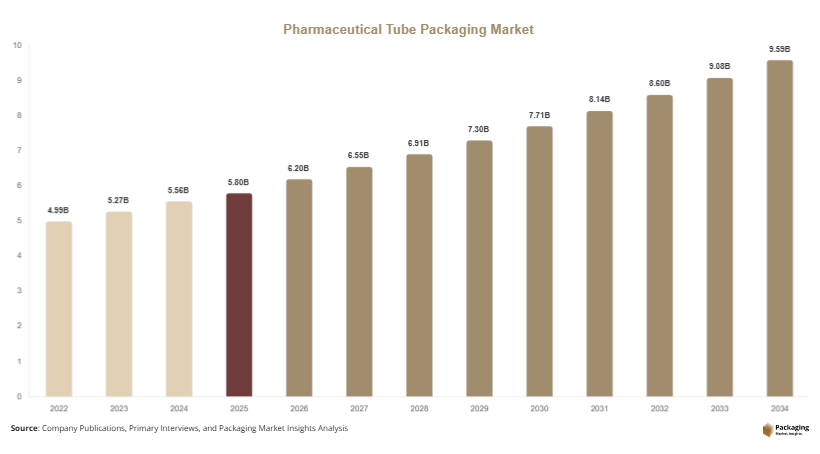
The pharmaceutical tube packaging market is experiencing steady expansion driven by rising demand for safe, convenient, and contamination-resistant packaging solutions across the global pharmaceutical sector. In 2025, the market size is estimated to reach USD 5.8 billion, and it is projected to grow to approximately USD 6.2 billion in 2026. By 2034, the market is forecasted to achieve a valuation of USD 10.1 billion, registering a compound annual growth rate (CAGR) of 5.6% from 2025 to 2034.
Pharmaceutical tube packaging is widely used for topical formulations such as creams, gels, ointments, and semi-solid medications. These tubes provide protection from external contamination, ensure accurate dispensing, and enhance product shelf life. Increasing consumer preference for user-friendly packaging formats and the growing prevalence of dermatological and chronic conditions are contributing to the expansion of the market. Additionally, pharmaceutical companies are focusing on improving packaging efficiency and compliance with stringent regulatory standards, which is further driving innovation in tube packaging technologies.
Key Highlights:
- The Pharmaceutical Tube Packaging Market is expected to reach USD 10.1 billion by 2034, reflecting steady growth in global demand. This expansion is supported by increasing use of protective and efficient pharmaceutical packaging solutions.
- The market is projected to grow at a CAGR of 5.6% during 2025–2034. This consistent growth highlights the rising need for advanced packaging aligned with pharmaceutical industry developments.
- Growing demand for topical drug delivery systems is a major growth factor. Increasing cases of skin-related conditions and preference for easy-to-use packaging are driving adoption.
- The market is benefiting from the shift toward sustainable and advanced packaging materials. Companies are focusing on recyclable, high-barrier solutions to meet environmental and regulatory standards.
- Expanding pharmaceutical manufacturing in emerging markets is further supporting growth. Rising investments and improved healthcare infrastructure are increasing the demand for tube packaging solutions.
Explore more data points, trends and opportunities Download Free Sample Report
Market Trends
Increasing Adoption of Sustainable and Recyclable Tube Materials
Sustainability is becoming a central focus in the pharmaceutical tube packaging market as manufacturers shift toward eco-friendly materials. Companies are increasingly adopting recyclable plastics, bio-based polymers, and aluminum alternatives to reduce environmental impact. Multi-layer laminates are being redesigned to improve recyclability without compromising barrier properties. Regulatory pressure and corporate sustainability commitments are encouraging pharmaceutical companies to reduce packaging waste and carbon emissions. Additionally, consumer awareness regarding environmental issues is influencing purchasing decisions, prompting brands to adopt greener packaging solutions. This trend is expected to reshape material selection and manufacturing processes across the industry.
Integration of Advanced Barrier and Anti-Counterfeiting Technologies
The incorporation of advanced barrier technologies is gaining momentum to enhance product safety and shelf life. Pharmaceutical tubes are now designed with improved oxygen, moisture, and light resistance, ensuring drug stability. Simultaneously, anti-counterfeiting features such as tamper-evident seals, holographic printing, and serialized QR codes are being integrated into packaging. These innovations help manufacturers comply with stringent regulations and protect against counterfeit drugs. The trend is particularly significant in emerging markets where counterfeit pharmaceuticals pose a major risk. As a result, packaging is evolving from a passive container to an active component of drug safety and authentication.
Market Drivers
Rising Demand for Topical and Dermatological Medications
The increasing prevalence of skin disorders, allergies, and chronic conditions is driving demand for topical medications, which directly boosts the pharmaceutical tube packaging market. Tubes offer precise dosing, ease of application, and protection from contamination, making them ideal for creams and ointments. The growing aging population and rising awareness of personal healthcare are further contributing to the demand for dermatological products. Pharmaceutical companies are expanding their product portfolios in this segment, leading to higher consumption of tube packaging solutions. Additionally, the convenience and portability of tubes make them a preferred choice among consumers, reinforcing their widespread adoption.
Expansion of Generic Drug Manufacturing and Contract Packaging
The rapid growth of generic drug production is significantly influencing the demand for pharmaceutical tube packaging. Generic drug manufacturers focus on cost efficiency and scalability, which aligns well with tube packaging solutions. Contract packaging organizations (CPOs) are also expanding their services to include tube filling and sealing, enabling pharmaceutical companies to outsource packaging operations. This trend is particularly strong in emerging markets where manufacturing costs are lower. As a result, the increasing volume of generic drug production is creating sustained demand for standardized and high-volume tube packaging formats across the industry.
Market Restraint
Stringent Regulatory Requirements and Compliance Challenges
One of the major restraints affecting the pharmaceutical tube packaging market is the complexity of regulatory compliance. Pharmaceutical packaging must adhere to strict guidelines related to material safety, labeling, and product integrity. Regulatory bodies require extensive testing to ensure that packaging materials do not interact with drug formulations or compromise their efficacy. This increases production costs and extends product development timelines. For example, changes in packaging materials often require revalidation and approval processes, which can delay product launches. Small and medium-sized manufacturers may face difficulties in meeting these requirements due to limited resources. Additionally, varying regulations across different regions create challenges for global manufacturers, impacting market expansion and operational efficiency.
Market Opportunities
Growth in Emerging Markets and Healthcare Infrastructure Development
Emerging economies present significant opportunities for the pharmaceutical tube packaging market due to rapid improvements in healthcare infrastructure and increasing access to medicines. Countries in Asia Pacific, Latin America, and parts of Africa are witnessing rising investments in pharmaceutical manufacturing and distribution. This growth is driven by expanding populations, increasing healthcare spending, and government initiatives to improve public health systems. As pharmaceutical companies establish production facilities in these regions, the demand for cost-effective and scalable packaging solutions, including tubes, is increasing. Local manufacturing also reduces dependency on imports, further supporting market growth.
Technological Advancements in Smart and Functional Packaging
The integration of smart technologies into pharmaceutical packaging is creating new growth opportunities. Features such as digital tracking, temperature indicators, and interactive labels are being incorporated into tube packaging to enhance functionality. These innovations improve patient compliance, enable real-time monitoring, and provide valuable data for manufacturers. For instance, smart packaging can help track product usage and ensure proper storage conditions. As the pharmaceutical industry continues to embrace digital transformation, the demand for technologically advanced packaging solutions is expected to rise. This trend opens new avenues for innovation and differentiation in the market.
Report Scope
| Report Metric | Details |
|---|---|
| Market Size in 2025 | USD 5.8 Billion |
| Market Size in 2026 | USD 6.2 Billion |
| Market Size in 2034 | USD 10.1 Billion |
| CAGR | 5.6% (2026-2034) |
| Base Year for Estimation | 2025 |
| Historical Data | 2022-2024 |
| Forecast Period | 2026-2034 |
| Report Coverage | Revenue Forecast, Competitive Landscape, Supply Chain Disruption, Growth Factors, Environment & Regulatory Landscape and Trends |
| Geographies Covered | North America, Europe, APAC, Middle East and Africa, LATAM |
| Countries Covered | U.S., Canada, U.K., Germany, France, Spain, Italy, Russia, Nordic, Benelux, Rest of Europe, China, South Korea, Japan, India, Australia, Singapore, Taiwan, South East Asia, Rest of Asia-Pacific, UAE, Turky, Saudi Arabia, South Africa, Egypt, Nigeria, Rest of MEA, Brazil, Mexico, Argentina, Chile, Colombia, Rest of LATAM |
Explore more data points, trends and opportunities Download Free Sample Report
Segmental Analysis
By Material Type
The plastic segment dominated the pharmaceutical tube packaging market in 2024, accounting for approximately 58% of the total market share. Plastic tubes are widely preferred due to their flexibility, lightweight nature, and cost-effectiveness. Materials such as polyethylene and polypropylene offer excellent barrier properties and are suitable for a wide range of pharmaceutical formulations. Additionally, plastic tubes can be easily customized in terms of size, shape, and design, making them a versatile packaging solution. The growing demand for affordable packaging options in emerging markets further supports the dominance of plastic materials in this segment.
The aluminum segment is expected to be the fastest-growing, with a projected CAGR of 6.2% during the forecast period. Aluminum tubes provide superior protection against light, oxygen, and moisture, making them ideal for sensitive pharmaceutical products. The increasing focus on product safety and shelf-life extension is driving the adoption of aluminum packaging. Furthermore, aluminum is recyclable, which aligns with the growing emphasis on sustainability. Pharmaceutical companies are increasingly adopting aluminum tubes for premium and high-value products, contributing to the segment’s growth.
By Application
The topical medications segment held the largest share in 2024, accounting for nearly 64% of the market. This dominance is attributed to the widespread use of tube packaging for creams, ointments, and gels. Tubes provide precise dispensing and minimize contamination, making them suitable for topical applications. The rising prevalence of skin conditions and increasing demand for dermatological treatments are driving this segment. Additionally, the convenience and portability of tubes make them a preferred choice for both consumers and healthcare providers.
The oral care segment is projected to be the fastest-growing, with a CAGR of 5.9% during the forecast period. Pharmaceutical-grade tube packaging is increasingly used for medicated toothpaste and oral gels. The growth of this segment is driven by rising awareness of oral hygiene and the increasing prevalence of dental issues. Pharmaceutical companies are introducing innovative oral care products, which is boosting demand for specialized tube packaging solutions.
By End-Use
Pharmaceutical companies dominated the market in 2024, holding around 61% share. These companies rely heavily on tube packaging for product distribution and branding. The need for compliance with regulatory standards and the demand for high-quality packaging solutions are key factors driving this segment. Pharmaceutical companies are also investing in advanced packaging technologies to enhance product safety and differentiation.
Contract packaging organizations are expected to witness the fastest growth, with a CAGR of 6.4%. The increasing trend of outsourcing packaging operations is driving this segment. Pharmaceutical companies are partnering with CPOs to reduce costs and improve efficiency. These organizations offer specialized services, including tube filling and sealing, which are essential for large-scale production. The growth of contract packaging is particularly strong in emerging markets, where cost advantages and skilled labor are readily available.
Pharmaceutical Tube Packaging Market Segmentations
Material Type
- Plastic Tubes
- Aluminum Tubes
- Laminate Tubes
Application
- Topical Medications
- Oral Care Products
- Others
End-Use
- Pharmaceutical Companies
- Contract Packaging Organizations
Regional Analysis
North America
North America held approximately 32% market share in 2025, making it a leading region in the pharmaceutical tube packaging market. The region is expected to grow at a CAGR of 5.2% during the forecast period. Strong demand for advanced pharmaceutical products and well-established healthcare infrastructure contribute to market growth. The presence of major pharmaceutical companies and strict regulatory standards also drive the adoption of high-quality packaging solutions.
The United States dominates the regional market due to its large pharmaceutical industry and high healthcare expenditure. A unique growth factor in this region is the increasing adoption of advanced packaging technologies, including anti-counterfeiting measures. Pharmaceutical companies are investing in innovative tube designs to enhance product safety and compliance, further boosting market demand.
Europe
Europe accounted for around 27% market share in 2025 and is projected to grow at a CAGR of 5.0% through 2034. The region’s focus on sustainability and regulatory compliance is shaping the pharmaceutical tube packaging market. Increasing demand for eco-friendly packaging solutions is driving innovation in materials and production processes.
Germany is a dominant country in the European market, supported by its strong pharmaceutical manufacturing base. A key growth factor is the emphasis on sustainable packaging practices. Companies are adopting recyclable materials and reducing plastic usage to meet environmental regulations, which is influencing market dynamics across the region.
Asia Pacific
Asia Pacific held approximately 24% market share in 2025 and is expected to register the highest CAGR of 6.5% during the forecast period. Rapid industrialization, growing pharmaceutical production, and increasing healthcare access are driving market growth in this region.
China leads the Asia Pacific market due to its large-scale pharmaceutical manufacturing capabilities. A unique growth factor is the expansion of contract manufacturing and packaging services. This trend is attracting global pharmaceutical companies to outsource production, thereby increasing demand for tube packaging solutions.
Middle East & Africa
The Middle East & Africa region accounted for about 9% market share in 2025 and is projected to grow at a CAGR of 5.8%. Improving healthcare infrastructure and rising demand for pharmaceutical products are supporting market growth.
Saudi Arabia is a key market in this region, driven by government initiatives to develop the healthcare sector. A unique growth factor is the increasing investment in local pharmaceutical manufacturing. This reduces reliance on imports and boosts demand for domestic packaging solutions, including tubes.
Latin America
Latin America held nearly 8% market share in 2025 and is expected to grow at a CAGR of 5.4%. The region’s expanding pharmaceutical sector and rising healthcare awareness are contributing to market growth.
Brazil dominates the Latin American market due to its large population and growing pharmaceutical industry. A key growth factor is the increasing demand for affordable generic drugs. This trend is driving the need for cost-effective packaging solutions, including pharmaceutical tubes, across the region.
Competitive Landscape
The pharmaceutical tube packaging market is moderately fragmented, with several global and regional players competing based on product quality, innovation, and pricing. Key companies are focusing on expanding their product portfolios and investing in sustainable packaging solutions. Strategic collaborations, mergers, and acquisitions are common as companies aim to strengthen their market position.
A leading player in the market is Amcor plc, known for its extensive range of pharmaceutical packaging solutions. The company has recently introduced recyclable tube packaging materials to align with sustainability goals. Other major players are also investing in advanced technologies such as multi-layer laminates and smart packaging features. The competitive landscape is characterized by continuous innovation and a strong emphasis on regulatory compliance.
Key Players List
- Amcor plc
- Berry Global Inc.
- Albea Group
- Essel Propack Ltd.
- Huhtamaki Oyj
- Montebello Packaging
- Linhardt GmbH & Co. KG
- Hoffmann Neopac AG
- Pirlo GmbH
- Alltub Group
- CCL Industries Inc.
- Sonoco Products Company
- Unette Corporation
- Intrapac International Corporation
- VisiPak