Pharmaceutical Rigid Packaging Market Size and Forecast (2025–2034)
Market Overview
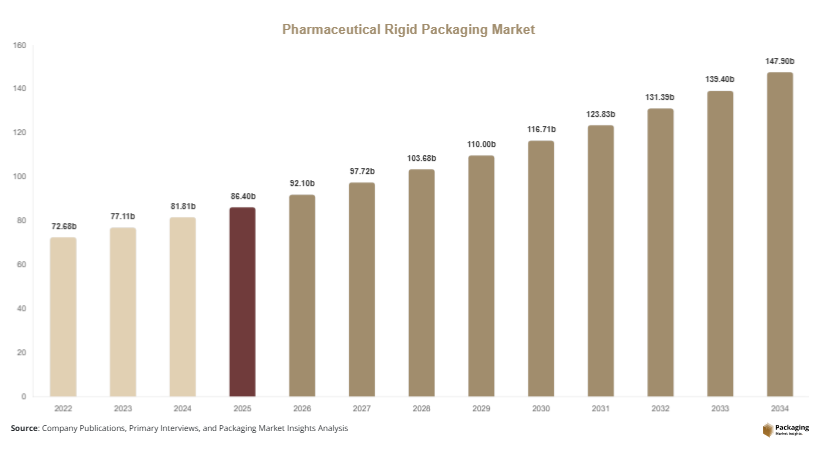
The Pharmaceutical Rigid Packaging Market is witnessing steady expansion driven by rising global pharmaceutical production, stringent drug safety regulations, and increasing demand for secure, contamination-free packaging formats. In 2025, the global market size is estimated at USD 86.4 billion, and it is projected to reach USD 92.1 billion in 2026. By 2034, the market is forecasted to reach approximately USD 148.7 billion, expanding at a CAGR of 6.1% (2025–2034). The industry is also influenced by adjacent operational technologies such as the evolving Container Loading Check CLC Market, which supports pharmaceutical logistics integrity and quality assurance during distribution.
Growth in the pharmaceutical rigid packaging market is primarily driven by increasing demand for biologics and specialty drugs that require high-barrier packaging solutions. Secondly, expanding global vaccination programs and injectable drug production are increasing the use of glass vials, ampoules, and rigid plastic containers. Thirdly, regulatory mandates from agencies such as the FDA and EMA are pushing manufacturers toward tamper-evident, traceable, and contamination-resistant packaging systems.
Key Highlights:
- North America dominated the pharmaceutical rigid packaging market with the largest share of 38.42% in 2025.
- Asia Pacific is expected to be the fastest-growing region during the forecast period at a CAGR of 7.4% (2025–2034).
- Based on material type, glass packaging dominated the market with a share of 44.18% in 2025.
- Based on product type, bottles & containers held the largest share of 41.55% in 2025.
- Based on end-use, pharmaceutical manufacturers accounted for 52.67% share in 2025.
- The U.S. pharmaceutical rigid packaging market size was valued at USD 28.9 billion in 2025 and is projected to reach USD 30.8 billion in 2026.
Explore more data points, trends and opportunities Download Free Sample Report
Market Trends
Shift Toward Sustainable Rigid Packaging Materials
One of the most significant trends shaping the pharmaceutical rigid packaging market is the increasing shift toward sustainable and recyclable packaging materials. Pharmaceutical companies are actively reducing dependency on non-recyclable plastics and moving toward biodegradable polymers, recyclable glass, and lightweight PET containers. Regulatory pressure from environmental agencies and growing corporate sustainability commitments are accelerating this transition. Manufacturers are investing in eco-friendly production technologies that maintain drug stability while reducing environmental impact. This trend is particularly strong in Europe and North America, where sustainability reporting and ESG compliance are influencing procurement decisions. The adoption of circular economy principles is also pushing packaging suppliers to redesign rigid containers for reuse and recyclability without compromising sterility or barrier properties.
Integration of Smart and Serialized Packaging Systems
Another major trend is the integration of smart packaging technologies such as RFID tags, QR codes, and tamper-evident digital seals. These innovations are improving traceability, reducing counterfeit drug circulation, and ensuring compliance with global serialization regulations. Pharmaceutical rigid packaging is increasingly being combined with digital tracking systems that allow real-time monitoring of drug movement across the supply chain. This trend is strongly linked with regulatory frameworks like the Drug Supply Chain Security Act (DSCSA). Additionally, the adoption of connected packaging enhances patient engagement by providing dosage instructions and authentication features. As a result, rigid packaging formats are evolving from passive containment solutions into intelligent data-driven systems.
Market Drivers
Rising Demand for Injectable and Biologic Drugs
The growing global demand for injectable drugs and biologics is a major driver of the pharmaceutical rigid packaging market. These products require high-integrity packaging formats such as glass vials, ampoules, and rigid polymer containers to ensure product stability and sterility. The increasing prevalence of chronic diseases such as cancer, diabetes, and autoimmune disorders has significantly expanded biologics production. As biologics are sensitive to temperature, light, and contamination, pharmaceutical companies are increasingly relying on advanced rigid packaging solutions with high barrier protection. This shift is further supported by expanding vaccine production programs worldwide, which heavily depend on glass-based rigid packaging systems for safe storage and distribution.
Stringent Regulatory and Safety Requirements
Strict regulatory frameworks across global pharmaceutical markets are another key driver. Agencies such as the FDA, EMA, and WHO enforce stringent packaging guidelines to ensure drug safety, traceability, and tamper resistance. These regulations mandate the use of standardized rigid packaging formats that minimize contamination risks and ensure product authenticity. As counterfeit drugs remain a global concern, governments are enforcing serialization and anti-tampering requirements, which directly boost demand for advanced rigid packaging solutions. Pharmaceutical companies are therefore investing heavily in compliant packaging systems that meet evolving regulatory expectations while maintaining operational efficiency and supply chain integrity.
Market Restraints
High Production Costs and Material Volatility
One of the primary restraints in the pharmaceutical rigid packaging market is the high cost associated with raw materials and manufacturing processes. Materials such as pharmaceutical-grade glass and high-quality polymers require energy-intensive production, which increases overall packaging costs. In addition, fluctuations in raw material prices, especially petroleum-based polymers and silica for glass manufacturing, create cost instability for packaging suppliers. Smaller pharmaceutical companies often face challenges in adopting advanced rigid packaging technologies due to budget limitations. Furthermore, stringent quality control requirements add additional manufacturing expenses, including sterilization, testing, and compliance validation. This cost burden can slow down innovation adoption in price-sensitive markets, particularly in developing economies. As a result, companies are exploring lightweighting technologies and alternative materials to reduce expenses while maintaining compliance and performance standards.
Market Opportunities
Expansion in Emerging Pharmaceutical Markets
Emerging economies in Asia Pacific, Latin America, and parts of Africa present significant growth opportunities for pharmaceutical rigid packaging manufacturers. Rapid urbanization, increasing healthcare access, and rising pharmaceutical production capacities are driving demand for advanced packaging solutions. Countries such as India, China, and Brazil are expanding their domestic drug manufacturing industries, which increases the need for high-quality rigid packaging formats. Additionally, government investments in healthcare infrastructure and vaccine distribution programs are creating a strong demand base. Local manufacturing partnerships and contract packaging organizations are further enhancing market penetration. This expansion is expected to create new revenue streams for global packaging companies seeking cost-effective production hubs and scalable distribution networks.
Technological Advancements in Packaging Design
Technological advancements in material science and packaging engineering are opening new opportunities in the market. Innovations such as break-resistant glass, lightweight polymer composites, and smart packaging integration are enhancing product safety and usability. Pharmaceutical companies are increasingly adopting advanced rigid packaging designs that improve shelf life and reduce breakage risks during transportation. The integration of IoT-enabled tracking systems and temperature-monitoring sensors is also creating opportunities for high-value packaging solutions, especially for biologics and temperature-sensitive drugs. These advancements are expected to transform traditional packaging systems into intelligent, data-driven ecosystems that enhance supply chain efficiency and patient safety.
Report Scope
| Report Metric | Details |
|---|---|
| Market Size in 2025 | USD 86.4 billion |
| Market Size in 2026 | USD 92.1 billion |
| Market Size in 2034 | USD 148.7 billion |
| CAGR | 6.1% (2026-2034) |
| Base Year for Estimation | 2025 |
| Historical Data | 2022-2024 |
| Forecast Period | 2026-2034 |
| Report Coverage | Revenue Forecast, Competitive Landscape, Supply Chain Disruption, Growth Factors, Environment & Regulatory Landscape and Trends |
| Geographies Covered | North America, Europe, APAC, Middle East and Africa, LATAM |
| Countries Covered | U.S., Canada, U.K., Germany, France, Spain, Italy, Russia, Nordic, Benelux, Rest of Europe, China, South Korea, Japan, India, Australia, Singapore, Taiwan, South East Asia, Rest of Asia-Pacific, UAE, Turky, Saudi Arabia, South Africa, Egypt, Nigeria, Rest of MEA, Brazil, Mexico, Argentina, Chile, Colombia, Rest of LATAM |
Explore more data points, trends and opportunities Download Free Sample Report
Segmental Analysis
Material Type Segment
Glass packaging dominated the pharmaceutical rigid packaging market with a 44.18% share in 2025, driven by its superior barrier properties, chemical resistance, and compatibility with injectable drugs. Glass vials and ampoules remain the preferred choice for biologics and vaccines due to their stability and regulatory acceptance.
The fastest-growing subsegment is plastic-based rigid packaging, expected to grow at a CAGR of 6.8% (2025–2034) due to its lightweight nature, cost efficiency, and reduced breakage risk. Increasing innovation in medical-grade polymers is supporting broader adoption across oral solid dosage forms and liquid medications.
Product Type Segment
Bottles & containers dominated the market with a 41.55% share in 2025, supported by widespread use in tablets, syrups, and injectable storage. Their versatility and scalability make them essential in pharmaceutical distribution systems.
Pre-filled syringes are the fastest-growing subsegment, expanding at a CAGR of 7.6%, driven by rising demand for self-administration drugs and biologics. These systems improve dosing accuracy and reduce contamination risks.
End-Use Segment
Pharmaceutical manufacturers accounted for 52.67% share in 2025, as they are the primary users of rigid packaging in drug production and distribution. High production volumes and global supply chain expansion support dominance.
Contract packaging organizations (CPOs) are the fastest-growing subsegment at a CAGR of 7.1%, driven by outsourcing trends and increasing demand for cost-efficient packaging services.
Pharmaceutical Rigid Packaging Market Segmentations
Component Type
- Hardware (Sensors, Cameras, Scanners)
- Software Solutions
- Integrated Systems
- Services (Installation, Maintenance, Consulting)
Technology Type
- Barcode & QR Code Systems
- RFID-Based Systems
- AI-Powered Vision Inspection Systems
- Laser Measurement Systems
End-Use Industry
- Logistics & Warehousing
- Manufacturing
- Retail & E-commerce
- Automotive
- Pharmaceuticals
Deployment Mode
- On-Premise
- Cloud-Based
- Hybrid Systems
Regional Analysis
North America
North America accounted for approximately 38.42% share of the global pharmaceutical rigid packaging market in 2025, driven by strong pharmaceutical manufacturing capabilities and high adoption of advanced packaging technologies. The region is expected to grow at a CAGR of 5.8% during 2025–2034, supported by increasing biologics production and regulatory compliance requirements.
The United States dominates the region due to its large pharmaceutical industry and strong presence of leading packaging manufacturers. A key growth factor is the rapid adoption of serialized and tamper-evident packaging systems to comply with FDA regulations and combat counterfeit drugs, strengthening supply chain integrity.
Europe
Europe held around 27.35% market share in 2025, with steady growth expected at a CAGR of 5.6% through 2034. Strict environmental regulations and high pharmaceutical production standards are key market drivers.
Germany leads the region due to its advanced pharmaceutical manufacturing base and strong focus on sustainable packaging innovations. Increasing investment in recyclable glass and eco-friendly rigid packaging solutions is supporting long-term growth.
Asia Pacific
Asia Pacific captured 22.18% share in 2025 and is projected to grow at the fastest CAGR of 7.4% during 2025–2034. Rapid pharmaceutical production expansion and rising healthcare spending are major contributors.
China dominates the region, supported by large-scale API production and expanding domestic drug manufacturing. Growth is driven by increasing demand for affordable healthcare solutions and government support for pharmaceutical infrastructure development.
Middle East & Africa
The Middle East & Africa region held 6.12% market share in 2025, with a CAGR of 6.3% expected through 2034. Growing healthcare investments and improving pharmaceutical supply chains are key drivers.
Saudi Arabia leads the region due to increasing localization of pharmaceutical manufacturing and rising demand for imported and domestically produced medicines, supporting packaging demand growth.
Latin America
Latin America accounted for 6.93% share in 2025, with expected CAGR of 6.0% during the forecast period. Expanding healthcare access and pharmaceutical imports are key growth factors.
Brazil dominates the region due to its strong pharmaceutical distribution network and increasing investment in local drug manufacturing facilities, driving demand for rigid packaging solutions.
Competitive Landscape
The pharmaceutical rigid packaging market is moderately consolidated, with several global players competing on innovation, compliance, and material quality. Key companies include Amcor, Gerresheimer, Schott AG, West Pharmaceutical Services, and Berry Global. These companies focus on expanding production capacity, improving material technology, and strengthening regulatory compliance capabilities.
Among these, Gerresheimer is a leading player, known for its advanced glass and plastic pharmaceutical packaging solutions. Recently, the company expanded its manufacturing facility in Europe to increase production of high-value injectable drug packaging systems. Competitive strategies also include mergers, acquisitions, and investments in sustainable packaging technologies to meet rising environmental standards.
Key Players List
- Amcor plc
- Gerresheimer AG
- Schott AG
- West Pharmaceutical Services
- Berry Global Inc.
- AptarGroup Inc.
- SGD Pharma
- Nipro Corporation
- O-I Glass Inc.
- Becton Dickinson and Company
- Stölzle Glass Group
- CCL Industries
- Stevanato Group
- AptarGroup
- RPC Group (Berry Global)