Pharmaceutical Packaging Machinery Market Size and Growth
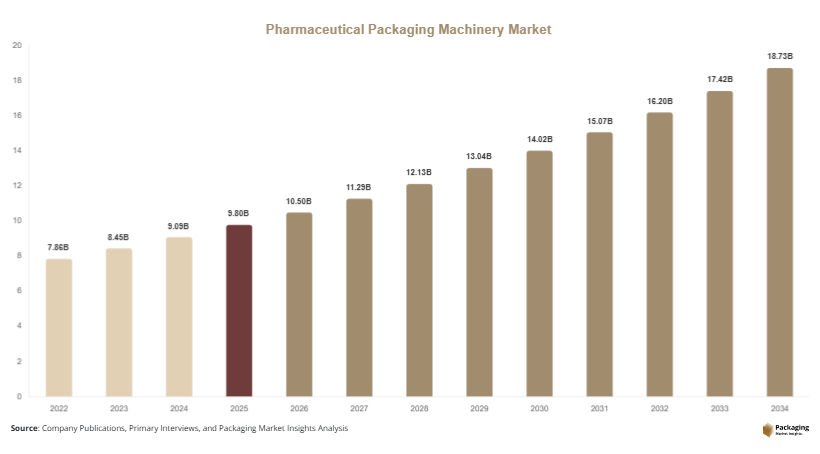
The global pharmaceutical packaging machinery market was valued at approximately USD 9.8 billion in 2025 and is projected to reach USD 10.5 billion in 2026. By 2034, the market is expected to attain nearly USD 18.7 billion, registering a CAGR of 7.5% during 2025–2034. The pharmaceutical packaging machinery market is experiencing stable growth due to rising pharmaceutical production, increasing demand for automated packaging systems, and growing regulatory requirements related to drug safety and traceability. Pharmaceutical packaging machinery includes equipment used for filling, labeling, sealing, blister packaging, cartoning, inspection, and serialization of pharmaceutical products. These systems are essential for maintaining product integrity, improving packaging efficiency, and ensuring compliance with strict healthcare standards.
One of the key growth factors driving the pharmaceutical packaging machinery market is the expansion of global pharmaceutical manufacturing activities. Increasing production of generic drugs, biologics, vaccines, and over-the-counter medicines is creating strong demand for advanced packaging systems capable of handling large-scale operations. Another important growth factor is the rising adoption of automation and smart manufacturing technologies within pharmaceutical production facilities. Manufacturers are investing in robotics, AI-enabled inspection systems, and integrated packaging lines to improve efficiency, reduce labor costs, and minimize packaging errors.
Key Highlights
- North America dominated the market with a 35.8% share in 2025.
- Asia Pacific is projected to grow at the fastest CAGR of 8.3%.
- Blister packaging machinery led the product type segment with a 31.6% share.
- Solid dosage applications dominated with a 47.2% share.
- Pharmaceutical manufacturing companies led the end-use segment with 52.4% share.
- The US remained the dominant country with a market size of USD 2.1 billion in 2025 and USD 2.3 billion in 2026.
Explore more data points, trends and opportunities Download Free Sample Report
Market Trends
Increasing Adoption of Smart and Automated Packaging Systems
Automation and digital integration are becoming important trends within the pharmaceutical packaging machinery market. Pharmaceutical manufacturers are increasingly implementing smart packaging lines equipped with robotics, machine vision inspection systems, and AI-driven process monitoring technologies. These advanced systems improve production efficiency, reduce human intervention, and ensure consistent packaging quality across high-volume operations. Integrated automation also supports predictive maintenance, real-time data monitoring, and packaging line optimization. Pharmaceutical companies are prioritizing smart manufacturing technologies to meet stringent regulatory standards while reducing operational costs. The growing need for faster packaging throughput and improved product traceability is expected to continue accelerating the adoption of intelligent packaging machinery solutions globally.
Rising Demand for Flexible and Sustainable Packaging Equipment
The increasing demand for sustainable pharmaceutical packaging solutions is encouraging manufacturers to adopt flexible and energy-efficient packaging machinery. Pharmaceutical companies are gradually shifting toward recyclable materials, lightweight packaging formats, and reduced material consumption to align with environmental sustainability goals. Packaging machinery manufacturers are responding by developing systems compatible with eco-friendly films, paper-based materials, and recyclable blister packaging structures. Flexible packaging equipment capable of handling multiple product formats and quick changeovers is also gaining popularity among pharmaceutical manufacturers producing diverse product portfolios. The trend toward sustainable operations and resource-efficient manufacturing processes is expected to significantly influence machinery design and investment strategies throughout the forecast period.
Market Drivers
Growing Pharmaceutical Production and Generic Drug Manufacturing
The rapid expansion of pharmaceutical production worldwide is a major driver supporting the pharmaceutical packaging machinery market. Increasing demand for prescription medicines, generic drugs, vaccines, and biologics is creating significant pressure on pharmaceutical manufacturers to improve packaging efficiency and production capacity. Emerging economies are expanding pharmaceutical manufacturing infrastructure to support domestic healthcare demand and export activities. Packaging machinery plays a critical role in ensuring high-speed packaging, product safety, and regulatory compliance during large-scale pharmaceutical production. The growing volume of generic drug manufacturing, particularly in Asia Pacific and North America, is encouraging investments in automated blister packaging, labeling, and serialization systems capable of supporting high-output pharmaceutical operations.
Strict Regulations for Drug Safety and Serialization
Stringent regulations related to pharmaceutical traceability, anti-counterfeiting measures, and product labeling are significantly driving market growth. Governments and regulatory agencies are requiring pharmaceutical manufacturers to implement serialization and track-and-trace technologies to improve supply chain transparency and protect consumers from counterfeit medicines. Packaging machinery equipped with barcode printing, digital coding, tamper-evident sealing, and inspection technologies is becoming essential for regulatory compliance. Pharmaceutical companies are increasingly upgrading packaging lines to meet serialization mandates across multiple countries. In addition, rising concerns regarding medication safety and product recalls are encouraging manufacturers to invest in advanced inspection and verification systems integrated into pharmaceutical packaging machinery operations.
Market Restraints
High Equipment Costs and Complex Integration Requirements
One of the major restraints affecting the pharmaceutical packaging machinery market is the high capital investment associated with advanced automated equipment. Pharmaceutical packaging machinery requires sophisticated engineering, robotics integration, digital monitoring systems, and strict compliance with regulatory standards, resulting in substantial acquisition and maintenance costs. Small and medium-sized pharmaceutical manufacturers often face financial challenges when upgrading packaging infrastructure. In addition, integrating advanced packaging machinery into existing production environments can be technically complex and time-consuming. Equipment installation may require facility modifications, operator training, software validation, and production downtime, increasing implementation expenses. For example, pharmaceutical companies implementing serialization-enabled blister packaging lines frequently encounter integration challenges involving software synchronization, packaging inspection systems, and regulatory validation procedures. These factors may slow adoption rates among smaller manufacturers operating with limited capital resources and technical expertise.
Market Opportunities
Expansion of Biologics and Injectable Drug Packaging
The growing market for biologics, injectable drugs, and specialty pharmaceuticals presents strong opportunities for pharmaceutical packaging machinery manufacturers. Biologics and injectable medications require specialized packaging formats such as prefilled syringes, vials, cartridges, and sterile containers. Packaging these products demands highly precise filling, sealing, inspection, and labeling machinery capable of operating under controlled sterile conditions. Pharmaceutical manufacturers are increasingly investing in advanced aseptic packaging technologies to support rising biologics production. The expansion of vaccine manufacturing and biosimilar development is also contributing to increased demand for specialized pharmaceutical packaging equipment designed for sensitive and high-value drug formulations.
Increasing Demand for Contract Packaging Services
The rapid growth of pharmaceutical contract packaging organizations is creating substantial opportunities within the pharmaceutical packaging machinery market. Many pharmaceutical companies are outsourcing packaging operations to specialized service providers to reduce operational costs, improve flexibility, and accelerate product launches. Contract packaging organizations require advanced machinery capable of handling multiple packaging formats, serialization requirements, and customized labeling operations. Growing demand for short production runs, personalized medicine packaging, and regional compliance labeling is encouraging packaging service providers to invest in flexible and modular packaging systems. The expansion of outsourcing trends within the pharmaceutical industry is expected to generate long-term demand for technologically advanced packaging machinery solutions.
Report Scope
| Report Metric | Details |
|---|---|
| Market Size in 2025 | USD 9.8 Billion |
| Market Size in 2026 | USD 10.5 Billion |
| Market Size in 2034 | USD 18.7 Billion |
| CAGR | 7.5% (2026-2034) |
| Base Year for Estimation | 2025 |
| Historical Data | 2022-2024 |
| Forecast Period | 2026-2034 |
| Report Coverage | Revenue Forecast, Competitive Landscape, Supply Chain Disruption, Growth Factors, Environment & Regulatory Landscape and Trends |
| Geographies Covered | North America, Europe, APAC, Middle East and Africa, LATAM |
| Countries Covered | U.S., Canada, U.K., Germany, France, Spain, Italy, Russia, Nordic, Benelux, Rest of Europe, China, South Korea, Japan, India, Australia, Singapore, Taiwan, South East Asia, Rest of Asia-Pacific, UAE, Turky, Saudi Arabia, South Africa, Egypt, Nigeria, Rest of MEA, Brazil, Mexico, Argentina, Chile, Colombia, Rest of LATAM |
Explore more data points, trends and opportunities Download Free Sample Report
Segmental Analysis
By Product Type
Blister packaging machinery dominated the pharmaceutical packaging machinery market in 2024, accounting for approximately 31.6% of the total market share. Blister packaging systems are widely used for tablets, capsules, and unit-dose pharmaceutical products because they provide product protection, dosage accuracy, and tamper evidence. Pharmaceutical manufacturers prefer blister packaging machinery due to its high production efficiency, compatibility with automated inspection systems, and ability to improve medication traceability. Increasing demand for patient-friendly packaging and unit-dose dispensing solutions is supporting continued growth within the segment. Advancements in high-speed blister packaging lines, integrated vision inspection systems, and sustainable blister material compatibility are further improving operational efficiency. The segment also benefits from rising pharmaceutical exports requiring durable and compliant packaging solutions.
Serialization machinery is expected to register the fastest CAGR of 8.8% during the forecast period. Growth in this segment is driven by increasing global regulations related to pharmaceutical traceability and anti-counterfeiting measures. Pharmaceutical manufacturers are implementing serialization systems equipped with barcode printing, track-and-trace software, and digital verification technologies to comply with regulatory mandates. Rising concerns regarding counterfeit medicines and supply chain security are accelerating investments in advanced coding and inspection systems integrated into packaging lines. In addition, pharmaceutical companies operating across multiple international markets require flexible serialization machinery capable of meeting varying regulatory requirements. Continuous advancements in cloud-based serialization management and real-time monitoring technologies are expected to further support segment expansion.
By Application
Solid dosage applications dominated the pharmaceutical packaging machinery market in 2024 with approximately 47.2% of the total market share. Tablets and capsules remain the most widely produced pharmaceutical dosage forms globally, creating substantial demand for blister packaging, bottle filling, cartoning, and labeling machinery. Pharmaceutical manufacturers are investing in automated solid dosage packaging systems capable of supporting high-volume production while maintaining strict quality standards. Increasing consumption of generic medicines and over-the-counter pharmaceutical products is contributing significantly to segment growth. Automated packaging lines equipped with inspection systems, robotic handling, and serialization technologies are helping manufacturers improve productivity and reduce packaging errors. Growing demand for unit-dose and adherence packaging formats is also strengthening investments in solid dosage pharmaceutical packaging machinery.
Biologics packaging applications are projected to grow at the fastest CAGR of 8.5% during the forecast period. The rapid expansion of biologics, vaccines, biosimilars, and specialty injectable drugs is increasing demand for advanced aseptic packaging systems. Packaging biologics requires highly controlled filling, sealing, and inspection machinery capable of maintaining product sterility and integrity throughout the packaging process. Pharmaceutical manufacturers are investing in specialized vial filling systems, syringe packaging machinery, and automated sterile inspection technologies to support rising biologics production volumes. Increasing healthcare demand for personalized medicine and temperature-sensitive pharmaceutical products is also contributing to segment growth. Technological advancements in aseptic packaging automation are expected to further enhance efficiency and product safety.
By End-Use
Pharmaceutical manufacturing companies dominated the end-use segment in 2024, accounting for approximately 52.4% of the global market share. Large pharmaceutical manufacturers require advanced packaging machinery capable of handling diverse product portfolios, high-speed production volumes, and strict regulatory compliance standards. Automated packaging lines improve operational efficiency by reducing manual intervention, increasing throughput, and supporting digital quality monitoring. Pharmaceutical companies are increasingly investing in integrated packaging systems featuring robotics, serialization capabilities, and machine vision inspection technologies. Rising global demand for prescription drugs, vaccines, and generic medicines is encouraging manufacturers to expand packaging infrastructure and modernize production facilities. Continuous technological advancements in packaging automation and smart manufacturing solutions are further strengthening segment growth.
Contract packaging organizations are expected to register the fastest CAGR of 8.1% during the forecast period. Growth in this segment is driven by increasing outsourcing of pharmaceutical packaging operations by drug manufacturers seeking cost efficiency and operational flexibility. Contract packaging providers require versatile machinery capable of handling multiple packaging formats, regulatory requirements, and customized labeling operations for various pharmaceutical clients. Rising demand for small-batch production, personalized medicine packaging, and regional packaging customization is encouraging contract packaging companies to invest in modular and flexible packaging systems. The growing pharmaceutical outsourcing trend is expected to continue generating strong demand for advanced pharmaceutical packaging machinery solutions.
Pharmaceutical Packaging Machinery Market Segmentations
By Product Type
- Blister Packaging Machinery
- Filling Machinery
- Cartoning Machinery
- Labeling Machinery
- Serialization Machinery
- Inspection Machinery
By Application
- Solid Dosage Packaging
- Liquid Pharmaceutical Packaging
- Biologics Packaging
- Injectable Drug Packaging
By End-User
- Pharmaceutical Manufacturing Companies
- Contract Packaging Organizations
- Biotechnology Companies
- Research Laboratories
Regional Analysis
North America
North America accounted for approximately 35.8% of the global pharmaceutical packaging machinery market share in 2025 and is projected to grow at a CAGR of 7.1% during the forecast period. The region benefits from a strong pharmaceutical manufacturing base, advanced healthcare infrastructure, and widespread adoption of automated packaging technologies. Pharmaceutical companies across the United States and Canada are investing in smart packaging systems to improve production efficiency and comply with serialization regulations. Increasing demand for biologics and specialty pharmaceuticals is also supporting machinery upgrades.
The United States dominates the North American market due to its large pharmaceutical industry and extensive investments in pharmaceutical automation technologies. A unique growth factor is the strong implementation of track-and-trace regulations requiring serialization and digital verification across pharmaceutical supply chains. These regulatory requirements are encouraging manufacturers to upgrade packaging lines with advanced coding, inspection, and tamper-evident packaging technologies capable of supporting regulatory compliance and product authentication.
Europe
Europe represented nearly 28.1% of the pharmaceutical packaging machinery market share in 2025 and is expected to grow at a CAGR of 7.0% through 2034. The region is characterized by advanced pharmaceutical manufacturing operations, strong regulatory frameworks, and rising demand for sustainable packaging technologies. Pharmaceutical companies across Europe are increasingly investing in automated blister packaging, cartoning, and inspection systems to improve packaging efficiency and reduce operational costs.
Germany remains the dominant country within Europe due to its strong engineering capabilities and established pharmaceutical manufacturing sector. A unique growth factor is the increasing focus on environmentally sustainable pharmaceutical production processes. Manufacturers in Germany are adopting energy-efficient packaging machinery and recyclable packaging solutions to align with regional environmental regulations and corporate sustainability objectives, driving technological innovation within the market.
Asia Pacific
Asia Pacific accounted for approximately 24.6% of the global market share in 2025 and is projected to register the fastest CAGR of 8.3% during the forecast period. Rapid pharmaceutical manufacturing expansion, increasing healthcare investments, and growing generic drug production are supporting strong market growth across the region. Governments are encouraging domestic pharmaceutical production capabilities to improve healthcare access and strengthen export competitiveness, leading to rising investments in packaging infrastructure.
China dominates the Asia Pacific market due to its large pharmaceutical manufacturing industry and expanding healthcare sector. A unique growth factor is the rapid establishment of pharmaceutical industrial parks and export-oriented drug manufacturing facilities. Pharmaceutical producers in China are increasingly adopting automated packaging technologies to meet international quality standards and support high-volume pharmaceutical exports to regulated global markets.
Middle East & Africa
The Middle East & Africa region held approximately 4.9% of the global pharmaceutical packaging machinery market share in 2025 and is anticipated to grow at a CAGR of 6.8% during the forecast period. Increasing healthcare infrastructure investments, expansion of pharmaceutical manufacturing capabilities, and rising government support for domestic drug production are contributing to regional market growth. Healthcare modernization initiatives are encouraging pharmaceutical companies to adopt automated packaging systems that improve efficiency and product quality.
Saudi Arabia dominates the regional market due to increasing pharmaceutical investments and healthcare diversification initiatives. A unique growth factor is the government’s emphasis on local pharmaceutical manufacturing under national healthcare development programs. This strategy is encouraging investments in modern pharmaceutical packaging facilities equipped with automated filling, labeling, and serialization machinery capable of meeting international pharmaceutical packaging standards.
Latin America
Latin America accounted for nearly 6.6% of the pharmaceutical packaging machinery market share in 2025 and is expected to grow at a CAGR of 7.4% through 2034. Rising pharmaceutical demand, expanding healthcare access, and increasing investments in pharmaceutical production facilities are supporting market development across the region. Pharmaceutical manufacturers are gradually upgrading packaging lines to improve productivity and meet evolving regulatory requirements.
Brazil remains the dominant country in Latin America due to its large pharmaceutical industry and growing domestic healthcare market. A unique growth factor is the increasing demand for affordable generic medicines and over-the-counter pharmaceutical products. This trend is encouraging manufacturers to adopt high-speed pharmaceutical packaging machinery capable of supporting large-scale production and cost-efficient packaging operations for mass-market pharmaceutical distribution.
Competitive Landscape
The pharmaceutical packaging machinery market is highly competitive, with major players focusing on automation technologies, digital inspection systems, and flexible packaging solutions to strengthen their market positions. Companies are investing in smart manufacturing capabilities, robotics integration, and serialization technologies to address evolving pharmaceutical packaging requirements. Strategic partnerships, product launches, and facility expansions are also influencing competition within the industry.
IMA Group remains one of the leading companies in the market due to its broad pharmaceutical packaging equipment portfolio and strong global presence. In 2024, the company introduced advanced high-speed blister packaging machinery integrated with AI-driven inspection systems designed to improve packaging accuracy and reduce operational downtime. Other major participants include Körber AG, Uhlmann Group, Marchesini Group, and Syntegon Technology. These companies are focusing on developing energy-efficient packaging machinery, improving digital connectivity, and expanding aseptic packaging capabilities. Increasing demand for automated pharmaceutical production systems is expected to encourage further technological innovation and strategic expansion activities across the market.
Key Players List
- IMA Group
- Körber AG
- Uhlmann Group
- Marchesini Group
- Syntegon Technology
- Coesia S.p.A.
- Romaco Group
- MULTIVAC Group
- ACG Worldwide
- MG2 S.r.l.
- OPTIMA packaging group GmbH
- Bausch+Ströbel
- Accutek Packaging Equipment
- CAM Packaging Systems
- Vanguard Pharmaceutical Machinery