Pharmaceutical Packaging Laminates Market Size and Growth
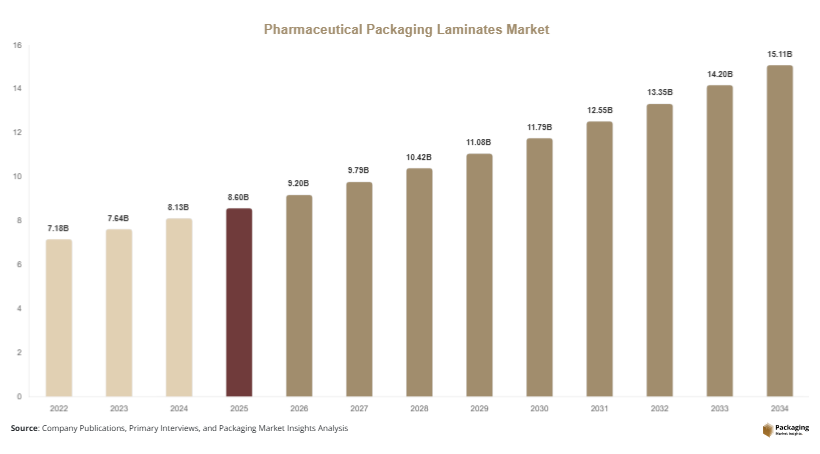
The global pharmaceutical packaging laminates market size was estimated at USD 8.6 billion in 2025 and is projected to reach USD 9.2 billion in 2026. Over the forecast period from 2025 to 2034, the market is expected to grow at a compound annual growth rate (CAGR) of 6.4%, reaching approximately USD 16.1 billion by 2034. The expansion is supported by growing pharmaceutical exports, the rising prevalence of chronic diseases, and the need for advanced packaging solutions that extend product shelf life.
The pharmaceutical packaging laminates market has experienced steady expansion due to rising pharmaceutical production, stricter packaging regulations, and the increasing demand for high-barrier materials that protect medicines from moisture, oxygen, and contamination. Laminated packaging structures are widely used in blister packs, sachets, pouches, and strip packaging to ensure drug stability throughout distribution and storage. As pharmaceutical supply chains expand globally, manufacturers are investing in multilayer laminate technologies that combine aluminum foil, polymer films, and specialty coatings.
Key Highlights
- Global market size expected to reach USD 16.1 billion by 2034
- CAGR of 6.4% from 2025 to 2034
- Increasing adoption of high-barrier multilayer laminates
- Rising pharmaceutical production in emerging economies
- Growing demand for sustainable and recyclable laminate materials
Explore more data points, trends and opportunities Download Free Sample Report
Market Trends
Rising Adoption of High-Barrier Multilayer Laminates
A key trend shaping the pharmaceutical packaging laminates market is the growing adoption of high-barrier multilayer laminate structures designed to protect sensitive drug formulations. Pharmaceutical products are highly vulnerable to moisture, oxygen exposure, and ultraviolet light, which can reduce drug effectiveness. To address this issue, manufacturers are increasingly using laminates that combine aluminum foil, polyethylene, polypropylene, and specialty barrier coatings. These multilayer configurations provide improved protection while maintaining flexibility and durability. The demand for high-barrier laminates is particularly strong in blister packaging, sachets, and strip packs used for tablets and capsules. As pharmaceutical companies focus on maintaining product stability during long distribution cycles, these advanced laminate materials are becoming a standard solution.
Growth of Sustainable and Recyclable Packaging Materials
Sustainability is emerging as an important trend across the pharmaceutical packaging industry. Companies are increasingly exploring recyclable laminate structures that reduce environmental impact while maintaining regulatory compliance. Traditional pharmaceutical laminates often contain complex material layers that are difficult to recycle. However, new material designs focus on mono-material laminates or simplified structures that improve recyclability. Packaging producers are also investing in lightweight films that reduce raw material consumption and transportation emissions. As pharmaceutical companies integrate sustainability goals into their supply chains, the demand for eco-friendly laminate packaging solutions is expected to grow steadily during the forecast period.
Market Drivers
Expanding Global Pharmaceutical Manufacturing
The expansion of pharmaceutical manufacturing worldwide is a major driver for the pharmaceutical packaging laminates market. Governments and private pharmaceutical companies are investing heavily in drug production facilities to meet rising healthcare demand. Emerging economies in Asia and Latin America are establishing new pharmaceutical clusters that supply both domestic and international markets. As drug production volumes increase, the need for reliable packaging materials also rises. Laminated packaging offers durability, chemical resistance, and effective barrier properties, making it suitable for a wide range of pharmaceutical products. This widespread applicability supports continuous demand growth for laminate packaging materials.
Increasing Demand for Protective Drug Packaging
Pharmaceutical products require strict protection against contamination, humidity, and temperature fluctuations. Laminated packaging materials provide strong barrier properties that help maintain drug stability and safety. With the increasing distribution of temperature-sensitive medicines and specialty pharmaceuticals, packaging requirements have become more stringent. Laminates are commonly used in blister packs, strip packaging, and flexible pouches due to their ability to maintain product integrity. As pharmaceutical regulations emphasize product safety and quality control, the demand for high-performance laminate packaging solutions is expected to increase steadily across global markets.
Market Restraint
Complex Recycling and Environmental Concerns
Despite the strong growth outlook, the pharmaceutical packaging laminates market faces challenges related to environmental sustainability and recycling limitations. Many pharmaceutical laminate structures consist of multiple material layers such as aluminum foil, polyethylene, polyester, and specialty adhesives. While these combinations provide strong barrier protection, they also create difficulties in recycling processes. Separating these layers requires specialized technologies that are not widely available in most waste management systems.
Environmental concerns surrounding plastic waste are increasing globally, prompting regulators and environmental organizations to push for stricter packaging guidelines. In some regions, governments are introducing policies aimed at reducing non-recyclable packaging materials. Pharmaceutical companies must balance regulatory compliance, product protection, and sustainability targets while selecting packaging materials.
For example, several pharmaceutical manufacturers have begun reviewing their packaging portfolios to reduce multilayer structures that are difficult to recycle. However, replacing traditional laminates without compromising drug stability remains technically challenging. The need for extensive validation and regulatory approval also slows the adoption of alternative materials.
These environmental and regulatory challenges may increase production costs and limit the pace of innovation in laminate packaging structures, creating a restraint for market growth over the forecast period.
Market Opportunities
Development of Recyclable Laminate Technologies
The development of recyclable laminate technologies presents a significant opportunity in the pharmaceutical packaging laminates market. Packaging manufacturers are actively investing in research to design laminate structures that maintain high barrier performance while improving recyclability. Innovations include mono-material polyethylene laminates and simplified polymer combinations that can be processed through existing recycling systems. These advancements help pharmaceutical companies meet sustainability goals without compromising product protection. As environmental regulations continue to evolve, companies that offer recyclable laminate solutions are likely to gain competitive advantages and expand their market presence.
Expansion of Pharmaceutical Production in Emerging Economies
Emerging economies offer considerable growth potential for laminate packaging suppliers. Countries across Asia, Latin America, and parts of Africa are increasing investments in pharmaceutical manufacturing infrastructure. Governments are supporting domestic drug production to improve healthcare accessibility and reduce dependence on imports. As pharmaceutical production expands, the demand for reliable and cost-efficient packaging materials increases. Laminated flexible packaging is widely preferred due to its lightweight structure, cost advantages, and strong barrier properties. This trend creates opportunities for packaging manufacturers to establish regional production facilities and strengthen supply chains in high-growth markets.
Report Scope
| Report Metric | Details |
|---|---|
| Market Size in 2025 | USD 8.6 Billion |
| Market Size in 2026 | USD 9.2 Billion |
| Market Size in 2034 | USD 16.1 Billion |
| CAGR | 6.4% (2026-2034) |
| Base Year for Estimation | 2025 |
| Historical Data | 2022-2024 |
| Forecast Period | 2026-2034 |
| Report Coverage | Revenue Forecast, Competitive Landscape, Supply Chain Disruption, Growth Factors, Environment & Regulatory Landscape and Trends |
| Geographies Covered | North America, Europe, APAC, Middle East and Africa, LATAM |
| Countries Covered | U.S., Canada, U.K., Germany, France, Spain, Italy, Russia, Nordic, Benelux, Rest of Europe, China, South Korea, Japan, India, Australia, Singapore, Taiwan, South East Asia, Rest of Asia-Pacific, UAE, Turky, Saudi Arabia, South Africa, Egypt, Nigeria, Rest of MEA, Brazil, Mexico, Argentina, Chile, Colombia, Rest of LATAM |
Explore more data points, trends and opportunities Download Free Sample Report
Segmental Analysis
By Material Type
The aluminum foil laminate segment held the dominant share of approximately 46% of the pharmaceutical packaging laminates market in 2024. Aluminum foil laminates are widely used in pharmaceutical packaging due to their superior barrier properties against moisture, oxygen, and light. These laminates are commonly applied in blister packs and strip packaging formats used for tablets and capsules. Pharmaceutical manufacturers prefer aluminum-based laminate structures because they maintain drug stability and extend shelf life. Additionally, aluminum foil laminates offer strong mechanical strength and compatibility with automated packaging machinery. These characteristics make them suitable for high-volume pharmaceutical production and global distribution networks.
The polymer-based laminate segment is expected to be the fastest-growing category, projected to expand at a CAGR of approximately 7.2% through 2034. Polymer laminates include combinations of polyethylene, polypropylene, and polyester films that provide flexibility and durability. Growth in this segment is supported by the increasing demand for lightweight packaging solutions that reduce transportation costs and material usage. Polymer laminates also allow for improved printability and design customization, which enhances branding and product identification. As pharmaceutical companies seek sustainable packaging alternatives, innovations in recyclable polymer laminates are expected to further accelerate growth within this segment.
By Packaging Format
The blister packaging laminate segment accounted for the largest share of nearly 41% in 2024 within the pharmaceutical packaging laminates market. Blister packaging is widely used for tablets and capsules because it provides individual dose protection and improves patient compliance. Laminated materials used in blister packs offer strong barrier protection while maintaining structural integrity during storage and transportation. Pharmaceutical companies prefer blister packaging because it helps maintain product safety and enables easy dosage tracking. Additionally, blister packs are compatible with automated packaging systems used in large-scale pharmaceutical manufacturing facilities, which further strengthens demand for laminate materials in this segment.
The sachet and pouch laminate segment is projected to grow at the fastest CAGR of approximately 7.0% during the forecast period. Sachets and pouches are increasingly used for single-dose pharmaceutical products such as powders, oral rehydration salts, and liquid formulations. These formats provide convenience, portability, and precise dosage control. Growth in this segment is driven by rising demand for over-the-counter medications and nutraceutical products packaged in flexible formats. Pharmaceutical companies are also expanding sachet packaging for emerging markets where smaller and affordable dosage formats are preferred. This trend supports increased consumption of laminate materials for flexible pharmaceutical packaging.
By End-Use
The pharmaceutical manufacturing companies segment held the dominant share of approximately 52% in 2024. These companies require large volumes of laminate packaging materials for tablets, capsules, powders, and liquid drug formulations. Laminated packaging ensures protection from environmental factors and helps maintain compliance with strict pharmaceutical quality standards. Drug manufacturers also rely on laminate packaging to support efficient packaging line operations and large-scale distribution. The expansion of pharmaceutical production capacity worldwide continues to drive demand for laminate packaging materials across this segment.
The contract packaging organizations segment is expected to register the fastest growth with a CAGR of around 7.5% through 2034. Contract packaging companies provide specialized packaging services for pharmaceutical brands that outsource certain operations. As pharmaceutical companies focus on core research and development activities, outsourcing packaging processes has become increasingly common. Contract packaging providers invest in advanced packaging technologies and automated equipment to meet large production requirements. This trend is creating strong demand for high-quality laminate materials that ensure product safety, regulatory compliance, and efficient packaging operations.
Pharmaceutical Packaging Laminates Market Segmentations
Material Type
- Aluminum Foil Laminates
- Polymer Laminates
- Paper-Based Laminates
Packaging Format
- Blister Packaging
- Sachets & Pouches
- Strip Packaging
- Bags & Flexible Packs
End-Use
- Pharmaceutical Manufacturing Companies
- Contract Packaging Organizations
- Research & Clinical Packaging Units
Regional Analysis
North America
North America accounted for approximately 32% of the pharmaceutical packaging laminates market share in 2025 and is expected to grow at a CAGR of around 5.8% during the forecast period. The region has a mature pharmaceutical industry with strong demand for high-quality packaging materials that comply with strict regulatory standards. Pharmaceutical companies in the region require packaging solutions that ensure drug safety, tamper resistance, and long shelf life, which supports continuous demand for laminate packaging.
The United States dominates the regional market due to its large pharmaceutical manufacturing sector and strong investment in advanced packaging technologies. A unique growth factor in the country is the increasing demand for specialty medicines and biologics that require protective packaging solutions. Pharmaceutical companies are adopting advanced laminate materials to ensure stability during distribution and storage, which continues to drive market expansion.
Europe
Europe held around 27% of the global market share in 2025, with the pharmaceutical packaging laminates market forecast to grow at a CAGR of approximately 5.9% through 2034. The region benefits from strong pharmaceutical production, extensive regulatory oversight, and a well-established packaging industry. European pharmaceutical companies prioritize high-barrier packaging materials to maintain compliance with strict drug safety standards.
Germany represents the leading country within the region due to its advanced pharmaceutical manufacturing base and well-developed packaging technology sector. A unique growth factor supporting the German market is the increasing focus on sustainable packaging innovation. Packaging manufacturers in the country are actively developing recyclable laminate structures that align with European environmental policies and circular economy initiatives.
Asia Pacific
Asia Pacific accounted for roughly 29% of the pharmaceutical packaging laminates market share in 2025 and is projected to register the fastest growth with a CAGR of approximately 7.4% during the forecast period. Rapid pharmaceutical manufacturing expansion, increasing healthcare investments, and rising demand for affordable medicines are major contributors to market growth across the region.
China is the dominant country in the Asia Pacific market due to its large pharmaceutical manufacturing sector and expanding export capabilities. A unique growth factor supporting the Chinese market is the rapid expansion of contract manufacturing organizations that produce medicines for global pharmaceutical brands. These facilities require large volumes of laminated packaging materials to support high production capacity.
Middle East & Africa
The Middle East & Africa represented about 6% of the global pharmaceutical packaging laminates market share in 2025 and is expected to grow at a CAGR of approximately 6.1% through 2034. The region’s pharmaceutical sector is gradually expanding as governments invest in healthcare infrastructure and local drug production facilities. Increasing pharmaceutical imports and distribution networks also support packaging demand.
Saudi Arabia is emerging as the leading country within the region due to its strategic efforts to strengthen domestic pharmaceutical manufacturing. A unique growth factor driving the market is the government’s healthcare diversification initiatives that aim to reduce reliance on imported medicines. These initiatives are encouraging local packaging suppliers to develop laminate packaging capabilities for pharmaceutical companies.
Latin America
Latin America held nearly 6% of the global market share in 2025, with the pharmaceutical packaging laminates market expected to grow at a CAGR of about 6.3% during the forecast period. Rising pharmaceutical consumption, expanding healthcare systems, and increasing drug manufacturing activities are contributing to regional growth.
Brazil leads the Latin American market due to its large pharmaceutical industry and strong domestic demand for medicines. A unique growth factor supporting the Brazilian market is the growing presence of generic drug manufacturers. These companies require cost-effective packaging materials for large-volume drug production, which increases demand for flexible laminate packaging solutions.
Competitive Landscape
The pharmaceutical packaging laminates market is moderately consolidated, with several global packaging manufacturers competing through product innovation, material technology development, and strategic partnerships with pharmaceutical companies. Major companies focus on improving barrier performance, sustainability, and manufacturing efficiency to strengthen their market position.
One of the leading companies in the market is Amcor plc, which holds a significant share due to its extensive portfolio of flexible packaging solutions for the pharmaceutical industry. The company continues to invest in sustainable laminate technologies that reduce environmental impact while maintaining high barrier protection.
Other prominent players include Berry Global, Huhtamaki, Constantia Flexibles, and UFlex. These companies are actively expanding production capacity and developing advanced multilayer laminate structures to meet evolving pharmaceutical packaging requirements. Strategic collaborations with pharmaceutical manufacturers and investments in research and development remain key competitive strategies in the market.
Recent developments include the introduction of recyclable laminate films, the expansion of flexible packaging production facilities, and the development of lightweight high-barrier materials that support pharmaceutical product stability.
Key Players List
- Amcor plc
- Berry Global Inc.
- Huhtamaki Oyj
- Constantia Flexibles
- UFlex Limited
- Mondi Group
- Winpak Ltd.
- Sealed Air Corporation
- Glenroy Inc.
- Clondalkin Group
- Coveris Holdings
- Cosmo Films Ltd.
- Jindal Poly Films Ltd.
- Toray Plastics
- Polyplex Corporation