Pharmaceutical Glass Packaging Market Size and Growth
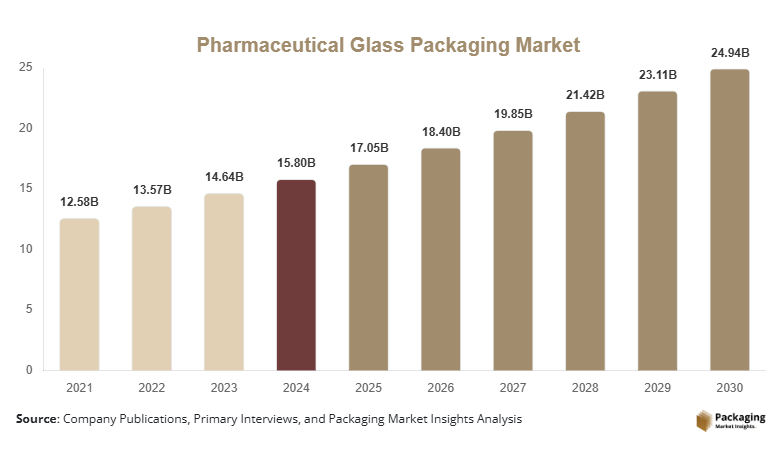
The global pharmaceutical glass packaging market size was valued at approximately USD 15.8 billion in 2024 and is projected to grow from around USD 17.05 billion in 2025 to reach nearly USD 24.93 billion by 2030, expanding at a CAGR of about 7.9% during the forecast period (2025-2030). The market growth reflected a steady increase in pharmaceutical production volumes, combined with the sustained preference for inert and contamination-resistant primary packaging solutions.
One of the key global factors supporting market growth was the rise in injectable drug formulations, including vaccines, biologics, and biosimilars. Glass packaging continued to be favored for its chemical inertness, barrier properties, and ability to maintain drug stability over extended shelf lives. Regulatory emphasis on drug safety and compatibility further reinforced the adoption of pharmaceutical glass containers across both developed and emerging healthcare systems. Manufacturers increasingly focused on product standardization, compliance with pharmacopeial requirements, and improved container integrity to address stringent regulatory frameworks. The transition toward high-quality molded and tubular glass solutions also supported consistent growth across multiple therapeutic categories.
Key Highlights
- Asia Pacific accounted for approximately 38.6% of global market share in 2024, while the region is expected to register the fastest growth at a CAGR of 8.6% through 2030.
- By product type, vials held the leading share at 41.2% in 2024, while cartridges are projected to grow fastest at a CAGR of 8.9%.
- By glass type, Type I borosilicate glass dominated the market with a 54.7% share, whereas Type II glass is anticipated to expand at a CAGR of 8.3%.
- The United States led the country-level market with a value of USD 3.9 billion in 2024, increasing to an estimated USD 4.2 billion in 2025.
Explore more data points, trends and opportunities Download Free Sample Report
Latest Market Trends
Shift Toward High-Purity Borosilicate Glass Packaging
Pharmaceutical manufacturers increasingly adopted high-purity borosilicate glass to address compatibility issues with complex drug formulations. This trend was driven by the growing use of sensitive biologics and injectable drugs that require minimal interaction with container surfaces. Enhanced resistance to chemical leaching and thermal shock positioned borosilicate glass as a preferred material for critical drug storage applications.
Growing Adoption of Ready-to-Fill Glass Containers
The pharmaceutical glass packaging market witnessed a rising shift toward ready-to-fill (RTF) containers. These pre-washed, sterilized, and validated containers reduced contamination risks and streamlined pharmaceutical filling operations. Contract manufacturing organizations and large pharmaceutical companies increasingly adopted RTF solutions to improve operational efficiency, shorten production cycles, and ensure regulatory compliance.
Market Drivers
Expanding the Injectable and Biologic Drug Pipeline
The increasing development and commercialization of injectable therapies significantly supported demand for pharmaceutical glass packaging. Injectable drugs require packaging materials that ensure sterility, stability, and extended shelf life, making glass containers the preferred option across therapeutic areas such as oncology, immunology, and endocrinology.
Stringent Regulatory Requirements for Drug Packaging
Global regulatory bodies emphasized packaging integrity, material safety, and compatibility testing. Pharmaceutical glass packaging met these regulatory expectations due to its inert nature and established compliance history. The need to meet pharmacopeial standards across multiple geographies reinforced the continued reliance on glass containers in pharmaceutical supply chains.
Market Restraints
Fragility and Breakage Risks in Glass Packaging
Despite its advantages, pharmaceutical glass packaging faced challenges related to breakage and handling risks. Glass containers are susceptible to cracks, delamination, and breakage during transportation and storage. These risks increased operational costs due to product loss, quality inspections, and secondary packaging requirements. The need for specialized handling and protective logistics solutions limited adoption in certain high-volume, cost-sensitive pharmaceutical segments.
Market Opportunities
Growth in Emerging Pharmaceutical Manufacturing Hubs
Emerging economies are rapidly expanding domestic pharmaceutical manufacturing capacities. Investments in local drug production facilities are creating new demand for pharmaceutical glass packaging solutions that meet international quality standards, presenting long-term growth opportunities for packaging suppliers.
Technological Advancements in Glass Strengthening
Advances in glass strengthening technologies, including surface treatments and improved annealing processes, are creating opportunities to enhance container durability. These innovations are expected to reduce breakage rates and expand the application scope of glass packaging in high-speed pharmaceutical filling lines.
Report Scope
| Report Metric | Details |
|---|---|
| Market Size in 2024 | USD 15.8 Billion |
| Market Size in 2025 | USD 17.05 Billion |
| Market Size in 2030 | USD 24.93 Billion |
| CAGR | 7.9% (2025-2030) |
| Base Year for Estimation | 2024 |
| Historical Data | 2021-2023 |
| Forecast Period | 2025-2030 |
| Report Coverage | Revenue Forecast, Competitive Landscape, Supply Chain Disruption, Growth Factors, Environment & Regulatory Landscape and Trends |
| Geographies Covered | North America, Europe, APAC, Middle East and Africa, LATAM |
| Countries Covered | U.S., Canada, U.K., Germany, France, Spain, Italy, Russia, Nordic, Benelux, Rest of Europe, China, South Korea, Japan, India, Australia, Singapore, Taiwan, South East Asia, Rest of Asia-Pacific, UAE, Turky, Saudi Arabia, South Africa, Egypt, Nigeria, Rest of MEA, Brazil, Mexico, Argentina, Chile, Colombia, Rest of LATAM |
Explore more data points, trends and opportunities Download Free Sample Report
Segmental Analysis
By Product Type
The Vials subsegment accounted for a dominant 41.2% share of the pharmaceutical glass packaging market by product type in 2024. This leadership was primarily driven by their extensive use in injectable drug packaging, including vaccines, antibiotics, and biologics. Vials offer superior chemical resistance, precise dosage control, and compatibility with automated filling lines, making them the preferred packaging solution for high-volume pharmaceutical manufacturing. Their ability to maintain sterility and drug stability across long storage periods further reinforced their widespread adoption across hospital and retail pharmaceutical supply chains.
The Cartridges subsegment is projected to be the fastest-growing, registering a CAGR of 8.9% from 2025 to 2030. This growth will be fueled by the increasing adoption of pen injectors for chronic disease management, particularly in diabetes, growth hormone deficiency, and autoimmune disorders. Cartridges enable patient-friendly drug administration and accurate dosing, aligning with the rising emphasis on self-injection therapies and home-based care models, thereby driving sustained demand.
By Glass Type
The Type I (Borosilicate Glass) subsegment held a commanding 54.7% share of the market by glass type in 2024. This dominance was attributed to its superior chemical inertness, high thermal resistance, and minimal risk of interaction with sensitive drug formulations. Type I glass is widely used for high-value injectables and biologics where product integrity is critical, making it a standard choice for regulated pharmaceutical applications requiring stringent compliance.
The Type II (Treated Soda-Lime Glass) subsegment is anticipated to grow at the fastest CAGR of 8.3% from 2025 to 2030. This accelerated growth will be driven by its cost-efficiency and suitability for buffered and acidic drug formulations. Advances in surface treatment technologies have enhanced the performance of Type II glass, enabling pharmaceutical manufacturers to balance regulatory compliance with cost optimization, particularly in large-scale generic drug production.
By Drug Type
The Injectable Drugs subsegment represented a significant 62.5% share of the pharmaceutical glass packaging market by drug type in 2024. This leading position was supported by the expanding use of injectable therapies across oncology, infectious diseases, and hospital-based treatments. Injectable drugs require packaging materials that ensure sterility, low extractables, and long shelf life, positioning glass containers as the most reliable option for parenteral drug delivery.
The Biologics & Biosimilars subsegment is projected to witness the highest growth at a CAGR of 9.1% from 2025 to 2030. This growth will be driven by the rapid expansion of biologic drug pipelines and increasing approvals of biosimilars globally. These complex and temperature-sensitive formulations require high-performance glass packaging to preserve molecular stability, driving increased adoption of premium pharmaceutical glass containers.
By End Use
The Pharmaceutical Manufacturers subsegment accounted for a dominant 68.9% share of the market by end use in 2024. This dominance was a direct result of in-house drug formulation, filling, and packaging operations conducted by large pharmaceutical companies. Direct procurement of glass containers enabled manufacturers to maintain quality control, regulatory compliance, and supply chain reliability across multiple drug categories.
The Contract Manufacturing Organizations (CMOs) subsegment is expected to register the fastest CAGR of 8.5% from 2025 to 2030. This growth will be supported by increasing outsourcing of pharmaceutical production, particularly for sterile injectables and biologics. CMOs require flexible, high-quality glass packaging solutions to serve multiple clients and drug formats, making them a key growth engine within the global market.
Pharmaceutical Glass Packaging Market Segmentations
By Product Type
- Vials
- Ampoules
- Bottles
- Cartridges
- Syringes
By Glass Type
- Type I (Borosilicate Glass)
- Type II (Treated Soda-Lime Glass)
- Type III (Soda-Lime Glass)
By Drug Type
- Injectable Drugs
- Oral Liquid Drugs
- Biologics & Biosimilars
By End Use
- Pharmaceutical Manufacturers
- Contract Manufacturing Organizations
Regional Analysis
North America
North America accounted for approximately 31.4% of the pharmaceutical glass packaging market share in 2025 and is expected to grow at a CAGR of 6.8% from 2025 to 2033. The region’s growth was supported by a mature pharmaceutical industry, strong regulatory enforcement, and high adoption of injectable therapies.
The United States dominated the regional market due to extensive biologics production and a robust pharmaceutical R&D ecosystem. High demand for sterile packaging solutions across hospital, retail, and specialty drug channels contributed to sustained market expansion.
Europe
Europe held nearly 27.6% of the global market share in 2025 and is projected to expand at a CAGR of 6.5% through 2033. The region benefited from established pharmaceutical manufacturing clusters and stringent packaging regulations emphasizing product safety and traceability.
Germany emerged as the dominant country, driven by advanced pharmaceutical manufacturing infrastructure and strong exports of injectable drugs. The country’s focus on quality-driven production supported consistent demand for high-grade pharmaceutical glass packaging.
Asia Pacific
Asia Pacific represented about 39.2% of the market share in 2025 and is forecast to grow at a CAGR of 8.6% between 2025 and 2033. Rapid expansion of pharmaceutical manufacturing capacities and increasing healthcare expenditure supported strong regional growth.
China led the regional market due to large-scale pharmaceutical production, growing vaccine manufacturing, and government initiatives supporting domestic drug development. Rising exports of pharmaceutical products further strengthened demand for compliant glass packaging solutions.
Middle East & Africa
The Middle East & Africa region accounted for 6.1% of global market share in 2025 and is expected to grow at a CAGR of 6.9% through 2033. Growth was supported by improving healthcare infrastructure and increasing pharmaceutical imports.
Saudi Arabia dominated the regional market, driven by investments in pharmaceutical manufacturing and localization strategies aimed at reducing import dependency.
Latin America
Latin America held approximately 5.7% of the pharmaceutical glass packaging market share in 2025 and is projected to grow at a CAGR of 6.7% from 2025 to 2033. Expanding healthcare access and pharmaceutical production supported moderate growth.
Brazil emerged as the leading country, supported by a growing generic drug manufacturing base and increasing government focus on healthcare self-sufficiency.
Competitive Landscape
The pharmaceutical glass packaging market is moderately consolidated, with several global and regional players competing on product quality, regulatory compliance, and supply reliability. Market leaders focus on expanding production capacity, improving glass formulations, and offering value-added services.
SCHOTT AG emerged as a market leader, supported by its broad portfolio of pharmaceutical glass solutions and recent investments in advanced borosilicate glass production technologies. Other players continued to strengthen their regional presence and form strategic partnerships with pharmaceutical manufacturers.
Key Players in the Pharmaceutical Glass Packaging Market
- SCHOTT AG
- Gerresheimer AG
- Corning Incorporated
- SGD Pharma
- Nipro Corporation
- Stevanato Group
- Ardagh Group
- West Pharmaceutical Services
- Piramal Glass
- Ompi S.p.A.
- Bormioli Pharma
- DWK Life Sciences
- Shandong Pharmaceutical Glass Co., Ltd.
- Stoelzle Glass Group
- Beatson Clark