Pharmaceutical Composite Films And Bags Market Size and Growth
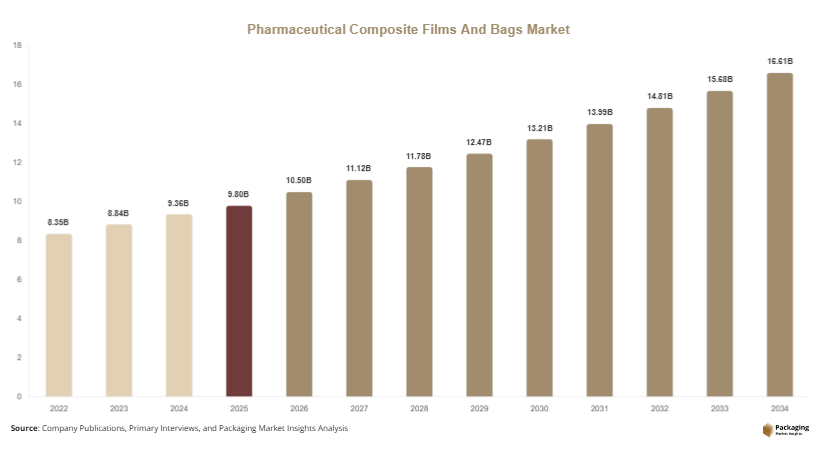
The global pharmaceutical composite films and bags market was valued at USD 9.8 billion in 2025 and is estimated to reach USD 10.5 billion in 2026. The market is projected to reach USD 17.6 billion by 2034, expanding at a CAGR of 5.9% during the forecast period from 2025 to 2034. The market is experiencing steady expansion due to increasing pharmaceutical manufacturing activities, rising biologics production, and growing demand for sterile and contamination-resistant packaging solutions across healthcare industries. Pharmaceutical composite films and bags are widely used for drug storage, intravenous solutions, biopharmaceutical processing, medical fluid handling, and single-use pharmaceutical packaging applications.
One of the primary growth factors driving the market is the rapid expansion of the global pharmaceutical industry. Increasing production of injectable drugs, vaccines, biologics, and biosimilars is significantly increasing demand for advanced pharmaceutical packaging materials with high barrier protection and chemical resistance properties. Pharmaceutical manufacturers are increasingly adopting multilayer composite films and sterile bags to ensure product integrity and comply with strict healthcare packaging regulations.
Key Market Insights
- Asia Pacific dominated the market with a 36.9% share in 2025.
- Latin America is projected to grow at the fastest CAGR of 6.5%.
- Multilayer composite films led the type segment with a 41.8% share.
- Polyethylene-based materials dominated with a 44.6% share.
- Pharmaceutical manufacturing applications led the end-use segment with 39.4% share.
- The US remained the dominant country with a market size of USD 2.4 billion in 2025 and USD 2.6 billion in 2026.
Explore more data points, trends and opportunities Download Free Sample Report
Market Trends
Rising Adoption of Single-Use Bioprocessing Bags
The pharmaceutical composite films and bags market is increasingly witnessing strong demand for single-use bioprocessing bags across pharmaceutical and biotechnology industries. Pharmaceutical companies are shifting toward disposable systems to reduce contamination risks and improve production flexibility during biologics and vaccine manufacturing. Single-use bags eliminate the need for extensive cleaning and sterilization processes, helping manufacturers reduce operational downtime and water consumption.
Biopharmaceutical facilities are increasingly using composite film bags for cell culture media storage, buffer handling, and sterile fluid transfer operations. Several pharmaceutical manufacturers in the United States and Germany are expanding biologics production lines supported by advanced multilayer bag systems with enhanced chemical compatibility and barrier performance.
The future impact of this trend is expected to include higher adoption of automated single-use manufacturing systems and increased investment in sterile pharmaceutical packaging infrastructure. Demand for flexible, contamination-resistant composite bags is likely to grow significantly as biologics and personalized medicine production continue expanding globally.
Development of Sustainable Pharmaceutical Packaging Materials
Sustainability is becoming an important trend within the pharmaceutical composite films and bags market as pharmaceutical companies increasingly focus on reducing healthcare packaging waste and improving environmental performance. Manufacturers are developing recyclable multilayer films, low-carbon polymer materials, and eco-friendly pharmaceutical bag solutions without compromising sterility and barrier protection.
Several healthcare packaging companies are investing in lightweight composite structures that reduce material consumption while maintaining pharmaceutical safety standards. Europe and North America are witnessing growing research into recyclable polyethylene-based composite films designed for pharmaceutical fluid packaging and medical device applications.
The long-term impact of this trend is expected to include wider commercialization of sustainable healthcare packaging solutions and stronger regulatory support for recyclable pharmaceutical materials. Pharmaceutical manufacturers are likely to adopt circular packaging strategies and recyclable sterile packaging systems to meet sustainability targets and improve waste management efficiency.
Market Drivers
Expansion of Biopharmaceutical Manufacturing Activities
The rapid expansion of biopharmaceutical manufacturing is a major driver supporting the pharmaceutical composite films and bags market. Biologics, vaccines, monoclonal antibodies, and cell therapies require sterile packaging systems capable of maintaining product purity and minimizing contamination risks during production and transportation.
Pharmaceutical composite films and bags are widely used in upstream and downstream bioprocessing applications because they provide flexibility, chemical resistance, and sterilization compatibility. Increasing investment in biologics production facilities across the United States, China, Germany, and South Korea is accelerating demand for advanced single-use packaging systems.
For example, several global pharmaceutical companies are expanding biologics manufacturing plants equipped with disposable fluid management systems utilizing sterile composite bags. Contract development and manufacturing organizations are also increasing adoption of high-performance composite packaging materials to support growing pharmaceutical outsourcing operations. The continuous expansion of biologics manufacturing capacity is expected to remain a strong market growth driver throughout the forecast period.
Increasing Demand for Sterile and High-Barrier Packaging
Rising demand for sterile pharmaceutical packaging solutions is another major factor driving market growth. Pharmaceutical products require advanced packaging systems capable of protecting drugs and medical fluids from oxygen, moisture, microbial contamination, and chemical degradation.
Composite films with multilayer barrier structures are increasingly used in pharmaceutical fluid bags, intravenous packaging, and sterile drug storage systems because they improve product stability and extend shelf life. Pharmaceutical companies are investing in advanced multilayer packaging technologies to comply with strict drug safety regulations and ensure packaging integrity.
Several pharmaceutical packaging suppliers are introducing low-extractable and high-purity film materials designed for injectable drug and biologics applications. Healthcare providers are additionally increasing demand for sterile medical bags used in hospitals, laboratories, and blood storage facilities. Growing pharmaceutical safety standards and rising injectable drug production are expected to continue supporting market growth globally.
Market Restraint
Complex Regulatory Compliance and Material Validation Requirements
Complex regulatory compliance and material validation requirements remain key restraints for the pharmaceutical composite films and bags market. Pharmaceutical packaging materials must comply with strict healthcare regulations related to sterility, extractables, leachables, chemical compatibility, and contamination prevention. Manufacturers are required to conduct extensive testing and validation procedures before composite films and bags can be approved for pharmaceutical applications.
The multilayer structure of pharmaceutical composite films often increases testing complexity because multiple polymer layers must meet pharmaceutical safety standards simultaneously. Regulatory approval processes can increase product development timelines and operational costs for packaging manufacturers.
For example, pharmaceutical packaging suppliers serving injectable drug and biologics industries must conduct comprehensive validation studies to ensure packaging materials do not negatively affect drug formulations. Small and medium-sized manufacturers may face challenges related to high compliance costs and technical documentation requirements. In developing markets, limited access to advanced testing infrastructure may further restrict product commercialization.
Fluctuating raw material prices for specialty polymers and rising healthcare packaging quality standards may additionally impact profitability for market participants. However, continuous investment in advanced barrier technologies and pharmaceutical-grade material innovation is expected to gradually improve product performance and support long-term market growth.
Market Opportunities
Growth of Personalized Medicine and Cell Therapy Applications
The increasing adoption of personalized medicine and cell therapy treatments presents significant opportunities for the pharmaceutical composite films and bags market. Personalized medicine requires highly specialized sterile packaging systems designed for small-batch biologics production, temperature-sensitive formulations, and contamination-controlled transport applications.
Pharmaceutical composite bags are increasingly utilized for cell culture media handling, cryogenic storage, and sterile transport of biological materials. Healthcare companies are investing in advanced flexible packaging systems capable of supporting highly sensitive pharmaceutical formulations used in gene therapy and regenerative medicine applications.
Several biotechnology firms across North America and Europe are expanding cell therapy production facilities equipped with single-use fluid management systems. Future opportunities are expected in customized sterile packaging solutions, cryogenic pharmaceutical bags, and advanced multilayer barrier films supporting precision medicine manufacturing and logistics operations.
Expansion of Pharmaceutical Manufacturing in Emerging Economies
The rapid expansion of pharmaceutical manufacturing infrastructure in emerging economies is creating strong opportunities for market growth. Countries such as India, China, Brazil, Vietnam, and Indonesia are increasing investment in pharmaceutical production facilities to support growing domestic healthcare demand and pharmaceutical exports.
Pharmaceutical manufacturers in emerging regions are increasingly adopting advanced sterile packaging systems to comply with international drug safety standards. Demand for composite films and bags is rising across injectable drug manufacturing, intravenous fluid packaging, and pharmaceutical logistics applications.
For example, India and China are witnessing rapid expansion of vaccine manufacturing and biologics production facilities that require high-performance composite packaging materials. Several healthcare packaging suppliers are establishing regional production facilities to strengthen supply chain efficiency and reduce packaging costs. Long-term market opportunities are expected in sustainable pharmaceutical packaging, cold chain transport bags, and multilayer sterile film technologies designed for emerging healthcare markets.
Report Scope
| Report Metric | Details |
|---|---|
| Market Size in 2025 | USD 9.8 Billion |
| Market Size in 2026 | USD 10.5 Billion |
| Market Size in 2034 | USD 17.6 Billion |
| CAGR | 5.9% (2026-2034) |
| Base Year for Estimation | 2025 |
| Historical Data | 2022-2024 |
| Forecast Period | 2026-2034 |
| Report Coverage | Revenue Forecast, Competitive Landscape, Supply Chain Disruption, Growth Factors, Environment & Regulatory Landscape and Trends |
| Geographies Covered | North America, Europe, APAC, Middle East and Africa, LATAM |
| Countries Covered | U.S., Canada, U.K., Germany, France, Spain, Italy, Russia, Nordic, Benelux, Rest of Europe, China, South Korea, Japan, India, Australia, Singapore, Taiwan, South East Asia, Rest of Asia-Pacific, UAE, Turky, Saudi Arabia, South Africa, Egypt, Nigeria, Rest of MEA, Brazil, Mexico, Argentina, Chile, Colombia, Rest of LATAM |
Explore more data points, trends and opportunities Download Free Sample Report
Segmental Analysis
By Type
Multilayer composite films dominated the pharmaceutical composite films and bags market in 2024 with a market share of 41.8%. These films are widely used across pharmaceutical packaging applications because they provide superior barrier protection against oxygen, moisture, and chemical contamination. Pharmaceutical manufacturers increasingly utilize multilayer film structures combining polyethylene, polypropylene, and ethylene vinyl alcohol layers to improve product stability and extend shelf life. High-barrier films are commonly used for injectable drugs, intravenous fluids, biologics, and sterile pharmaceutical packaging systems. Several healthcare packaging companies across North America and Europe are investing in advanced multilayer film technologies with improved puncture resistance and sterilization compatibility. Growth in biologics production and increasing pharmaceutical safety standards continue supporting segment dominance globally.
Sterile pharmaceutical bags are projected to witness the fastest CAGR of 6.7% during the forecast period due to increasing demand for single-use bioprocessing systems and sterile fluid handling solutions. These bags are extensively used for buffer storage, vaccine manufacturing, intravenous solutions, and biologics transport applications. Pharmaceutical companies are increasingly adopting disposable sterile bags to reduce contamination risks and improve manufacturing flexibility. Several biotechnology firms are expanding production facilities equipped with advanced fluid management systems utilizing high-performance composite bags. Future market growth is expected to benefit from rising demand for personalized medicine, expansion of biologics manufacturing infrastructure, and increasing investment in sterile pharmaceutical logistics operations globally.
By Material
Polyethylene-based materials accounted for the largest market share of 44.6% in 2024 due to their flexibility, chemical resistance, and compatibility with pharmaceutical sterilization processes. Polyethylene films are extensively used in pharmaceutical bags, fluid packaging systems, and medical storage applications because they offer strong moisture protection and low extractable properties. Pharmaceutical manufacturers increasingly prefer polyethylene-based multilayer structures for biologics and injectable drug packaging applications. Several healthcare packaging suppliers are introducing advanced polyethylene film formulations designed to improve durability and pharmaceutical purity. Growth in sterile pharmaceutical packaging demand and expansion of injectable drug manufacturing continue supporting segment dominance across healthcare industries.
Polypropylene-based materials are expected to register the fastest CAGR of 6.3% during the forecast period due to rising demand for high-temperature resistant pharmaceutical packaging systems. Polypropylene offers excellent thermal stability, mechanical strength, and sterilization compatibility, making it suitable for pharmaceutical processing and bioprocessing applications. Pharmaceutical companies are increasingly using polypropylene composite films for biologics storage, fluid transfer systems, and pharmaceutical transport packaging. Several packaging manufacturers are investing in lightweight polypropylene multilayer structures designed for sustainable healthcare packaging applications. Future growth opportunities are expected in recyclable pharmaceutical packaging materials, advanced polymer blending technologies, and high-performance medical bag systems supporting pharmaceutical manufacturing expansion.
By End-Use
Pharmaceutical manufacturing applications dominated the pharmaceutical composite films and bags market in 2024 with a market share of 39.4%. Pharmaceutical production facilities require advanced composite films and sterile bags for drug formulation, injectable medicine packaging, medical fluid storage, and contamination-controlled manufacturing operations. Pharmaceutical companies are increasingly investing in high-barrier packaging systems designed to maintain drug integrity and comply with healthcare regulations. Several pharmaceutical manufacturers across Asia Pacific and North America are expanding injectable drug and vaccine production facilities utilizing multilayer packaging technologies. Increasing pharmaceutical exports and rising demand for sterile packaging systems continue supporting segment dominance globally.
Biopharmaceutical applications are projected to witness the fastest CAGR of 6.8% during the forecast period due to increasing biologics production and rising adoption of single-use manufacturing technologies. Biopharmaceutical companies extensively utilize sterile bags and composite films for cell culture media handling, vaccine production, and biologics transport applications. Several biotechnology firms are investing in disposable fluid management systems to improve operational efficiency and reduce contamination risks. Growth in monoclonal antibody production, personalized medicine development, and cell therapy manufacturing is expected to strengthen demand for advanced pharmaceutical packaging materials. Future market expansion is likely to benefit from continuous investment in biologics manufacturing infrastructure and high-performance sterile packaging technologies.
Pharmaceutical Composite Films And Bags Market Segmentations
By Type
- Composite Films
- Sterile Bags
- Barrier Films
- Multilayer Pharmaceutical Bags
- High-Performance Laminates
By Material
- Polyethylene (PE)
- Polypropylene (PP)
- Polyamide (PA)
- Ethylene Vinyl Alcohol (EVOH)
- Aluminum Foil Composites
By End-User
- Biopharmaceutical Manufacturing
- Injectable Drug Packaging
- Medical Device Packaging
- Diagnostic Product Packaging
- Contract Pharmaceutical Manufacturing
Regional Analysis
North America
North America accounted for 29.4% of the global pharmaceutical composite films and bags market share in 2025 and is projected to grow at a CAGR of 5.6% during the forecast period. The region benefits from strong pharmaceutical manufacturing infrastructure, high biologics production capacity, and advanced healthcare packaging technologies. Pharmaceutical companies across the United States and Canada are increasingly adopting multilayer composite films and sterile bags for biologics, injectable drugs, and medical fluid packaging applications. The region is also witnessing strong investment in single-use bioprocessing systems and pharmaceutical cold chain infrastructure. Increasing healthcare expenditure and rising demand for contamination-resistant pharmaceutical packaging continue supporting market growth across North America.
The United States remained the dominant country within the region due to its large pharmaceutical manufacturing industry and strong biotechnology research ecosystem. One important growth driver is the expansion of biologics manufacturing facilities utilizing single-use packaging technologies. Several pharmaceutical companies are investing in advanced sterile fluid handling systems equipped with multilayer composite bags designed for vaccine and injectable drug production. Canada is also witnessing increasing adoption of recyclable healthcare packaging materials and pharmaceutical cold storage solutions. Rising demand for high-barrier pharmaceutical packaging products continues strengthening market growth throughout the region.
Europe
Europe represented 26.1% of the global pharmaceutical composite films and bags market share in 2025 and is forecast to expand at a CAGR of 5.7% through 2034. The region continues benefiting from strong pharmaceutical exports, advanced healthcare infrastructure, and strict pharmaceutical safety regulations. Pharmaceutical companies across Germany, France, Switzerland, and the United Kingdom are increasingly adopting high-barrier composite packaging materials to improve drug stability and contamination prevention.
Germany emerged as the dominant country within Europe because of its extensive pharmaceutical manufacturing capacity and strong investment in medical packaging technologies. One unique growth driver is the increasing development of sustainable pharmaceutical packaging solutions within the European healthcare industry. Several packaging manufacturers are investing in recyclable multilayer films and low-extractable polymer materials to comply with environmental regulations. Switzerland and France are also expanding biologics production operations requiring advanced sterile packaging systems. Growing pharmaceutical research activities continue supporting demand for flexible pharmaceutical packaging solutions across the region.
Asia Pacific
Asia Pacific dominated the pharmaceutical composite films and bags market with a 36.9% share in 2025 and is projected to register a CAGR of 6.3% during the forecast period. Rapid pharmaceutical manufacturing expansion, increasing healthcare expenditure, and rising vaccine production are major factors driving regional market growth. Countries such as China, India, Japan, and South Korea are witnessing increasing demand for pharmaceutical composite films and sterile bags across biologics, injectable drugs, and medical fluid packaging applications.
China remained the dominant country in Asia Pacific due to its expanding pharmaceutical manufacturing infrastructure and growing biologics production capacity. One major growth driver is the rapid expansion of vaccine manufacturing facilities requiring advanced sterile packaging systems. Chinese pharmaceutical companies are increasingly adopting multilayer barrier films and disposable fluid handling bags to improve pharmaceutical safety and operational efficiency. India is also witnessing rising investment in pharmaceutical exports and injectable drug manufacturing infrastructure. Japan continues focusing on advanced healthcare packaging technologies and high-purity pharmaceutical materials supporting regional market expansion.
Middle East & Africa
The Middle East & Africa accounted for 3.8% of the global pharmaceutical composite films and bags market share in 2025 and is expected to expand at a CAGR of 4.9% during the forecast period. The region is gradually experiencing growth due to increasing healthcare infrastructure investment, pharmaceutical import substitution initiatives, and rising demand for sterile medical packaging products. Countries across the Gulf region are investing in pharmaceutical manufacturing and healthcare logistics operations to strengthen domestic healthcare capabilities.
Saudi Arabia remained the dominant country within the region because of increasing pharmaceutical production investments and healthcare modernization initiatives. One important growth driver is the expansion of hospital and healthcare infrastructure requiring advanced medical fluid packaging systems. Pharmaceutical companies are increasingly adopting sterile composite bags and multilayer pharmaceutical films for injectable drugs and intravenous fluid applications. The United Arab Emirates is also witnessing rising demand for temperature-controlled pharmaceutical packaging solutions. South Africa continues supporting gradual growth in pharmaceutical packaging demand driven by expanding healthcare services.
Latin America
Latin America held 3.8% of the global pharmaceutical composite films and bags market share in 2025 and is projected to witness the fastest CAGR of 6.5% during the forecast period. Increasing pharmaceutical production, rising healthcare investments, and expanding vaccine manufacturing activities are contributing to regional market growth. Countries such as Brazil, Mexico, and Argentina are increasingly adopting advanced pharmaceutical packaging systems to improve drug safety and export competitiveness.
Brazil emerged as the dominant country in Latin America because of its growing pharmaceutical manufacturing base and increasing healthcare spending. One unique growth driver is the expansion of domestic vaccine production facilities utilizing sterile composite bag systems and multilayer pharmaceutical films. Several healthcare packaging suppliers are strengthening regional distribution networks to support growing pharmaceutical demand. Mexico is additionally witnessing increasing adoption of flexible pharmaceutical packaging for injectable drug transport and storage applications. Expansion of healthcare logistics infrastructure continues supporting long-term regional market growth.
Competitive Landscape
The pharmaceutical composite films and bags market is moderately competitive with the presence of global healthcare packaging manufacturers, bioprocessing solution providers, and pharmaceutical material suppliers focusing on sterile packaging innovation and high-barrier film technologies.
Saint-Gobain is considered one of the leading companies in the market due to its strong portfolio of pharmaceutical fluid transfer systems and advanced composite film technologies. The company continues investing in high-purity pharmaceutical packaging materials and bioprocessing solutions.
Sartorius AG focuses on single-use bioprocessing bags and sterile pharmaceutical packaging systems supporting biologics manufacturing operations. Thermo Fisher Scientific is expanding disposable pharmaceutical fluid management technologies for biopharmaceutical applications. 3M continues developing advanced pharmaceutical barrier films and healthcare packaging materials. Amcor plc is investing in sustainable pharmaceutical packaging solutions and recyclable multilayer film technologies.
Companies are increasingly focusing on sterile packaging innovation, sustainable polymer development, and expansion of single-use pharmaceutical manufacturing solutions to strengthen global market competitiveness.
Key Players List
- Saint-Gobain
- Sartorius AG
- Thermo Fisher Scientific
- 3M
- Amcor plc
- West Pharmaceutical Services
- Avantor
- DuPont
- Berry Global
- Sealed Air
- Nipro Corporation
- Renolit
- Mitsubishi Chemical Group
- Wipak Group
- Tekni-Plex