Pharmaceutical Blister Packaging Tooling Market Size and Growth
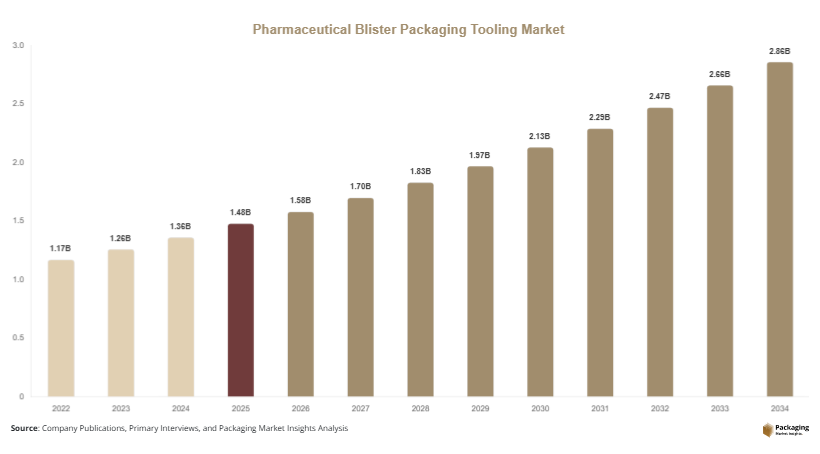
The global pharmaceutical blister packaging tooling market size was valued at approximately USD 1.48 billion in 2025 and is expected to reach USD 1.58 billion in 2026. By 2034, the market is forecasted to reach nearly USD 2.86 billion, expanding at a CAGR of 7.7% during 2025–2034. pharmaceutical blister packaging tooling market is experiencing steady growth due to increasing pharmaceutical production, rising demand for unit-dose packaging, and expanding investments in automated packaging systems. Pharmaceutical blister packaging tooling includes forming tools, sealing tools, perforation tools, embossing units, and cutting systems used in the production of blister packs for tablets, capsules, and medical devices.
The growth of the pharmaceutical industry is one of the primary factors driving the market. Rising consumption of prescription drugs, over-the-counter medications, and nutraceutical products is increasing the need for efficient blister packaging solutions. Another significant growth factor is the growing adoption of automated high-speed packaging lines by pharmaceutical manufacturers seeking higher productivity and precision. Blister packaging tooling plays a critical role in ensuring packaging consistency, product safety, and operational efficiency.
Key Highlights
- Asia Pacific dominated the market with a 39.1% share in 2025.
- Latin America is projected to grow at the fastest CAGR of 8.1%.
- Thermoform tooling led the type segment with a 46.8% share%.
- Aluminum tooling materials dominated with a 52.6% share.
- Tablet packaging applications led the segment with 48.4% share.
- The US remained the dominant country with a market size of USD 412 million in 2025 and USD 439 million in 2026.
Explore more data points, trends and opportunities Download Free Sample Report
Market Trends
Increasing Integration of Precision Engineering and Digital Monitoring Systems
Pharmaceutical manufacturers are increasingly adopting precision-engineered blister packaging tooling integrated with digital monitoring systems to improve packaging efficiency and product consistency. Advanced tooling systems equipped with sensors and real-time performance tracking capabilities help manufacturers reduce downtime, monitor wear levels, and improve quality control. This trend is particularly important in high-volume pharmaceutical production facilities where operational accuracy and compliance are critical. Companies are investing in CNC-machined tooling and automated inspection technologies to enhance cavity precision and sealing performance. The use of predictive maintenance systems is also growing because it reduces unexpected equipment failures and improves production continuity. These developments are contributing to higher productivity and reduced packaging defects across pharmaceutical manufacturing operations.
Growing Demand for Sustainable and Material-Efficient Tooling Solutions
Sustainability is becoming an important trend in the pharmaceutical blister packaging tooling market as manufacturers seek to reduce material waste and energy consumption. Tooling providers are developing systems optimized for thinner films, recyclable blister materials, and lower energy usage during production. Pharmaceutical companies are increasingly focusing on environmentally responsible packaging strategies to align with global sustainability goals and regulatory expectations. Lightweight tooling designs and modular tooling systems are also gaining attention because they improve operational flexibility and reduce production costs. In addition, manufacturers are emphasizing longer tooling life cycles through advanced surface coatings and corrosion-resistant materials. This trend is encouraging innovation in tooling design and supporting the adoption of sustainable pharmaceutical packaging practices across global markets.
Market Drivers
Rising Pharmaceutical Production and Generic Drug Manufacturing
The expansion of pharmaceutical manufacturing activities worldwide is a major driver for the pharmaceutical blister packaging tooling market. Increasing demand for generic medicines, over-the-counter drugs, and specialty pharmaceutical products is creating higher packaging requirements across production facilities. Blister packaging remains widely preferred because it offers product protection, dosage accuracy, and extended shelf life. As pharmaceutical companies increase production volumes, they require durable and high-performance tooling systems capable of supporting continuous operations. Emerging economies such as India, China, and Brazil are witnessing strong growth in generic drug manufacturing, further driving demand for advanced blister tooling equipment. In addition, increasing healthcare access and aging populations are contributing to rising pharmaceutical consumption globally.
Growing Adoption of Automated High-Speed Packaging Lines
The increasing adoption of automated packaging machinery is significantly driving the demand for pharmaceutical blister packaging tooling. Pharmaceutical manufacturers are investing in high-speed packaging systems to improve operational efficiency, reduce labor costs, and meet rising product demand. Advanced tooling systems enable accurate forming, sealing, and cutting processes while supporting consistent packaging quality. Automation also helps manufacturers comply with strict pharmaceutical regulations related to serialization and traceability. Contract manufacturing organizations are increasingly integrating automated blister packaging systems to enhance productivity and support multiple product formats. Furthermore, technological advancements in robotics and digital manufacturing are encouraging pharmaceutical companies to modernize packaging facilities, creating sustained demand for advanced tooling solutions.
Market Restraint
High Initial Investment and Maintenance Costs of Advanced Tooling Systems
One of the primary restraints affecting the pharmaceutical blister packaging tooling market is the high cost associated with advanced tooling systems and maintenance requirements. Precision-engineered tooling designed for pharmaceutical packaging involves complex manufacturing processes, high-grade materials, and specialized customization, leading to significant upfront investment. Small and medium-sized pharmaceutical companies often face budget limitations that restrict adoption of advanced tooling technologies. In addition, maintenance expenses related to calibration, replacement parts, and wear-resistant coatings can increase operational costs over time. For example, tooling systems used for high-speed aluminum blister packaging require regular inspection and servicing to maintain cavity accuracy and sealing performance. These cost-related challenges may limit market penetration in developing regions where pharmaceutical manufacturers prioritize low-cost packaging alternatives and operational efficiency over advanced tooling upgrades.
Market Opportunities
Expansion of Biologic Drug and Specialty Medicine Packaging
The growing production of biologic drugs and specialty medicines presents a significant opportunity for the pharmaceutical blister packaging tooling market. Biologic products often require advanced packaging solutions that provide enhanced protection against moisture, contamination, and temperature variations. Pharmaceutical companies are investing in specialized blister packaging systems capable of handling sensitive drug formulations with improved precision and consistency. This trend is increasing demand for customized tooling systems designed for complex cavity structures and advanced sealing applications. The rise in personalized medicine and specialty therapeutics is further supporting investments in innovative packaging technologies. As pharmaceutical companies continue expanding biologic manufacturing capabilities, the need for high-performance blister packaging tooling is expected to increase steadily.
Growth of Pharmaceutical Contract Packaging Services
The rapid expansion of pharmaceutical contract packaging services is creating new opportunities for tooling manufacturers worldwide. Contract packaging organizations are increasing investments in flexible packaging infrastructure to serve multiple pharmaceutical clients and product categories. These facilities require versatile tooling systems capable of supporting various blister pack formats and rapid production changeovers. Growing outsourcing trends among pharmaceutical companies are encouraging packaging providers to adopt advanced tooling technologies that improve efficiency and reduce production downtime. In addition, contract manufacturers are emphasizing automation and digital integration to enhance operational performance and regulatory compliance. This growing demand for flexible and scalable packaging solutions is expected to create long-term growth opportunities for pharmaceutical blister packaging tooling suppliers.
Report Scope
| Report Metric | Details |
|---|---|
| Market Size in 2025 | USD 1.48 Billion |
| Market Size in 2026 | USD 1.58 Billion |
| Market Size in 2034 | USD 2.86 Billion |
| CAGR | 7.7% (2026-2034) |
| Base Year for Estimation | 2025 |
| Historical Data | 2022-2024 |
| Forecast Period | 2026-2034 |
| Report Coverage | Revenue Forecast, Competitive Landscape, Supply Chain Disruption, Growth Factors, Environment & Regulatory Landscape and Trends |
| Geographies Covered | North America, Europe, APAC, Middle East and Africa, LATAM |
| Countries Covered | U.S., Canada, U.K., Germany, France, Spain, Italy, Russia, Nordic, Benelux, Rest of Europe, China, South Korea, Japan, India, Australia, Singapore, Taiwan, South East Asia, Rest of Asia-Pacific, UAE, Turky, Saudi Arabia, South Africa, Egypt, Nigeria, Rest of MEA, Brazil, Mexico, Argentina, Chile, Colombia, Rest of LATAM |
Explore more data points, trends and opportunities Download Free Sample Report
Segmental Analysis
By Type
Thermoform tooling dominated the pharmaceutical blister packaging tooling market in 2024, accounting for approximately 46.8% of the total market share. This segment leads because thermoform blister packaging is widely used for tablets, capsules, and over-the-counter pharmaceutical products due to its cost efficiency and production flexibility. Thermoform tooling systems support high-speed packaging operations while enabling transparent packaging designs that improve product visibility. Pharmaceutical manufacturers prefer thermoform tooling because it is compatible with PVC, PET, and recyclable plastic materials commonly used in blister packaging applications. Rising production of oral solid dosage forms is further strengthening segment demand. In addition, ongoing investments in automated thermoforming machinery and precision cavity engineering are improving operational efficiency and packaging consistency across pharmaceutical manufacturing facilities worldwide.
Cold form tooling is projected to be the fastest-growing type segment, expanding at a CAGR of 8.3% during the forecast period. This growth is primarily driven by increasing demand for moisture-sensitive and light-sensitive pharmaceutical products that require superior barrier protection. Cold form blister packaging uses aluminum-based materials that offer enhanced protection against oxygen, humidity, and environmental contamination. Pharmaceutical manufacturers are increasingly adopting cold form tooling for biologics, specialty medicines, and high-value drug formulations. Growth in chronic disease treatments and specialty therapeutics is further contributing to demand for advanced cold form packaging systems. Additionally, technological improvements in aluminum forming techniques and tooling durability are supporting wider adoption of cold form tooling across regulated pharmaceutical manufacturing environments.
By Material
Aluminum tooling materials dominated the market in 2024 with a share of approximately 52.6%. Aluminum tooling is widely preferred because of its lightweight properties, corrosion resistance, thermal conductivity, and cost efficiency. Manufacturers utilize aluminum tooling systems for high-speed blister packaging operations due to their ability to support accurate cavity formation and efficient heat transfer. The material also enables easier machining and customization, making it suitable for diverse pharmaceutical packaging applications. Rising demand for automated blister packaging lines is increasing the adoption of aluminum tooling in pharmaceutical manufacturing facilities. Furthermore, advances in anodized coatings and surface treatment technologies are improving tooling durability and reducing maintenance requirements, strengthening the position of aluminum tooling materials within the global market.
Stainless steel tooling materials are anticipated to register the fastest CAGR of 7.9% during the forecast period. This segment is gaining traction because stainless steel tooling offers high durability, superior wear resistance, and long operational life in demanding pharmaceutical production environments. Pharmaceutical companies are increasingly adopting stainless steel systems for applications involving complex cavity designs and continuous high-volume production. The material also supports strict hygiene standards and resistance to chemical exposure during cleaning and sterilization processes. Increasing investments in advanced pharmaceutical manufacturing facilities are driving demand for premium tooling solutions capable of supporting long-term operational efficiency. Additionally, growth in biologic and specialty drug packaging applications is expected to further strengthen demand for stainless steel tooling technologies.
By Application
Tablet packaging dominated the application segment in 2024, holding approximately 48.4% of the market share. Blister packaging remains one of the most widely used solutions for tablet products because it provides unit-dose accuracy, improved product protection, and extended shelf life. Pharmaceutical companies rely on precision tooling systems to ensure consistent cavity formation and sealing performance for large-scale tablet production. Increasing demand for over-the-counter medicines and generic pharmaceutical products is significantly contributing to segment growth. In addition, regulatory requirements related to tamper evidence and traceability are encouraging manufacturers to invest in advanced blister packaging tooling technologies. Growing pharmaceutical consumption among aging populations and expanding healthcare access globally continue to support stable demand for tablet packaging solutions.
Biologic drug packaging is projected to be the fastest-growing application segment, registering a CAGR of 8.5% during the forecast period. Biologic drugs often require specialized packaging systems capable of protecting sensitive formulations from environmental exposure and contamination. This requirement is increasing demand for precision-engineered tooling solutions designed for high-barrier blister packaging applications. Pharmaceutical manufacturers are investing in advanced packaging technologies to support the rising production of injectable therapies, specialty medicines, and personalized treatments. The increasing prevalence of chronic diseases and growing investments in biotechnology research are also contributing to segment expansion. Additionally, regulatory emphasis on product integrity and cold-chain compatibility is driving innovation in biologic drug packaging systems and associated tooling technologies.
Pharmaceutical Blister Packaging Tooling Market Segmentations
By Type
- Thermoform Tooling
- Cold Form Tooling
- Rotary Tooling
- Flat Form Tooling
By Material
- Aluminum
- Stainless Steel
- Composite Materials
By Application
- Tablet Packaging
- Capsule Packaging
- Biologic Drug Packaging
- Medical Device Packaging
By End-User
- Pharmaceutical Manufacturers
- Contract Packaging Organizations
- Research Laboratories
Regional Analysis
North America
North America accounted for approximately 28.6% of the global pharmaceutical blister packaging tooling market share in 2025 and is projected to grow at a CAGR of 7.1% during the forecast period. The region benefits from strong pharmaceutical manufacturing infrastructure, advanced packaging technologies, and increasing investments in automation. Regulatory compliance requirements related to pharmaceutical safety and serialization are further supporting adoption of advanced blister tooling systems across manufacturing facilities.
The United States dominates the regional market due to its extensive pharmaceutical production capacity and strong demand for automated packaging systems. One unique growth factor is the increasing investment in biologic drug manufacturing facilities that require advanced blister packaging technologies for sensitive pharmaceutical products. This trend is strengthening demand for precision-engineered tooling systems and high-performance packaging equipment across the country.
Europe
Europe held nearly 24.2% of the pharmaceutical blister packaging tooling market share in 2025 and is expected to expand at a CAGR of 6.8% through 2034. Growth in the region is supported by strong pharmaceutical exports, established healthcare infrastructure, and increasing demand for sustainable packaging solutions. Pharmaceutical manufacturers are investing in advanced tooling technologies to improve production efficiency and comply with strict European packaging regulations.
Germany remains the dominant country in Europe due to its advanced pharmaceutical engineering capabilities and strong industrial manufacturing base. A unique growth factor is the increasing focus on precision manufacturing and automation within pharmaceutical packaging facilities. German companies are adopting digitally integrated tooling systems to improve productivity and maintain high packaging quality standards across pharmaceutical production lines.
Asia Pacific
Asia Pacific dominated the market with a 39.1% share in 2025 and is forecasted to grow at a CAGR of 8.0% during the forecast period. Rapid pharmaceutical production growth, increasing generic drug manufacturing, and expanding healthcare infrastructure are major factors supporting regional market expansion. The region also benefits from rising investments in packaging automation and industrial manufacturing technologies.
China is the leading country in the Asia Pacific market due to its large pharmaceutical manufacturing sector and growing exports of generic medicines. A unique growth factor is the rapid expansion of contract pharmaceutical packaging facilities designed to serve international drug manufacturers. This trend is increasing demand for efficient blister tooling systems capable of supporting high-volume production and diverse packaging requirements.
Middle East & Africa
The Middle East & Africa region represented approximately 4.7% of the market share in 2025 and is anticipated to grow at a CAGR of 7.5% during the forecast period. Increasing healthcare investments, pharmaceutical production expansion, and modernization of packaging infrastructure are supporting market development across the region. Governments are also encouraging local pharmaceutical manufacturing to improve healthcare supply chain stability.
Saudi Arabia dominates the regional market because of its growing pharmaceutical production capacity and industrial diversification initiatives. One unique growth factor is the establishment of new pharmaceutical industrial zones aimed at strengthening domestic medicine manufacturing. These investments are creating demand for advanced blister packaging machinery and specialized tooling systems within the country’s expanding pharmaceutical sector.
Latin America
Latin America accounted for nearly 3.4% of the global pharmaceutical blister packaging tooling market share in 2025 and is expected to grow at the fastest CAGR of 8.1% during the forecast period. Increasing pharmaceutical consumption, expansion of healthcare access, and rising investments in packaging technologies are supporting market growth. Regional manufacturers are also upgrading packaging facilities to improve operational efficiency and regulatory compliance.
Brazil leads the Latin American market due to its large pharmaceutical industry and increasing domestic drug production. A unique growth factor is the rising investment in generic medicine packaging infrastructure supported by government healthcare programs. Pharmaceutical manufacturers are adopting advanced blister tooling systems to improve packaging quality and increase production capacity for affordable medicines.
Competitive Landscape
The pharmaceutical blister packaging tooling market is moderately competitive, with leading companies focusing on precision engineering, automation integration, and customized tooling solutions. Manufacturers are investing in advanced machining technologies, digital manufacturing systems, and high-durability tooling materials to strengthen their market position. Product innovation and long-term supply agreements with pharmaceutical companies remain important competitive strategies across the industry.
Ima Group is considered one of the leading players in the market due to its strong pharmaceutical packaging equipment portfolio and global operational presence. In 2024, the company introduced upgraded blister tooling systems designed for faster production changeovers and improved compatibility with sustainable blister materials. Other major companies operating in the market include Uhlmann Group, Marchesini Group, Pentaplast Solutions, and ACG Worldwide. These companies are expanding manufacturing capabilities and investing in precision tooling technologies to improve packaging efficiency and meet evolving pharmaceutical industry requirements. Strategic collaborations with contract manufacturing organizations are also supporting market expansion for leading tooling providers.
Key Players List
- Ima Group
- Uhlmann Group
- Marchesini Group
- ACG Worldwide
- Pentaplast Solutions
- Mediseal GmbH
- Hoonga Co., Ltd.
- HPT Pharma
- Jornen Machinery
- Romaco Group
- Sepha Ltd.
- Körber Pharma
- Thomas Packaging
- Pharmaworks LLC
- Zhejiang Hoping Machinery