Pharmaceutical And Chemical Aluminum Bottles And Cans Market Size and Growth
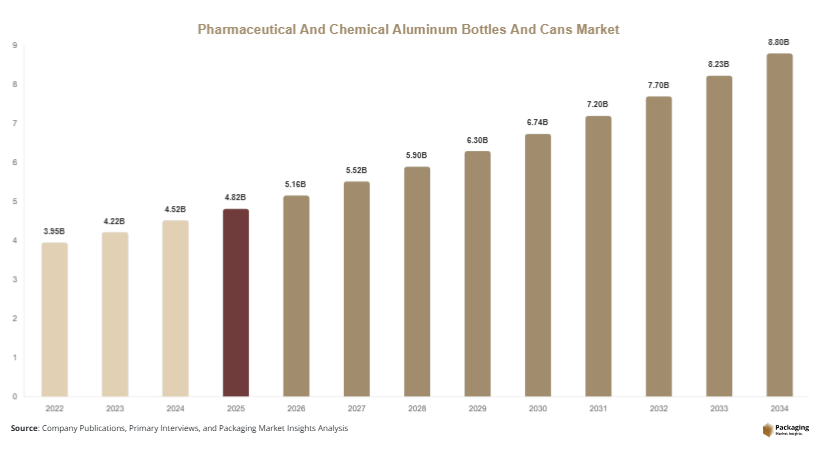
The global pharmaceutical and chemical aluminum bottles and cans market size is estimated at USD 4.82 billion in 2025, increasing to USD 5.16 billion in 2026. By 2034, the market is projected to reach USD 8.91 billion, registering a CAGR of 6.9% (2025–2034). Growth is supported by increasing pharmaceutical production, chemical transportation safety requirements, and rising adoption of sustainable metal packaging formats. The pharmaceutical and chemical aluminum bottles and cans market is witnessing steady expansion driven by rising demand for secure, lightweight, and contamination-resistant packaging solutions across highly regulated end-use industries.
One of the primary growth factors is the expansion of the global pharmaceutical sector, particularly injectable drugs, biologics, and specialty medicines that require high-barrier packaging. Aluminum bottles and cans offer superior protection against light, oxygen, and moisture, making them suitable for sensitive formulations. Another important driver is the tightening of chemical transport regulations, where leakage-proof and corrosion-resistant containers are mandatory for safe logistics. Additionally, sustainability initiatives are accelerating adoption, as aluminum is fully recyclable and aligns with circular economy targets across Europe and North America.
Key Highlights:
- Europe dominated the market with a 36.8% share in 2025.
- Asia Pacific is projected to grow at the fastest CAGR of 8.6% (2025–2034).
- Continuous motion HFFS pouching machines led the machine type segment with a 58.4% share in 2024.
- Food and beverage application dominated the market with a 46.7% share in 2024.
- FMCG end-use industry accounted for a 49.2% share in 2024.
- The US market reached USD 1.35 billion in 2025 and USD 1.46 billion in 2026.
Explore more data points, trends and opportunities Download Free Sample Report
Market Trends
Shift Toward High-Barrier and Specialty Coated Aluminum Packaging
The pharmaceutical and chemical industries are increasingly adopting advanced coated aluminum bottles and cans that provide enhanced barrier protection against oxidation, UV exposure, and chemical corrosion. These coatings improve compatibility with aggressive formulations such as acids, solvents, and biologics. Manufacturers are investing in multilayer internal coatings such as epoxy-phenolic and BPA-free polymer linings to meet regulatory standards. This trend is particularly strong in injectable pharmaceuticals and high-purity chemicals where product stability is critical. The demand is also influenced by extended shelf-life requirements and global distribution of temperature-sensitive drugs. As regulatory frameworks tighten, companies are moving toward premium aluminum packaging solutions that ensure compliance and reduce contamination risks.
Increasing Adoption of Lightweight and Recyclable Metal Packaging
Sustainability concerns are driving a shift toward lightweight aluminum packaging formats in both pharmaceutical and chemical applications. Aluminum is highly recyclable and retains quality even after multiple recycling cycles, making it a preferred material in circular packaging systems. Companies are reducing material thickness while maintaining structural strength, enabling lower transportation costs and reduced carbon footprint. This trend is further supported by ESG compliance requirements and corporate sustainability goals across major pharmaceutical companies. Governments in Europe and North America are encouraging the replacement of plastic and composite packaging with recyclable aluminum alternatives, accelerating adoption across multiple end-use industries.
Market Drivers
Growth in Pharmaceutical Manufacturing and Drug Distribution
The global expansion of pharmaceutical manufacturing is a major driver of the aluminum bottles and cans market. Increasing production of liquid medicines, syrups, injectables, and diagnostic reagents requires secure and contamination-free packaging solutions. Aluminum containers offer superior protection compared to plastic alternatives, particularly for oxygen-sensitive formulations. The rise of contract manufacturing organizations (CMOs) and contract development and manufacturing organizations (CDMOs) has also increased demand for standardized packaging formats. Additionally, global vaccine distribution programs have reinforced the importance of durable and sterile packaging systems, further boosting aluminum bottle adoption in regulated pharmaceutical supply chains.
Rising Demand for Safe Chemical Storage and Transport
The chemical industry is another major contributor to market growth, driven by strict safety regulations and the need for leak-proof packaging. Aluminum bottles and cans are widely used for storing solvents, reagents, laboratory chemicals, and industrial formulations. Their corrosion resistance and ability to withstand pressure variations make them ideal for hazardous materials. Regulatory frameworks such as REACH and OSHA guidelines are pushing manufacturers toward safer and more standardized packaging solutions. As chemical exports increase globally, companies are prioritizing packaging formats that ensure safe cross-border transportation, further supporting demand for aluminum-based containers.
Market Restraint
High Production Costs and Limited Flexibility in Design
Despite strong demand, the market faces constraints due to relatively high production costs associated with aluminum processing, coating, and precision forming. Compared to plastic alternatives, aluminum packaging requires energy-intensive manufacturing processes, increasing overall cost structures. Additionally, customization flexibility is limited, especially for complex bottle shapes and multi-compartment designs. Small and medium-sized pharmaceutical manufacturers often find aluminum packaging economically challenging for low-margin products. In addition, fluctuations in raw aluminum prices can affect supply chain stability and pricing consistency. These factors collectively restrict widespread adoption in cost-sensitive markets and emerging economies.
Market Opportunities
Expansion in Biopharmaceutical and Specialty Drug Packaging
The rapid growth of biopharmaceuticals presents significant opportunities for aluminum bottles and cans. Biologics, vaccines, and specialty injectables require high-barrier packaging to maintain stability and prevent contamination. Aluminum packaging, combined with advanced internal coatings, provides a controlled environment suitable for sensitive molecules. Increasing investment in biologics production across North America, Europe, and Asia Pacific is expected to boost demand. Additionally, the rise of personalized medicine and small-batch drug production is creating new opportunities for customized aluminum packaging formats that ensure safety and compliance.
Growth in Sustainable Industrial Chemical Packaging
Industrial chemical manufacturers are increasingly shifting toward recyclable and reusable packaging systems to meet sustainability targets. Aluminum bottles and cans offer a closed-loop recycling advantage, reducing environmental impact and improving corporate ESG scores. This creates opportunities for packaging companies to develop returnable and refillable aluminum container systems for industrial chemicals. Emerging economies are also adopting stricter environmental policies, pushing chemical manufacturers toward safer and more sustainable packaging solutions. This trend is expected to open new revenue streams for aluminum packaging suppliers.
Report Scope
| Report Metric | Details |
|---|---|
| Market Size in 2025 | USD 4.82 Billion |
| Market Size in 2026 | USD 5.16 Billion |
| Market Size in 2034 | USD 8.91 Billion |
| CAGR | 6.9% (2026-2034) |
| Base Year for Estimation | 2025 |
| Historical Data | 2022-2024 |
| Forecast Period | 2026-2034 |
| Report Coverage | Revenue Forecast, Competitive Landscape, Supply Chain Disruption, Growth Factors, Environment & Regulatory Landscape and Trends |
| Geographies Covered | North America, Europe, APAC, Middle East and Africa, LATAM |
| Countries Covered | U.S., Canada, U.K., Germany, France, Spain, Italy, Russia, Nordic, Benelux, Rest of Europe, China, South Korea, Japan, India, Australia, Singapore, Taiwan, South East Asia, Rest of Asia-Pacific, UAE, Turky, Saudi Arabia, South Africa, Egypt, Nigeria, Rest of MEA, Brazil, Mexico, Argentina, Chile, Colombia, Rest of LATAM |
Explore more data points, trends and opportunities Download Free Sample Report
Segmental Analysis
By Product Type
Aluminum bottles dominated the market with approximately 44.7% share in 2024, owing to their widespread usage in pharmaceutical liquids, syrups, injectables, and laboratory chemical storage. Their high barrier properties against moisture, oxygen, and UV light make them ideal for sensitive formulations. These bottles are extensively used in both pharmaceutical and chemical industries where contamination prevention and product stability are critical requirements. Increasing regulatory pressure for safe and sterile packaging further strengthens demand for aluminum bottles globally.
The fastest-growing subsegment is aluminum aerosol cans, expanding at a CAGR of 7.8% during 2025–2034, driven by increasing demand in pharmaceutical sprays, disinfectants, and industrial chemical aerosols. Growth is supported by rising adoption of portable and easy-to-use dispensing formats. Technological advancements in can design, including precision valves and controlled spray mechanisms, are further accelerating demand. In addition, growing consumer preference for convenient drug delivery systems is supporting long-term expansion of aerosol-based aluminum packaging solutions.
By End-Use Industry
The pharmaceutical industry accounted for the dominant share of 52.1% in 2024, driven by rising production of injectable drugs, vaccines, biologics, and specialty formulations. Aluminum bottles and cans are widely preferred due to their sterile nature, durability, and ability to maintain drug stability during transportation and storage. Increasing global healthcare expenditure and expansion of pharmaceutical manufacturing facilities continue to support strong demand in this segment.
The chemical industry is the fastest-growing end-use segment with a CAGR of 7.2%, driven by increasing demand for safe storage and transportation of hazardous and industrial chemicals. Aluminum packaging provides strong resistance to corrosion and leakage, making it suitable for solvents, reagents, and specialty chemicals. Growing international trade of chemicals and stricter safety regulations are further accelerating adoption. Expansion of industrial manufacturing in Asia Pacific and Middle Eastern countries is also boosting segment growth.
By Capacity
Medium-capacity containers (250 ml – 1 liter) held the largest share of 41.5% in 2024, as they are widely used across pharmaceutical formulations and chemical solutions. These containers offer an optimal balance between storage efficiency and portability, making them suitable for both industrial and healthcare applications. Their versatility across multiple end-use industries ensures consistent demand globally.
The fastest-growing segment is small-capacity containers (below 250 ml), expanding at a CAGR of 7.5%, driven by increasing demand for precision dosing and high-value pharmaceutical formulations. These containers are widely used in specialty drugs, diagnostic reagents, and laboratory chemicals where accurate measurement is critical. Rising adoption of personalized medicine and small-batch drug manufacturing is further accelerating growth in this segment.
Pharmaceutical And Chemical Aluminum Bottles And Cans Market Segmentations
By Product Type
- Aluminum Bottles
- Aluminum Cans
- Aerosol Cans
- Specialty Coated Containers
By Capacity
- Below 250 ml
- 250 ml – 1 Liter
- Above 1 Liter
By End-Use Industry
- Pharmaceutical
- Chemical
- Laboratory & Research
- Industrial Chemicals
- Specialty Chemicals
Regional Analysis
North America
North America accounted for approximately 28.4% share of the global pharmaceutical and chemical aluminum bottles and cans market in 2025, supported by strong pharmaceutical manufacturing capacity and advanced chemical processing industries. The region is projected to grow at a CAGR of 6.3% during 2025–2034, driven by increasing demand for high-barrier, contamination-free packaging solutions. The presence of large-scale pharmaceutical companies and strict regulatory frameworks such as FDA packaging compliance standards significantly boosts adoption of aluminum bottles and cans in this region.
The United States dominates the North American market due to its highly developed pharmaceutical ecosystem and extensive chemical production base. A key growth factor is the rising investment in biologics, injectable drugs, and vaccine manufacturing, all of which require sterile and inert packaging formats. Additionally, increasing focus on sustainable packaging and recycling infrastructure is encouraging manufacturers to adopt aluminum-based solutions over plastic alternatives. Canada also contributes steadily, supported by growing pharmaceutical imports and expanding chemical distribution networks.
Europe
Europe held the largest regional share of 31.2% in 2025, making it a key hub for the pharmaceutical and chemical aluminum bottles and cans market. The region is expected to grow at a CAGR of 6.7% between 2025 and 2034, driven by strict environmental regulations and strong demand for sustainable packaging materials. The European Union’s circular economy policies and packaging waste directives are pushing industries toward recyclable aluminum solutions.
Germany leads the European market due to its robust pharmaceutical manufacturing base and advanced chemical industry infrastructure. A major growth factor is the increasing adoption of eco-friendly packaging mandated by EU sustainability regulations. France, the UK, and Italy also contribute significantly, supported by strong pharmaceutical exports and growing investments in specialty drug production. The shift toward high-barrier, lightweight packaging is further strengthening aluminum bottle and can adoption across the region.
Asia Pacific
Asia Pacific is the fastest-growing regional market, with a projected CAGR of 8.1% during 2025–2034, and accounted for 25.6% share in 2025. Rapid industrialization, expansion of pharmaceutical manufacturing, and rising chemical exports are key drivers of market growth in this region. Increasing healthcare demand and cost-efficient production capabilities are also attracting global pharmaceutical companies to establish manufacturing bases in Asia Pacific.
China dominates the regional market due to its large-scale pharmaceutical production and strong chemical manufacturing ecosystem. A key growth factor is government investment in healthcare infrastructure and domestic drug production capabilities. India also plays a significant role, supported by its expanding generic drug industry and increasing export of pharmaceutical formulations. Additionally, Japan and South Korea contribute through advanced chemical research and high-quality pharmaceutical packaging demand, further strengthening regional market expansion.
Middle East & Africa
The Middle East & Africa accounted for approximately 8.3% share of the global market in 2025, with a projected CAGR of 5.9% during 2025–2034. Growth in this region is supported by increasing chemical production activities, rising pharmaceutical imports, and gradual industrial diversification efforts. Governments in several Gulf countries are investing in healthcare infrastructure and local manufacturing capabilities, which is gradually increasing demand for aluminum packaging solutions.
Saudi Arabia leads the regional market due to its expanding petrochemical industry and strong government-led industrial development programs under Vision initiatives. A key growth factor is the increasing focus on reducing dependency on imports by developing domestic pharmaceutical production capabilities. The United Arab Emirates also contributes through its logistics and re-export pharmaceutical trade hub, while South Africa drives demand through its growing healthcare sector and chemical distribution networks.
Latin America
Latin America held a 6.5% market share in 2025, with a projected CAGR of 5.7% through 2034, driven by growing pharmaceutical consumption and expanding chemical distribution infrastructure. The region is gradually increasing its adoption of aluminum packaging due to improved regulatory standards and rising awareness of product safety and contamination prevention.
Brazil dominates the Latin American market due to its strong pharmaceutical consumption base and growing chemical manufacturing sector. A key growth factor is the expansion of domestic pharmaceutical production and increasing government support for healthcare accessibility. Mexico also contributes significantly due to its proximity to North American supply chains and increasing participation in global pharmaceutical exports. Argentina shows steady growth supported by rising chemical imports and industrial development initiatives.
Competitive Landscape
The pharmaceutical and chemical aluminum bottles and cans market is moderately consolidated, with key players focusing on capacity expansion, coating innovation, and sustainability initiatives. Leading companies include Ball Corporation, Crown Holdings Inc., Silgan Holdings Inc., TUBEX Group, and Tecnocap Group. These companies compete on product quality, regulatory compliance, and global distribution networks.
Among them, Ball Corporation remains a dominant player due to its extensive aluminum packaging portfolio and strong global presence. The company has recently expanded its pharmaceutical-grade aluminum packaging production facilities in Europe to meet rising demand for sterile packaging solutions. Investments in low-carbon aluminum production further strengthen its market position.
Key Players List
- Ball Corporation
- Crown Holdings Inc.
- Silgan Holdings Inc.
- TUBEX Group
- Tecnocap Group
- CCL Container
- Ardagh Group
- BWAY Corporation
- Bharat Containers
- Nampak Ltd.
- Graham Packaging Company
- Alucan Packaging
- Montebello Packaging
- Envases Group
- Guala Closures Group