Pharma Blister Packaging Machines Market Size and Growth
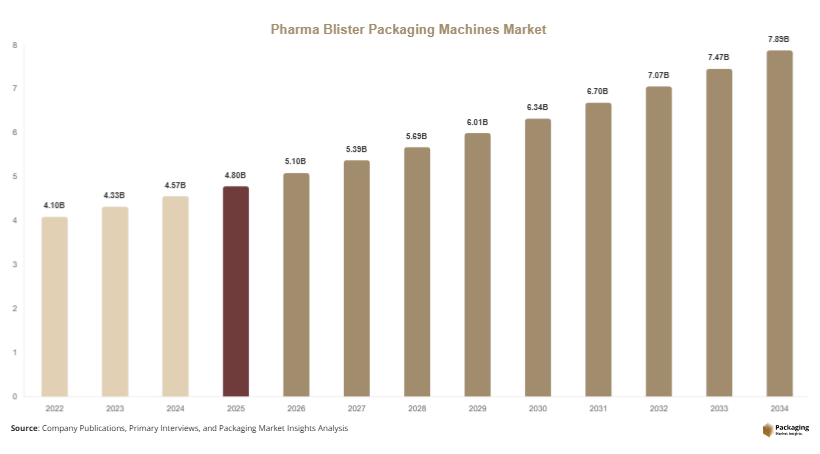
The global pharma blister packaging machines market was valued at USD 4.8 billion in 2025 and is estimated to reach USD 5.1 billion in 2026. The market is projected to reach USD 8.3 billion by 2034, expanding at a CAGR of 5.6% during the forecast period from 2025 to 2034. The market is experiencing consistent growth due to rising pharmaceutical production, increasing demand for unit-dose packaging, and growing regulatory emphasis on product safety and traceability. Pharma blister packaging machines are widely used for packaging tablets, capsules, lozenges, and medical devices in secure and contamination-resistant blister packs.
The pharmaceutical industry continues to adopt automated blister packaging systems to improve operational efficiency, reduce packaging errors, and enhance production speed. Rising global demand for prescription drugs, over-the-counter medications, and nutraceutical products is creating strong demand for high-capacity blister packaging equipment. Pharmaceutical manufacturers are increasingly investing in advanced packaging technologies that ensure precise dosage control and improved patient compliance.
Key Market Insights
- Asia Pacific dominated the market with a 39.8% share in 2025.
- Latin America is projected to grow at the fastest CAGR of 6.3%.
- Automatic blister packaging machines led the type segment with a 47.2% share.
- Aluminum-based blister materials dominated with a 44.9% share.
- Pharmaceutical manufacturing applications led the end-use segment with 52.6% share.
- The US remained the dominant country in North America with a market size of USD 1.1 billion in 2025 and USD 1.2 billion in 2026.
Explore more data points, trends and opportunities Download Free Sample Report
Market Trends
Integration of Smart Automation and Vision Inspection Systems
The pharma blister packaging machines market is increasingly witnessing the integration of smart automation technologies and vision inspection systems within pharmaceutical packaging lines. Pharmaceutical companies are focusing on reducing packaging defects, improving compliance, and increasing operational efficiency through automated packaging systems capable of real-time monitoring and quality control.
Advanced blister packaging machines now include AI-based inspection cameras, robotic feeding units, barcode verification systems, and automated rejection technologies that improve packaging accuracy and reduce human intervention. These technologies help manufacturers comply with strict pharmaceutical packaging regulations while improving production consistency.
For example, several pharmaceutical manufacturers in Europe and North America are implementing Industry 4.0-enabled blister packaging systems capable of predictive maintenance and digital process tracking. This trend is expected to strengthen as pharmaceutical companies increasingly prioritize automation to reduce labor costs and improve packaging reliability. Future demand for intelligent blister packaging machines is likely to increase significantly with the expansion of personalized medicine and small-batch pharmaceutical production.
Rising Adoption of Sustainable Blister Packaging Solutions
Sustainability has become an important trend influencing the pharma blister packaging machines market. Pharmaceutical companies are increasingly adopting recyclable blister materials and eco-friendly packaging formats to comply with environmental regulations and corporate sustainability goals. This shift is driving demand for blister packaging machines compatible with recyclable polymers, mono-material structures, and reduced plastic packaging solutions.
Machine manufacturers are developing advanced systems capable of processing biodegradable blister films and recyclable aluminum materials without compromising packaging efficiency. Several pharmaceutical packaging suppliers are also investing in low-energy thermoforming technologies designed to reduce material waste and operational energy consumption.
For instance, pharmaceutical companies across Germany, Japan, and the United States are introducing sustainable blister packs for over-the-counter medications and nutraceutical products. Over the forecast period, stricter environmental regulations and rising consumer preference for sustainable healthcare packaging are expected to accelerate adoption of eco-compatible blister packaging machinery worldwide.
Market Drivers
Increasing Pharmaceutical Production and Generic Drug Demand
The growing pharmaceutical manufacturing industry is a major factor driving the pharma blister packaging machines market. Rising demand for generic medicines, over-the-counter drugs, and specialty pharmaceuticals is increasing the need for efficient and high-speed packaging systems capable of supporting large-scale production operations.
Blister packaging is widely preferred in the pharmaceutical industry because it offers product protection, dosage accuracy, moisture resistance, and improved patient convenience. Pharmaceutical companies are increasingly investing in automated blister packaging lines to improve operational productivity and meet rising global medicine demand.
Countries such as India and China are rapidly expanding pharmaceutical manufacturing capacities to support domestic healthcare requirements and international exports. Several contract manufacturing organizations are additionally upgrading packaging facilities with advanced blister packaging systems to improve production efficiency. The expansion of global pharmaceutical supply chains and increasing demand for affordable medicines continue to create strong growth opportunities for blister packaging machine manufacturers.
Regulatory Focus on Product Safety and Anti-Counterfeiting
Strict pharmaceutical packaging regulations and growing concerns regarding counterfeit medicines are significantly supporting market growth. Regulatory authorities across North America, Europe, and Asia Pacific are implementing serialization, traceability, and tamper-evident packaging requirements to improve pharmaceutical supply chain security.
Blister packaging machines equipped with digital coding, track-and-trace systems, and automated inspection technologies help pharmaceutical companies comply with regulatory standards while protecting product integrity. The ability of blister packs to provide individual dose protection and visible tamper evidence further supports their widespread adoption across pharmaceutical applications.
For example, pharmaceutical manufacturers in the United States and Europe are integrating serialization technologies into blister packaging systems to comply with evolving drug safety regulations. The increasing use of smart packaging technologies and digital verification systems is expected to strengthen long-term demand for advanced pharmaceutical blister packaging machinery.
Market Restraint
High Initial Investment and Maintenance Costs
High equipment investment and operational maintenance costs remain major restraints for the pharma blister packaging machines market. Advanced automatic blister packaging systems integrated with robotic handling, digital inspection technologies, and serialization modules require significant capital expenditure. Small and medium-sized pharmaceutical manufacturers often face financial challenges when upgrading existing packaging infrastructure with modern automated systems.
In addition to equipment costs, pharmaceutical companies must invest in operator training, machine validation, software integration, and regular maintenance to ensure compliance with strict regulatory standards. Production downtime associated with equipment calibration and maintenance can also increase operational expenses.
For example, pharmaceutical manufacturers in developing economies may continue relying on semi-automatic blister packaging systems due to limited capital availability. Frequent technological upgrades and changing regulatory requirements further increase operational complexity for packaging companies. Additionally, fluctuations in raw material prices for aluminum foils and polymer films can impact packaging economics and delay investment decisions among cost-sensitive pharmaceutical manufacturers.
These factors may slow the adoption of advanced blister packaging technologies in smaller pharmaceutical facilities despite growing industry demand for automation and regulatory compliance.
Market Opportunities
Expansion of Contract Pharmaceutical Manufacturing
The rapid expansion of contract pharmaceutical manufacturing organizations presents major growth opportunities for the pharma blister packaging machines market. Pharmaceutical companies are increasingly outsourcing packaging operations to contract manufacturers to reduce operational costs and improve production flexibility.
Contract packaging providers require high-speed and versatile blister packaging machines capable of handling multiple drug formats, batch sizes, and packaging materials. This trend is driving demand for modular and automated blister packaging systems designed for flexible pharmaceutical production environments.
Several contract manufacturing facilities in India, China, and Eastern Europe are investing in modern blister packaging equipment to support export-oriented pharmaceutical production. Future opportunities are expected in biologics, nutraceuticals, and personalized medicine packaging applications where flexible packaging systems are increasingly required. Manufacturers Growth in Personalized Medicine and Small-Batch Drug Packaging
The growing adoption of personalized medicine and specialty pharmaceuticals is creating new opportunities for advanced blister packaging systems. Personalized drug therapies often require smaller production batches, specialized dosage formats, and customized packaging solutions to improve patient adherence and treatment accuracy.
Pharmaceutical companies are increasingly investing in compact and flexible blister packaging machines capable of supporting low-volume and high-precision packaging operations. Machines integrated with digital printing, variable data coding, and automated inspection systems are becoming important for customized pharmaceutical packaging applications.
Healthcare providers and pharmaceutical companies across North America and Europe are expanding precision medicine programs for oncology, rare diseases, and chronic disease management. Future demand for intelligent blister packaging systems is expected to rise as pharmaceutical companies continue shifting toward patient-specific therapies and digitally monitored healthcare solutions.
Report Scope
| Report Metric | Details |
|---|---|
| Market Size in 2025 | USD 4.8 Billion |
| Market Size in 2026 | USD 5.1 Billion |
| Market Size in 2034 | USD 8.3 Billion |
| CAGR | 5.6% (2026-2034) |
| Base Year for Estimation | 2025 |
| Historical Data | 2022-2024 |
| Forecast Period | 2026-2034 |
| Report Coverage | Revenue Forecast, Competitive Landscape, Supply Chain Disruption, Growth Factors, Environment & Regulatory Landscape and Trends |
| Geographies Covered | North America, Europe, APAC, Middle East and Africa, LATAM |
| Countries Covered | U.S., Canada, U.K., Germany, France, Spain, Italy, Russia, Nordic, Benelux, Rest of Europe, China, South Korea, Japan, India, Australia, Singapore, Taiwan, South East Asia, Rest of Asia-Pacific, UAE, Turky, Saudi Arabia, South Africa, Egypt, Nigeria, Rest of MEA, Brazil, Mexico, Argentina, Chile, Colombia, Rest of LATAM |
Explore more data points, trends and opportunities Download Free Sample Report
Segmental Analysis
By Type
Automatic blister packaging machines dominated the pharma blister packaging machines market in 2024 with a market share of 47.2%. These machines are widely preferred because they provide high-speed production, improved operational efficiency, reduced labor dependency, and better packaging accuracy. Pharmaceutical manufacturers are increasingly adopting automatic systems capable of handling large-scale tablet and capsule packaging operations while maintaining strict quality standards. Automatic machines integrated with vision inspection systems, digital controls, and robotic feeding technologies help pharmaceutical companies improve productivity and reduce packaging errors. Several pharmaceutical production facilities across North America and Europe are replacing older semi-automatic systems with fully automated blister packaging lines to improve manufacturing efficiency and regulatory compliance. The increasing demand for large-volume pharmaceutical production and rising investments in smart factory infrastructure continue supporting segment dominance across global pharmaceutical packaging operations.
Robotic blister packaging machines are projected to witness the fastest CAGR of 6.8% during the forecast period due to increasing adoption of advanced automation technologies in pharmaceutical manufacturing. Robotic systems provide improved flexibility, precision handling, and faster changeover capabilities compared to conventional packaging systems. Pharmaceutical companies are increasingly integrating robotic blister packaging machines into production lines to support personalized medicine packaging and small-batch manufacturing requirements. These systems also reduce manual intervention and improve contamination control within pharmaceutical packaging environments. Several pharmaceutical manufacturers in Japan, Germany, and the United States are adopting collaborative robotic systems integrated with AI-based quality inspection technologies. Future demand is expected to rise significantly as pharmaceutical production facilities continue focusing on intelligent automation and digitally connected manufacturing environments.
By Material
Aluminum-based blister materials accounted for the largest market share of 44.9% in 2024 due to their superior barrier protection, moisture resistance, and product safety characteristics. Aluminum blister packaging is extensively used for pharmaceutical products requiring extended shelf life and protection from environmental exposure. Pharmaceutical manufacturers widely prefer aluminum-based blister materials for sensitive drugs, capsules, and specialty medicines because they provide strong protection against oxygen, humidity, and contamination. Several global pharmaceutical companies continue investing in cold-form aluminum blister packaging systems for export-oriented drug production and long-term storage applications. The increasing demand for secure and tamper-evident pharmaceutical packaging solutions is also supporting the continued dominance of aluminum blister materials. Growing pharmaceutical exports across Asia Pacific and Europe further strengthen demand for advanced aluminum-compatible blister packaging machinery.
Recyclable polymer materials are expected to register the fastest CAGR of 6.1% through 2034 due to increasing sustainability initiatives within the pharmaceutical packaging industry. Pharmaceutical companies are increasingly adopting recyclable blister materials to reduce plastic waste and comply with environmental regulations. Machine manufacturers are developing advanced blister packaging systems capable of processing eco-friendly polymer films without reducing packaging efficiency or product protection. Several healthcare packaging companies across Europe and North America are introducing mono-material blister packaging formats designed for easier recycling and reduced environmental impact. Future growth opportunities are expected in over-the-counter medicines, nutraceuticals, and consumer healthcare products where sustainable packaging demand continues increasing. Investments in bio-based and recyclable blister film technologies are likely to accelerate segment growth over the forecast period.
By End-Use
Pharmaceutical manufacturing applications dominated the pharma blister packaging machines market in 2024 with a market share of 52.6%. Pharmaceutical manufacturers remain the largest end users of blister packaging machinery due to increasing global medicine production and rising demand for secure dosage packaging solutions. Blister packaging systems are extensively used for tablets, capsules, and unit-dose pharmaceutical products because they improve patient safety, dosage accuracy, and product shelf life. Pharmaceutical companies across North America, Europe, and Asia Pacific are investing heavily in automated packaging infrastructure to improve production efficiency and regulatory compliance. The increasing adoption of serialization, tamper-evident packaging, and digital traceability systems is also supporting segment growth. Large pharmaceutical manufacturers are increasingly integrating intelligent blister packaging lines with automated inspection and coding technologies to improve packaging consistency and supply chain visibility.
Contract packaging services are expected to grow at the fastest CAGR of 6.5% during the forecast period due to increasing outsourcing of pharmaceutical packaging operations. Pharmaceutical companies are increasingly partnering with contract packaging providers to reduce operational costs and improve production flexibility. Contract packaging facilities require versatile blister packaging systems capable of handling multiple product formats, packaging materials, and regulatory requirements. Several contract packaging organizations in India, China, Brazil, and Eastern Europe are investing in high-speed blister packaging machinery to support growing pharmaceutical export activities. Future opportunities are expected in specialty pharmaceuticals, biologics, and personalized medicine packaging applications requiring flexible production systems. The expansion of global pharmaceutical outsourcing trends is likely to create sustained demand for advanced blister packaging equipment worldwide.
Pharma Blister Packaging Machines Market Segmentations
By Type
- Automatic Blister Packaging Machines
- Semi-Automatic Blister Packaging Machines
- Robotic Blister Packaging Machines
By Material
- Aluminum-Based Blister Materials
- Plastic Films
- Recyclable Polymer Materials
By End-User
- Pharmaceutical Manufacturing
- Contract Packaging Services
- Nutraceutical Packaging
- Medical Device Packaging
- Consumer Healthcare Packaging
Regional Analysis
North America
North America accounted for 27.1% of the global pharma blister packaging machines market share in 2025 and is projected to grow at a CAGR of 5.2% through 2034. The region benefits from strong pharmaceutical manufacturing infrastructure, increasing healthcare expenditure, and widespread adoption of automated packaging technologies. Pharmaceutical companies across the United States and Canada are investing heavily in high-speed blister packaging systems to improve production efficiency and regulatory compliance. Rising demand for prescription drugs, specialty medicines, and over-the-counter pharmaceutical products continues to support market growth. The presence of major pharmaceutical manufacturers and packaging technology suppliers also contributes to continuous technological innovation within the regional market.
The United States remained the dominant country within North America due to its advanced pharmaceutical production capabilities and strong regulatory framework. One major growth driver is the increasing implementation of serialization and track-and-trace systems for pharmaceutical packaging. Drug manufacturers are integrating digital verification technologies into blister packaging operations to comply with evolving supply chain security regulations. Several U.S.-based pharmaceutical facilities are additionally investing in robotic blister packaging systems to reduce labor dependency and improve packaging precision. Canada is also witnessing rising adoption of sustainable blister packaging materials across healthcare product manufacturing operations.
Europe
Europe represented 24.3% of the global pharma blister packaging machines market share in 2025 and is expected to expand at a CAGR of 5.4% during the forecast period. The region continues to benefit from strong pharmaceutical exports, strict product safety regulations, and increasing demand for sustainable healthcare packaging solutions. Pharmaceutical companies across Germany, France, Italy, and the United Kingdom are investing in advanced blister packaging technologies designed to improve operational efficiency and reduce packaging waste.
Germany emerged as the dominant country in Europe because of its strong pharmaceutical machinery manufacturing industry and growing focus on Industry 4.0 automation. One unique growth driver is the increasing adoption of recyclable blister packaging materials in pharmaceutical applications. German pharmaceutical manufacturers are collaborating with machine suppliers to develop blister packaging systems compatible with sustainable packaging materials. France and the United Kingdom are additionally witnessing increased investments in automated packaging lines supporting biologics and specialty pharmaceutical production. The region’s strong emphasis on environmental compliance and pharmaceutical product quality continues supporting long-term market growth.
Asia Pacific
Asia Pacific dominated the pharma blister packaging machines market with a 39.8% share in 2025 and is projected to expand at a CAGR of 6.0% through 2034. Rapid pharmaceutical manufacturing expansion, rising healthcare spending, and growing generic drug exports are major factors supporting regional growth. Countries such as China, India, Japan, and South Korea are significantly increasing investments in pharmaceutical production infrastructure and packaging automation technologies.
China remained the leading country within the regional market due to its extensive pharmaceutical manufacturing base and export-oriented production facilities. One important growth driver is the rapid expansion of contract pharmaceutical manufacturing operations requiring high-speed blister packaging systems. Chinese pharmaceutical companies are increasingly adopting automated packaging lines integrated with quality inspection technologies to improve production efficiency and international compliance standards. India is also emerging as a major market because of its growing generic medicine industry and expanding pharmaceutical export activities. Southeast Asian countries continue witnessing rising demand for compact blister packaging systems used in regional pharmaceutical manufacturing facilities.
Middle East & Africa
The Middle East & Africa accounted for 4.8% of the global pharma blister packaging machines market share in 2025 and is forecast to grow at a CAGR of 5.5% during the study period. Rising healthcare investments, expanding pharmaceutical manufacturing activities, and increasing government focus on domestic medicine production are contributing to regional market growth. Several countries across the Gulf region are investing in pharmaceutical industrial zones and healthcare infrastructure modernization programs.
Saudi Arabia remained the dominant market within the region because of increasing pharmaceutical localization initiatives and healthcare sector expansion. One major growth driver is the establishment of local pharmaceutical manufacturing facilities aimed at reducing import dependency. Pharmaceutical companies in the country are investing in modern blister packaging technologies to improve product safety and manufacturing efficiency. The United Arab Emirates is additionally supporting regional demand through investments in healthcare packaging automation and pharmaceutical logistics infrastructure. South Africa continues witnessing steady adoption of blister packaging machinery across regional pharmaceutical production operations.
Latin America
Latin America held 4.0% of the global pharma blister packaging machines market share in 2025 and is expected to register the fastest CAGR of 6.3% through 2034. The market is benefiting from increasing pharmaceutical production, expanding healthcare access, and rising investments in packaging modernization projects across Brazil, Mexico, Argentina, and Colombia. Pharmaceutical companies in the region are increasingly adopting automated blister packaging systems to improve production quality and support export activities.
Brazil emerged as the dominant market within Latin America due to strong pharmaceutical industry expansion and increasing demand for generic medicines. One important growth driver is the rising investment in regional pharmaceutical packaging facilities supporting domestic healthcare demand. Brazilian pharmaceutical manufacturers are upgrading packaging lines with automated blister packaging systems integrated with inspection and coding technologies. Mexico is additionally witnessing strong growth in contract pharmaceutical manufacturing and packaging outsourcing services. Government healthcare expansion programs and rising medicine consumption continue supporting long-term regional market growth.
Competitive Landscape
The pharma blister packaging machines market is moderately competitive with the presence of global pharmaceutical packaging equipment manufacturers focusing on automation, digital inspection technologies, and sustainable packaging solutions. Companies are increasingly investing in smart packaging technologies, modular machine designs, and high-speed production systems to strengthen their market position.
IMA Group is considered a leading company within the market due to its extensive pharmaceutical packaging machinery portfolio and strong global distribution network. The company continues investing in automated blister packaging systems integrated with digital monitoring and serialization technologies.
Uhlmann Group focuses on intelligent blister packaging systems designed for pharmaceutical production flexibility and compliance. Marchesini Group is expanding its automated packaging equipment portfolio for contract pharmaceutical manufacturing applications. Romaco Group continues investing in sustainable blister packaging technologies compatible with recyclable materials. ACG Worldwide is strengthening its market presence through pharmaceutical packaging automation and integrated inspection technologies.
Manufacturers are increasingly collaborating with pharmaceutical companies and contract packaging providers to develop customized blister packaging solutions for high-volume and personalized medicine applications.
Key Players List
- IMA Group
- Uhlmann Group
- Marchesini Group
- Romaco Group
- ACG Worldwide
- Syntegon Technology
- Hoonga Co., Ltd.
- Mediseal GmbH
- CAM Packaging Systems
- Jornen Machinery
- Zhejiang Hoping Machinery
- Aylward Enterprises
- Hamer Packaging Technology
- Sepha Ltd.
- Körber AG