Pfas Free Food Packaging Market Size and Growth
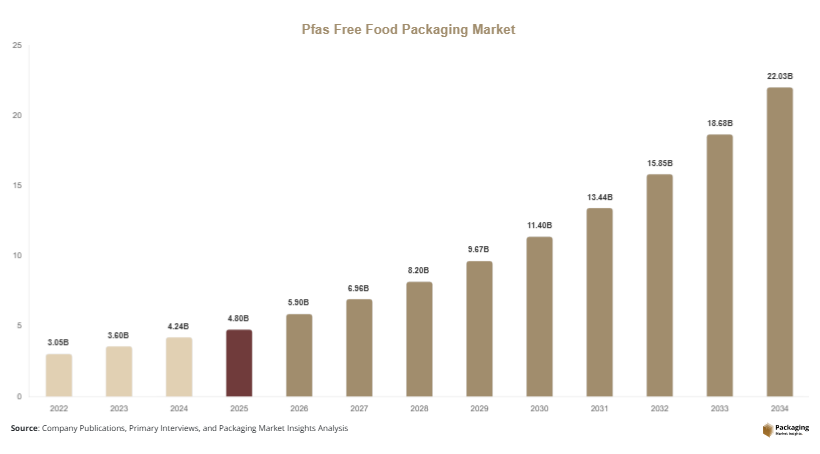
The Pfas free food packaging market size is estimated at USD 4.8 billion in 2025 and is expected to reach USD 5.9 billion in 2026. With increasing regulatory bans and consumer awareness, the market is projected to reach USD 22.4 billion by 2034, expanding at a CAGR of 17.9% during the forecast period (2025–2034). The Pfas free food packaging market is witnessing strong growth as regulatory bodies and consumers increasingly focus on eliminating harmful chemicals from food contact materials. PFAS (per- and polyfluoroalkyl substances) have been widely used in food packaging for their grease and water resistance properties. However, due to growing concerns about their persistence in the environment and potential health risks, industries are transitioning toward PFAS-free alternatives.
One of the primary growth factors is the rising regulatory pressure to eliminate PFAS from food packaging. Governments across North America and Europe are implementing strict guidelines and bans on the use of PFAS in food contact materials. These regulations are compelling manufacturers to adopt safer and compliant alternatives, driving market growth.
Key Highlights:
- Market size is projected to reach USD 22.4 billion by 2034, reflecting steady growth driven by the shift toward safer food packaging materials. Increasing industry focus on eliminating harmful chemicals is supporting long-term expansion.
- The market is expected to grow at a CAGR of 17.9% from 2025 to 2034, indicating strong adoption across food and packaging industries. Continuous investments in sustainable materials are further strengthening this growth trend.
- There is an increase in regulatory bans on PFAS usage as governments aim to protect public health and the environment. These regulations are pushing manufacturers to transition toward compliant packaging solutions.
- Rising consumer demand for safe food packaging is influencing companies to adopt PFAS-free materials. Consumers are becoming more aware of health risks and are prioritizing non-toxic packaging options.
- Advancements in alternative barrier technologies are improving the performance of PFAS-free packaging solutions. Innovations in coatings and biodegradable materials are enhancing durability and functionality.
Explore more data points, trends and opportunities Download Free Sample Report
Market Trends
Shift Toward Plant-Based and Biodegradable Barrier Coatings
A major trend in the Pfas free food packaging market is the increasing adoption of plant-based and biodegradable barrier coatings. Manufacturers are replacing PFAS with alternatives such as starch-based coatings, cellulose films, and bio-wax solutions. These materials provide adequate resistance to grease and moisture while being environmentally friendly. Food service providers and quick-service restaurants are actively adopting these solutions to comply with regulations and meet sustainability goals. Continuous research and development are improving the performance of these coatings, making them suitable for a wide range of food packaging applications.
Growing Adoption of Compostable Food Packaging Solutions
Another notable trend is the rising demand for compostable food packaging solutions. PFAS-free packaging materials that can decompose under industrial or home composting conditions are gaining popularity. These solutions are particularly relevant in the food delivery and takeaway segments, where packaging waste is significant. Companies are introducing compostable containers, wraps, and trays made from renewable resources. This trend is supported by increasing investments in composting infrastructure and growing consumer awareness about waste management.
Market Drivers
Stringent Government Regulations on PFAS Usage
Strict government regulations aimed at reducing the use of PFAS in food packaging are a key driver of the market. Regulatory bodies are implementing bans and restrictions to protect public health and the environment. These regulations are forcing manufacturers to adopt PFAS-free alternatives, accelerating market growth. Companies are investing in research and development to develop compliant packaging solutions that meet performance requirements. The enforcement of these regulations is expected to drive the adoption of PFAS-free packaging across various industries.
Rising Demand for Safe and Non-Toxic Packaging Materials
The increasing demand for safe and non-toxic packaging materials is another major driver of the market. Consumers are becoming more aware of the potential health risks associated with PFAS, leading to a shift toward safer alternatives. Food brands are responding to this demand by adopting PFAS-free packaging solutions. This trend is particularly strong in the organic and premium food segments, where consumers prioritize health and sustainability. The growing emphasis on food safety is driving the adoption of PFAS-free packaging materials.
Market Restraint
Performance Limitations of PFAS-Free Alternatives
One of the key challenges in the Pfas free food packaging market is the performance limitations of PFAS-free alternatives. While significant progress has been made in developing alternative materials, some solutions may not offer the same level of grease and moisture resistance as PFAS-based coatings. This can impact the functionality and shelf life of packaged food products. For example, certain biodegradable coatings may struggle to maintain performance under high-temperature or high-moisture conditions. These limitations can lead to increased costs and operational challenges for manufacturers. Addressing these issues requires ongoing research and innovation, which can slow down market adoption.
Market Opportunities
Expansion in Food Delivery and Takeaway Packaging
The rapid growth of food delivery and takeaway services presents significant opportunities for the Pfas free food packaging market. These services generate large volumes of packaging waste, creating a need for sustainable and safe packaging solutions. PFAS-free materials are increasingly being used in containers, wraps, and trays for food delivery applications. Companies are focusing on developing packaging solutions that offer both performance and sustainability, driving market growth.
Innovation in Water-Based and Bio-Coating Technologies
Advancements in water-based and bio-coating technologies offer promising opportunities for the market. These technologies provide effective barrier properties without the use of harmful chemicals. Manufacturers are investing in research and development to improve the performance and cost efficiency of these coatings. As these technologies become more advanced, the adoption of PFAS-free packaging solutions is expected to increase significantly.
Report Scope
| Report Metric | Details |
|---|---|
| Market Size in 2025 | USD 4.8 Billion |
| Market Size in 2026 | USD 5.9 Billion |
| Market Size in 2034 | USD 22.4 Billion |
| CAGR | 17.9% (2026-2034) |
| Base Year for Estimation | 2025 |
| Historical Data | 2022-2024 |
| Forecast Period | 2026-2034 |
| Report Coverage | Revenue Forecast, Competitive Landscape, Supply Chain Disruption, Growth Factors, Environment & Regulatory Landscape and Trends |
| Geographies Covered | North America, Europe, APAC, Middle East and Africa, LATAM |
| Countries Covered | U.S., Canada, U.K., Germany, France, Spain, Italy, Russia, Nordic, Benelux, Rest of Europe, China, South Korea, Japan, India, Australia, Singapore, Taiwan, South East Asia, Rest of Asia-Pacific, UAE, Turky, Saudi Arabia, South Africa, Egypt, Nigeria, Rest of MEA, Brazil, Mexico, Argentina, Chile, Colombia, Rest of LATAM |
Explore more data points, trends and opportunities Download Free Sample Report
Segmental Analysis
By Material Type
The paper and paperboard segment dominated the market in 2024, accounting for approximately 47% of the total share. These materials are widely used due to their recyclability and compatibility with PFAS-free coatings. Food service providers are increasingly adopting paper-based packaging for items such as wraps, containers, and trays. The growing demand for sustainable packaging solutions is driving the adoption of this segment. Additionally, advancements in coating technologies are enhancing the barrier properties of paper-based materials, making them suitable for various food applications.
The bioplastics segment is expected to be the fastest-growing, with a CAGR of 18.8% during the forecast period. Bioplastics offer biodegradability and flexibility, making them suitable for a wide range of food packaging applications. The growth of this segment is driven by increasing demand for compostable packaging solutions. Innovations in biopolymer technology are improving the performance and cost efficiency of bioplastics, supporting their adoption in the market.
By Application
The food service packaging segment held the largest market share of approximately 45% in 2024. The high volume of packaging used in restaurants, cafes, and takeaway services is driving demand for PFAS-free solutions. Companies are adopting alternative materials to comply with regulations and meet consumer expectations. The growing trend of food delivery services is further supporting the growth of this segment.
The retail food packaging segment is expected to grow at the highest CAGR of 18.3% during the forecast period. The increasing demand for packaged food products is driving the adoption of PFAS-free packaging in retail. Food manufacturers are focusing on safe and sustainable packaging solutions to enhance product appeal and meet regulatory requirements.
By End-Use Industry
The food and beverage industry dominated the market in 2024, accounting for around 52% of the total share. The need for safe and compliant packaging solutions is driving the adoption of PFAS-free materials in this sector. Companies are using these solutions to ensure food safety and reduce environmental impact.
The quick-service restaurant segment is expected to be the fastest-growing, with a CAGR of 19.1% during the forecast period. The increasing demand for takeaway and delivery services is driving the adoption of PFAS-free packaging solutions. Restaurants are focusing on sustainable packaging to enhance their brand image and meet regulatory requirements.
Pfas Free Food Packaging Market Segmentations
By Material Type
- Paper & Paperboard
- Bioplastics
- Molded Fiber
- Other Materials
By Application
- Food Service Packaging
- Retail Food Packaging
- Takeaway Packaging
- Frozen Food Packaging
By End-Use Industry
- Food & Beverage
- Quick-Service Restaurants
- Catering Services
- Hospitality Industry
Regional Analysis
North America
North America accounted for approximately 34% of the global Pfas free food packaging market share in 2025 and is projected to grow at a CAGR of 17.1% during the forecast period. The region benefits from strong regulatory frameworks and high consumer awareness regarding food safety and environmental issues. The presence of major food and packaging companies is also contributing to market growth.
The United States dominates the regional market, driven by strict regulations on PFAS usage and increasing demand for sustainable packaging solutions. A unique growth factor is the rapid adoption of PFAS-free packaging in the food service industry, particularly among quick-service restaurants and food delivery platforms.
Europe
Europe held around 30% of the market share in 2025 and is expected to grow at a CAGR of 17.5%. The region’s stringent environmental policies and focus on sustainability are key drivers of market growth. Governments are actively promoting the use of PFAS-free materials in food packaging.
Germany is the leading country in Europe, supported by its strong manufacturing sector and commitment to sustainability. A unique growth factor is the integration of PFAS-free packaging with circular economy initiatives, enabling efficient recycling and waste management.
Asia Pacific
Asia Pacific accounted for approximately 23% of the market share in 2025 and is expected to grow at the fastest CAGR of 19.6%. Rapid urbanization, increasing disposable income, and growing awareness of food safety are driving demand for PFAS-free packaging in the region.
China dominates the Asia Pacific market due to its large food processing industry and increasing regulatory focus on food safety. A key growth factor is the adoption of PFAS-free packaging solutions by food exporters to meet international standards.
Middle East & Africa
The Middle East & Africa region held a market share of around 7% in 2025 and is projected to grow at a CAGR of 16.4%. The market is driven by increasing awareness of food safety and environmental sustainability.
The United Arab Emirates is a leading country in this region, with growing adoption of PFAS-free packaging solutions. A unique growth factor is the increasing demand for sustainable packaging in the hospitality and tourism sectors.
Latin America
Latin America accounted for approximately 6% of the market share in 2025 and is expected to grow at a CAGR of 16.9%. The region is witnessing increasing adoption of sustainable packaging solutions in the food industry.
Brazil dominates the regional market, supported by its large food processing sector. A key growth factor is the adoption of PFAS-free packaging solutions by food manufacturers to enhance product safety and meet regulatory requirements.
Competitive Landscape
The Pfas free food packaging market is moderately fragmented, with several global and regional players competing based on innovation, compliance, and sustainability initiatives. Companies are focusing on developing advanced barrier coatings and expanding their product portfolios to meet growing demand.
Huhtamaki Oyj is considered a leading player in the market, known for its strong focus on sustainable food packaging solutions. The company recently introduced a new range of PFAS-free packaging products designed for food service applications. Other key players such as Amcor plc, Berry Global Inc., and Sealed Air Corporation are also investing in research and development to enhance their offerings. Strategic partnerships and collaborations are common, enabling companies to leverage technological expertise and expand their market presence.
Key Players List
- Huhtamaki Oyj
- Amcor plc
- Berry Global Inc.
- Sealed Air Corporation
- Mondi Group
- Smurfit Kappa Group
- WestRock Company
- Stora Enso Oyj
- DS Smith Plc
- International Paper Company
- Graphic Packaging Holding Company
- Genpak LLC
- Sabert Corporation
- Dart Container Corporation
- Pactiv Evergreen Inc.