Pet Shrink Film Market Size and Growth
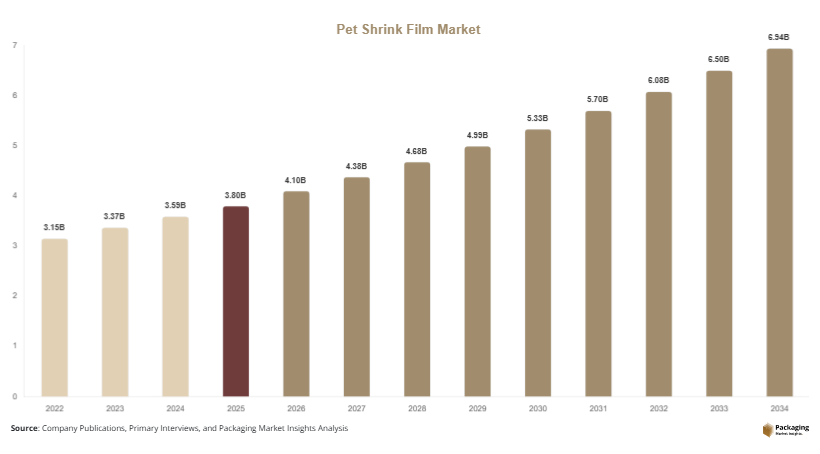
The pet shrink film market is experiencing steady growth driven by increasing demand for high-performance packaging solutions across beverage, food, personal care, and pharmaceutical industries. PET shrink films are widely used for labeling and packaging applications due to their clarity, strength, recyclability, and ability to conform tightly to container shapes. These films offer enhanced shelf appeal and durability, making them suitable for modern retail environments. In 2025, the global market size is estimated at USD 3.8 billion, and it is projected to reach USD 4.1 billion in 2026. Over the forecast period from 2025 to 2034, the market is expected to grow at a CAGR of 6.8%, reaching approximately USD 7.5 billion by 2034.
One of the primary growth factors is the increasing demand for packaged beverages. PET shrink films are extensively used in beverage labeling due to their ability to provide 360-degree branding and tamper-evident features. The growth of bottled water, carbonated drinks, and functional beverages is significantly contributing to market expansion.
Key Highlights:
- Market size valued at USD 3.8 billion in 2025
- Expected to reach USD 7.5 billion by 2034
- CAGR of 6.8% during 2025–2034
- Growing demand from beverage and personal care industries
- Increasing focus on sustainable and recyclable packaging
Explore more data points, trends and opportunities Download Free Sample Report
Market Trends
Rising Adoption of Recyclable and Eco-Friendly Shrink Films
Sustainability is a major trend in the pet shrink film market. Manufacturers are focusing on developing recyclable PET shrink films that align with circular economy goals. Traditional shrink films often pose challenges in recycling due to incompatible materials. However, advancements in PET-based shrink films are improving recyclability and reducing environmental impact. Companies are introducing low-density shrink films that can be easily separated during recycling processes. This trend is gaining traction across industries, particularly in food and beverage packaging, where sustainability requirements are increasing.
Increasing Use of Full-Body Sleeve Labeling
The use of full-body sleeve labeling is expanding rapidly in the market. PET shrink films are widely used for creating shrink sleeves that cover the entire surface of containers. This provides enhanced branding opportunities and allows manufacturers to display detailed product information. The trend is particularly prominent in the beverage and personal care industries, where visual appeal plays a crucial role in consumer purchasing decisions. Advances in printing technologies are enabling high-resolution graphics, further driving the adoption of shrink sleeve labeling.
Market Drivers
Growth in Beverage Packaging Industry
The growth of the beverage industry is a major driver of the pet shrink film market. PET shrink films are widely used for labeling bottles and containers due to their excellent clarity and shrink properties. The increasing consumption of bottled beverages, including water, soft drinks, and energy drinks, is driving demand for shrink films. Additionally, the need for tamper-evident packaging is supporting the adoption of PET shrink films. The expansion of beverage production and distribution networks is further contributing to market growth.
Demand for High-Quality Packaging and Branding
The increasing demand for high-quality packaging and branding solutions is another key driver. PET shrink films offer superior printability and design flexibility, enabling brands to create attractive packaging. The ability to conform to complex shapes and provide 360-degree coverage makes these films ideal for modern packaging needs. The growing competition among brands is encouraging the use of innovative packaging solutions, which is driving market growth.
Market Restraint
Recycling Challenges in Mixed Material Packaging
Despite their recyclability, PET shrink films face challenges when used in combination with other materials. Mixed material packaging can complicate recycling processes, reducing the overall efficiency of recycling systems. For example, when PET shrink films are used with non-compatible adhesives or inks, it can affect the quality of recycled materials. This issue is particularly relevant in regions with limited recycling infrastructure.
The need for specialized recycling processes can increase costs and limit adoption. Additionally, regulatory pressures to improve recycling rates are pushing manufacturers to redesign packaging solutions. While advancements are being made, the challenge of ensuring compatibility across materials remains a restraint for market growth. Companies are working to develop solutions that address these issues, but progress is gradual.
Market Opportunities
Development of Low-Density and Floatable Films
The development of low-density and floatable PET shrink films presents significant opportunities for the market. These films are designed to separate easily during recycling processes, improving recyclability. Floatable films can be separated from PET bottles in water-based recycling systems, reducing contamination. This innovation is expected to drive the adoption of PET shrink films in regions with strict recycling regulations. Manufacturers are investing in research and development to enhance the performance of these films while maintaining sustainability.
Expansion in Emerging Markets
Emerging markets offer substantial growth opportunities for the pet shrink film market. Rapid urbanization and increasing disposable incomes are driving demand for packaged products in regions such as Asia Pacific and Latin America. The expansion of retail and e-commerce sectors is further supporting market growth. Additionally, the growing middle-class population is increasing the demand for branded and packaged goods. These factors are creating new opportunities for market players to expand their presence.
Report Scope
| Report Metric | Details |
|---|---|
| Market Size in 2025 | USD 3.8 Billion |
| Market Size in 2026 | USD 4.1 Billion |
| Market Size in 2034 | USD 7.5 Billion |
| CAGR | 6.8% (2026-2034) |
| Base Year for Estimation | 2025 |
| Historical Data | 2022-2024 |
| Forecast Period | 2026-2034 |
| Report Coverage | Revenue Forecast, Competitive Landscape, Supply Chain Disruption, Growth Factors, Environment & Regulatory Landscape and Trends |
| Geographies Covered | North America, Europe, APAC, Middle East and Africa, LATAM |
| Countries Covered | U.S., Canada, U.K., Germany, France, Spain, Italy, Russia, Nordic, Benelux, Rest of Europe, China, South Korea, Japan, India, Australia, Singapore, Taiwan, South East Asia, Rest of Asia-Pacific, UAE, Turky, Saudi Arabia, South Africa, Egypt, Nigeria, Rest of MEA, Brazil, Mexico, Argentina, Chile, Colombia, Rest of LATAM |
Explore more data points, trends and opportunities Download Free Sample Report
Segmental Analysis
By Type
Low shrink PET films dominated the pet shrink film market in 2024, accounting for approximately 52% of the total share. These films are widely used in labeling applications due to their stability and ease of processing. Low shrink films are suitable for applications where minimal distortion is required. Their cost-effectiveness and compatibility with various printing techniques make them a preferred choice among manufacturers. Additionally, advancements in film technology are enhancing their performance.
The fastest-growing subsegment is high shrink PET films, expected to grow at a CAGR of 7.4%. This growth is driven by their ability to conform to complex shapes and provide tight packaging. High shrink films are widely used in full-body sleeve labeling applications. The increasing demand for visually appealing packaging is supporting the growth of this segment.
By Application
Beverage packaging held the largest share in 2024, accounting for around 55% of the market. PET shrink films are extensively used for labeling bottles and containers in this segment. The increasing consumption of bottled beverages is driving demand. Additionally, the need for attractive and informative packaging is boosting adoption.
The fastest-growing subsegment is personal care packaging, with a projected CAGR of 7.2%. The growth is driven by the increasing demand for branded personal care products. PET shrink films provide high-quality printing and design flexibility, making them suitable for this segment.
By End-Use Industry
The food and beverage industry accounted for the largest share in 2024, contributing approximately 57% of the market. PET shrink films are widely used in this industry for labeling and packaging applications. The increasing demand for packaged food and beverages is driving the adoption of these materials.
The fastest-growing subsegment is the healthcare industry, expected to grow at a CAGR of 7.0%. The growth is driven by the increasing demand for secure and tamper-evident packaging solutions. PET shrink films are used in pharmaceutical packaging applications, supporting this trend.
Pet Shrink Film Market Segmentations
Type
- Low Shrink Films
- High Shrink Films
Application
- Beverage Packaging
- Food Packaging
- Personal Care Packaging
- Pharmaceutical Packaging
End-Use Industry
- Food & Beverage
- Personal Care
- Healthcare
- Industrial
Regional Analysis
North America
North America accounted for approximately 27% of the pet shrink film market share in 2025 and is expected to grow at a CAGR of 6.2% during the forecast period. The region benefits from strong demand in beverage and personal care industries. The presence of advanced packaging technologies and established market players is supporting growth.
The United States dominates the regional market due to its large consumer base and developed retail sector. A unique growth factor is the increasing adoption of sustainable packaging practices. Companies are focusing on improving recyclability and reducing environmental impact, which is driving demand for PET shrink films.
Europe
Europe held around 25% of the market share in 2025 and is projected to grow at a CAGR of 6.1%. The region is characterized by strict environmental regulations and a strong focus on sustainability. These factors are encouraging the adoption of recyclable packaging materials.
Germany leads the European market, supported by its strong manufacturing sector. A key growth factor is the implementation of stringent packaging waste regulations. Companies are investing in innovative materials to comply with these regulations, driving market growth.
Asia Pacific
Asia Pacific accounted for nearly 33% of the market share in 2025 and is expected to register the highest CAGR of 7.6%. Rapid urbanization and industrialization are driving demand for packaging solutions in the region. The expanding beverage and food industries are key contributors to market growth.
China dominates the regional market due to its large manufacturing base. A major growth factor is the increasing demand for packaged beverages and consumer goods. The region’s cost-effective production capabilities are attracting investments from global players.
Middle East & Africa
The Middle East & Africa region held a market share of approximately 7% in 2025 and is projected to grow at a CAGR of 6.4%. The market is driven by increasing investments in infrastructure and industrial development. The demand for packaging solutions is rising in various sectors.
Saudi Arabia is a leading country in the region, supported by its growing industrial sector. A unique growth factor is the expansion of the retail and beverage industries, which require advanced packaging solutions.
Latin America
Latin America accounted for around 8% of the market share in 2025 and is expected to grow at a CAGR of 6.5%. The region is witnessing steady growth due to increasing demand for packaged goods. Economic development and urbanization are supporting market expansion.
Brazil dominates the regional market, driven by its large consumer base. A key growth factor is the growth of the beverage industry, which requires high-quality labeling solutions.
Competitive Landscape
The pet shrink film market is moderately competitive, with several global and regional players focusing on innovation and sustainability. Companies are investing in advanced materials and production technologies to enhance product performance and meet regulatory requirements. Strategic collaborations and expansions are common strategies adopted by market players.
Klöckner Pentaplast is a leading player in the market, known for its extensive product portfolio and focus on sustainable packaging solutions. The company has recently introduced recyclable PET shrink films designed for beverage applications. Other key players such as Berry Global Inc., CCL Industries Inc., Fuji Seal International, and Taghleef Industries are also actively investing in research and development. These companies are focusing on expanding their market presence and improving product offerings.
Key Players List
- Klöckner Pentaplast
- Berry Global Inc.
- CCL Industries Inc.
- Fuji Seal International
- Taghleef Industries
- Polyplex Corporation Ltd.
- Jindal Poly Films Ltd.
- Bonset America Corporation
- Toray Industries, Inc.
- Uflex Ltd.
- Ester Industries Ltd.
- SRF Limited
- Flex Films
- Garware Polyester Ltd.
- Plastopil Hazorea Company Ltd.