Personalised Packaging Market Size and Growth
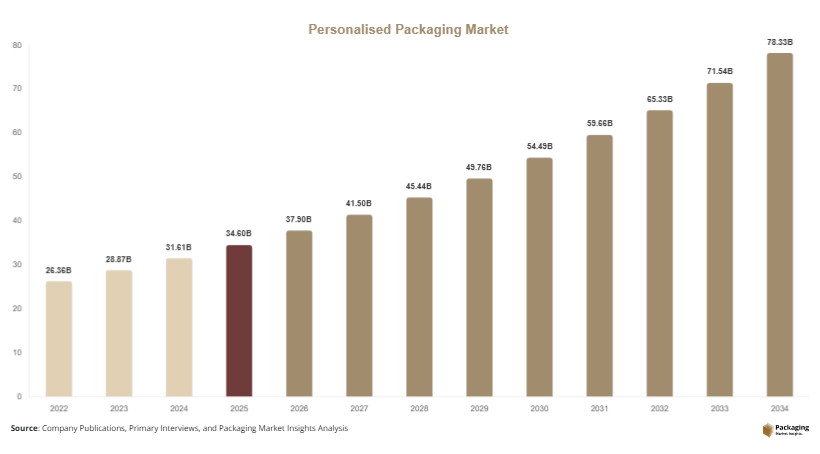
The global personalised packaging market size was valued at approximately USD 34.6 billion in 2025 and is estimated to reach USD 37.9 billion in 2026. Driven by increasing adoption of digital printing technologies and demand for brand differentiation, the market is projected to expand to USD 78.4 billion by 2034, registering a compound annual growth rate (CAGR) of 9.5% from 2025 to 2034. Growing demand for customized packaging in e-commerce and direct-to-consumer channels is reshaping packaging strategies across industries.
The personalised packaging market has emerged as a strategic segment within the global packaging industry as brands increasingly seek to deliver customized customer experiences. Personalised packaging refers to packaging solutions that incorporate individualized design elements, variable printing, targeted messaging, and consumer-specific visual features. These packaging formats are widely used in e-commerce shipments, promotional campaigns, luxury goods, cosmetics, and consumer packaged goods to enhance customer engagement and brand recognition.
Key Highlights
- The personalised packaging market was valued at USD 34.6 billion in 2025 and is projected to reach USD 78.4 billion by 2034, growing at a CAGR of 9.5% during 2025–2034.
- E-commerce growth and rising demand for unique unboxing experiences are key factors increasing the adoption of personalised packaging across retail and direct-to-consumer brands.
- Advancements in digital printing technologies are enabling cost-effective, scalable customization, helping brands strengthen customer engagement and brand differentiation.
Explore more data points, trends and opportunities Download Free Sample Report
Market Trends
Growing Integration of Digital Printing for Custom Packaging
Digital printing technologies are transforming the personalised packaging industry by enabling flexible production and variable design capabilities. Packaging manufacturers are increasingly adopting high-speed digital presses that allow brands to produce unique graphics, targeted messages, and region-specific packaging without requiring large production runs. This capability reduces waste and improves design flexibility compared to traditional printing methods.
Brands are also using digital printing to create limited-edition packaging campaigns, seasonal product releases, and region-specific marketing messages. Beverage companies, cosmetics brands, and subscription box providers are among the early adopters of this technology. The growing accessibility of digital printing equipment and declining operational costs are expected to support continued adoption across small and medium enterprises.
Expansion of Personalized Packaging in E-commerce Fulfillment
E-commerce businesses increasingly rely on personalised packaging to improve the overall customer experience and strengthen brand loyalty. Custom shipping boxes, personalized inserts, branded tissue papers, and customized labels are commonly used to create memorable unboxing experiences. Social media sharing of unboxing moments has further amplified the importance of visually distinctive packaging.
Retailers also use personalized packaging to include promotional messages, discount codes, and product recommendations tailored to individual customers. This approach helps brands create stronger emotional connections with consumers. As global e-commerce volumes continue to rise, demand for scalable personalised packaging solutions is expected to increase steadily.
Market Drivers
Rising Demand for Enhanced Brand Differentiation
Intensifying competition in consumer goods markets is driving brands to differentiate their products through packaging innovation. Personalised packaging enables companies to communicate brand values and unique identities more effectively than standard packaging formats. Customized graphics, consumer names, interactive QR codes, and targeted marketing messages help create stronger emotional connections with customers.
Brands in sectors such as beverages, cosmetics, luxury goods, and food products are increasingly using personalized packaging to launch limited-edition campaigns and promotional packaging series. These campaigns often attract significant consumer attention and increase brand visibility. As marketing strategies continue to evolve toward personalized experiences, demand for customised packaging solutions is expected to grow steadily.
Growth of Direct-to-Consumer Business Models
The expansion of direct-to-consumer (DTC) business models is another key factor driving the personalised packaging market . Many emerging brands sell products directly through online channels, bypassing traditional retail distribution networks. These companies rely heavily on packaging to create strong first impressions and establish brand identity.
Personalised packaging allows DTC brands to deliver unique customer experiences through customized messages, product recommendations, and visually appealing designs. This strategy improves customer retention and encourages repeat purchases. As the number of digital-first brands continues to increase, demand for personalized packaging solutions is expected to expand across multiple product categories.
Market Restraint
High Production Costs for Large-Scale Personalization
One of the major restraints in the personalised packaging market is the relatively high cost associated with large-scale customization. While digital printing technologies have improved production flexibility, personalized packaging still requires specialized equipment, design resources, and variable printing processes. These requirements can increase operational expenses, particularly for companies that produce high volumes of packaging materials.
Smaller brands may find it difficult to justify the cost of customized packaging for large product lines, especially when operating with limited budgets. Additionally, personalized packaging often requires more complex supply chain coordination, including design management, inventory control, and production scheduling.
For example, large consumer goods manufacturers that distribute products across multiple regions must manage several packaging variations simultaneously. This complexity can increase logistics costs and create operational challenges. As a result, some companies continue to rely on standardized packaging formats rather than adopting fully personalized solutions. Addressing cost efficiency and operational scalability will remain important for market expansion.
Market Opportunities
Integration of Smart Packaging Technologies
The integration of smart packaging technologies presents a promising opportunity for the personalised packaging industry. Technologies such as QR codes, near-field communication (NFC) tags, and augmented reality elements allow brands to combine customization with digital interaction. Consumers can scan packaging to access product information, promotional content, or interactive experiences.
This approach enables brands to deliver personalized marketing campaigns that extend beyond the physical packaging itself. Companies can track consumer engagement and gather valuable data to improve marketing strategies. As smart packaging technologies become more affordable and widely adopted, their integration with personalised packaging designs is expected to create new market opportunities.
Increasing Adoption in Sustainable Packaging Solutions
Sustainability initiatives are creating additional opportunities for the personalised packaging market . Many companies are exploring ways to combine eco-friendly packaging materials with customized design features. Recyclable paperboard, biodegradable films, and reusable packaging formats are increasingly used in personalized packaging applications.
Consumers are becoming more environmentally conscious and prefer brands that demonstrate sustainable practices. Personalized packaging printed on recyclable or biodegradable materials allows companies to meet both environmental goals and marketing objectives. The growing focus on circular packaging solutions is expected to encourage innovation in sustainable personalised packaging technologies.
Report Scope
| Report Metric | Details |
|---|---|
| Market Size in 2025 | USD 34.6 Billion |
| Market Size in 2026 | USD 37.9 Billion |
| Market Size in 2034 | USD 78.4 Billion |
| CAGR | 9.5% (2026-2034) |
| Base Year for Estimation | 2025 |
| Historical Data | 2022-2024 |
| Forecast Period | 2026-2034 |
| Report Coverage | Revenue Forecast, Competitive Landscape, Supply Chain Disruption, Growth Factors, Environment & Regulatory Landscape and Trends |
| Geographies Covered | North America, Europe, APAC, Middle East and Africa, LATAM |
| Countries Covered | U.S., Canada, U.K., Germany, France, Spain, Italy, Russia, Nordic, Benelux, Rest of Europe, China, South Korea, Japan, India, Australia, Singapore, Taiwan, South East Asia, Rest of Asia-Pacific, UAE, Turky, Saudi Arabia, South Africa, Egypt, Nigeria, Rest of MEA, Brazil, Mexico, Argentina, Chile, Colombia, Rest of LATAM |
Explore more data points, trends and opportunities Download Free Sample Report
Segmental Analysis
By Packaging Type
Boxes and cartons represented the dominant segment in 2024, accounting for approximately 41% of the global market share. These packaging formats are widely used in e-commerce shipments, cosmetics packaging, food delivery services, and subscription box businesses. Their large printable surfaces allow companies to display personalized messages, customized graphics, and marketing content effectively. In addition, paperboard boxes are easy to print using digital technologies, making them ideal for small batch customization. Many brands use personalized shipping boxes to create distinctive unboxing experiences that encourage social media sharing. As e-commerce retailers increasingly emphasize customer engagement and brand identity, demand for customized boxes and cartons continues to remain strong across global markets.
Labels and tags are expected to be the fastest-growing packaging type segment, registering a CAGR of approximately 10.6% during the forecast period. Personalized labels enable companies to customize packaging without changing the entire container structure, which reduces production costs and improves operational flexibility. Brands frequently use variable data printing to produce unique label designs, promotional messages, or individualized product identifiers. Beverage companies, personal care brands, and pharmaceutical manufacturers often use personalized labels to support marketing campaigns and product traceability initiatives. The increasing use of QR codes and smart labels further strengthens the growth potential of this segment.
By Printing Technology
Digital printing dominated the market in 2024 with an estimated share of 46%. The technology allows packaging manufacturers to produce short runs of customized designs without requiring expensive printing plates. Digital presses support variable data printing, enabling brands to create unique graphics or messages on each package. This capability is especially useful for promotional campaigns, seasonal packaging releases, and personalized product packaging. In addition, digital printing reduces setup time and allows faster production cycles compared with conventional printing methods. As companies increasingly demand flexible production capabilities, digital printing continues to play a central role in personalized packaging manufacturing.
Flexographic printing is projected to be the fastest-growing printing technology segment with a CAGR of approximately 9.8% during the forecast period. Flexographic printing has evolved significantly with the development of advanced plates and improved ink technologies. Modern flexographic systems can produce high-quality prints while maintaining efficient large-scale production capabilities. Packaging manufacturers are integrating hybrid systems that combine flexographic printing with digital printing features. This hybrid approach allows companies to maintain cost efficiency for large production volumes while still offering limited personalization features. The growing demand for scalable and cost-efficient customization supports the growth of this segment.
By End-Use Industry
The food and beverage industry held the largest share of approximately 38% in 2024. Companies in this sector frequently use personalized packaging to support marketing campaigns, limited-edition product launches, and seasonal promotions. Beverage companies have widely adopted personalized packaging strategies to print consumer names, custom messages, or unique artwork on product containers. This approach increases consumer engagement and strengthens brand visibility. In addition, food brands use personalized packaging to communicate nutritional information, promotional offers, and brand stories. The growing demand for unique product presentation in retail environments continues to support the dominance of this segment.
The cosmetics and personal care industry is expected to be the fastest-growing end-use segment with a projected CAGR of 11.2% during the forecast period. Personal care brands rely heavily on packaging aesthetics and brand identity to attract consumers. Personalized packaging designs allow cosmetic companies to target specific customer segments and create premium product experiences. Many brands offer customized product packaging for special events, gift packages, and online purchases. The increasing popularity of personalized beauty products and luxury cosmetic packaging is expected to drive strong growth in this segment over the coming years.
Personalised Packaging Market Segmentations
Packaging Type
- Boxes & Cartons
- Labels & Tags
- Pouches
- Wrappers
Printing Technology
- Digital Printing
- Flexographic Printing
- Lithographic Printing
- Screen Printing
End-Use Industry
- Food & Beverage
- Cosmetics & Personal Care
- Consumer Electronics
- Pharmaceuticals
- Retail & E-commerce
Regional Analysis
North America
North America accounted for approximately 32% of the global personalised packaging market share in 2025. The region is projected to grow at a CAGR of 8.7% through 2034, supported by advanced printing technologies and strong adoption of customized packaging solutions across multiple industries. The presence of established packaging manufacturers and leading consumer brands contributes to widespread adoption of personalized packaging strategies in marketing campaigns.
The United States dominates the regional market due to its large e-commerce ecosystem and high demand for innovative branding solutions. Many companies in the country focus on delivering premium customer experiences through custom packaging designs and personalized messages. The growth of subscription box services and direct-to-consumer retail brands represents a major factor driving personalized packaging demand in the United States.
Europe
Europe held nearly 27% of the global market share in 2025 and is expected to grow at a CAGR of 8.9% during the forecast period. The region’s strong packaging industry and strict sustainability regulations are encouraging companies to adopt innovative personalized packaging solutions. European brands increasingly combine customized designs with recyclable and biodegradable packaging materials.
Germany represents the dominant country within the European market. The country’s advanced manufacturing infrastructure and focus on sustainable packaging innovation support market growth. Many German companies are investing in digital printing technologies and environmentally responsible packaging materials to produce personalized packaging solutions that comply with evolving environmental regulations.
Asia Pacific
Asia Pacific accounted for around 26% of the global personalised packaging market share in 2025 and is projected to register the fastest CAGR of 11.4% between 2025 and 2034. Rapid urbanization, increasing internet penetration, and expanding e-commerce markets are driving demand for personalized packaging solutions across the region.
China is the largest contributor to the Asia Pacific market due to its massive manufacturing sector and rapidly growing online retail industry. Chinese brands increasingly use personalized packaging to enhance product presentation and improve customer engagement. The country’s large-scale adoption of digital printing technology is supporting the growth of personalized packaging applications.
Middle East & Africa
The Middle East & Africa region represented approximately 8% of the global market share in 2025 and is forecast to grow at a CAGR of 9.1% through 2034. Rising retail modernization and increasing investment in packaging technologies are contributing to market expansion across the region.
The United Arab Emirates leads the regional market due to its strong retail sector and expanding luxury goods industry. Many brands in the country use personalized packaging to create premium product experiences for consumers. Growth in tourism and high-end retail markets also contributes to increasing demand for customized packaging solutions.
Latin America
Latin America accounted for nearly 7% of the global market share in 2025 and is expected to grow at a CAGR of 8.5% during the forecast period. Increasing adoption of digital marketing strategies and growing consumer awareness of brand identity are encouraging companies to invest in personalized packaging solutions.
Brazil dominates the regional market due to its large consumer goods industry and expanding retail sector. Many domestic brands are incorporating customized packaging designs to strengthen brand recognition and customer loyalty. Growth in local e-commerce platforms also contributes to increasing demand for personalized packaging across the country.
Competitive Landscape
The personalised packaging market is moderately fragmented, with several global and regional packaging companies competing through technological innovation and design capabilities. Leading companies focus on digital printing technologies, sustainable packaging materials, and strategic partnerships with consumer brands to strengthen their market presence.
Major players include DS Smith, Smurfit Kappa Group, WestRock Company, Mondi Group, and International Paper Company. Among these, Smurfit Kappa Group is considered a leading company due to its extensive portfolio of customized packaging solutions and strong global manufacturing network. The company has invested heavily in digital printing infrastructure to provide personalized packaging for large consumer brands and e-commerce retailers.
Companies are also focusing on sustainability initiatives and smart packaging technologies to remain competitive. Many firms collaborate with brand owners to develop innovative packaging designs that combine customization with eco-friendly materials. Continuous investment in printing technology and packaging automation is expected to shape the competitive landscape in the coming years.
Key Players List
- DS Smith Plc
- Smurfit Kappa Group
- WestRock Company
- Mondi Group
- International Paper Company
- Stora Enso Oyj
- Sealed Air Corporation
- Amcor Plc
- Huhtamaki Oyj
- Crown Holdings Inc.
- Avery Dennison Corporation
- Sonoco Products Company
- Graphic Packaging International
- Quad Packaging
- Packlane Inc.