Perfume Packaging Market Size
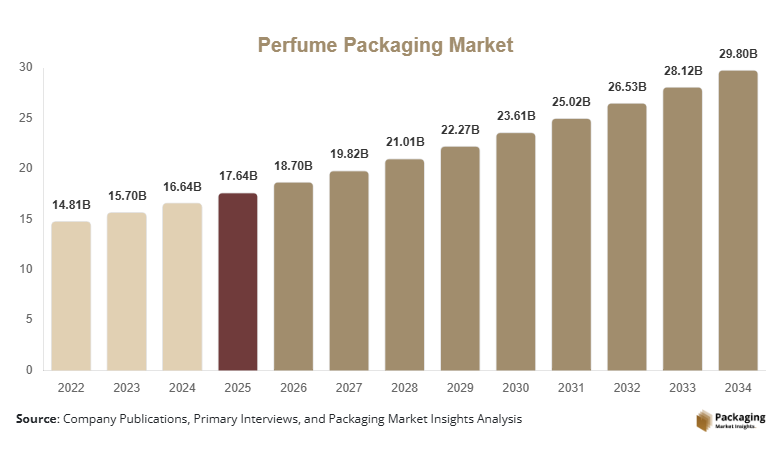
Perfume packaging market size is projected at USD 18.7 billion in 2026 and is expected to hit USD 29.8 billion by 2034 with a CAGR of 6.0%.” The market growth is influenced by increasing fragrance consumption, premium cosmetic product launches, innovative bottle designs, and rising demand for sustainable packaging formats. This report provides detailed analysis covering market segmentation, production trends, regional performance, competitive landscape, material innovation, and industry insights across historical years 2022–2024, base year 2025, current year 2026, and forecast period 2026–2034.
The perfume packaging market analysis evaluates packaging formats, including bottles, caps, pumps, containers, and decorative components used across luxury, premium, and mass fragrance categories. Increasing investments in customized designs, recyclable materials, and high-end packaging solutions are shaping competitive strategies among global manufacturers.
Market Introduction
The perfume packaging market includes the production and supply of containers and accessories designed for storing, protecting, and presenting fragrance products. Global perfume packaging production exceeded 9 billion units in 2025, supported by rising fragrance consumption across Europe, North America, and Asia-Pacific. Glass bottles accounted for approximately 60% of total packaging volume due to premium appearance, chemical stability, and compatibility with alcohol-based formulations.
Luxury perfumes contributed nearly 45% of overall packaging demand, while mass fragrances represented around 40% share due to increasing retail availability and affordable fragrance adoption. Growing penetration of e-commerce platforms, personalized fragrance products, and sustainable packaging solutions continues to influence the perfume packaging market.
Explore more data points, trends and opportunities Download Free Sample Report
Perfume Packaging Market Trends
Increasing Demand for Premium and Sustainable Fragrance Packaging
The perfume packaging market trend is shifting toward premium glass designs, lightweight materials, and environmentally responsible packaging solutions. Global production of perfume bottles exceeded 9 billion units in 2025, with luxury fragrance brands accounting for more than 4 billion units. Manufacturers are adopting recycled glass, refillable bottles, and reduced-material packaging concepts, with sustainable packaging adoption increasing by approximately 20% between 2022 and 2026.
Advanced manufacturing technologies such as digital printing, automated decoration, and precision molding are improving packaging customization capabilities. More than 35% of premium fragrance launches introduced enhanced decorative packaging features, including metallic finishes, engraving, and customized bottle structures. These developments are strengthening long-term opportunities in the perfume packaging market.
Growth of Customized and E-Commerce-Friendly Packaging Formats
The increasing influence of online fragrance sales is driving demand for durable and visually attractive perfume packaging. E-commerce fragrance sales contributed nearly 30% of global perfume distribution in 2025, increasing requirements for lightweight and protective packaging solutions. More than 2 billion fragrance packages were shipped through online channels, requiring improved packaging strength and damage resistance.
Brands are adopting innovative pump systems, compact travel bottles, and refillable packaging formats to improve consumer convenience. Approximately 25% of new fragrance packaging launches included sustainable or reusable features, supporting changing consumer preferences and expanding the perfume packaging market.
Perfume Packaging Market Drivers
Increasing Premiumization of Fragrance Products
The rising demand for luxury and premium fragrances is a major driver for the perfume packaging market. Premium fragrance products accounted for approximately 45% of global perfume sales in 2025, creating strong demand for high-quality glass bottles, decorative components, and customized designs. Luxury brands invest significantly in packaging aesthetics, with packaging costs representing nearly 15–20% of total product value. Expanding middle-class populations, increasing disposable income, and growing beauty product consumption across emerging economies are supporting market expansion and driving the perfume packaging market.
Perfume Packaging Market Restraints
High Production Costs and Material Price Volatility
The perfume packaging market faces challenges due to fluctuating raw material prices, especially glass, aluminum, and specialty coatings. Glass production costs increased by approximately 10–15% during recent years due to energy price fluctuations. Small and medium manufacturers experience higher operational expenses because customized perfume packaging requires specialized molds, finishing processes, and quality control systems. These factors can limit profitability and create challenges for cost-sensitive fragrance brands.
Perfume Packaging Market Opportunities
Expansion of Sustainable and Refillable Packaging Solutions
The growing adoption of sustainable packaging creates significant opportunities for the perfume packaging market. Refillable perfume bottles and recycled material packaging solutions are gaining acceptance, with sustainable formats accounting for nearly 25% of new product launches in 2025. Manufacturers are investing in recyclable glass technologies, eco-friendly coatings, and modular packaging designs. Increasing environmental awareness among consumers and regulatory support for circular packaging systems are expected to create new growth opportunities.
Challenges in Perfume Packaging Market
Balancing Design Innovation with Environmental Requirements
The perfume packaging market faces challenges related to maintaining premium aesthetics while meeting sustainability requirements. Developing innovative packaging structures requires significant investment in research, tooling, and material testing. More than 30% of fragrance manufacturers are redesigning packaging formats to reduce material usage and improve recyclability. Maintaining luxury appearance, durability, and environmental compliance remains a key challenge for industry participants.
Report Scope
| Report Metric | Details |
|---|---|
| Market Size in 2025 | USD 17.64 Billion |
| Market Size in 2026 | USD 18.7 Billion |
| Market Size in 2034 | USD 29.8 Billion |
| CAGR | 6.0% (2026-2034) |
| Base Year for Estimation | 2025 |
| Historical Data | 2022-2024 |
| Forecast Period | 2026-2034 |
| Report Coverage | Revenue Forecast, Competitive Landscape, Supply Chain Disruption, Growth Factors, Environment & Regulatory Landscape and Trends |
| Geographies Covered | North America, Europe, APAC, Middle East and Africa, LATAM |
| Countries Covered | U.S., Canada, U.K., Germany, France, Spain, Italy, Russia, Nordic, Benelux, Rest of Europe, China, South Korea, Japan, India, Australia, Singapore, Taiwan, South East Asia, Rest of Asia-Pacific, UAE, Turky, Saudi Arabia, South Africa, Egypt, Nigeria, Rest of MEA, Brazil, Mexico, Argentina, Chile, Colombia, Rest of LATAM |
Explore more data points, trends and opportunities Download Free Sample Report
Perfume Packaging Market Segmentation
The perfume packaging market segmentation is based on material type and application. Glass packaging dominates the market with approximately 60% share due to its premium appearance and chemical resistance. Plastic packaging contributes nearly 30% share because of lightweight properties, while metal packaging represents around 10% demand. Luxury perfumes remain the largest application segment with approximately 45% share.
BY TYPE
Glass packaging dominates the perfume packaging market with nearly 60% market share and annual production exceeding 5 billion units. Glass bottles are preferred for luxury perfumes because of transparency, durability, and compatibility with fragrance formulations. Premium brands use advanced glass molding, coating, and decoration technologies to create differentiated designs. Recycled glass adoption has increased by more than 20%, supporting sustainability objectives within fragrance packaging.
Plastic packaging accounts for approximately 30% market share, with global production exceeding 2.5 billion units annually. Plastic bottles and containers are widely used for mass fragrances, travel-sized products, and affordable perfume formats. Lightweight characteristics can reduce transportation costs by 15–25%, making plastic packaging attractive for large-scale production. Manufacturers are increasingly using recyclable polymers and improved barrier technologies.
Metal packaging represents around 10% of the market, with production exceeding 800 million units in 2025. Aluminum containers are used for travel perfumes, aerosol fragrances, and premium limited-edition products. Metal packaging provides durability, corrosion resistance, and a premium visual appearance. Increasing demand for compact and portable fragrance formats supports segment growth.
BY APPLICATION
Luxury perfumes represent approximately 45% of the perfume packaging market, with more than 4 billion packaging units produced annually. Premium fragrance brands invest heavily in customized glass bottles, decorative caps, and advanced finishing technologies. Approximately 70% of luxury perfume packaging uses glass materials due to premium positioning and product protection requirements.
Mass fragrances account for nearly 40% market share, supported by expanding retail distribution and affordable product availability. More than 3 billion packaging units are manufactured annually for this segment. Plastic and lightweight glass formats dominate due to cost efficiency and large-volume production requirements. Increasing consumer adoption in emerging markets continues to support demand.
Travel perfumes contribute around 15% market share, with production exceeding 1 billion units annually. Compact bottles, mini sprays, and portable packaging formats are increasingly popular among consumers. Approximately 35% of travel fragrance products use lightweight plastic or metal packaging due to portability and durability requirements.
Perfume Packaging Market Segmentations
Material Type
- Glass Packaging
- Plastic Packaging
- Metal Packaging
Application
- Luxury Perfumes
- Mass Fragrances
- Travel Perfumes
Packaging Component
- Bottles
- Caps and Closures
- Pumps and Sprayers
- Decorative Packaging Components
Perfume Packaging Market Regional Outlook
North America
North America accounted for approximately 28% of the perfume packaging market share in 2025. The United States contributes more than 75% of regional demand due to strong luxury fragrance consumption and established cosmetic brands. The region produced over 2 billion perfume packaging units, with luxury fragrances representing nearly 50% of consumption.
Europe
Europe held around 32% market share, making it one of the largest fragrance packaging regions globally. France, Germany, Italy, and the United Kingdom are major contributors, supported by luxury fragrance manufacturers. The region produced more than 3 billion packaging units in 2025, with glass packaging accounting for nearly 65% of demand.
Asia-Pacific
The Asia-Pacific represented approximately 30% market share and was the fastest-growing region. China, India, Japan, and South Korea are major contributors due to rising beauty product consumption and expanding fragrance markets. Regional production exceeded 2.7 billion units, with mass fragrances contributing nearly 45% of demand.
Latin America and Middle East & Africa
These regions collectively accounted for around 10% market share in 2025. Brazil, the UAE, Saudi Arabia, and South Africa are increasing investments in premium fragrance products. Growing luxury retail expansion and rising consumer interest in personal care products are supporting regional demand.
Top Players In The Perfume Packaging Market
- Albéa Group,
- AptarGroup Inc.
- Verescence /li>
- SGD Pharma
- Quadpack Industries
- Berry Global Inc.
- Amcor plc,
- Silgan Holdings Inc.
- Heinz-Glas GmbH & Co. KG
- Gerresheimer AG
- Berlin Packaging
- Vidrala S.A.
Verescence holds a significant position in premium perfume glass packaging with an estimated 10–12% share in luxury fragrance bottle manufacturing. The company specializes in high-end glass bottle production, decoration, and sustainable packaging solutions. It supplies global luxury fragrance brands and focuses on recycled glass adoption, lightweight designs, and advanced manufacturing technologies. Its strong presence in Europe and North America supports its competitive positioning in the perfume packaging market. AptarGroup, Inc. AptarGroup maintains a strong market position with approximately 8–10% share in fragrance dispensing systems. The company provides pumps, closures, and dispensing technologies for perfume brands worldwide. It focuses on precision engineering, sustainable materials, and innovative spray systems. Expanding investments in recyclable components and smart dispensing solutions strengthen its role in the perfume packaging market.