PBAT PGA Blend Films For Sustainable Packaging Market Size and Growth
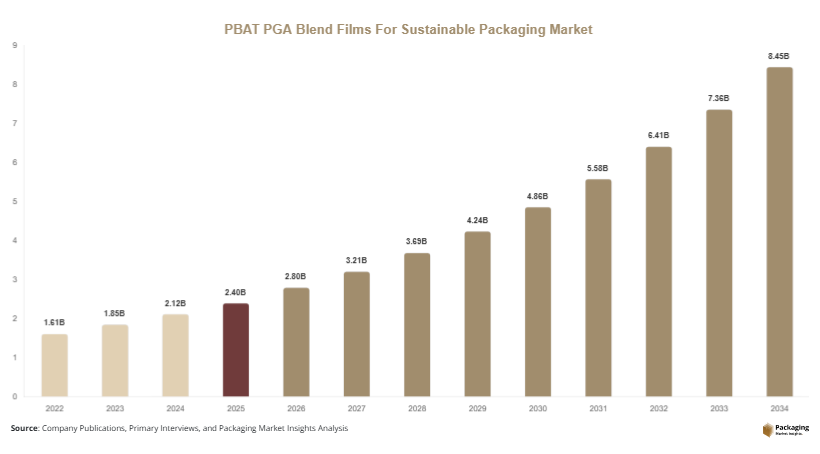
The global PBAT PGA blend films for sustainable packaging market size was valued at USD 2.4 billion in 2025 and is projected to reach USD 2.8 billion in 2026. Over the forecast period, the market is expected to reach approximately USD 9.6 billion by 2034, growing at a CAGR of 14.8% from 2025 to 2034. PBAT (polybutylene adipate terephthalate) and PGA (polyglycolic acid) blends offer a balance of flexibility, strength, and biodegradability, making them suitable for sustainable packaging applications. The PBAT PGA blend films for sustainable packaging market is gaining traction as industries transition toward biodegradable and compostable materials in response to environmental concerns and regulatory pressure.
One of the major growth factors is the increasing regulatory pressure to reduce plastic waste. Governments across regions are implementing bans and restrictions on conventional plastics, which is encouraging the adoption of biodegradable alternatives such as PBAT-PGA films. These materials decompose under controlled conditions, reducing environmental impact and supporting circular economy goals.
Key Highlights:
- Asia Pacific dominated the market with a 39.2% share in 2025, while Latin America is projected to grow at the fastest CAGR of 15.3%.
- PBAT-based blends led the type segment with a 46.7% share, while high-barrier PGA blends are expected to grow at a CAGR of 15.6%.
- Flexible packaging dominated with a 58.4% share, while compostable rigid films are forecasted to grow at a CAGR of 14.2%.
- Food & beverage applications led the segment with 47.6% share, while healthcare packaging is expected to grow at a CAGR of 14.9%.
- China remained the dominant country with a market size of USD 0.9 billion in 2025 and USD 1.1 billion in 2026.
Explore more data points, trends and opportunities Download Free Sample Report
Market Trends
Increasing Adoption of Compostable Packaging Solutions
The PBAT PGA blend films for sustainable packaging market is witnessing a growing shift toward compostable packaging solutions. Companies are focusing on replacing conventional plastic films with biodegradable alternatives that can break down under industrial composting conditions. PBAT-PGA blends are gaining popularity due to their ability to provide flexibility and strength while maintaining compostability. This trend is particularly evident in the food and beverage industry, where packaging waste is a significant concern. Manufacturers are also investing in certifications and standards to ensure compliance with compostability requirements. As awareness of environmental sustainability continues to grow, the adoption of compostable packaging is expected to increase significantly.
Advancements in Barrier Properties and Film Performance
Technological advancements are improving the barrier properties and overall performance of PBAT-PGA blend films. These materials are being engineered to provide enhanced resistance to moisture, oxygen, and other external factors, making them suitable for sensitive applications such as food packaging. Innovations in polymer blending techniques are enabling manufacturers to achieve a balance between biodegradability and performance. This is helping PBAT-PGA films compete with traditional plastic materials in terms of functionality. The development of high-performance films is expected to expand the application scope of these materials and drive market growth.
Market Drivers
Stringent Environmental Regulations and Plastic Bans
The implementation of stringent environmental regulations is a major driver of the PBAT PGA blend films for sustainable packaging market. Governments are introducing policies to reduce plastic waste and promote sustainable alternatives. These regulations include bans on single-use plastics and incentives for adopting biodegradable materials. PBAT-PGA blend films are well-positioned to benefit from these policies due to their compostable nature. Companies are increasingly adopting these materials to comply with regulations and avoid penalties. This trend is expected to continue as environmental concerns remain a priority.
Growing Demand for Sustainable Packaging in Food Industry
The food industry is a significant driver of demand for PBAT-PGA blend films. With increasing consumer awareness and regulatory requirements, food manufacturers are seeking sustainable packaging solutions that ensure product safety and quality. PBAT-PGA films offer suitable barrier properties and flexibility, making them ideal for food packaging applications. The rise of packaged food consumption and online food delivery services is further driving demand. As the food industry continues to expand, the adoption of sustainable packaging materials is expected to increase.
Market Restraint
High Production Costs and Limited Recycling Infrastructure
The PBAT PGA blend films for sustainable packaging market faces challenges related to high production costs and limited recycling infrastructure. The production of PBAT-PGA blend films involves advanced technologies and raw materials, which can increase costs compared to conventional plastics. This can limit adoption, particularly among small and medium-sized enterprises. Additionally, the lack of adequate composting and recycling infrastructure in many regions can hinder the effective disposal of these materials. For example, in regions without industrial composting facilities, biodegradable films may not decompose as intended. These challenges can impact market growth and require investments in infrastructure and cost optimization.
Market Opportunities
Expansion of Sustainable Packaging in Emerging Economies
Emerging economies present significant opportunities for the PBAT PGA blend films for sustainable packaging market. Rapid urbanization and increasing consumer awareness are driving demand for sustainable packaging solutions. Governments in these regions are also implementing policies to reduce plastic waste, creating a favorable environment for biodegradable materials. Companies that invest in these markets can benefit from growing demand and favorable regulatory conditions. The expansion of retail and e-commerce sectors is further supporting market growth.
Development of Cost-Effective Production Technologies
The development of cost-effective production technologies offers opportunities for market expansion. Manufacturers are focusing on improving production efficiency and reducing costs through innovations in polymer processing and material sourcing. Advances in blending techniques and the use of renewable feedstocks are helping reduce production costs. This makes PBAT-PGA blend films more competitive with traditional plastics. As technology continues to evolve, the adoption of these materials is expected to increase.
Report Scope
| Report Metric | Details |
|---|---|
| Market Size in 2025 | USD 2.4 Billion |
| Market Size in 2026 | USD 2.8 Billion |
| Market Size in 2034 | USD 9.6 Billion |
| CAGR | 14.8% (2026-2034) |
| Base Year for Estimation | 2025 |
| Historical Data | 2022-2024 |
| Forecast Period | 2026-2034 |
| Report Coverage | Revenue Forecast, Competitive Landscape, Supply Chain Disruption, Growth Factors, Environment & Regulatory Landscape and Trends |
| Geographies Covered | North America, Europe, APAC, Middle East and Africa, LATAM |
| Countries Covered | U.S., Canada, U.K., Germany, France, Spain, Italy, Russia, Nordic, Benelux, Rest of Europe, China, South Korea, Japan, India, Australia, Singapore, Taiwan, South East Asia, Rest of Asia-Pacific, UAE, Turky, Saudi Arabia, South Africa, Egypt, Nigeria, Rest of MEA, Brazil, Mexico, Argentina, Chile, Colombia, Rest of LATAM |
Explore more data points, trends and opportunities Download Free Sample Report
Segmental Analysis
By Type
PBAT-based blends accounted for the largest share of 46.7% in 2024, driven by their flexibility and biodegradability. These materials are widely used in packaging applications due to their ability to provide strength and durability while maintaining compostability. PBAT blends are also compatible with existing processing technologies, making them easier to adopt. The increasing demand for sustainable packaging solutions is supporting segment growth.
High-barrier PGA blends are expected to grow at a CAGR of 15.6%, driven by their superior barrier properties. These materials are suitable for applications requiring protection from moisture and oxygen. The development of advanced blending techniques is improving performance and expanding application areas.
By Application
Flexible packaging accounted for the largest share of 58.4% in 2024, driven by high demand for lightweight and cost-effective packaging solutions. PBAT-PGA films are widely used in flexible packaging due to their flexibility and biodegradability. The growth of e-commerce and food delivery services is further driving demand.
Compostable rigid films are expected to grow at a CAGR of 14.2%, supported by increasing demand for sustainable alternatives in rigid packaging applications. These materials offer improved strength and durability, making them suitable for various applications.
By End-Use
Food & beverage end-use accounted for the largest share of 47.6% in 2024, driven by high demand for sustainable packaging solutions. PBAT-PGA films are used to ensure product safety and extend shelf life. The increasing demand for packaged food products is supporting segment growth.
Healthcare end-use is expected to grow at a CAGR of 14.9%, driven by the need for safe and sustainable packaging solutions. These materials are used in medical packaging applications due to their biodegradability and performance.
PBAT PGA Blend Films For Sustainable Packaging Market Segmentations
By Type
- PBAT-Based Blends
- PGA-Based Blends
- High-Barrier Composite Blends
By Application
- Flexible Packaging
- Rigid Packaging Films
- Industrial Packaging
- Agricultural Films
By End-Use
- Food & Beverage
- Healthcare
- Personal Care
- Industrial
Regional Analysis
North America
North America accounted for 24.5% of the PBAT PGA blend films for sustainable packaging market share in 2025 and is projected to grow at a CAGR of 14.2%. The region benefits from strong regulatory frameworks and increasing consumer awareness of environmental issues. The presence of major packaging companies and technological advancements is supporting market growth. Additionally, the growing demand for sustainable packaging in the food and beverage sector is driving adoption.
The United States dominates the regional market due to its large consumer base and advanced infrastructure. A key growth factor is the implementation of state-level regulations banning single-use plastics, which is encouraging the adoption of biodegradable materials such as PBAT-PGA films.
Europe
Europe held a market share of 23.8% in 2025 and is expected to grow at a CAGR of 14.5%. The region is characterized by strict environmental regulations and a strong focus on sustainability. European countries are promoting the use of biodegradable materials and reducing plastic waste, which is driving demand for PBAT-PGA blend films. The presence of established packaging manufacturers also supports market growth.
Germany is the leading country in the European market, driven by its strong industrial base and commitment to sustainability. A unique growth factor is the implementation of circular economy policies, which is encouraging the adoption of biodegradable packaging solutions.
Asia Pacific
Asia Pacific dominated the market with a 39.2% share in 2025 and is projected to grow at a CAGR of 15.1%. The region’s growth is driven by rapid industrialization, urbanization, and increasing consumer demand for sustainable products. Countries such as China, India, and Japan are witnessing significant growth in packaging industries, which is driving demand for PBAT-PGA blend films.
China is the dominant country in the region, supported by its large manufacturing base and government initiatives to reduce plastic waste. A key growth factor is the implementation of national policies promoting biodegradable materials, which is driving market growth.
Middle East & Africa
The Middle East & Africa region accounted for 5.2% of the market share in 2025 and is expected to grow at a CAGR of 14.0%. The region is experiencing growth in consumer markets and increasing awareness of environmental issues. Governments are implementing policies to reduce plastic waste, which is supporting the adoption of biodegradable materials.
The United Arab Emirates is a key market in the region due to its focus on sustainability and innovation. A unique growth factor is the development of smart cities and green initiatives, which is driving demand for sustainable packaging solutions.
Latin America
Latin America held a 5.3% share in 2025 and is projected to grow at a CAGR of 15.3%. The region’s growth is driven by increasing consumer demand and expanding retail sectors. Governments are implementing policies to reduce plastic waste, which is encouraging the adoption of biodegradable materials.
Brazil dominates the regional market, supported by its large population and growing economy. A key growth factor is the increasing adoption of sustainable packaging in the food industry, which is driving demand for PBAT-PGA blend films.
Competitive Landscape
The PBAT PGA blend films for sustainable packaging market is moderately competitive, with several players focusing on innovation and sustainability. Companies are investing in research and development to improve material performance and reduce costs. Strategic partnerships and collaborations are common strategies used to expand market presence.
BASF SE is recognized as a leading player in the market, offering a range of biodegradable polymer solutions. The company recently introduced advanced PBAT-based materials designed for high-performance packaging applications. Other major players are also focusing on expanding their product portfolios and enhancing their technological capabilities.
Key Players List
- BASF SE
- Novamont S.p.A.
- Mitsubishi Chemical Group Corporation
- Toray Industries Inc.
- Kuraray Co. Ltd.
- TotalEnergies Corbion
- NatureWorks LLC
- Danimer Scientific
- FKuR Kunststoff GmbH
- Biome Bioplastics
- Jiangsu Torise Biomaterials Co. Ltd.
- Shenzhen Ecomann Biotechnology Co. Ltd.
- Kingfa Sci. & Tech. Co. Ltd.
- SK Chemicals
- LG Chem Ltd.