Paper Tubes Market Size and Growth
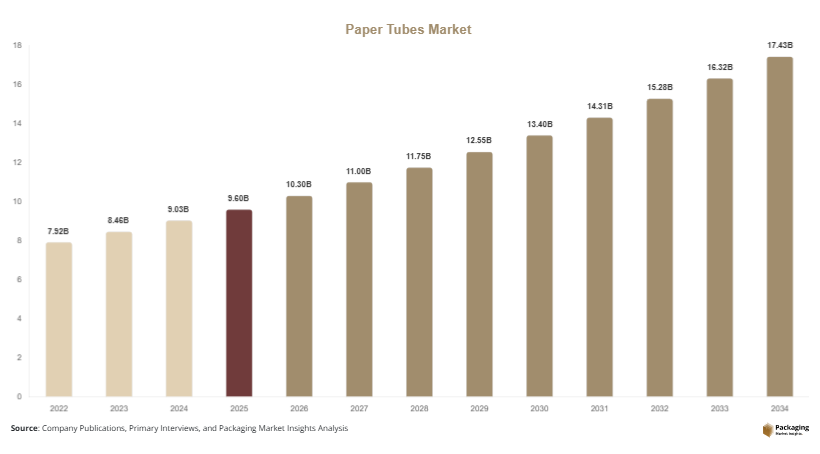
The global paper tubes market size was valued at USD 9.6 billion in 2025 and is projected to reach USD 10.3 billion in 2026, further expanding to USD 17.8 billion by 2034, registering a compound annual growth rate (CAGR) of 6.8% from 2025 to 2034. This growth reflects the rising demand for eco-friendly packaging materials and the expanding use of paper tubes across multiple industrial applications. The paper tubes market is experiencing steady growth as industries increasingly adopt sustainable and cost-effective packaging and industrial solutions.
One of the primary factors driving market growth is the increasing shift toward sustainable packaging solutions. As governments and organizations implement regulations to reduce plastic usage, paper-based alternatives such as paper tubes are gaining traction due to their recyclability and biodegradability. Another important growth factor is the expansion of the e-commerce sector, which has increased the demand for protective and lightweight packaging solutions. Paper tubes are widely used for shipping documents, textiles, and specialty products, offering durability while reducing environmental impact.
Key Highlights
- Asia Pacific dominated the market with a 39.2% share in 2025, while Latin America is projected to grow at the fastest CAGR of 7.4%.
- Spiral wound tubes led the type segment with a 42.5% share, while convolute wound tubes are expected to grow at a CAGR of 7.1%.
- Recycled paper dominated with a 58.6% share, while virgin paper is forecasted to grow at a CAGR of 6.5%.
- Textile applications led the segment with 36.8% share, while food packaging is expected to grow at a CAGR of 7.3%.
- China remained the dominant country with a market size of USD 3.4 billion in 2025 and USD 3.7 billion in 2026.
Explore more data points, trends and opportunities Download Free Sample Report
Market Trends
Increasing adoption of sustainable packaging solutions
The shift toward environmentally sustainable packaging is a prominent trend influencing the paper tubes market. Businesses across industries are replacing plastic and metal packaging with paper-based alternatives to reduce environmental impact and comply with regulatory requirements. Paper tubes offer recyclability and biodegradability, making them an attractive option for companies aiming to align with sustainability goals. Retail and e-commerce sectors are increasingly using paper tubes for packaging products such as posters, cosmetics, and specialty goods. This trend is further supported by consumer preference for eco-friendly packaging, which is influencing purchasing decisions and encouraging brands to adopt paper-based solutions.
Advancements in manufacturing technologies
Technological advancements in paper tube manufacturing are significantly enhancing product performance and expanding application areas. Innovations in adhesive formulations, layering techniques, and automated production processes are improving the strength, durability, and customization of paper tubes. Manufacturers are developing high-strength tubes capable of supporting heavy loads, making them suitable for industrial applications such as construction and textiles. Additionally, digital printing technologies are enabling better branding and product differentiation. These advancements are increasing the versatility of paper tubes and driving their adoption across diverse industries.
Market Drivers
Rising demand from industrial applications
The growing demand for paper tubes in industrial applications is a key driver of market growth. Industries such as textiles, paper manufacturing, and construction rely heavily on paper tubes as cores for winding materials. These tubes provide structural support and facilitate efficient handling and transportation of products. The expansion of manufacturing activities and increasing production volumes are driving the demand for paper tubes. Additionally, their cost-effectiveness and ease of customization make them a preferred choice for industrial applications, further supporting market growth.
Growth of e-commerce and retail sectors
The rapid expansion of e-commerce and retail sectors is significantly contributing to the growth of the paper tubes market. Online retailers require packaging solutions that are lightweight, durable, and environmentally friendly. Paper tubes meet these requirements and are widely used for shipping products such as documents, posters, and small consumer goods. The increasing volume of online transactions is driving demand for protective packaging solutions, boosting the adoption of paper tubes. Furthermore, the emphasis on sustainable packaging in the retail sector is encouraging the use of paper-based materials, supporting market expansion.
Market Restraint
Fluctuating raw material prices and supply challenges
The paper tubes market faces challenges related to fluctuating raw material prices and supply constraints. The primary raw material used in paper tube production is paper, which is subject to price volatility due to changes in supply and demand, as well as environmental regulations affecting pulp production. These fluctuations can impact production costs and profit margins for manufacturers. Additionally, disruptions in the supply chain can lead to delays in production and increased operational costs. For example, shortages of recycled paper can affect the availability of raw materials, limiting production capacity. These challenges can hinder market growth, particularly for small and medium-sized enterprises.
Market Opportunities
Expansion in emerging markets
Emerging markets present significant growth opportunities for the paper tubes market. Rapid industrialization, urbanization, and increasing consumer demand for packaged goods are driving the need for efficient packaging solutions. Countries in Asia, Latin America, and Africa are experiencing growth in manufacturing and retail sectors, creating demand for paper tubes. Governments in these regions are also promoting sustainable practices, encouraging the use of paper-based packaging. As infrastructure improves and awareness increases, emerging markets are expected to contribute significantly to global market growth.
Innovation in product design and applications
Continuous innovation in product design and applications is creating new opportunities for market expansion. Manufacturers are developing customized paper tubes with enhanced strength, moisture resistance, and aesthetic appeal to meet specific industry requirements. These innovations are enabling the use of paper tubes in new applications such as premium packaging and specialty products. Additionally, the integration of smart packaging features, such as QR codes and tracking systems, is enhancing product functionality. As industries seek innovative and sustainable packaging solutions, the demand for advanced paper tubes is expected to grow.
Report Scope
| Report Metric | Details |
|---|---|
| Market Size in 2025 | USD 9.6 Billion |
| Market Size in 2026 | USD 10.3 Billion |
| Market Size in 2034 | USD 17.8 Billion |
| CAGR | 6.8% (2026-2034) |
| Base Year for Estimation | 2025 |
| Historical Data | 2022-2024 |
| Forecast Period | 2026-2034 |
| Report Coverage | Revenue Forecast, Competitive Landscape, Supply Chain Disruption, Growth Factors, Environment & Regulatory Landscape and Trends |
| Geographies Covered | North America, Europe, APAC, Middle East and Africa, LATAM |
| Countries Covered | U.S., Canada, U.K., Germany, France, Spain, Italy, Russia, Nordic, Benelux, Rest of Europe, China, South Korea, Japan, India, Australia, Singapore, Taiwan, South East Asia, Rest of Asia-Pacific, UAE, Turky, Saudi Arabia, South Africa, Egypt, Nigeria, Rest of MEA, Brazil, Mexico, Argentina, Chile, Colombia, Rest of LATAM |
Explore more data points, trends and opportunities Download Free Sample Report
Segmental Analysis
By Type
Spiral wound tubes accounted for the largest share of 42.5% in 2024, driven by their high strength and cost-effectiveness. These tubes are widely used in industries such as textiles and paper manufacturing for winding applications. Their ability to support heavy loads makes them suitable for industrial use.
Convolute wound tubes are expected to grow at the fastest CAGR of 7.1% during the forecast period. The growth is driven by their superior strength and smooth surface, making them suitable for high-end packaging applications.
By Material
Recycled paper held a dominant share of 58.6% in 2024 due to its environmental benefits and cost advantages. The use of recycled materials aligns with sustainability goals and reduces production costs.
Virgin paper is projected to grow at the fastest CAGR of 6.5%, driven by its superior strength and quality. It is widely used in applications requiring high durability and performance.
By Application
Textile applications dominated the market with a 36.8% share in 2024. Paper tubes are extensively used as cores for winding fabrics and yarns, supporting manufacturing processes.
Food packaging is expected to grow at the fastest CAGR of 7.3%, driven by increasing demand for sustainable packaging solutions in the food industry.
Paper Tubes Market Segmentations
By Type
- Spiral Wound Tubes
- Convolute Wound Tubes
By Material
- Recycled Paper
- Virgin Paper
By Application
- Textiles
- Food Packaging
- Construction
- Industrial
Regional Analysis
North America
North America accounted for approximately 23.5% of the paper tubes market share in 2025 and is projected to grow at a CAGR of 6.3% during the forecast period. The region’s growth is driven by increasing demand for sustainable packaging solutions and the presence of established manufacturing industries. Companies are adopting paper tubes to reduce environmental impact and comply with regulatory standards.
The United States dominates the regional market due to its strong industrial base and advanced packaging sector. A key growth factor is the increasing adoption of eco-friendly packaging in e-commerce and retail industries, which is driving demand for paper tubes.
Europe
Europe held a 21.8% share of the market in 2025 and is expected to grow at a CAGR of 6.6%. The region is characterized by strict environmental regulations and a strong focus on sustainability. Industries are increasingly adopting paper-based packaging solutions to reduce plastic usage.
Germany leads the European market, supported by its robust manufacturing sector and recycling infrastructure. A unique growth factor is the widespread adoption of circular economy practices, which encourage the use of recyclable materials such as paper tubes.
Asia Pacific
Asia Pacific dominated the market with a 39.2% share in 2025 and is projected to grow at a CAGR of 7.2%. The region’s growth is driven by rapid industrialization and increasing demand for packaging solutions. Countries such as China and India are major contributors to market expansion.
China remains the dominant country in the region due to its large manufacturing base and growing packaging industry. A key growth factor is the increasing demand for paper tubes in textile and paper industries.
Middle East & Africa
The Middle East & Africa region accounted for 7.0% of the market share in 2025 and is expected to grow at a CAGR of 6.1%. The market is gradually expanding as industries adopt sustainable packaging solutions.
The United Arab Emirates leads the regional market, driven by its focus on sustainability and industrial development. A unique growth factor is the increasing use of paper tubes in construction and infrastructure projects.
Latin America
Latin America held a 8.5% share in 2025 and is projected to grow at the fastest CAGR of 7.4%. The region is witnessing increased adoption of paper-based packaging due to environmental concerns.
Brazil dominates the market, supported by its growing manufacturing and retail sectors. A key growth factor is the rising demand for sustainable packaging solutions in the food and beverage industry.
Competitive Landscape
The paper tubes market is moderately fragmented, with several global and regional players competing for market share. Companies are focusing on innovation, cost efficiency, and sustainability to strengthen their positions. Sonoco Products Company is recognized as a leading player due to its extensive product portfolio and global presence. The company has recently introduced advanced paper tube solutions with enhanced durability and sustainability features.
Other key players are investing in research and development to improve product quality and expand application areas. Strategic partnerships and acquisitions are also common, enabling companies to enhance their capabilities and market reach.
Key Players List
- Sonoco Products Company
- Smurfit Kappa Group
- DS Smith plc
- Mondi Group
- WestRock Company
- Caraustar Industries Inc.
- Valk Industries Inc.
- Chicago Mailing Tube Co.
- Yazoo Mills Inc.
- Ace Paper Tube Corporation
- Pacific Paper Tube Inc.
- Ridgid Paper Tube Corporation
- Ox Industries Inc.
- Kunert Group
- Romiley Board Mill