Packaging Watermarking Technology Market Size and Growth
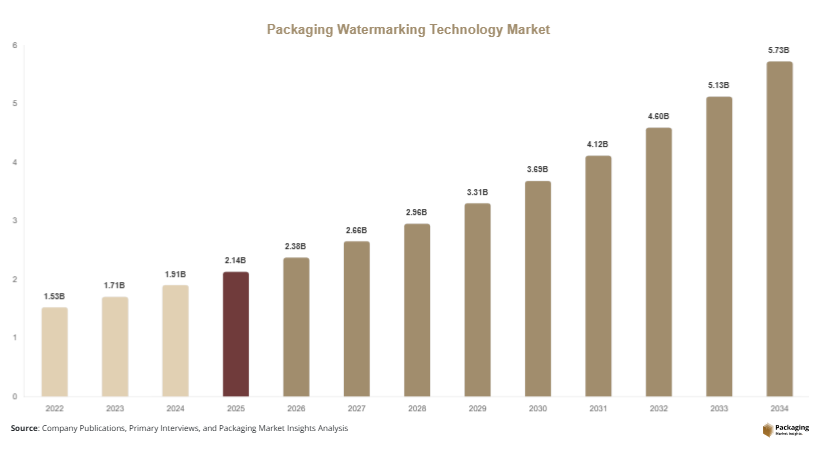
The global packaging watermarking technology market size was valued at approximately USD 2.14 billion in 2025 and is projected to reach USD 2.38 billion in 2026. By 2034, the market is forecast to reach nearly USD 6.41 billion, expanding at a CAGR of 11.6% during 2025–2034. Growing emphasis on smart packaging solutions and increasing regulatory focus on packaging traceability are key factors supporting market expansion.
The packaging watermarking technology market is gaining significant momentum as manufacturers, retailers, and recycling companies increasingly adopt advanced digital identification solutions to improve product traceability, anti-counterfeiting measures, and recycling efficiency. Packaging watermarking technology involves embedding invisible or semi-visible digital codes into product packaging materials, enabling automated scanning, authentication, and material sorting across supply chains. These technologies are widely used in food packaging, pharmaceuticals, personal care products, and consumer electronics packaging.
Key Highlights
- Europe dominated the market with a 35.1% share in 2025.
- Asia Pacific is expected to grow at the fastest CAGR of 12.4%.
- Invisible digital watermarking technologies accounted for 49.3% share in 2025.
- Food & beverage applications led the market with a 38.7% share due to increasing traceability requirements.
- Plastic packaging materials dominated implementation with a 54.2% market share.
- The US remained the leading country in North America with a market size of USD 0.46 billion in 2025 and USD 0.51 billion in 2026.
Explore more data points, trends and opportunities Download Free Sample Report
Market Trends
Integration of AI-Based Scanning and Smart Recycling Systems
One of the major trends shaping the packaging watermarking technology market is the integration of AI-powered scanning systems with automated recycling infrastructure. Digital watermarking allows packaging materials to carry invisible identification codes that can be recognized by advanced optical scanners in waste sorting facilities. These systems improve material classification accuracy and increase recycling efficiency. For example, packaging companies in Europe are collaborating with recycling technology providers to deploy AI-enabled sorting lines capable of identifying food-grade plastics and multilayer materials using digital watermarks. This trend is expected to strengthen as governments and manufacturers invest in circular economy initiatives and advanced recycling technologies.
Growing Adoption of Connected and Interactive Packaging
Another important trend is the increasing use of connected packaging solutions that enable consumer engagement and product authentication through digital watermarking technologies. Brands are embedding invisible watermarks into labels and packaging designs to provide access to product information, promotional content, and supply chain transparency using smartphone scanning applications. For instance, cosmetics and premium beverage brands are deploying interactive packaging campaigns that allow consumers to verify product authenticity and access sustainability data. Future developments in augmented reality integration and cloud-based product tracking platforms are expected to further expand the role of watermarking technologies in marketing and brand protection strategies.
Market Drivers
Rising Demand for Anti-Counterfeiting Solutions
The increasing prevalence of counterfeit products in pharmaceutical, food, and luxury goods industries is a major factor driving the packaging watermarking technology market. Counterfeit products can negatively impact consumer safety, brand reputation, and regulatory compliance. Packaging watermarking technologies help manufacturers authenticate products and track supply chain movements using machine-readable identifiers embedded within packaging graphics. For example, pharmaceutical companies are implementing digital watermarking systems to ensure product authenticity and reduce risks associated with counterfeit medicines. Growing awareness regarding product safety and increasing government regulations on traceability are expected to strengthen market demand.
Increasing Focus on Sustainable Packaging and Recycling Efficiency
The growing emphasis on sustainability and waste reduction is another significant market driver. Recycling facilities often struggle to accurately sort complex packaging materials, reducing recovery efficiency and increasing contamination rates. Digital watermarking systems improve sorting precision by enabling optical scanners to identify packaging composition and recycling instructions in real time. For example, beverage packaging companies are adopting watermarking technologies to improve PET bottle recycling rates and support closed-loop recycling systems. As governments implement stricter recycling targets and extended producer responsibility regulations, demand for intelligent packaging identification technologies is expected to rise steadily.
Market Restraint
High Implementation Costs and Technology Integration Challenges
Despite growing adoption, the packaging watermarking technology market faces challenges related to high implementation costs and integration complexity. Deploying digital watermarking systems requires investment in specialized printing technologies, high-resolution imaging systems, software integration platforms, and scanning infrastructure. Small and medium-sized packaging manufacturers may face financial limitations when upgrading existing production systems to support watermark embedding technologies.
For example, companies operating traditional packaging lines may require extensive modifications to integrate invisible coding systems and machine-readable graphic structures. In addition, recycling facilities adopting digital watermark detection systems must invest in advanced optical sorting equipment and AI-based image processing technologies. These costs can slow adoption, particularly in developing economies with limited technological infrastructure.
Another challenge is the lack of universal standardization across watermarking platforms and scanning systems. Packaging manufacturers, retailers, and recycling operators may use different coding protocols, reducing interoperability and operational efficiency. Training requirements and technical expertise shortages also create barriers to implementation. Until industry-wide standards and cost-effective deployment models become more widely available, these operational and financial constraints may limit broader market penetration.
Market Opportunities
Expansion in Pharmaceutical Serialization and Traceability
The pharmaceutical sector presents major growth opportunities for packaging watermarking technology providers. Governments and healthcare regulators are increasingly mandating product serialization and traceability systems to combat counterfeit medicines and improve patient safety. Digital watermarking technologies can support secure product authentication while enabling real-time supply chain monitoring. Pharmaceutical companies are integrating watermarking solutions into medicine cartons, blister packs, and labels to strengthen product security. Future advancements in blockchain integration and cloud-based authentication systems are expected to create additional opportunities for technology providers serving healthcare industries.
Growth in Smart Retail and Inventory Management Applications
The rise of smart retail environments and automated inventory management systems is creating new opportunities for digital packaging watermarking technologies. Retailers are adopting machine-readable packaging systems to improve inventory tracking, reduce checkout times, and enhance customer engagement. For example, supermarkets are testing smart shelf systems capable of reading invisible package identifiers for automated stock monitoring and dynamic pricing applications. Watermarking technologies can also improve omnichannel retail operations by enabling real-time product traceability across supply chains. Increasing investment in connected retail infrastructure is expected to support long-term market growth.
Report Scope
| Report Metric | Details |
|---|---|
| Market Size in 2025 | USD 2.14 Billion |
| Market Size in 2026 | USD 2.38 Billion |
| Market Size in 2034 | USD 6.41 Billion |
| CAGR | 11.6% (2026-2034) |
| Base Year for Estimation | 2025 |
| Historical Data | 2022-2024 |
| Forecast Period | 2026-2034 |
| Report Coverage | Revenue Forecast, Competitive Landscape, Supply Chain Disruption, Growth Factors, Environment & Regulatory Landscape and Trends |
| Geographies Covered | North America, Europe, APAC, Middle East and Africa, LATAM |
| Countries Covered | U.S., Canada, U.K., Germany, France, Spain, Italy, Russia, Nordic, Benelux, Rest of Europe, China, South Korea, Japan, India, Australia, Singapore, Taiwan, South East Asia, Rest of Asia-Pacific, UAE, Turky, Saudi Arabia, South Africa, Egypt, Nigeria, Rest of MEA, Brazil, Mexico, Argentina, Chile, Colombia, Rest of LATAM |
Explore more data points, trends and opportunities Download Free Sample Report
Segmental Analysis
By Technology Type
Invisible digital watermarking technologies dominated the market with a 49.3% share in 2024, primarily due to their ability to integrate seamlessly into packaging designs without affecting visual appearance. These technologies are widely used in food, pharmaceutical, and luxury goods packaging because they enable product authentication and traceability while maintaining branding aesthetics. Manufacturers prefer invisible watermarking systems because they are difficult to replicate and can be scanned using specialized optical systems. For example, pharmaceutical packaging companies are embedding invisible digital identifiers into medicine labels to support anti-counterfeiting initiatives and regulatory compliance. The growing focus on secure packaging solutions continues to support segment dominance across global industries.
Blockchain-integrated watermarking systems are projected to be the fastest-growing segment, registering a CAGR of 12.9% during the forecast period. Growth is driven by increasing demand for secure supply chain tracking and real-time product verification. These systems combine digital watermarking with blockchain-based data storage to create tamper-resistant traceability networks. Food manufacturers and luxury product brands are increasingly adopting blockchain-enabled watermarking solutions to improve transparency and consumer trust. Future advancements in cloud connectivity and decentralized authentication platforms are expected to strengthen adoption across high-value product categories and international trade operations.
By Packaging Material
Plastic packaging materials accounted for approximately 54.2% market share in 2024, supported by widespread use of plastic packaging across food, beverage, pharmaceutical, and consumer goods industries. Digital watermarking technologies are extensively implemented on plastic packaging because these materials are commonly processed in automated recycling systems and retail supply chains. Beverage manufacturers, for example, are integrating invisible digital codes into PET bottle labels to improve recycling efficiency and material traceability. The large installed base of plastic packaging infrastructure and growing investment in smart recycling technologies continue to strengthen this segment’s market position.
Paper and paperboard packaging materials are expected to register the fastest CAGR of 12.2% during 2025–2034. Growth is supported by rising demand for sustainable packaging and increasing adoption of recyclable paper-based packaging formats. Retailers and FMCG companies are implementing watermarking technologies on paper cartons and corrugated packaging to improve product authentication and inventory tracking. Advancements in digital printing and optical scanning technologies are making it easier to integrate machine-readable identifiers into paper packaging structures. Increasing environmental regulations aimed at reducing plastic waste are expected to further accelerate segment growth.
By End-Use
The food & beverage segment dominated the packaging watermarking technology market with a 38.7% share in 2024, driven by increasing traceability requirements and growing investments in smart packaging solutions. Food manufacturers and beverage companies are implementing digital watermarking systems to improve supply chain visibility, reduce counterfeiting risks, and support recycling programs. For example, packaged food companies are embedding digital identifiers into labels and flexible packaging to improve product tracking and waste sorting efficiency. Expansion of modern retail channels and stricter food safety regulations continue to support strong adoption across the food and beverage sector.
Pharmaceutical applications are expected to grow at the fastest CAGR of 12.7% during the forecast period. Growth is driven by increasing regulatory requirements for serialization, product authentication, and secure supply chain monitoring. Pharmaceutical companies are adopting advanced watermarking technologies to prevent counterfeit medicines and improve patient safety. Digital watermarking systems also support automated inventory management and compliance reporting in healthcare distribution networks. Rising investments in connected healthcare packaging and smart authentication platforms are expected to create long-term growth opportunities for technology providers serving pharmaceutical industries.
Packaging Watermarking Technology Market Segmentations
By Technology Type
- Invisible Digital Watermarking
- Visible Watermarking
- Blockchain-Integrated Watermarking
- QR and Hybrid Watermarking Systems
By Packaging Material
- Plastic Packaging
- Paper & Paperboard Packaging
- Glass Packaging
- Metal Packaging
By End-User
- Food & Beverage
- Pharmaceuticals
- Personal Care & Cosmetics
- Consumer Electronics
- Retail & Logistics
By Distribution Channel
- Direct Enterprise Solutions
- Packaging Technology Providers
- Cloud-Based Authentication Platforms
- Industrial Automation Integrators
- Digital Printing Solution Providers
Regional Analysis
North America
North America accounted for approximately 28.4% market share in 2025 and is projected to grow at a CAGR of 10.8% during 2025–2034. The region benefits from strong adoption of smart packaging technologies and advanced recycling infrastructure. Food, pharmaceutical, and retail industries are increasingly implementing digital watermarking systems to improve traceability and operational efficiency. Growing investments in AI-based recycling systems and connected packaging technologies are supporting market growth across the United States and Canada.
The United States dominates the regional market due to its advanced packaging technology ecosystem and strong anti-counterfeiting regulations. A unique growth factor is the increasing deployment of digital watermarking technologies in pharmaceutical serialization systems. Major healthcare manufacturers are integrating invisible coding systems into medicine packaging to strengthen product authentication and regulatory compliance.
Europe
Europe held the largest market share of 35.1% in 2025 and is expected to expand at a CAGR of 11.4% during the forecast period. The region’s leadership is supported by strong circular economy policies and increasing investments in smart recycling infrastructure. Governments and packaging companies are actively promoting digital watermarking systems to improve waste sorting and packaging traceability.
Germany dominates the European market because of its advanced recycling infrastructure and packaging innovation ecosystem. A unique growth factor is the country’s focus on AI-enabled waste sorting systems integrated with digital watermark recognition technologies. Packaging manufacturers and recycling operators are collaborating to improve material recovery rates and support sustainable packaging initiatives.
Asia Pacific
Asia Pacific represented approximately 26.7% market share in 2025 and is forecast to grow at the fastest CAGR of 12.4% through 2034. Rapid industrialization, increasing packaged food consumption, and growing investments in smart manufacturing technologies are driving regional demand. Countries such as China, Japan, and India are increasingly adopting digital packaging technologies to improve supply chain visibility and recycling efficiency.
China dominates the regional market due to its large-scale packaging manufacturing industry and expanding e-commerce sector. A unique growth factor is the increasing integration of smart packaging identification technologies into logistics and retail operations. Chinese retailers and logistics providers are investing in connected packaging systems to improve product tracking and inventory automation.
Middle East & Africa
The Middle East & Africa accounted for nearly 4.7% market share in 2025 and is projected to grow at a CAGR of 9.3% during the forecast period. The market is gradually expanding due to increasing adoption of digital packaging technologies in retail and pharmaceutical industries. Rising focus on product authentication and anti-counterfeiting measures is supporting demand for intelligent packaging systems.
The United Arab Emirates dominates the regional market due to growing investments in smart retail infrastructure and logistics technologies. A unique growth factor is the rapid adoption of connected packaging systems in luxury retail and premium consumer goods sectors. Retailers are implementing interactive packaging technologies to improve customer engagement and product verification.
Latin America
Latin America represented approximately 5.1% market share in 2025 and is expected to expand at a CAGR of 11.1% during the forecast period. Rising awareness regarding recycling efficiency and increasing investments in packaged consumer goods industries are supporting market development. Brazil and Mexico are major contributors to regional growth.
Brazil dominates the Latin American market due to expanding food and beverage manufacturing industries. A unique growth factor is the increasing adoption of digital packaging identification systems in beverage recycling programs. Packaging companies are collaborating with recycling facilities to improve sorting accuracy and support sustainability initiatives across urban markets.
Competitive Landscape
The packaging watermarking technology market is moderately competitive, with technology providers, packaging companies, and digital printing firms focusing on smart packaging innovation and supply chain integration. Key companies operating in the market include Digimarc Corporation, Avery Dennison Corporation, SICPA Holding SA, Zebra Technologies Corporation, and AlpVision SA. Among these, Digimarc Corporation is recognized as a leading player due to its strong digital watermarking technology portfolio and strategic partnerships with packaging manufacturers and recycling organizations.
Companies are investing heavily in AI-enabled scanning technologies, blockchain-based authentication systems, and connected packaging platforms to strengthen market presence. Strategic collaborations with retailers, recycling facilities, and FMCG companies are accelerating commercialization of intelligent packaging systems. Recent developments include expansion of digital watermark-enabled recycling programs and deployment of invisible coding systems for pharmaceutical product authentication.
Key Players List
- Digimarc Corporation
- Avery Dennison Corporation
- SICPA Holding SA
- Zebra Technologies Corporation
- AlpVision SA
- Domino Printing Sciences plc
- Videojet Technologies Inc.
- HP Inc.
- Markem-Imaje
- Honeywell International Inc.
- Toppan Inc.
- EVRYTHNG Ltd.
- Kezzler AS
- Scantrust SA
- Optel Group