Packaging Waste Recycling Market Size and Growth
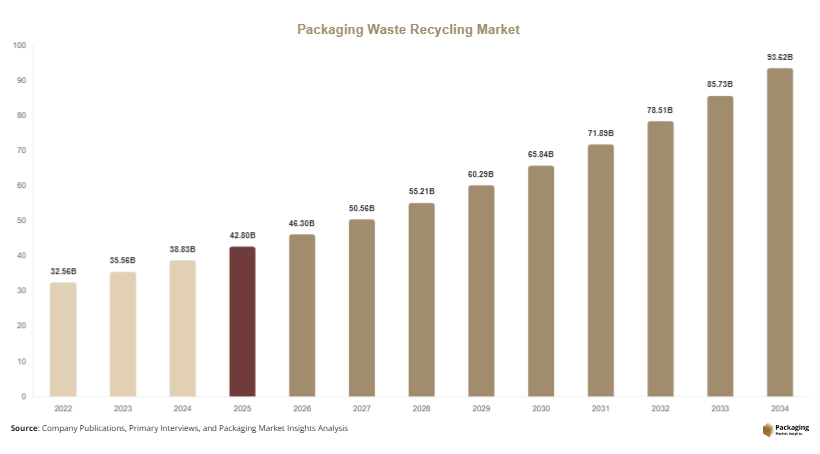
In 2025, the global Packaging Waste Recycling Market size is estimated at approximately USD 42.8 billion. By 2026, it is projected to reach around USD 46.3 billion, reflecting consistent growth in recycling infrastructure investments and policy-driven adoption across major economies. Looking ahead, the market is expected to reach nearly USD 98.6 billion by 2034, expanding at a CAGR of 9.2% during the forecast period from 2025 to 2034. The packaging waste recycling market is witnessing steady expansion driven by tightening environmental regulations, increasing corporate sustainability commitments, and rising global awareness regarding plastic pollution and circular economy models.
Several key factors are contributing to this upward trajectory. First, government regulations banning single-use plastics and mandating recycled content in packaging are significantly boosting demand for recycling services. Second, rapid growth in e-commerce and food delivery sectors has increased packaging waste generation, necessitating efficient recovery systems. Third, advancements in sorting, chemical recycling, and AI-driven waste management technologies are improving recycling efficiency and profitability for stakeholders.
Key Highlights:
- Market size (2025): USD 42.8 billion, reflecting steady expansion driven by regulatory pressure and rising recycling infrastructure investments across developed and emerging economies. The market continues to benefit from increasing adoption of circular economy practices.
- Market size (2026): USD 46.3 billion, supported by growing demand for advanced recycling technologies and increased corporate participation in sustainable packaging initiatives. Expansion is also driven by stricter waste management policies globally.
- Forecast size (2034): USD 98.6 billion, indicating strong long-term growth as recycling systems become more integrated with industrial supply chains. Rising investments in chemical recycling and AI-enabled waste processing further support this outlook.
- CAGR (2025–2034): 9.2%, driven by rapid technological advancements, regulatory enforcement on packaging waste reduction, and increasing consumer demand for sustainable and recyclable packaging solutions.
- Strong regulatory push toward circular economy initiatives, with governments enforcing extended producer responsibility (EPR) programs and mandatory recycling targets. These policies are significantly increasing demand for structured packaging waste recovery systems.
- Increasing adoption of AI-enabled recycling systems, improving sorting accuracy, operational efficiency, and material recovery rates. Automation and smart waste management technologies are reducing contamination issues and lowering overall recycling costs.
- Rising demand from e-commerce and food packaging sectors, driven by rapid growth in online retail and food delivery services. This is significantly increasing packaging waste volumes, creating strong demand for efficient recycling solutions.
Explore more data points, trends and opportunities Download Free Sample Report
Market Trends
Expansion of Chemical Recycling Technologies
Chemical recycling is emerging as a transformative trend in the packaging waste recycling market. Unlike traditional mechanical recycling, chemical recycling breaks down plastic waste into its molecular components, allowing for higher-quality recycled outputs. This is particularly important for multilayer and contaminated packaging materials that were previously difficult to recycle. Between 2025 and 2034, investments in pyrolysis, depolymerization, and gasification technologies are expected to increase significantly. Major packaging firms are collaborating with technology providers to scale pilot plants into commercial facilities. This trend is also supported by regulatory acceptance of chemically recycled outputs as equivalent to virgin materials, enhancing their market usability.
Integration of AI and Smart Sorting Systems
The adoption of artificial intelligence and automation in waste sorting facilities is another significant trend shaping the packaging waste recycling market. AI-powered optical sorting systems, robotics, and sensor-based technologies are improving accuracy in identifying different types of packaging waste. This leads to higher recovery rates and reduced operational costs. Municipalities and private waste operators are increasingly investing in smart recycling plants to enhance efficiency and meet strict recycling targets. The integration of IoT-enabled monitoring systems also allows real-time tracking of waste streams, enabling better data-driven decision-making in recycling operations.
Market Drivers
Strict Environmental Regulations and Plastic Bans
One of the strongest drivers of the packaging waste recycling market is the implementation of strict environmental regulations across global economies. Governments are introducing extended producer responsibility (EPR) policies, mandatory recycling targets, and bans on single-use plastics. These regulatory frameworks compel manufacturers to incorporate recycled content in packaging materials. Europe has been particularly aggressive with circular economy directives, while Asia Pacific countries are rapidly introducing similar mandates. These policies are significantly increasing demand for recycling infrastructure and services, encouraging private sector investment in large-scale recycling facilities and boosting overall market expansion.
Rising Demand from Sustainable Packaging Industry
The growing demand for sustainable packaging solutions is another key driver supporting market growth. Companies in FMCG, food & beverage, and e-commerce sectors are increasingly adopting recycled packaging materials to meet sustainability goals and consumer expectations. Brands are under pressure to reduce their carbon footprint and improve recyclability of packaging formats. As a result, recycled PET, paper, and aluminum packaging materials are witnessing increased utilization. This shift is encouraging recycling companies to scale operations and improve material recovery efficiency, strengthening the overall packaging waste recycling ecosystem.
Market Restraint
Despite strong growth potential, the packaging waste recycling market faces several constraints, with the most significant being high operational and infrastructure costs. Establishing advanced recycling facilities requires substantial capital investment in sorting technologies, chemical processing units, and logistics systems. In many developing regions, limited financial resources and inadequate waste collection infrastructure restrict market penetration. Additionally, contamination of recyclable waste streams reduces efficiency and increases processing costs, making recycling economically challenging in certain cases. For example, mixed plastic waste with food contamination often requires additional cleaning processes, which further increases operational complexity. These challenges collectively slow down adoption rates and create disparities between developed and emerging markets in recycling efficiency and scalability.
Market Opportunities
Growth of Circular Economy Business Models
The increasing shift toward circular economy frameworks presents a major opportunity in the packaging waste recycling market. Businesses are transitioning from linear "produce-use-dispose" models to closed-loop systems where packaging materials are continuously reused and recycled. This transformation is encouraging collaborations between packaging manufacturers, waste management firms, and technology providers. Governments are also supporting circular initiatives through subsidies and tax incentives. As a result, companies investing in closed-loop recycling systems are expected to gain competitive advantages, especially in sectors such as retail, FMCG, and e-commerce, where packaging waste volumes are significantly high.
Expansion in Emerging Economies
Emerging economies present strong growth opportunities due to increasing urbanization, rising consumption, and improving waste management infrastructure. Countries in Asia Pacific, Latin America, and parts of Africa are gradually developing structured recycling ecosystems supported by international funding and public-private partnerships. The lack of established recycling infrastructure in these regions provides significant room for investment in collection systems, sorting facilities, and recycling plants. Additionally, growing environmental awareness among consumers in these regions is driving demand for sustainable packaging solutions, further enhancing market expansion opportunities.
Report Scope
| Report Metric | Details |
|---|---|
| Market Size in 2025 | USD 42.8 Billion |
| Market Size in 2026 | USD 46.3 Billion |
| Market Size in 2034 | USD 98.6 Billion |
| CAGR | 9.2% (2026-2034) |
| Base Year for Estimation | 2025 |
| Historical Data | 2022-2024 |
| Forecast Period | 2026-2034 |
| Report Coverage | Revenue Forecast, Competitive Landscape, Supply Chain Disruption, Growth Factors, Environment & Regulatory Landscape and Trends |
| Geographies Covered | North America, Europe, APAC, Middle East and Africa, LATAM |
| Countries Covered | U.S., Canada, U.K., Germany, France, Spain, Italy, Russia, Nordic, Benelux, Rest of Europe, China, South Korea, Japan, India, Australia, Singapore, Taiwan, South East Asia, Rest of Asia-Pacific, UAE, Turky, Saudi Arabia, South Africa, Egypt, Nigeria, Rest of MEA, Brazil, Mexico, Argentina, Chile, Colombia, Rest of LATAM |
Explore more data points, trends and opportunities Download Free Sample Report
Segmental Analysis
By Material Type
Plastic packaging waste dominates this segment with approximately 52% share in 2024, driven by its widespread use in food, beverage, and consumer goods packaging. Plastic remains the most recycled material due to its high volume generation and regulatory pressure to reduce environmental impact.
The fastest-growing subsegment is biodegradable and bio-based packaging waste, projected to grow at a CAGR of 11.3%. Growth is supported by increasing adoption of sustainable packaging alternatives and government incentives promoting compostable and recyclable materials.
By Recycling Process
Mechanical recycling holds the dominant share of around 61% in 2024 due to its established infrastructure and cost efficiency. It is widely used for PET, HDPE, and paper-based packaging materials.
Chemical recycling is the fastest-growing subsegment with a CAGR of 12.1%, driven by its ability to process complex and contaminated waste streams, making it suitable for multilayer packaging materials.
By End-Use Industry
The food and beverage industry dominates with approximately 38% share in 2024 due to high packaging consumption and stringent sustainability regulations. This sector generates large volumes of recyclable waste, particularly plastic and paper packaging.
The e-commerce sector is the fastest-growing end-use segment, expanding at a CAGR of 10.9% due to rapid online retail growth and increasing demand for sustainable packaging solutions in logistics and shipping operations.
Packaging Waste Recycling Market Segmentations
By Material Type
- Plastic
- Paper & Paperboard
- Glass
- Metal
- Biodegradable Materials
By Recycling Process
- Mechanical Recycling
- Chemical Recycling
- Energy Recovery
- Advanced Sorting & Recovery
By End-Use Industry
- Food & Beverage
- E-commerce & Retail
- Healthcare & Pharmaceuticals
- Consumer Goods
- Industrial Packaging
Regional Analysis
North America
North America holds approximately 28% market share in 2025 and is projected to grow at a CAGR of 8.7% during the forecast period. The region benefits from strong regulatory frameworks and advanced recycling infrastructure.
The United States dominates the regional market, driven by increasing investments in municipal recycling programs and corporate sustainability initiatives across packaging-intensive industries.
Europe
Europe accounts for around 30% market share in 2025 with a CAGR of 9.5%. The region leads in circular economy adoption and strict waste management regulations.
Germany is the dominant country due to its advanced recycling systems and strong policy enforcement promoting high recycling rates for packaging waste.
Asia Pacific
Asia Pacific holds nearly 24% market share in 2025 and is expected to grow at a CAGR of 10.8%, the fastest globally.
China leads the region, driven by rapid industrialization and government-led initiatives to reduce plastic waste and enhance recycling infrastructure.
Middle East & Africa
The Middle East & Africa region represents about 10% market share in 2025 with a CAGR of 8.9%. Growth is driven by increasing urbanization and sustainability programs.
The United Arab Emirates is the dominant country, supported by smart city initiatives and investments in advanced waste management systems.
Latin America
Latin America holds around 8% market share in 2025 and is projected to grow at a CAGR of 9.1%. Expansion is driven by rising environmental awareness and policy reforms.
Brazil leads the region due to increasing investments in recycling infrastructure and growing industrial packaging waste generation.
Competitive Landscape
The packaging waste recycling market is moderately fragmented, with several global and regional players competing through technological innovation and capacity expansion. Key companies include Veolia Environment, Waste Management Inc., SUEZ Recycling, Republic Services, and DS Smith. Veolia Environment remains a leading player due to its extensive global recycling infrastructure and continuous investment in advanced sorting technologies and circular economy projects. Recently, the company expanded its chemical recycling capabilities through new partnerships aimed at scaling plastic-to-feedstock conversion facilities, strengthening its position in the sustainable packaging ecosystem.
Key Players List
- Veolia Environment
- Waste Management Inc.
- SUEZ Recycling
- Republic Services
- DS Smith
- Biffa plc
- Clean Harbors
- Stericycle Inc.
- Covanta Holding Corporation
- Remondis SE & Co. KG
- Waste Connections Inc.
- ALBA Group
- Plastipak Holdings
- Tomra Systems ASA
- Umicore SA