Packaging Vacuum Coater Market Size and Growth
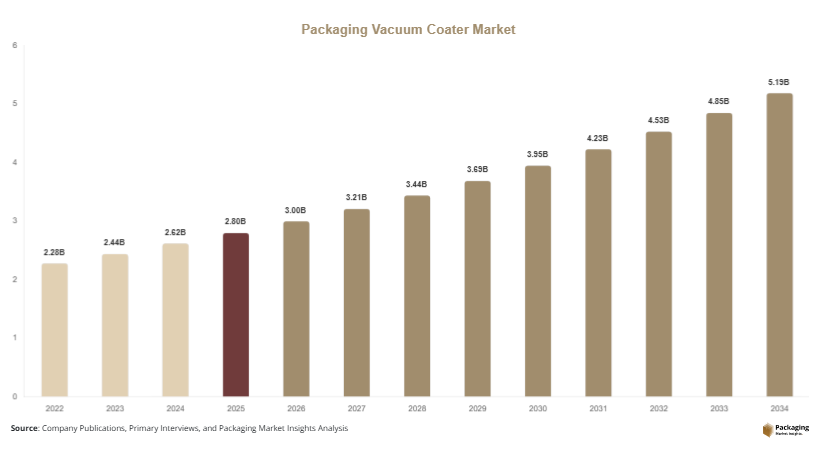
The global packaging vacuum coater market was valued at approximately USD 2.8 billion in 2025 and is projected to reach USD 3.0 billion in 2026. By 2034, the market is forecasted to reach nearly USD 5.4 billion, expanding at a CAGR of 7.1% during 2025–2034. The packaging vacuum coater market is experiencing consistent growth due to increasing demand for high-barrier packaging materials, rising adoption of sustainable packaging technologies, and expanding food and pharmaceutical packaging industries. Packaging vacuum coaters are specialized systems used to apply thin metallic or functional coatings on flexible films, paper, and polymer substrates under vacuum conditions. These coatings improve barrier protection against moisture, oxygen, light, and contaminants while enhancing packaging appearance and shelf life.
One of the major growth factors supporting the packaging vacuum coater market is the increasing consumption of packaged food products globally. Food manufacturers are increasingly adopting metallized and coated packaging films to preserve freshness and extend shelf life. Another important factor is the growing pharmaceutical packaging industry, where vacuum-coated films are used to provide moisture resistance and product protection for medicines and healthcare products. Additionally, the expansion of e-commerce and retail packaging applications is creating demand for visually attractive and durable packaging materials.
Key Highlights
- Asia Pacific dominated the market with a 41.8% share in 2025.
- Latin America is projected to grow at the fastest CAGR of 7.6%.
- Metallizing vacuum coaters led the type segment with a 48.2% share.
- Flexible packaging applications dominated with a 54.3% share.
- Food & beverage end-use led the market with 46.8% share.
- The US remained the dominant country with a market size of USD 620 million in 2025 and USD 670 million in 2026.
Explore more data points, trends and opportunities Download Free Sample Report
Market Trends
Increasing Adoption of Sustainable Barrier Coating Technologies
Sustainability is becoming a major trend in the packaging vacuum coater market as packaging manufacturers seek alternatives to traditional multilayer plastic laminates. Vacuum coating technologies are increasingly being used to develop recyclable mono-material packaging structures with enhanced barrier performance. Manufacturers are adopting thin-film coating technologies that reduce material usage while maintaining moisture and oxygen resistance. This trend is particularly strong in food and beverage packaging applications where regulatory pressure and consumer awareness are encouraging environmentally responsible packaging solutions. Equipment manufacturers are introducing vacuum coaters compatible with biodegradable films, paper-based substrates, and recyclable polymer materials. The growing emphasis on circular packaging economies is expected to significantly influence future coating system development and investment strategies.
Integration of High-Speed Automation and Digital Process Monitoring
Automation and digital process control are becoming increasingly important in the packaging vacuum coater market as manufacturers seek improved production efficiency and coating precision. Modern vacuum coating systems are being equipped with AI-assisted monitoring tools, touchscreen interfaces, and real-time deposition control technologies that improve coating consistency and reduce downtime. Automated roll handling systems and predictive maintenance software are also helping manufacturers optimize operational performance and reduce maintenance costs. The growing demand for high-volume flexible packaging production is accelerating adoption of automated vacuum coating equipment. This trend is especially visible in large food packaging and pharmaceutical packaging facilities where production speed and coating accuracy are critical for maintaining packaging quality standards.
Market Drivers
Rising Demand for High-Barrier Flexible Packaging
The increasing demand for high-barrier flexible packaging is one of the primary drivers supporting growth in the packaging vacuum coater market. Food, pharmaceutical, and consumer goods manufacturers are increasingly using metallized and coated films to improve product shelf life and packaging durability. Vacuum coating technologies provide strong oxygen and moisture barrier properties while maintaining lightweight and flexible packaging structures. Growing consumption of packaged snacks, ready-to-eat meals, coffee, dairy products, and pharmaceutical products is significantly increasing demand for coated packaging films. In addition, flexible packaging offers advantages such as lower transportation costs and reduced material usage compared to rigid packaging formats, further encouraging adoption of vacuum-coated packaging materials across global industries.
Expansion of Pharmaceutical and Healthcare Packaging
The pharmaceutical and healthcare industries are significantly contributing to growth in the packaging vacuum coater market. Pharmaceutical packaging applications require advanced barrier protection to prevent moisture penetration, contamination, and product degradation. Vacuum-coated films are widely used in blister packaging, sachets, pouches, and medical packaging due to their excellent barrier performance and product stability characteristics. Rising pharmaceutical production, increasing demand for generic medicines, and expanding healthcare infrastructure are supporting investments in advanced packaging technologies. Pharmaceutical manufacturers are also focusing on sustainable packaging solutions while maintaining strict packaging safety standards. These requirements are encouraging adoption of vacuum coating systems capable of producing high-performance barrier films suitable for pharmaceutical and healthcare applications.
Market Restraint
High Installation Costs and Technical Complexity
One of the major restraints affecting the packaging vacuum coater market is the high capital investment associated with vacuum coating systems and related production infrastructure. Advanced vacuum coating equipment requires sophisticated deposition chambers, vacuum pumps, precision control systems, and automated handling technologies, resulting in substantial installation and operational costs. Small and medium-sized packaging manufacturers may face financial limitations when adopting large-scale vacuum coating technologies. In addition, operating vacuum coating systems requires skilled technical personnel and regular maintenance procedures to maintain coating consistency and equipment efficiency. For example, metallized film production facilities often require continuous calibration and process optimization to achieve uniform coating thickness across high-speed production lines. These technical and financial challenges can limit market adoption, particularly in cost-sensitive packaging markets and developing manufacturing regions.
Market Opportunities
Growth in Recyclable and Mono-Material Packaging Solutions
The increasing shift toward recyclable and mono-material packaging structures presents significant opportunities for the packaging vacuum coater market. Packaging companies are seeking advanced coating technologies capable of replacing traditional multilayer laminates while maintaining strong barrier performance. Vacuum coating systems allow manufacturers to apply ultra-thin metallic and transparent barrier coatings onto recyclable polymer films and paper substrates. This capability supports sustainability objectives while reducing overall packaging material usage. Governments and brand owners are increasingly promoting recyclable packaging formats to reduce environmental impact, encouraging investments in advanced vacuum coating technologies. The growing adoption of sustainable packaging solutions across food, beverage, and consumer goods industries is expected to create long-term market opportunities.
Expansion of Premium Packaging in Consumer Goods Industries
The growing demand for premium packaging solutions in cosmetics, personal care, and electronics industries is creating additional opportunities for packaging vacuum coater manufacturers. Vacuum-coated packaging films provide enhanced visual appeal, glossy finishes, and metallic effects that improve product presentation and brand differentiation. Luxury consumer goods brands are increasingly adopting metallized and decorative packaging materials to strengthen product visibility in retail markets. In addition, vacuum coating technologies improve packaging durability and resistance to external environmental conditions. Rising disposable income and growing consumer preference for visually attractive packaging are expected to increase investments in decorative and functional vacuum coating technologies across global consumer goods industries.
Report Scope
| Report Metric | Details |
|---|---|
| Market Size in 2025 | USD 2.8 Billion |
| Market Size in 2026 | USD 3.0 Billion |
| Market Size in 2034 | USD 5.4 Billion |
| CAGR | 7.1% (2026-2034) |
| Base Year for Estimation | 2025 |
| Historical Data | 2022-2024 |
| Forecast Period | 2026-2034 |
| Report Coverage | Revenue Forecast, Competitive Landscape, Supply Chain Disruption, Growth Factors, Environment & Regulatory Landscape and Trends |
| Geographies Covered | North America, Europe, APAC, Middle East and Africa, LATAM |
| Countries Covered | U.S., Canada, U.K., Germany, France, Spain, Italy, Russia, Nordic, Benelux, Rest of Europe, China, South Korea, Japan, India, Australia, Singapore, Taiwan, South East Asia, Rest of Asia-Pacific, UAE, Turky, Saudi Arabia, South Africa, Egypt, Nigeria, Rest of MEA, Brazil, Mexico, Argentina, Chile, Colombia, Rest of LATAM |
Explore more data points, trends and opportunities Download Free Sample Report
Segmental Analysis
By Type
Metallizing vacuum coaters dominated the packaging vacuum coater market in 2024, accounting for approximately 48.2% of the total market share. These systems are widely used for applying thin aluminum coatings onto plastic films, paper, and flexible substrates to improve barrier performance and visual appearance. Metallized packaging films are extensively utilized in snack food packaging, coffee packaging, pharmaceutical sachets, and decorative consumer goods packaging due to their excellent moisture and oxygen resistance. The increasing demand for lightweight high-barrier packaging solutions is significantly contributing to segment growth. Additionally, metallizing coaters support high-speed production operations and compatibility with flexible packaging materials. Continuous advancements in deposition control technologies and energy-efficient vacuum systems are further strengthening the adoption of metallizing vacuum coating equipment across global packaging industries.
Transparent barrier coaters are projected to be the fastest-growing type segment, expanding at a CAGR of 7.9% during the forecast period. Growth in this segment is driven by increasing demand for recyclable and transparent packaging solutions that maintain product visibility while providing strong barrier protection. Transparent coatings are increasingly used in food, pharmaceutical, and personal care packaging applications where consumers prefer clear product visibility. Packaging manufacturers are investing in advanced oxide coating technologies such as silicon oxide and aluminum oxide coatings to improve packaging sustainability and reduce dependence on traditional multilayer structures. Furthermore, rising regulatory pressure to develop environmentally responsible packaging materials is encouraging adoption of transparent barrier coating systems compatible with recyclable mono-material packaging formats.
By Application
Flexible packaging dominated the application segment in 2024 with approximately 54.3% of the total market share. Vacuum-coated flexible packaging materials are widely used across food, beverage, pharmaceutical, and personal care industries because they provide lightweight, durable, and high-barrier packaging solutions. Flexible packaging reduces transportation costs, improves shelf-life performance, and supports customized packaging designs. Increasing global demand for packaged snacks, ready-to-eat foods, coffee products, and frozen foods is significantly contributing to segment growth. Packaging manufacturers are increasingly adopting vacuum coating technologies to improve moisture resistance and oxygen barrier performance while maintaining packaging flexibility. In addition, growing investments in sustainable flexible packaging production are supporting adoption of advanced coating systems capable of processing recyclable and biodegradable packaging substrates.
Pharmaceutical packaging applications are anticipated to register the fastest CAGR of 7.7% during the forecast period. This growth is supported by rising pharmaceutical production, increasing healthcare demand, and expanding use of moisture-resistant packaging materials. Pharmaceutical products require advanced barrier protection to maintain stability and prevent contamination during storage and transportation. Vacuum-coated films are increasingly used in blister packaging, pouches, and sachets for tablets, capsules, and medical products. Pharmaceutical manufacturers are also focusing on sustainable packaging solutions while complying with strict safety regulations. These trends are encouraging investments in advanced coating technologies capable of producing high-performance pharmaceutical packaging films with improved barrier characteristics and recyclable material compatibility.
By End-Use
Food & beverage companies dominated the end-use segment in 2024, accounting for approximately 46.8% of the total market share. These companies heavily rely on vacuum-coated packaging materials to preserve freshness, extend shelf life, and improve product presentation. Metallized and coated films are extensively used in snack packaging, dairy packaging, coffee pouches, confectionery products, and ready-to-eat meal applications. Rising consumer demand for packaged convenience foods and increasing retail distribution activities are supporting segment growth. Food manufacturers are also emphasizing lightweight and sustainable packaging solutions to reduce transportation costs and environmental impact. Technological advancements in high-speed coating systems and recyclable packaging structures are further increasing adoption of vacuum-coated packaging materials within global food and beverage industries.
Cosmetics packaging is expected to be the fastest-growing end-use segment, expanding at a CAGR of 7.4% during the forecast period. Growth in this segment is driven by increasing consumer demand for premium and visually attractive cosmetic packaging solutions. Vacuum-coated films provide glossy metallic finishes, decorative effects, and improved durability that enhance product visibility in retail environments. Cosmetic brands are increasingly investing in premium flexible packaging and decorative labels to strengthen product differentiation and brand recognition. Additionally, rising demand for sustainable cosmetic packaging materials is encouraging adoption of advanced vacuum coating technologies compatible with recyclable and lightweight substrates. Expanding beauty and personal care industries in emerging markets are also contributing to increasing demand for decorative packaging vacuum coating solutions.
Packaging Vacuum Coater Market Segmentations
By Type
- Metallizing Vacuum Coaters
- Transparent Barrier Coaters
- Roll-to-Roll Vacuum Coaters
- Decorative Vacuum Coaters
By Application
- Flexible Packaging
- Pharmaceutical Packaging
- Industrial Packaging
- Consumer Goods Packaging
By End-User
- Food & Beverage
- Pharmaceuticals
- Cosmetics & Personal Care
- Electronics
Regional Analysis
North America
North America accounted for approximately 27.4% of the global packaging vacuum coater market share in 2025 and is projected to grow at a CAGR of 6.5% during the forecast period. The region benefits from advanced packaging manufacturing infrastructure, increasing demand for sustainable packaging solutions, and strong pharmaceutical production activities. Packaging companies across the United States and Canada are investing in automated coating systems and recyclable packaging technologies to improve operational efficiency and environmental performance.
The United States dominates the North American market due to its large food packaging industry and advanced flexible packaging manufacturing capabilities. A unique growth factor is the increasing adoption of recyclable high-barrier packaging films within retail food and pharmaceutical sectors. Packaging manufacturers are investing in vacuum coating technologies that support sustainable packaging goals while maintaining strong barrier protection and product shelf life.
Europe
Europe held nearly 24.1% of the packaging vacuum coater market share in 2025 and is expected to grow at a CAGR of 6.3% through 2034. Growth in the region is supported by strict environmental regulations, rising demand for recyclable packaging materials, and increasing investments in sustainable flexible packaging production. Packaging companies are emphasizing energy-efficient coating technologies and environmentally responsible packaging systems across multiple industrial sectors.
Germany remains the dominant country within Europe due to its advanced packaging machinery industry and strong industrial manufacturing base. A unique growth factor is the increasing development of paper-based barrier packaging solutions using vacuum coating technologies. German manufacturers are investing in innovative coating systems designed to improve recyclability while maintaining high packaging performance standards across food and consumer goods industries.
Asia Pacific
Asia Pacific dominated the market with a 41.8% share in 2025 and is forecasted to grow at a CAGR of 7.3% during the forecast period. Rapid industrialization, increasing packaged food consumption, and expanding pharmaceutical manufacturing activities are major factors supporting regional market growth. Countries across Asia Pacific are also witnessing substantial investments in flexible packaging production and export-oriented packaging industries.
China leads the Asia Pacific market due to its extensive packaging manufacturing ecosystem and strong demand for flexible packaging materials. A unique growth factor is the rapid expansion of e-commerce packaging and retail food distribution networks, which require durable and visually attractive packaging solutions. This trend is encouraging large-scale investments in high-speed vacuum coating systems across the country’s packaging manufacturing sector.
Middle East & Africa
The Middle East & Africa region represented approximately 3.8% of the market share in 2025 and is anticipated to grow at a CAGR of 6.8% during the forecast period. Increasing investments in food processing, pharmaceutical manufacturing, and industrial packaging are supporting market expansion across the region. Governments are also encouraging local packaging production to improve supply chain resilience and industrial diversification.
Saudi Arabia dominates the regional market due to its growing food processing industry and expanding pharmaceutical manufacturing activities. A unique growth factor is the increasing establishment of domestic flexible packaging production facilities aimed at reducing packaging import dependence. These developments are supporting demand for advanced vacuum coating equipment capable of producing high-barrier packaging films within the country.
Latin America
Latin America accounted for approximately 2.9% of the global packaging vacuum coater market share in 2025 and is projected to grow at the fastest CAGR of 7.6% during the forecast period. Rising packaged food consumption, expanding retail sectors, and increasing pharmaceutical production are supporting regional market growth. Packaging manufacturers are investing in modern coating technologies to improve packaging quality and shelf-life performance.
Brazil remains the dominant country in Latin America due to its strong food and beverage packaging industry and growing flexible packaging demand. A unique growth factor is the increasing adoption of premium packaged consumer products driven by urbanization and changing consumer lifestyles. This trend is encouraging packaging companies to invest in decorative and high-barrier vacuum coating technologies across the country’s packaging manufacturing sector.
Competitive Landscape
The packaging vacuum coater market is moderately competitive, with leading manufacturers focusing on automation technologies, sustainable coating solutions, and advanced deposition systems to strengthen market presence. Companies are investing in energy-efficient coating equipment, AI-assisted monitoring systems, and recyclable packaging-compatible technologies to meet evolving industry requirements. Strategic collaborations with flexible packaging manufacturers and food packaging companies remain important growth strategies within the market.
Bobst Group is considered one of the leading companies in the packaging vacuum coater market due to its strong product portfolio and global packaging equipment network. In 2024, the company introduced upgraded vacuum coating systems designed for recyclable mono-material flexible packaging applications. Other major market participants include Applied Materials, Bühler Leybold Optics, Nordmeccanica Group, and ULVAC Inc. These companies are focusing on product innovation, regional expansion, and digital process optimization technologies to improve operational efficiency and coating precision. Increasing investments in sustainable packaging technologies and high-speed production systems are expected to influence future competitive strategies across the industry.
Key Players List
- Bobst Group
- Applied Materials, Inc.
- Bühler Leybold Optics
- Nordmeccanica Group
- ULVAC Inc.
- General Vacuum Equipment Ltd.
- Mustang Vacuum Systems
- Shandong Baofeng Vacuum Equipment
- Sichuan Y&J Industries
- Shanghai Hanqi Industrial
- Impact Coatings AB
- Kolzer SRL
- Denton Vacuum LLC
- Singulus Technologies AG
- IHI Corporation